

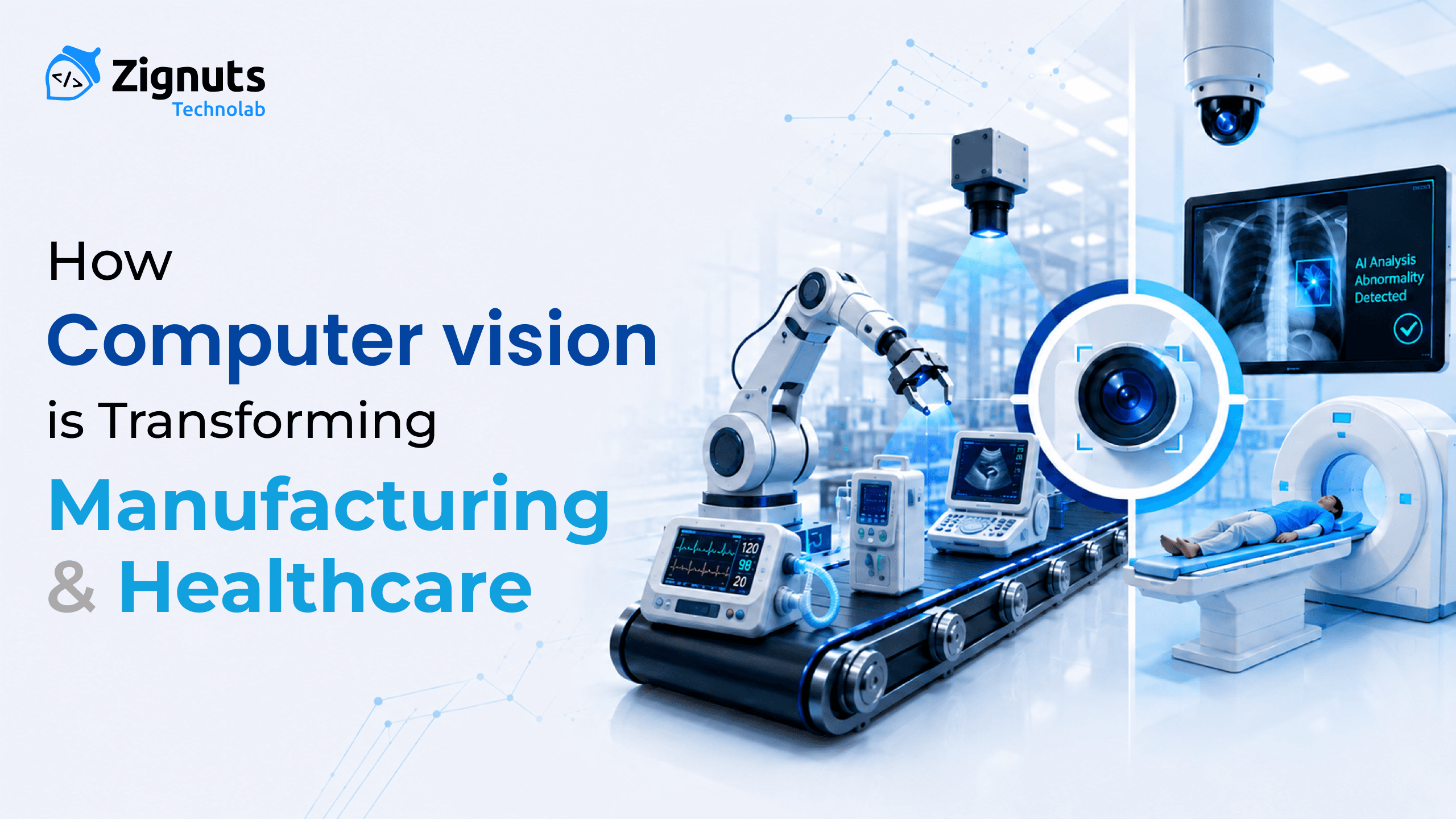
Computer vision is changing how businesses use visual data.
Manufacturers can use computer vision to inspect products, detect defects, monitor production lines, and improve workplace safety.
Healthcare organizations can use computer vision to process medical images, extract data from documents, monitor environments, and support digital health workflows.
But the real value of computer vision does not come from a model alone.
A production-ready computer vision system needs reliable data, the right AI model, strong software architecture, secure deployment, monitoring, and integration with existing business systems.
This is where engineering becomes important.
Zignuts builds computer vision solutions that turn images, video streams, documents, and other visual data into business intelligence.
Its computer vision capabilities include image recognition, object detection, OCR, segmentation, visual search, anomaly detection, quality inspection, and real-time video analytics. These systems can run across web, mobile, cloud, and edge environments.
This article explains how computer vision is transforming manufacturing and healthcare, what use cases create the most value, and what companies should consider before moving from an AI proof of concept to production.
What Is Computer Vision and Why Does It Matter?
Computer vision is an AI technology that helps software understand visual information.
That information can come from:
Industrial cameras
Mobile cameras
Medical images
Scanned documents
CCTV systems
Wareouse cameras
Drones
Product imags
Video streams
Sensors that generate visual data
A computer vision system can identify objects, detect patterns, extract text, locate defects, track movement, or classify images.
The important step comes after detection.
The system must turn the result into an action.
For example:
A camera sees a product.
Computer vision detects a possible defect.
The system sends the result to a quality workflow.
The product is flagged for review.
The event is stored for reporting.
The production team can investigate the issue.
That is the difference between a computer vision model and a computer vision solution.
How Computer Vision Is Transforming Manufacturing
Manufacturing environments generate a large amount of visual information every day. Much of it is still reviewed manually.
That creates several problems.
Manual inspection can be slow. It can also be inconsistent. Human reviewers can miss small defects, especially during repetitive work.
Computer vision can automate parts of this process.
It can inspect products at speed. It can detect defined patterns. It can also create a digital record of inspection results.
Zignuts' computer vision offering includes automated defect detection, visual inspection, assembly validation, packaging verification, and production-line quality monitoring.
Computer Vision for Manufacturing Quality Inspection
Computer vision can automate visual quality inspection across production environments.
A typical inspection workflow can look like this:
A camera captures the product.
The system preprocesses the image.
The computer vision model analyzes the image.
The system detects a defect or confirms an acceptable result.
Business rules determine the next action.
The result is stored for reporting and analysis.
This approach can support:
Surface inspection
Scratch detection
Crack detection
Assembly checks
Packaging inspection
Label verification
Missing component detection
Shape and appearance checks
The model must be trained on data that reflects real production conditions.
That includes different lighting conditions, camera angles, product variations, and expected defects.
A model that works well in a controlled test environment may perform differently on a production line.
This is why data quality and system design matter as much as model selection.
Turn Computer Vision Into a Business Advantage

Computer Vision for Manufacturing Defect Detection
Manufacturing defect detection is one of the most valuable applications of computer vision.
The right computer vision approach depends on the type of problem.
Image classification can work when the system only needs to decide whether an item belongs to a specific class.
Object detection is useful when the system needs to identify and locate defects.
Segmentation is useful when the exact defect area matters.
Anomaly detection can help when normal products are easy to define but possible defects are difficult to enumerate.
The key question should not be:
“Which model is the most advanced?”
The better question is:
“Which model can solve this production problem with acceptable accuracy, speed, and cost?”
Zignuts' computer vision service includes image classification, object detection, segmentation, anomaly detection, and visual inspection workflows.
Computer Vision for Manufacturing Safety
Computer vision can also support industrial safety.
A video analytics system can detect people, equipment, movement, and defined safety events.
Potential applications include:
PPE detection
Restricted-zone monitoring
Intrusion alerts
Occupancy monitoring
Motion tracking
Safety event detection
Zignuts describes real-time video analytics for safety monitoring, occupancy analytics, intrusion alerts, PPE compliance, behavior recognition, and operational dashboards.
However, safety systems need careful engineering.
Camera placement matters.
Lighting matters.
Occlusion matters.
Inference latency matters.
The system also needs a clear escalation process.
For example, an alert can be sent to a dashboard, notification service, or operational workflow.
The goal is not just to detect an event.
The goal is to help someone respond to it.
Computer Vision for Manufacturing Production Monitoring
Computer vision can help manufacturers understand what is happening on a production floor.
A system can monitor:
Objects
Product movement
Workstation activity
Production stages
Machine-related events
Process deviations
This becomes more useful when computer vision connects to other enterprise systems.
A vision event can be sent to an API.
The API can update another system.
That system can create an alert, update a dashboard, or trigger an operational action.
This turns computer vision into part of the production workflow.
Computer Vision for Manufacturing and Warehouse Automation
Manufacturing and warehouse operations are closely connected.
Products move from production to storage, picking, packing, and distribution.
Computer vision can add another layer of automation across these workflows.
Zignuts' warehouse management case study describes a platform built for real-time inventory tracking, automated stock movement, order fulfillment, and warehouse visibility. The published case study reports more than 100,000 inventory transactions, 99% inventory accuracy, and 50% faster order fulfillment.
The system includes:
AI-powered inventory optimization
Real-time inventory tracking
Automated receiving and put-away
Smart picking and packing
Barcode and QR code workflows
Multi-warehouse management
Order fulfillment automation
Warehouse analytics
Computer vision can complement these workflows through visual verification.
For example, businesses can explore:
Package identification
Product counting
Label verification
Visual inventory checks
Shipment verification
Pallet inspection
Loading verification
The technology becomes more useful when visual events are connected to the warehouse system.
How Computer Vision Is Transforming Healthcare
Healthcare has a different risk profile from manufacturing.
A manufacturing defect may lead to a rejected product.
An incorrect healthcare prediction can have much more serious consequences.
That makes validation, privacy, security, human oversight, and auditability essential.
Computer vision in healthcare can support medical imaging, document processing, visual data extraction, and operational workflows.
The use case should determine the level of automation.
Some workflows may allow full automation.
Others may require human review.
Computer Vision for Medical Image Analysis
Medical imaging is one of the most important areas of computer vision in healthcare.
Computer vision can help analyze visual patterns in medical images.
Depending on the use case, it can:
Classify images
Detect regions of interest
Segment structures
Compare images
Support image prioritization
Help identify visual patterns
The engineering challenge is larger than model accuracy.
Healthcare datasets can vary by device, location, patient population, and acquisition process.
A model trained in one environment may behave differently in another.
This is why medical computer vision requires strong data governance and validation.
The system should also clearly define where AI ends and human judgment begins.
Turn Computer Vision Into a Business Advantage
Computer Vision for Healthcare Document Processing
Healthcare organizations process large volumes of visual documents.
These can include:
Medical records
Forms
Identification documents
Reports
Referrals
Prescriptions
Scanned paperwork
OCR and document AI can convert this information into structured data.
Zignuts provides OCR and visual data extraction capabilities for printed, handwritten, and scanned documents. Its stated use cases include medical records, forms, IDs, invoices, labels, shipping documents, and other semi-structured data.
A typical workflow can look like this:
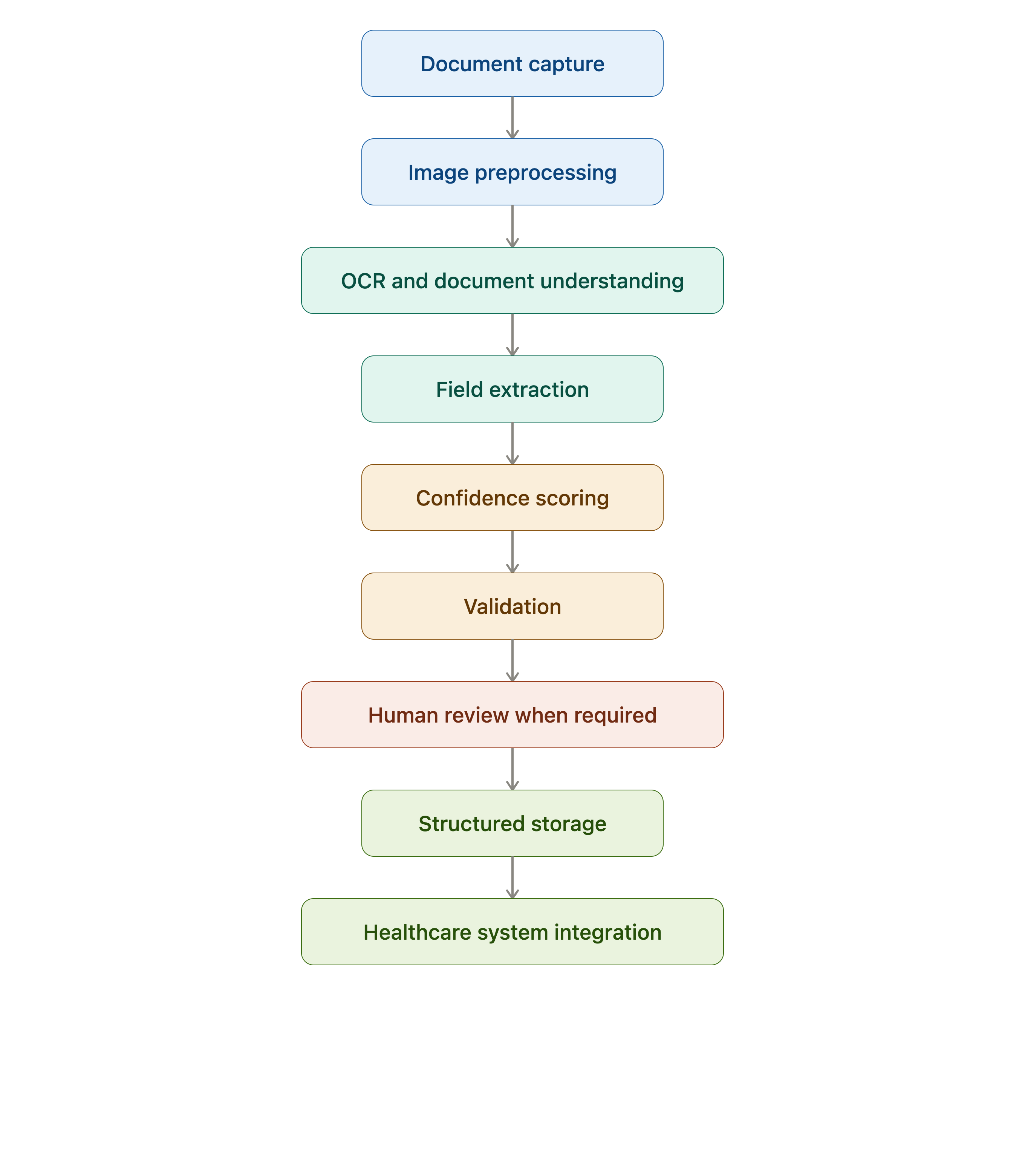
The goal is usable data.
Computer Vision for Healthcare Operations
Computer vision can also support non-clinical healthcare workflows.
Possible applications include:
Occupancy monitoring
Queue analysis
Safety monitoring
Restricted-area monitoring
Workflow analysis
Activity recognition
These use cases need strong privacy controls.
The architecture should define who can access visual data, how long it is retained, where it is processed, and how events are logged.
Privacy should be part of the initial design.
It should not be added at the end.
Computer Vision for Digital Healthcare Systems
Computer vision becomes more useful when it works with a broader healthcare software ecosystem.
Zignuts has experience with digital healthcare applications and health-focused software systems. Its published healthcare work shows the importance of scalable architecture, interactive data presentation, and software that makes health information easier to use.
This matters because computer vision produces information.
That information still needs to be:
Stored
Secured
Validated
Explained
Presented
Monitored
Computer vision is therefore only one layer of a broader healthcare platform.
Computer Vision in Manufacturing vs Computer Vision in Healthcare
Manufacturing and healthcare can use the same core computer vision technologies.
The engineering priorities are different.
Computer Vision Area | Manufacturing | Healthcare |
Main objective | Quality, safety, and operational efficiency | Clinical and operational support |
Common inputs | Industrial cameras, video, product images | Medical images, documents, video |
Common tasks | Defect detection, inspection, tracking | Image analysis, OCR, visual extraction |
Accuracy priority | High | Very high and use-case dependent |
Latency | Often critical for production | Depends on workflow |
Human review | Often used for exceptions | Frequently important |
Privacy | Important | Critical |
Integration | MES, ERP, WMS, analytics | EHR, healthcare platforms, analytics |
Deployment | Cloud, edge, on-premise | Cloud, edge, on-premise, hybrid |
Monitoring | Model and production monitoring | Model, system, and workflow monitoring |
Main risks | False rejects, missed defects, downtime | Incorrect output, privacy, trust, safety |
The lesson is simple.
There is no single computer vision architecture that fits every industry.
The system should be designed around the consequences of an incorrect prediction.
Turn Computer Vision Into a Business Advantage
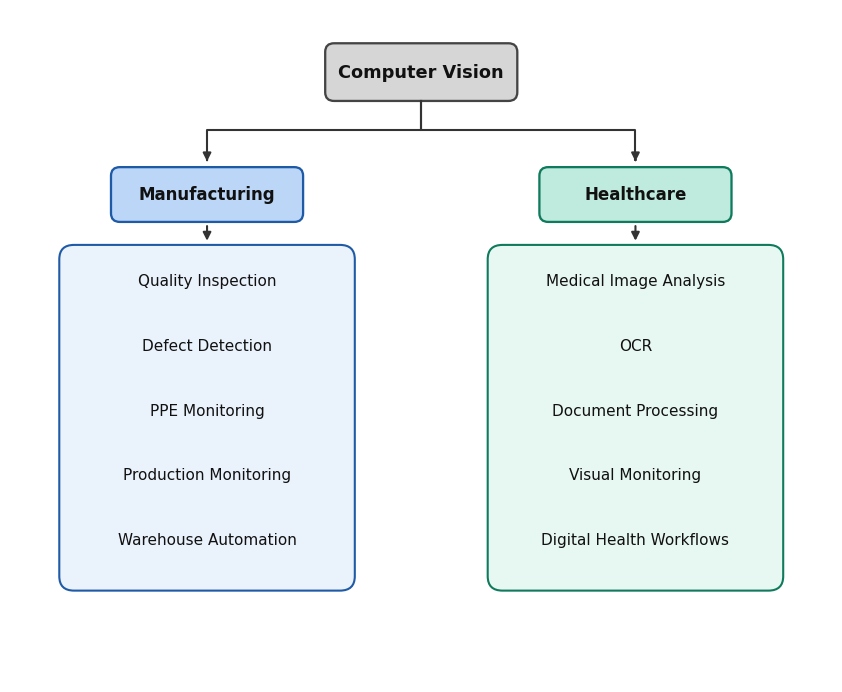
Data → AI Model → Integration → Security → Monitoring → Continuous Improvement
This gives readers a simple mental model of how the same technology supports two very different industries.
How to Build a Production-Ready Computer Vision System
Building computer vision for production requires more than model training.
A strong implementation starts with the business workflow.
Step 1: Define the Business Problem
Start with the decision the system needs to improve.
Examples include:
“Should this product pass inspection?”
“Is PPE present?”
“Does this image contain the required component?”
“What information is present in this document?”
“Has this package entered the correct zone?”
A clear decision creates a measurable objective.
Step 2: Evaluate the Visual Data
Before choosing a model, inspect the data.
Look for:
Image quality
Lighting variation
Camera position
Product variation
Background changes
Occlusion
Label quality
Dataset imbalance
Poor data can limit system performance even when the model is technically strong.
Step 3: Select the Right Model
Choose the model according to the task.
Use classification when you need categories.
Use object detection when you need location and category.
Use segmentation when exact regions matter.
Use OCR when the system needs to extract text.
Use anomaly detection when normal behavior is easier to define than every possible defect.
The simplest suitable approach is often the best starting point.
Step 4: Design the Integration Layer
Computer vision should not operate alone.
Zignuts designs computer vision integrations with enterprise systems such as ERP, MES, WMS, CRM, EHR, analytics platforms, ticketing systems, notification services, and custom applications.
This can include:
APIs
Event pipelines
Dashboards
Human-review queues
Audit trails
The integration layer turns predictions into business actions.
Step 5: Decide Between Cloud and Edge
Cloud and edge deployment both have advantages.
Cloud infrastructure can simplify centralized management and scaling.
Edge infrastructure can reduce latency and limit dependence on network connectivity.
A hybrid architecture can also work.
For example, inference can run near the camera while model management and analytics remain centralized.
The correct decision depends on:
Latency
Privacy
Connectivit
Processing volume
Hardware cost
Data transfer requirements
Turn Computer Vision Into a Business Advantage
Step 6: Add Monitoring and MLOps
A computer vision model can degrade after deployment.
Products change.
Cameras move.
Lighting changes.
Documents change.
New edge cases appear.
Zignuts' computer vision approach includes model benchmarking, versioning, CI/CD, containerization, monitoring, drift detection, retraining workflows, and inference optimization.
Production monitoring should cover both the software system and the model.
That can include:
Precision
Recall
Latency
Throughput
Uptime
Model drift
Error patterns
Step 7: Add Human Review Where It Matters
Not every prediction needs automatic action.
A confidence threshold can define when automation is safe.
Low-confidence results can move to human review.
This creates a practical balance between automation and control.
It is especially important in sensitive healthcare workflows.
Computer Vision Architecture for Enterprise Applications
A production computer vision platform may include several layers.
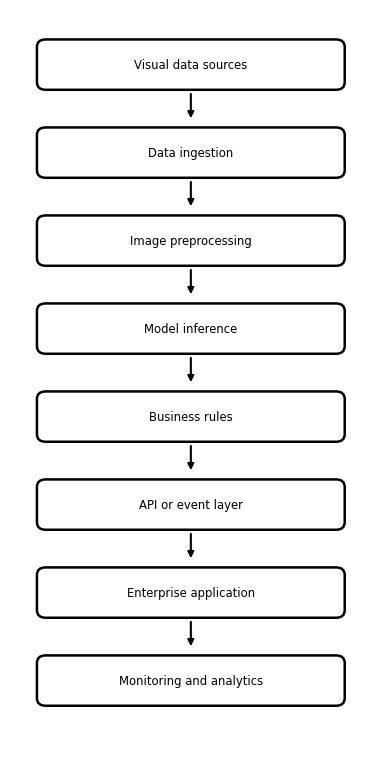
Object storage
Database
Message queues
API gateways
Role-based access
Monitoring systems
Model registries
Deployment pipelines
Zignuts describes enterprise-ready computer vision architecture with API-first services, event streaming, role-based access, observability, MLOps, model versioning, and cloud or edge deployment options.
The objective is maintainability.
A model should be replaceable.
A data pipeline should be observable.
An integration should be testable.
A deployment should be repeatable.
Computer Vision Security and Privacy Considerations
Computer vision systems can process sensitive information.
In manufacturing, this could include production processes, proprietary products, or facility footage.
In healthcare, it can include medical images, records, and patient-related information.
Security controls should therefore include:
Encryption
Authentication
Role-based access
Audit logs
Secure APIs
Data retention controls
Environment isolation
Controlled access to training data
Healthcare systems may also need to consider the regulations that apply to their specific geography and use case.
Security should be designed into the architecture.
It should not be treated as a final checklist item.
Computer Vision MLOps and Continuous Improvement
Deploying a computer vision model is not the end of the project.
It is the start of operating the system.
A strong computer vision MLOps process can include:
Dataset versioning
Model versioning
Validation datasets
Performance benchmarks
Automated deployment
Production monitoring
Drift detection
Error analysis
Retraining
This creates a repeatable improvement cycle.
It also reduces the risk of silently degraded model performance.
Common Computer Vision Implementation Mistakes
Many computer vision projects struggle because of system design, not because computer vision itself does not work.
Mistake 1: Starting With the Model
The business problem should come first.
Choosing a model before understanding the workflow can create unnecessary complexity.
Mistake 2: Using Poor Training Data
A small or unrealistic dataset can create problems in production.
The data should represent real operating conditions.
Mistake 3: Ignoring the Physical Environment
Camera angle, lighting, background, movement, and occlusion can affect computer vision performance.
The physical setup is part of the system.
Mistake 4: Treating a PoC as Production
A proof of concept can demonstrate technical feasibility.
It does not automatically solve:
Security
Monitoring
Integration
Maintenance
Mistake 5: Measuring Accuracy Alone
A model can achieve strong technical metrics and still fail to create business value.
The organization should also measure:
Processing time
Manual effort reduced
Error reduction
Operational throughput
Review volume
Workflow completion time
Turn Computer Vision Into a Business Advantage
Computer Vision Decision Framework for Enterprise Leaders
Before investing in computer vision, CTOs and engineering leaders should answer a few practical questions.
What business decision should computer vision improve?
What visual data already exists?
Is that data good enough for the target use case?
What level of false positives is acceptable?
What level of false negatives is acceptable?
Does the system require real-time processing?
Should inference run on the edge or in the cloud?
Which enterprise systems need the output?
What security controls are required?
Who will monitor the model?
Who will manage retraining?
What happens when the model is uncertain?
What is the long-term operating cost?
These questions help separate viable computer vision projects from experiments that are difficult to operate at scale.
How Zignuts Approaches Computer Vision Solutions
Zignuts approaches computer vision as an engineering system rather than only a model-development exercise.
Its computer vision offering covers image recognition, object detection, OCR, facial recognition, video analytics, quality inspection, visual data extraction, and enterprise AI architecture.
The company also describes several engagement approaches, including dedicated AI engineering teams, project-based delivery, proof of concept to production, and AI modernization and integration.
This approach aligns with the broader engineering challenges shown across Zignuts' published case studies.
For example, its warehouse management case study focuses on inventory tracking, fulfillment automation, real-time visibility, and operational analytics rather than treating automation as an isolated feature.
Its healthcare work similarly shows the importance of building scalable digital systems around sensitive health information and usable software workflows.
The common lesson is clear.
AI creates more value when it is connected to the software systems around it.
What Is the Future of Computer Vision in Manufacturing and Healthcare?
Computer vision is moving toward deeper integration with business software.
In manufacturing, this can mean tighter connections between cameras, quality systems, warehouse platforms, production systems, and analytics.
In healthcare, it can mean deeper connections between images, documents, digital health platforms, and operational workflows.
The technology will continue to evolve.
But the engineering fundamentals will remain important.
Better data will matter.
Better integration will matter.
Security will matter.
Monitoring will matter.
Human oversight will matter.
The best computer vision solutions will not simply recognize what is inside an image.
They will help organizations make better decisions with that information.
Key Takeaways About Computer Vision
Computer vision can turn visual data into actionable business information.
In manufacturing, computer vision can support quality inspection, defect detection, safety monitoring, production monitoring, and warehouse workflows.
In healthcare, computer vision can support medical image analysis, OCR, document processing, visual monitoring, and digital health workflows.
Production-ready computer vision requires data engineering, model development, software integration, deployment, monitoring, security, and continuous improvement.
Cloud and edge deployment should be selected based on latency, privacy, connectivity, processing needs, and cost.
Human review remains important for low-confidence or high-risk decisions.
The best computer vision projects begin with a clear business problem.
Conclusion: Why Computer Vision Needs Strong Engineering
Computer vision has the potential to change how manufacturing and healthcare organizations use visual information.
But the model is only one part of the solution.
A successful system needs reliable data.
It needs the right model.
It needs strong integration.
It needs secure infrastructure.
It needs monitoring.
It needs a clear workflow for acting on predictions.
Manufacturers can use computer vision to improve inspection, safety, production visibility, and warehouse operations.
Healthcare organizations can use computer vision to support imaging, document processing, visual data extraction, and operational workflows.
The organizations that gain the most value will be the ones that connect computer vision with their existing technology environment.
That is where experienced engineering teams can make a difference.
Zignuts works across computer vision development, AI engineering, enterprise integrations, cloud and edge deployment, MLOps, and custom software development. The focus is on moving computer vision from a technical proof of concept toward a maintainable production system.
For companies evaluating computer vision for manufacturing, healthcare, logistics, or other visual-data workflows, the right starting point is not simply choosing an AI model.
The right starting point is defining the business problem, the data, the workflow, and the outcome.
Then build the computer vision system around them.

Deep Mistry
Digital Marketing Enthusiast | Diving into the world of trends, tools, and strategies, sharing discoveries that help create impactful online experiences.