

API Development Cost: Key Considerations
A useful API budget starts with the business outcome and the integration surface, not the number of endpoints alone. API Development Services cover more than endpoint implementation; they account for the design, integration, security, and operational requirements of the API. A small CRUD API that reads and writes a single database is materially different from a public, multi-tenant API that moves payments, handles regulated data, supports partner onboarding, and must meet defined uptime objectives.
Planning Question | Why It Matters |
|---|---|
What must the API enable? | Business workflows, consumers, roles, data, and edge cases define scope. |
What systems must it connect? | Third-party APIs, legacy systems, data mapping, and sandbox access can dominate effort. |
What must be proven before launch? | Security, contract tests, performance, observability, and recovery add necessary work. |
What will it cost after launch? | Hosting, gateway usage, monitoring, support, upgrades, and versioning are recurring costs. |
What Does API Development Include in a Project Quote?
API development is the work of designing, implementing, testing, documenting, and operating an interface through which software systems exchange data or trigger actions. A complete engagement can include discovery, API contract design, authentication and authorization, business logic, database access, integrations, automated tests, deployment, monitoring, and lifecycle management.
An estimate that only counts endpoint implementation can understate the real work. For example, a “create order” endpoint may require validation, idempotency, inventory checks, payment-provider calls, retry handling, audit logging, permissions, notifications, and reconciliation. The endpoint count is visible; the failure modes and business rules often determine the effort.
Common Types of APIs and Their Development Costs
API Type | Typical Use | Cost Pressure Points |
|---|---|---|
Internal API | Connect modules or services inside one organisation. | Existing code quality, permissions, service boundaries. |
Public / developer API | Expose capabilities to external developers. | Documentation, versioning, quotas, developer experience. |
Partner API | Connect a defined set of business partners. | Onboarding, mapping, sandbox, support, and contract changes. |
Composite/orchestration API | Combine several services into one workflow. | Dependency sequencing, partial failures, consistency. |
Real-time API | Live updates via WebSockets, events, or streaming. | Connection scale, delivery guarantees, observability. |
AI/data API | Serve model, retrieval, or data-processing capabilities. | Data controls, token/usage costs, latency and evaluation. |
The categories overlap. A public partner API can also be real-time and regulated; estimate against requirements rather than forcing the project into a single label.
Ready to Build a Secure, Scalable API?

API Development Investment Trends in 2026
API budgets are increasingly tied to product strategy, integration reliability and security, not just backend implementation. Postman’s 2025 State of the API report surveyed more than 5,700 developers, architects, and executives and found widespread API-first adoption alongside persistent collaboration problems.
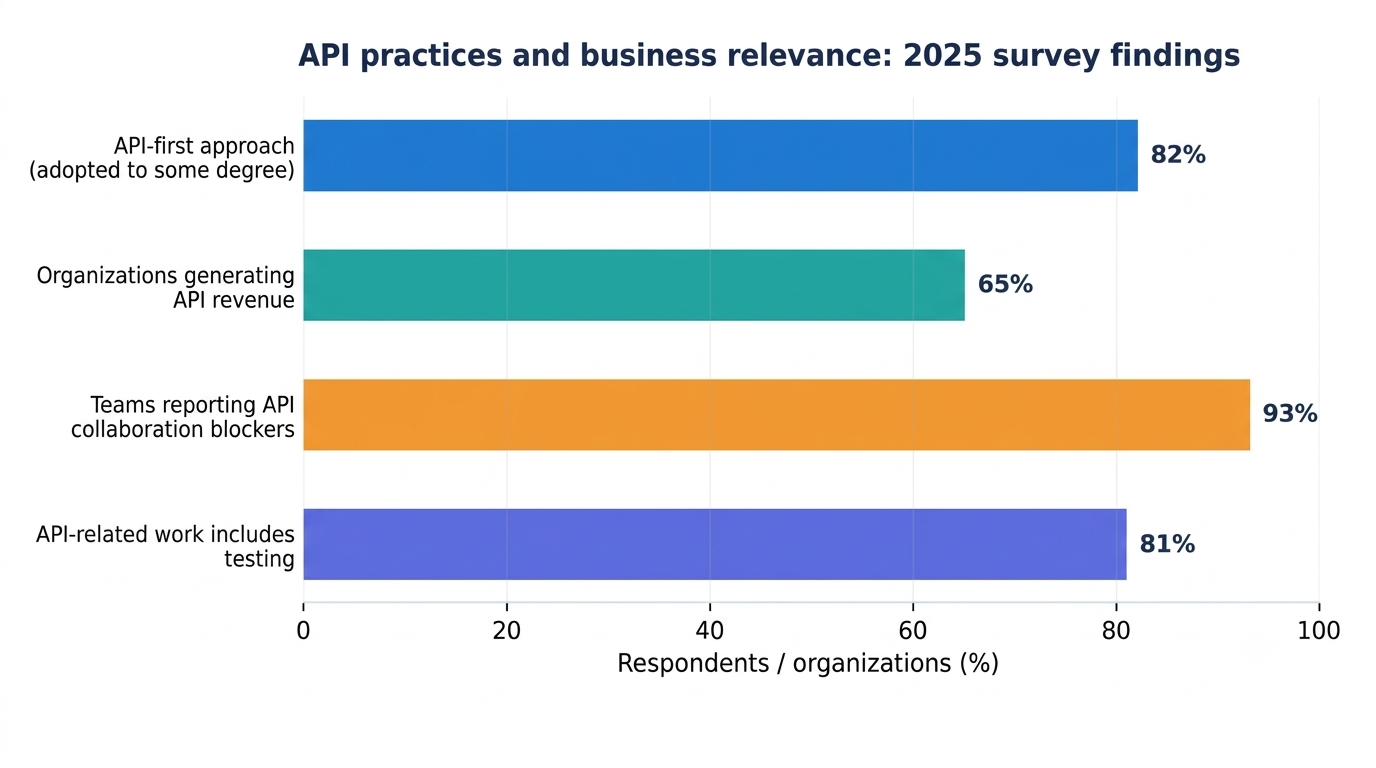
What this means for budgets: API work includes organisational and lifecycle costs. Documentation, contract testing, discovery, and cross-team coordination deserve explicit line items rather than being assumed to happen “for free.” The four percentages describe different survey questions; they are not a combined index.
The same report says 81% of respondents identify testing as an API-related activity, while API-first adoption is 82% at some level. That supports budgeting for repeatable delivery practices. It does not prove that any one process automatically lowers project cost.
How Software Development Rates Affect API Costs
Clutch’s software development pricing guide, updated in 2026, lists typical hourly bands by location. These directory-level rates help sanity-check a proposal, but they are not API-specific rates, do not control for team seniority or scope, and should not be read as a guaranteed price.
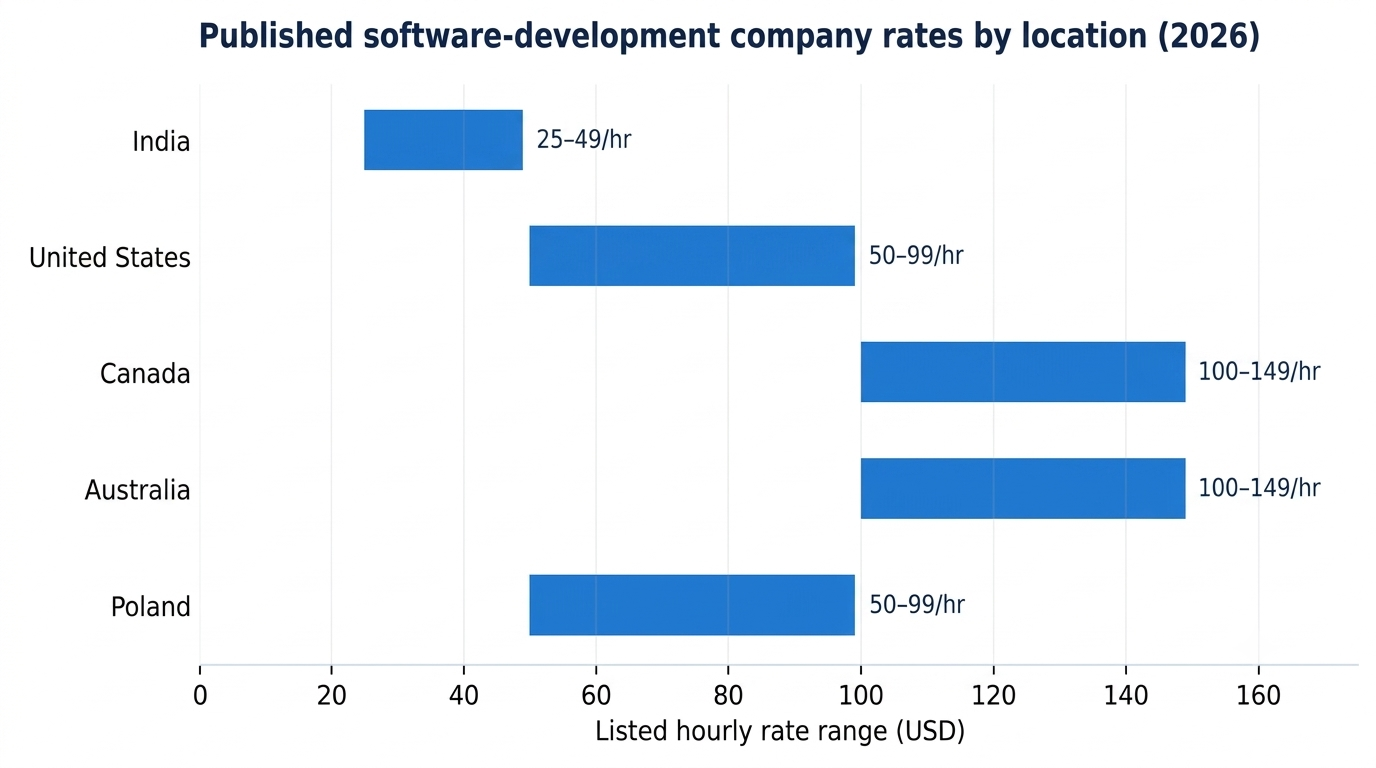
A lower hourly rate does not guarantee a lower total cost. A team that misses integration edge cases or underestimates security may require more rework. Compare scope, named deliverables, assumptions, quality gates, and ownership, not just the rate.
API Development Cost Estimates by Project Complexity
The following ranges provide a starting point for API project budgeting. They are illustrative estimates based on common project scope patterns, not measured market benchmarks or fixed quotations. The final cost depends on the requirements, technical complexity, integrations, and agreed project scope.
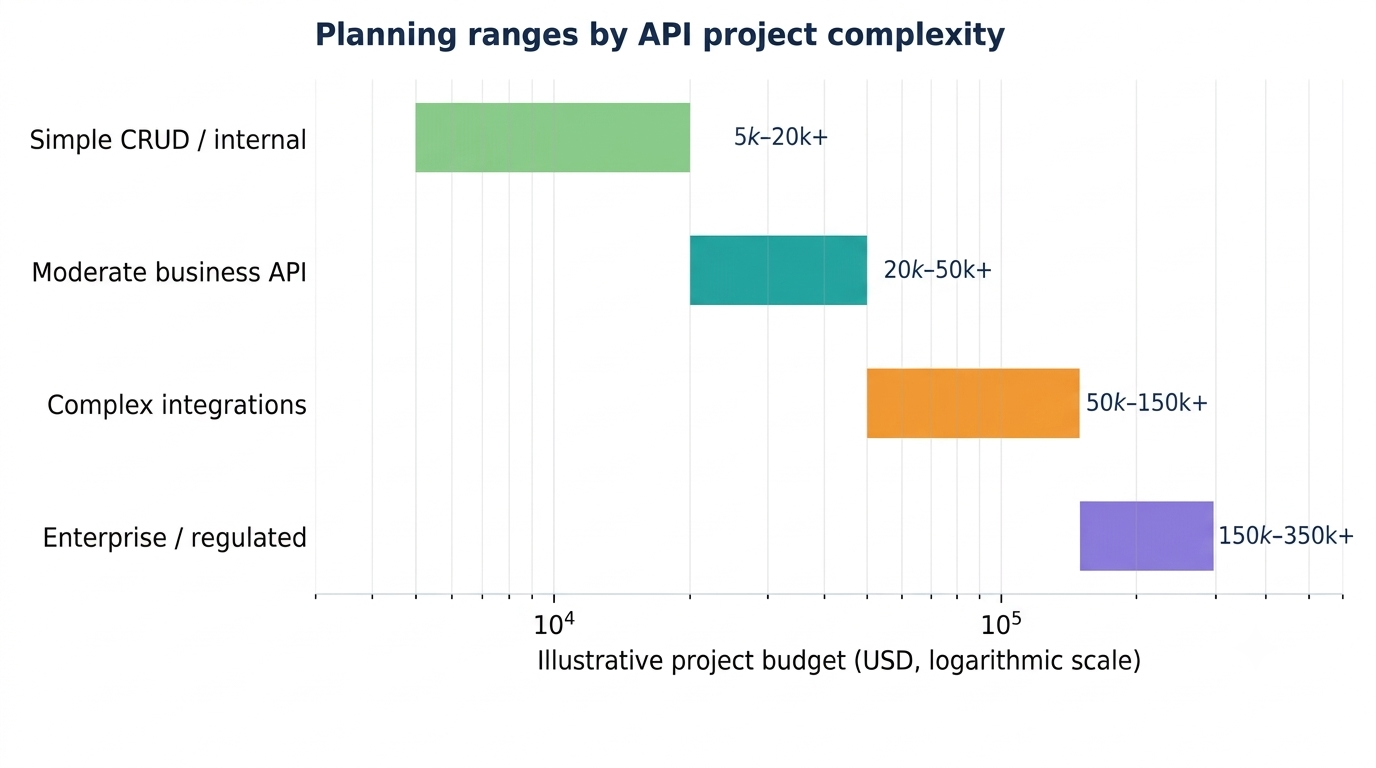
Complexity | Indicative Budget (USD) | Typical Scope Assumptions |
|---|---|---|
Simple | $5,000–$20,000 | Small CRUD surface, one data source, basic auth, limited integration and modest test requirements. |
Moderate | $20,000–$50,000 | Several workflows, role-based access, business validation, one or two integrations, automated tests and deployment. |
Complex | $50,000–$150,000 | Multiple systems, payment or CRM/ERP integration, asynchronous jobs, richer monitoring, stronger reliability and security. |
Enterprise / regulated | $150,000+ | Large API surface, multiple teams/tenants, compliance evidence, high availability, extensive migration, governance or advanced analytics. |
These bands can overlap. A seemingly small API can be expensive if it must safely update a legacy system with poor documentation. Conversely, a larger endpoint set may be relatively straightforward when the domain model and integration contracts are stable.
API Development Cost by Type
Type | Illustrative Range (USD) | What Commonly Changes the Estimate |
|---|---|---|
Internal API | $5k–$25k | Existing application structure, permissions, service boundaries. |
Public API | $20k–$100k | Developer portal, versioning, rate limits, support and documentation. |
Partner API | $25k–$100k | Partner-specific mappings, sandbox access, certification and change management. |
Composite API | $20k–$80k | Number of dependencies, partial failures, consistency and orchestration. |
Real-time API | $30k–$120k | Connection concurrency, delivery guarantees, state and performance testing. |
AI / ML API | $50k–$150k+ | Model/provider integration, data governance, evaluation, latency and usage costs. |
The table is not a promise that every project in a category will fall inside its range. API type helps describe the work; complexity and quality requirements determine the final estimate.
Ready to Build a Secure, Scalable API?
6 Factors That Affect API Development Cost
1. Functional Complexity and Business Rules
Basic request-response operations are relatively predictable. Costs rise when workflows include approval states, retries, idempotency, calculations, audit trails, partial completion, complex validation, or multiple actor roles. Ask the team to list important rules and exceptions before estimating.
2. Third-Party and Legacy Integrations
Integration work includes reading documentation, obtaining sandbox credentials, mapping data, handling rate limits, translating errors, retries, webhook verification, reconciliation, and monitoring. An integration with a stable, well-documented provider is not equivalent to a legacy system with incomplete documentation or delayed access.
3. Security, Privacy and Compliance
Authentication proves identity; authorization determines what that identity may do. Secure APIs also require input validation, secrets management, encryption, logging, abuse controls, and appropriate data retention. OWASP’s API Security Top 10 highlights risks such as broken object-level authorization, broken authentication, unrestricted resource consumption, and security misconfiguration.
Cost control does not mean removing security. Keep security controls in the baseline scope. If budget is tight, reduce non-essential features or stage delivery; do not silently remove authorization tests, secrets management, or abuse protections.
4. Scale, Latency and Availability
Expected traffic, burst patterns, response-time targets, payload sizes, regional availability, and recovery objectives influence architecture and test effort. Prematurely introducing microservices can increase deployment and observability overhead. A modular monolith may be a better starting point when one team owns a bounded domain.
5. Data Quality and Migration
Data mapping, deduplication, backfills, historical records, and reconciliation can become a major workstream. Budget for representative test data, migration rehearsals, rollback plans, and validation, not only the happy-path API call.
6. Delivery Quality and Operations
OpenAPI specifications, contract tests, CI/CD, logs, metrics, traces, alerts, runbooks, and version policies require initial investment but reduce ambiguity during future change. The right level depends on criticality: a prototype and a payment API should not have identical release controls.
Key Factors to Consider When Estimating API Costs
Driver | Questions to Resolve Before Approval | Budget Impact if Unresolved |
|---|---|---|
Scope | Which consumers, endpoints, roles, and workflows are in v1? | Scope creep and estimation variance. |
Dependencies | Are provider docs, credentials, and sandboxes available? | Blocked work, mocks, and rework. |
Security | What data is sensitive and who can access each object? | Late redesign and risk exposure. |
Reliability | What are the expected load, SLO, and recovery needs? | Architecture changes and performance rework. |
Operations | Who owns monitoring, incidents, upgrades, and versioning? | Unpriced post-launch effort. |
Production-Ready API Architecture and Cost Considerations
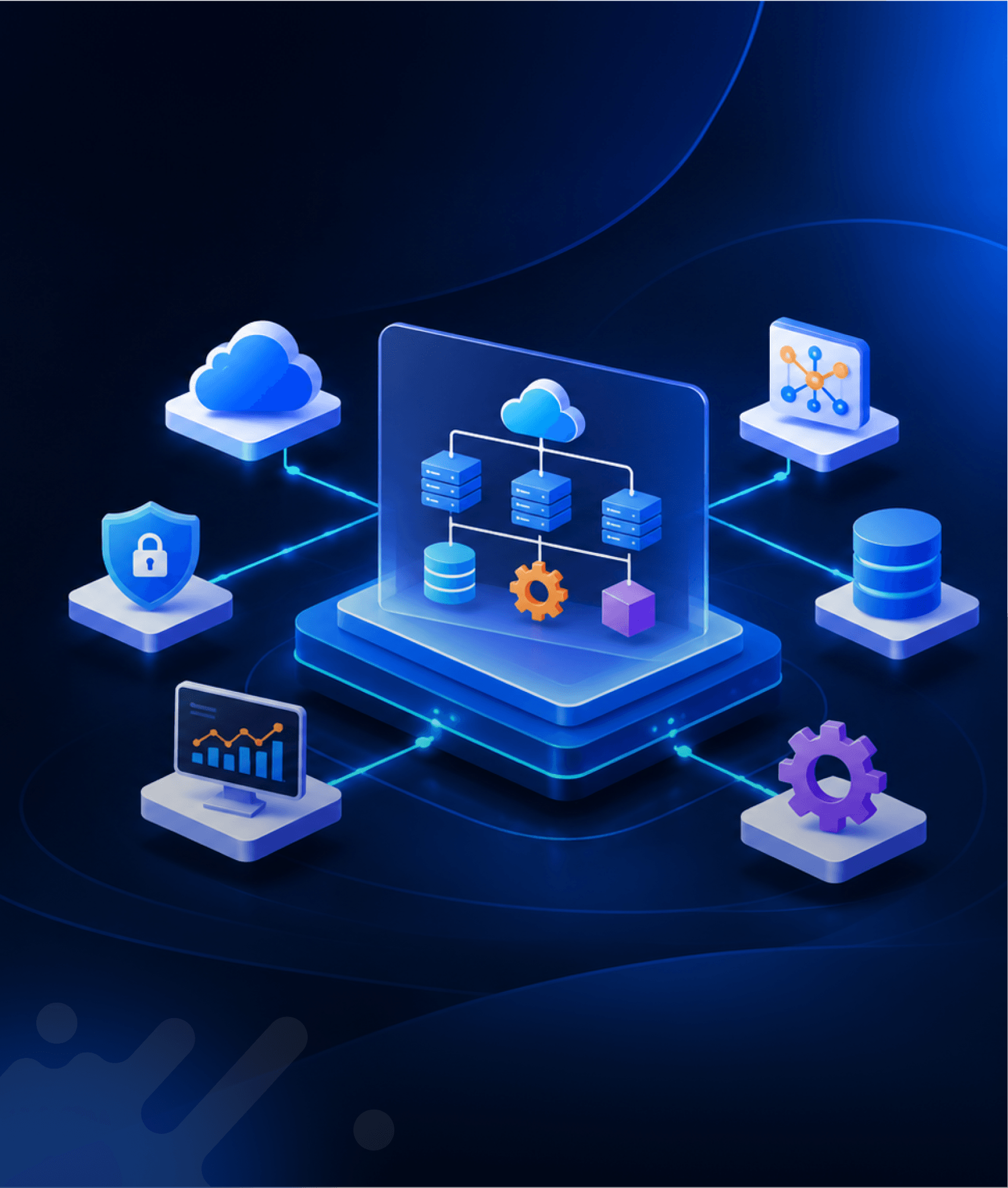
A typical production API architecture separates request handling, identity and policy checks, business logic, data storage, and operational monitoring. The following is an illustrative reference architecture. Its components can vary depending on the product’s security requirements, traffic, and operating model.
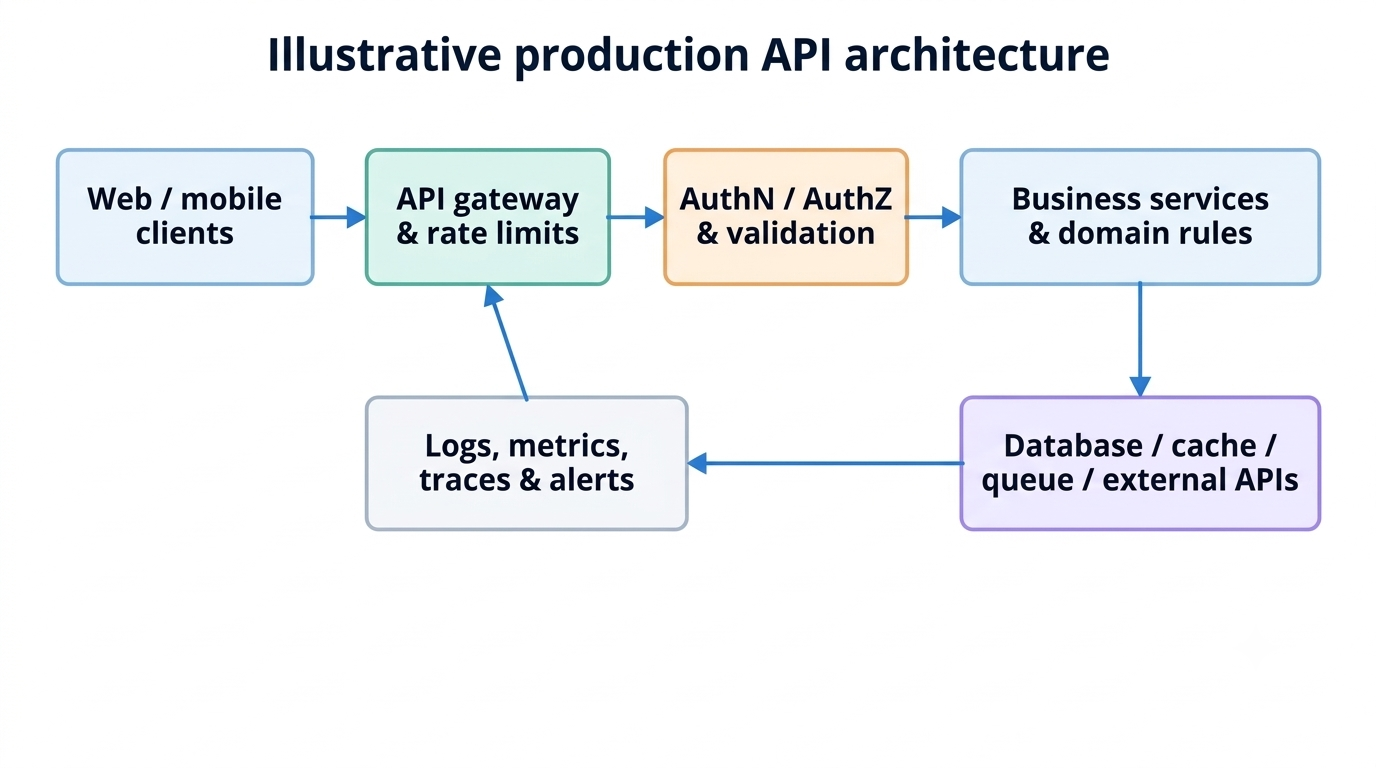
At the service layer, use clear error contracts, request validation, and idempotency where repeated requests could create duplicate actions. For long-running tasks, a queue can decouple request handling from processing, but introduces retry, ordering, and dead-letter handling decisions.
API Security Requirements to Include in Your Budget
Authentication and least-privilege authorization, including object- and function-level checks.
Input validation, output minimisation, safe error responses, and rate/resource limits.
Secret storage and rotation; TLS in transit and encryption at rest where appropriate.
Audit logs for sensitive actions, with access and retention controls.
Dependency scanning, automated tests, security review, and a response process for vulnerabilities.
OWASP’s API Security Top 10 is a useful threat checklist, not a substitute for threat modelling. Apply controls according to data sensitivity, exposure, business impact, and regulatory obligations.
API Development Lifecycle and Timeline
A staged delivery approach makes assumptions visible early. The following workflow is a recommended planning model; actual duration depends on team size, decision latency, integration access, and scope.
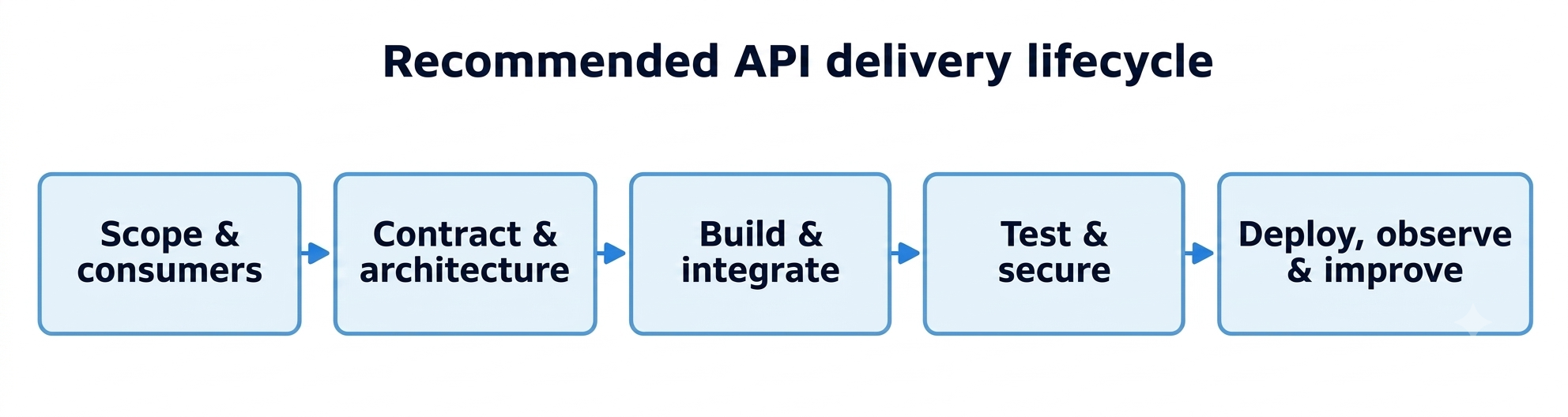
Stage | Useful Outputs | Budget Gate |
|---|---|---|
Discovery | Use cases, consumers, risks, acceptance criteria, dependency list. | Confirm v1 boundary and unknowns. |
Contract & design | OpenAPI contract, data model, auth model, error conventions. | Review integration and security assumptions. |
Build & integrate | Endpoints, domain rules, adapters, migrations, async processing if needed. | Demo end-to-end workflows against sandbox or mocks. |
Test & secure | Unit/integration/contract tests, threat checks, load tests as needed. | Agree on defects and launch criteria. |
Deploy & operate | CI/CD, dashboards, alerts, runbooks, versioning, and support plan. | Confirm ownership and operating cost. |
Avoid treating “development complete” as “ready for production.” The acceptance criteria should specify test coverage expectations, supported API versions, monitoring, deployment rollback, and documentation ownership.
Ready to Build a Secure, Scalable API?
API Development Rates, Team Models, and Pricing Structures
Published vendor directories can provide a starting point for regional comparisons, but country-level rate bands hide variation in seniority, company size, specialisation, project management, and assurance. A senior architect’s rate and a junior implementer’s rate are not interchangeable.
Common API Development Engagement Models
Model | Works Best When | Watch-Outs |
|---|---|---|
Fixed price | Requirements and acceptance criteria are stable. | Change requests can become expensive; assumptions must be explicit. |
Time and materials | Scope is evolving, or discovery will change priorities. | Needs transparent timesheets, demos, and budget checkpoints. |
Dedicated team | API work is ongoing, and priorities will evolve. | Requires product ownership, backlog discipline, and clear decision rights. |
Discovery then build | Unknown integrations or architecture make estimates uncertain. | Discovery must produce actionable artifacts, not only meetings. |
For buyers in India, request proposals in a common currency and clarify taxes, third-party charges, support hours, IP ownership, documentation, source-code access, and post-launch warranty. Compare total cost of ownership over at least the first operating year, not just the build fee.
API Development Budget Examples and Cost Optimization
The examples below are transparent arithmetic models, not market facts. They show how estimated effort and a blended delivery rate combine. Replace the assumptions with the team’s own estimates.
Scenario | Effort Assumption | Blended Rate Assumption | Illustrative Build Cost |
|---|---|---|---|
Lean internal API | 200–350 hours | $25–$49/hour | $5,000–$17,150 |
Moderate partner integration | 600–1,000 hours | $25–$49/hour | $15,000–$49,000 |
Complex multi-system API | 1,600–3,000 hours | $25–$49/hour | $40,000–$147,000 |
Formula: estimated effort in hours × blended hourly rate = labour estimate.
The model excludes or may not fully capture taxes, cloud usage, paid third-party services, travel, contingency, major data remediation, and ongoing support. The effort bands are illustrative planning assumptions; the Clutch rate band is a published general software-development directory range.
How to Reduce API Development Costs Without Compromising Quality
Define a narrow v1 around one or two high-value workflows; defer speculative endpoints until a consumer needs them.
Use a contract-first approach: agree on request/response schemas, error formats, authentication, and versioning before parallel implementation.
Validate integration access early. Secure credentials and sandbox data before committing to a fixed timeline.
Reuse proven identity, logging, gateway, and CI/CD capabilities where they fit; avoid building commodity infrastructure without a reason.
Automate contract and regression tests for stable, high-risk behaviours. Keep exploratory testing for areas where human judgement adds value.
Set a change-control process: every new workflow should state its user value, dependencies, effort impact, and what moves out of scope.
Plan operations before launch. Establish who responds to alerts, handles provider changes, rotates secrets, and manages API versions.
Contingency rule: Do not add a universal contingency percentage blindly. Size contingency around named uncertainties, such as undocumented legacy behaviour, provider approval delays, or unclear data quality, and reduce it as those risks are retired.
Ready to Build a Secure, Scalable API?
How to Choose the Right API Development Partner
A credible proposal explains the work and the assumptions behind the price. Ask each vendor to respond to the same scope so the comparison is meaningful.
Does the estimate include discovery, API contract design, documentation, testing, deployment, and handover?
Are all integrations named, with assumptions about credentials, sandbox access, rate limits, and vendor support?
Does the design explain authentication, authorization, tenant isolation, auditability, and abuse prevention?
Are acceptance criteria and release gates explicit, including performance expectations where relevant?
Who owns source code, API specifications, infrastructure configuration, test suites, and operational runbooks?
What is excluded: cloud fees, paid gateways, third-party licences, migration, penetration testing, support, or taxes?
How are scope changes priced and approved? What happens when an external provider changes its API?
What monitoring, incident response, warranty and maintenance options are available after go-live?
Prefer proposals that expose uncertainty over proposals that promise a suspiciously precise total before requirements are understood. A short paid discovery phase can be valuable when integration or compliance risks are material.
Key Takeaways on API Development Cost
API development cost is driven by business rules, integration uncertainty, security and operating requirements, not endpoint count alone.
Published software-company rates are directional references; they are not API-specific quotes.
Keep planning estimates separate from measured market statistics and disclose the assumptions behind every model.
Budget for contracts, tests, documentation, observability, and maintenance as part of the product lifecycle.
Use discovery and stage gates to reduce uncertainty before locking scope and price.
Understanding API Development Cost Before You Invest
A well-planned API budget starts with a clear understanding of the work involved. Define the required workflows, identify integration points, account for security and reliability requirements, and establish what the API must achieve before going live. Comparing vendors against the same scope and deliverables makes it easier to evaluate proposals and plan your investment with confidence.
Whether you need a new API, system integrations, or improvements to an existing application, the right development approach should align with your business goals and technical requirements. Contact us today to discuss your API development needs and explore an approach that fits your project scope.

Hard Trivedi
Business Enthusiast | Exploring ideas, understanding business challenges, and turning insights into practical solutions that create meaningful value and growth.