

When a multinational retail enterprise set out to launch an AI-driven real-time inventory platform, it hired a team of skilled software engineers to build a state-of-the-art microservices application. However, just six weeks after launch, the platform stalled due to several architectural challenges: multi-region database synchronization latency reached 14 seconds, third-party ERP integration calls hit strict rate limits, and compliance auditors identified unencrypted data pathways across hybrid clouds. The issue was not code quality or software design but the absence of a Solution Architect to align business requirements, infrastructure, security policies, and third-party SaaS integrations into a cohesive, production-ready system blueprint. Software Architecture Consulting can help bridge this gap by ensuring application design, infrastructure decisions, and integration strategies work together to meet enterprise requirements.
In 2026, enterprise technology environments require more than standalone applications. They involve:
Connecting high-level business goals with complex multi-cloud ecosystems.
Establishing security guardrails and meeting compliance standards.
Designing reliable, high-throughput, and cost-optimised infrastructure.
Aligning technology investments with measurable business capabilities.
Selecting the right Solution Architecture Services partner helps enterprises address these requirements and build technology systems that support long-term business needs.
Solution Architecture vs. Software Architecture: Key Differences
Dimension | Solution Architecture | Software Architecture |
|---|---|---|
Primary Focus | Translating business requirements into an end-to-end technology blueprint (Infrastructure, Data, Security, Integrations). | Structuring internal code, modules, packages, and design patterns within a single application or service. |
Operational Scope | Broad enterprise ecosystem: Cloud platforms (AWS/Azure/GCP), SaaS tools, legacy ERPs, APIs, and network topologies. | Internal application boundaries, layer separation (MVC/Clean Architecture), data models, and class structures. |
Primary Stakeholders | CTOs, VPs of Product, Enterprise Architects, Security Officers, and Business Unit Leaders. | Engineering Leads, Senior Developers, Module Owners, and Code Reviewers. |
Core Success Metric | Business capability alignment, enterprise system reliability, compliance, and cloud cost efficiency. | Code maintainability, unit test coverage, low internal complexity, and module reuse. |
How to Evaluate Solution Architecture Services, Providers
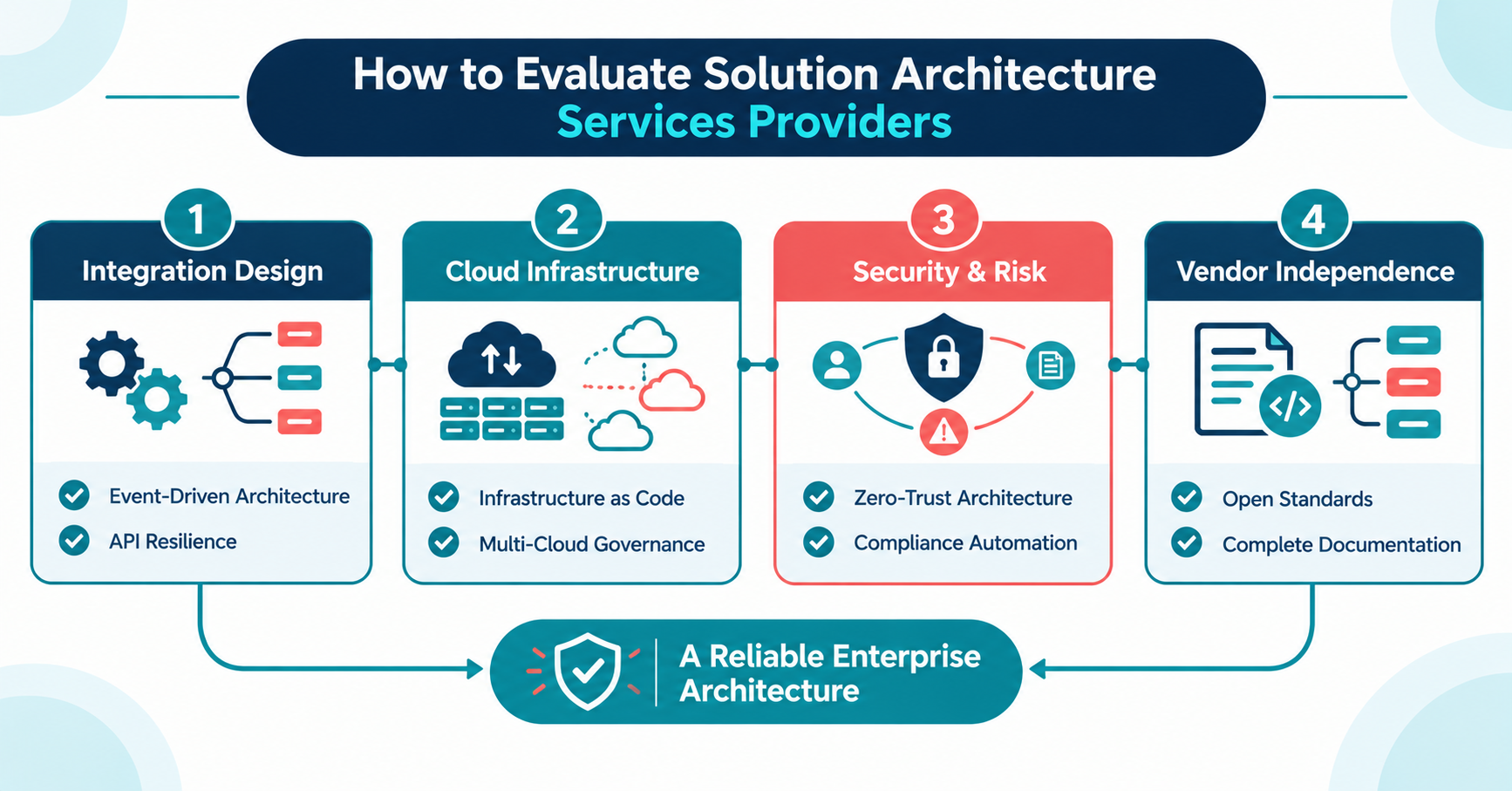
Architectural Area | Traditional Vendor Red Flags (Avoid) | Strategic Solution Partner (Look For) | Business & Engineering ROI |
|---|---|---|---|
Integration Design | Rigid point-to-point custom API scripts creating "spaghetti" dependencies. | Event-driven integration fabric (Kafka, EventBridge) with canonical data schemas. | Eliminates API rate-limit bottlenecks and prevents cascading system failures. |
Cloud Infrastructure | Manual cloud provisioning lacking centralized landing zone governance. | Infrastructure as Code (OpenTofu/Terraform) with automated Policy-as-Code guardrails. | Slashes environment provisioning time while enforcing cloud FinOps guardrails. |
Security & Risk | Security audits treated as a late-stage checklist prior to go-live. | Zero-Trust architecture with automated IAM role least-privilege policies from day one. | Ensures continuous SOC 2, HIPAA, and PCI-DSS compliance across all environments. |
Vendor Independence | Lock-in to proprietary consulting frameworks and opaque cloud services. | Open standards, cloud-agnostic container orchestration, and full C4 documentation handover. | Guarantees complete internal team autonomy with zero ongoing vendor lock-in. |
Key Evaluation Criteria for Solution Architecture Services
Evaluating a prospective Solution Architecture consulting partner requires looking beyond high-level vendor slide decks. Production reliability, system performance, and long-term cost efficiency depend on how rigorously a firm structures cross-system dependencies, cloud guardrails, and third-party integrations.
Engineering and business leaders should evaluate prospective solution partners across four core operational pillars:
1. Enterprise Integration Design and Event-Driven Architecture
A common point of failure in enterprise solutions is relying on point-to-point custom API scripts that couple core applications directly to legacy ERPs or SaaS tools. Leading solution architects design event-driven integration fabrics (using tools like Apache Kafka, AWS EventBridge, or NATS) to establish asynchronous communication boundaries, preventing downstream API outages from bringing down front-end applications.
2. Multi-Cloud and Hybrid Infrastructure Governance
Solution architecture must enforce consistent cloud infrastructure standards across AWS, Azure, GCP, or on-premises environments. Evaluate whether the consulting firm deploys modular Infrastructure as Code (IaC using OpenTofu or Terraform, paired with automated Policy-as-Code engines (such as Open Policy Agent or Kyverno) to automatically block noncompliant storage buckets, weak network security groups, and unencrypted databases before deployment.
3. Observability and Distributed Tracing
In modern distributed systems, diagnosing a failing transaction across multiple microservices and SaaS APIs requires end-to-end visibility. Vendor-neutral solutions adopt OpenTelemetry semantic conventions across all layers, insulating your organization from third-party vendor lock-in while ensuring unified context propagation across metrics, logs, and distributed traces.
4. Non-Functional Requirements and Performance Validation
Non-functional requirements such as P99 latency SLAs, zero-trust security controls, and disaster recovery RTO/RPO targets must be validated continuously throughout the development lifecycle. Top partners implement automated load testing and failure injection (chaos engineering) directly inside preview pipelines to verify resilience under peak load conditions.
Technical Standards for Evaluating Enterprise Solution Architecture
Pillar | Vendor Red Flags (Avoid) | Strategic Enterprise Standards (Look For) |
|---|---|---|
API & Integration Strategy | Hardcoded endpoint URLs, lack of rate-limiting, and synchronous HTTP chaining. | Centralized API Gateways, circuit breakers (Resilience4j/Envoy), and standardized Schema Registries. |
Identity & Access Management | Static IAM access keys hardcoded into environment configurations. | Zero-Trust federated identity (OIDC/SAML), short-lived IAM tokens, and automated secrets vault management. |
Cloud FinOps & Cost Controls | Unrestricted resource sizing, no auto-scaling policies, and missing resource cost allocation tags. | Automated TTL auto-teardown for non-production environments, spot instance pools, and real-time anomaly alerts. |
System Blueprinting & Handover | Outdated static architectural diagrams stored in unmaintained slide decks. | Dynamic C4 Model documentation (Context, Container, Component, Code) versioned directly alongside code repositories. |
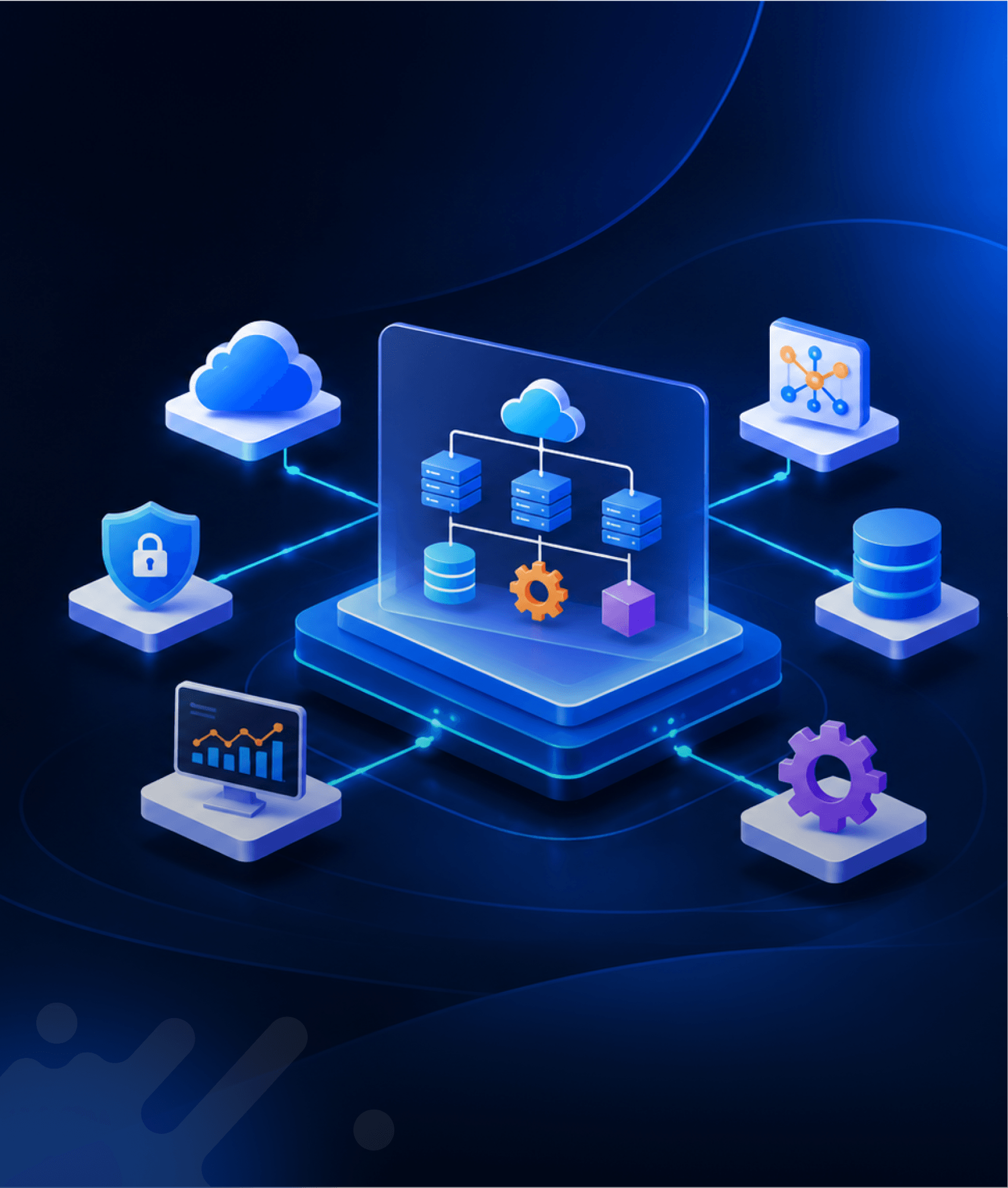
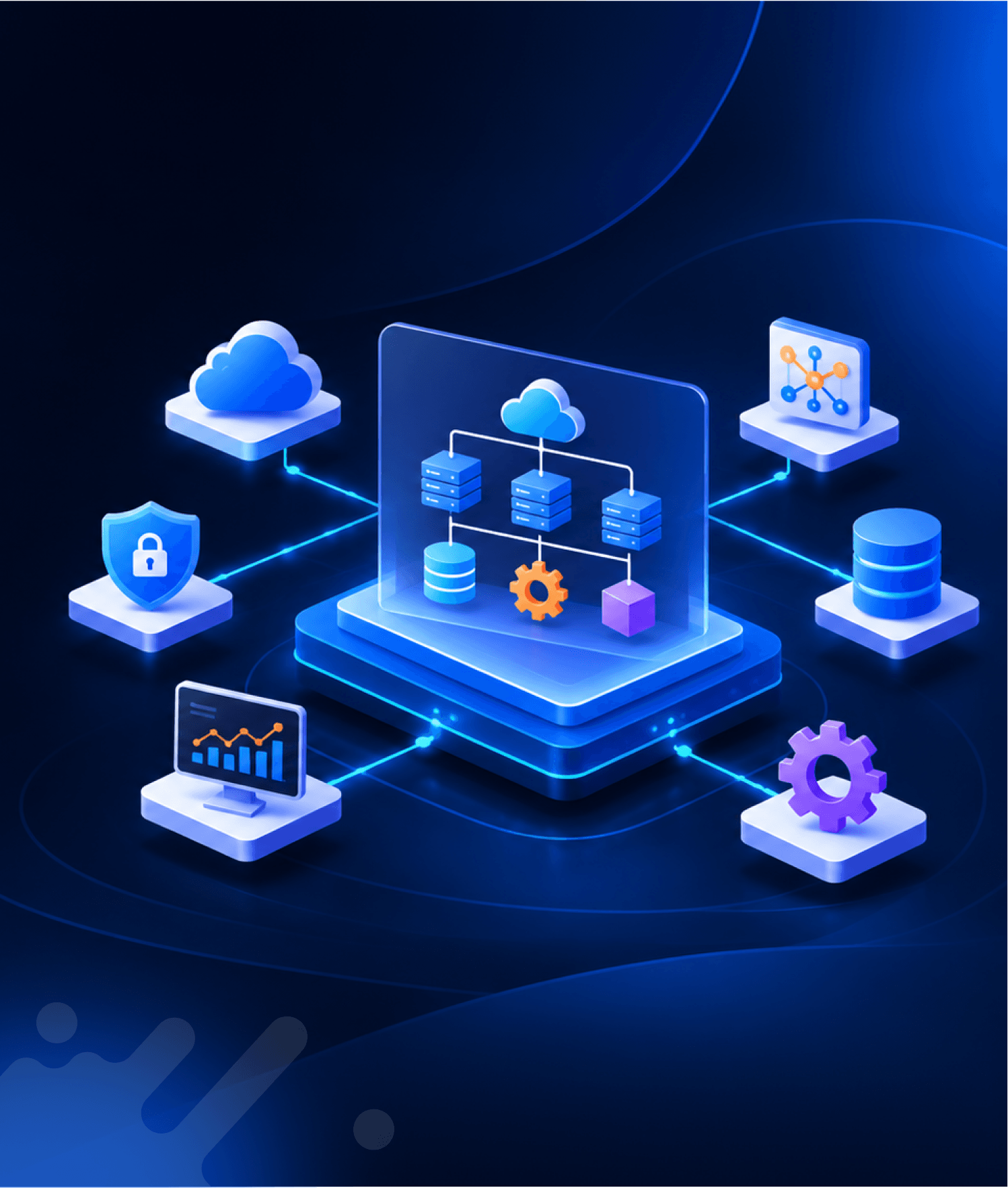
Enterprise Solution Architecture: Components and System Design
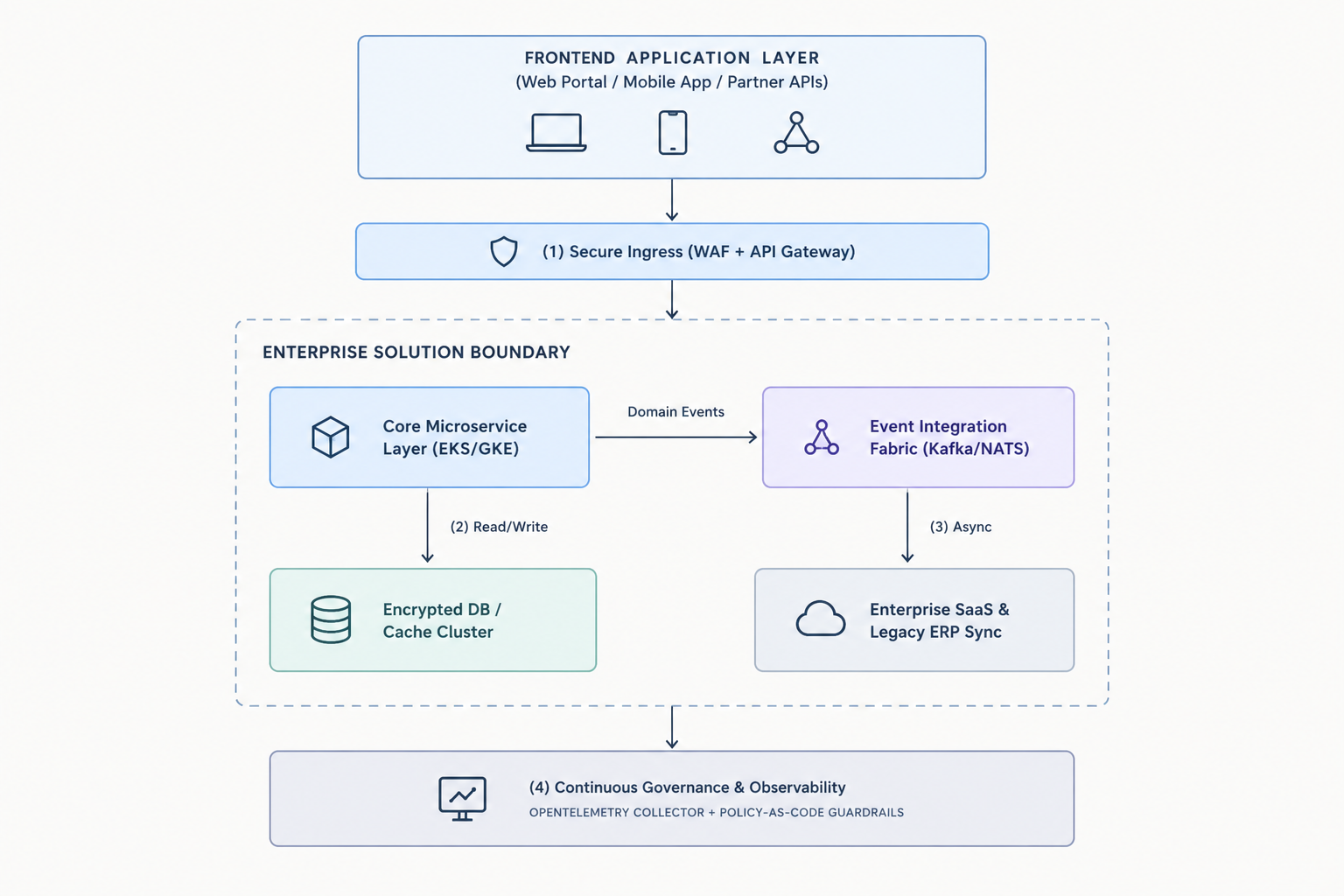
End-to-End Enterprise Solution Architecture Topology
Common Production Risks in Enterprise System Integrations
Over 80% of cross-system outages in integrated SaaS environments are caused by unhandled rate-limit responses (HTTP 429) and missing exponential backoff circuit breakers on outgoing integration webhooks.
Real-World Solution Architecture Case Study: Enterprise System Integration
A global logistics and supply chain provider struggled with order processing delays due to brittle, synchronous API calls connecting their custom customer portal to legacy warehouse ERP systems.
Our solution architecture team redesigned the integration topology around an asynchronous event streaming fabric, decoupling core ordering logic from legacy ERP response cycles while establishing automated OpenTelemetry tracing across all service boundaries.
Measurable Results of the Solution Architecture Implementation
Order processing capacity increased by 600% during peak seasonal demand.
Integration failure rates dropped from 4.2% to under 0.01% through automated dead-letter queue (DLQ) retry handlers.
Achieved system-wide operational visibility with real-time, end-to-end trace propagation across all third-party endpoints.
Completed operational handover in 10 weeks, leaving the internal engineering team with fully automated IaC blueprints and C4 documentation.
10 Questions to Ask Before Hiring a Solution Architecture Services Partner
Before signing an engagement agreement, enterprise leadership should put prospective solution architecture partners through a structured evaluation audit. The questions below help separate genuine end-to-end solution architects from basic application development agencies:
Category | Interview Question for Prospective Solution Partner | Target Answer (What You Want to Hear) |
|---|---|---|
System Integration | How do you handle third-party API rate limits and resilience across high-throughput enterprise integrations? | Implementing asynchronous event streaming (Kafka/EventBridge), circuit breaker patterns, and automated dead-letter queues (DLQ) with exponential backoff handlers. |
Cloud FinOps & Sizing | How do you ensure the proposed solution architecture does not lead to unconstrained cloud infrastructure bill spikes? | Setting hard CPU/memory limits, leveraging spot instance auto-scaling pools, and implementing Policy-as-Code rules to auto-teardown non-production preview environments. |
Security & Compliance | How do you enforce Zero-Trust security and data encryption standards across hybrid cloud topologies? | Mandating mutual TLS (mTLS), short-lived federated OIDC/SAML IAM roles, automated secrets rotation, and shift-left compliance scanning in CI/CD pipelines. |
Architectural Governance | How do you document and communicate complex solution topologies across executive and developer stakeholders? | Utilizing the C4 Model framework (Context, Containers, Components, Code) accompanied by Architecture Decision Records (ADRs) versioned directly in Git. |
Vendor Independence | How do you guarantee our internal engineering team is not locked into proprietary vendor modules after off-boarding? | Building on open standards (OpenTofu, Kubernetes, OpenTelemetry), conducting paired engineering workshops, and providing comprehensive runbooks before exit. |
Solution Architecture Engagement: A Four-Phase Implementation Plan
A structured four-phase implementation plan helps ensure smooth project delivery, reduce integration risks, and create long-term business value. Each phase builds on the previous one, moving from initial discovery and architecture planning to integration, testing, and operational handover.
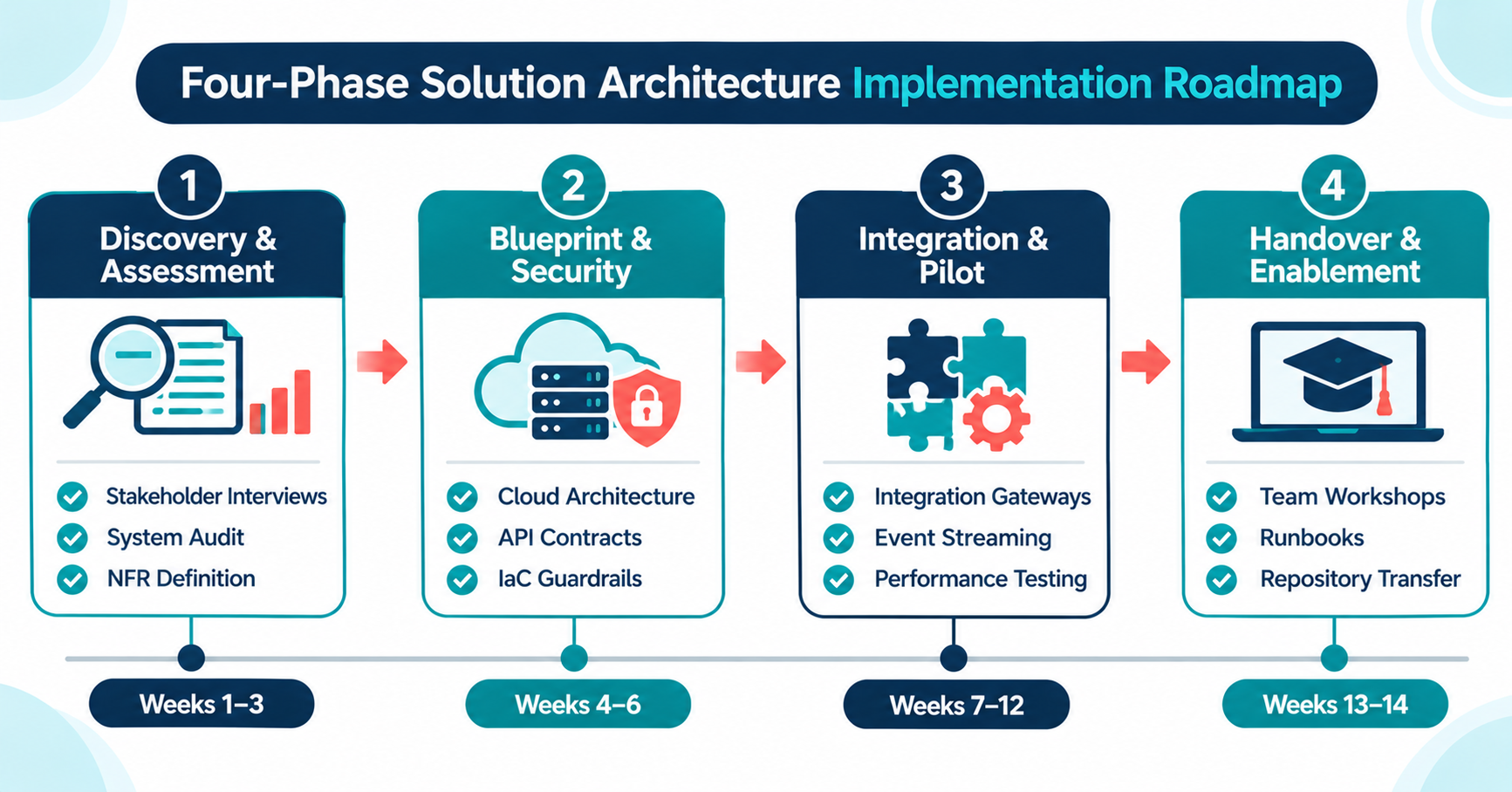
Phase 1: Discovery and System Architecture Assessment
Begin by understanding the existing technology environment and business requirements. Conduct in-depth stakeholder interviews, audit current SaaS and ERP integration endpoints, and define the required non-functional requirements (NFRs).
Expected Outcome:
Validated solution requirements document
Initial C4 Context blueprint
Identified risks and risk matrix
Phase 2: Solution Blueprint and Security Planning
Use the discovery findings to design the end-to-end cloud topology and establish event integration contracts. Set up Infrastructure as Code (IaC) and Policy-as-Code guardrails to support consistent infrastructure deployment and security governance.
Expected Outcome:
Production-ready Infrastructure as Code modules
Defined API specifications
Automated compliance pipelines
Phase 3: System Integration and Pilot Implementation
Develop the core integration gateways and deploy asynchronous event buses to enable communication across connected systems. Run continuous chaos and load testing under peak-load scenarios to evaluate system reliability, performance, and resilience.
Expected Outcome:
Fully functional solution pilot in a staging environment
Validated P99 latency service-level agreements (SLAs)
Zero-Trust security implementation
Phase 4: Team Enablement and Operational Handover
Prepare internal engineering teams to manage and maintain the solution independently. Conduct hands-on paired operations workshops, finalize operational runbooks, and transfer full repository ownership to the internal teams.
Expected Outcome:
Operational independence for internal engineering teams
Complete documentation and repository ownership transfer
No ongoing vendor lock-in
Conclusion: Choosing the Right Solution Architecture Services Partner
Effective solution architecture connects business strategy with the technical systems required to deliver it. From cloud infrastructure and event-driven integrations to security governance, observability, and cost controls, a well-defined architecture helps enterprises build reliable systems that can support evolving business requirements.
Choosing the right solution architecture partner means evaluating technical standards, implementation processes, documentation, and knowledge transfer. With a structured engagement and the right engineering expertise, businesses can reduce integration risks, improve system resilience, and maintain control over their technology investments. Contact us today to discuss your solution architecture requirements and explore how the right architecture approach can support your business goals.

Utkrishti Mishra
Business Analyst Intern | Exploring data, processes, and business strategies to turn insights into smarter decisions and impactful solutions.