

Why Accuracy Matters When Implementing AI solutions in Finance Departments
Enterprise AI Solutions are transforming business operations, but finance departments require a much higher level of accuracy. While a marketing team may celebrate an AI model that generates persuasive ad copy with 95% success, even a 1% error rate in financial operations can have serious consequences. A system used by a CFO to reconcile accounts payable or generate general ledger entries must maintain strict accuracy.
In corporate accounting, a 1% error rate can result in:
Misclassified tax withholdings
Duplicate vendor disbursements
Unbalanced double-entry journals
Material weaknesses flagged during Sarbanes-Oxley (SOX) Section 404 audits
Potentially significant quarterly earnings restatements
For years, these risks have made financial leaders skeptical of AI. While generative AI has transformed software development and customer service, accounting teams have continued to rely on manual spreadsheet work, repetitive three-way invoice matching, and lengthy ten-day month-end close cycles.
Based on our experience architecting enterprise financial systems, the solution is not to apply generic conversational models to accounting spreadsheets. It requires a Dual-Engine Financial AI Architecture that combines the contextual understanding of large language models with the mathematical precision of deterministic accounting engines.
This approach helps modern AI transform key finance operations without compromising compliance or auditability:
Accounts payable
Financial close cycles
Cash flow forecasting
Fraud governance
Key Considerations for Enterprise Finance Leaders Adopting AI
The Zero-Hallucination Standard: Financial AI must never allow generative models to calculate general ledger arithmetic directly. Language models ingest and contextualize unstructured documents; deterministic code computes the numbers.
The Continuous Close Paradigm: The goal of modern financial transformation is not speeding up the painful 10-day month-end sprint; it is eliminating the sprint entirely through continuous, sub-second transaction auditing and real-time ledger reconciliations.
Transaction Taxation vs. Asset Ownership: Off-the-shelf financial SaaS tools frequently charge punitive per-invoice transaction fees. Custom financial AI platforms allow organizations to build proprietary intellectual property on top of existing ERPs with predictable infrastructure overhead.
How Can Enterprise AI Improve Accuracy in Financial Operations?
When corporate controllers review artificial intelligence proposals, their primary question is straightforward: "How do we guarantee that the system will never fabricate an expense, misread an invoice total, or corrupt our general ledger?"
Our team solves this by deploying the Dual-Engine Financial AI Architecture:
Dual-Engine Architecture for Reliable Financial AI
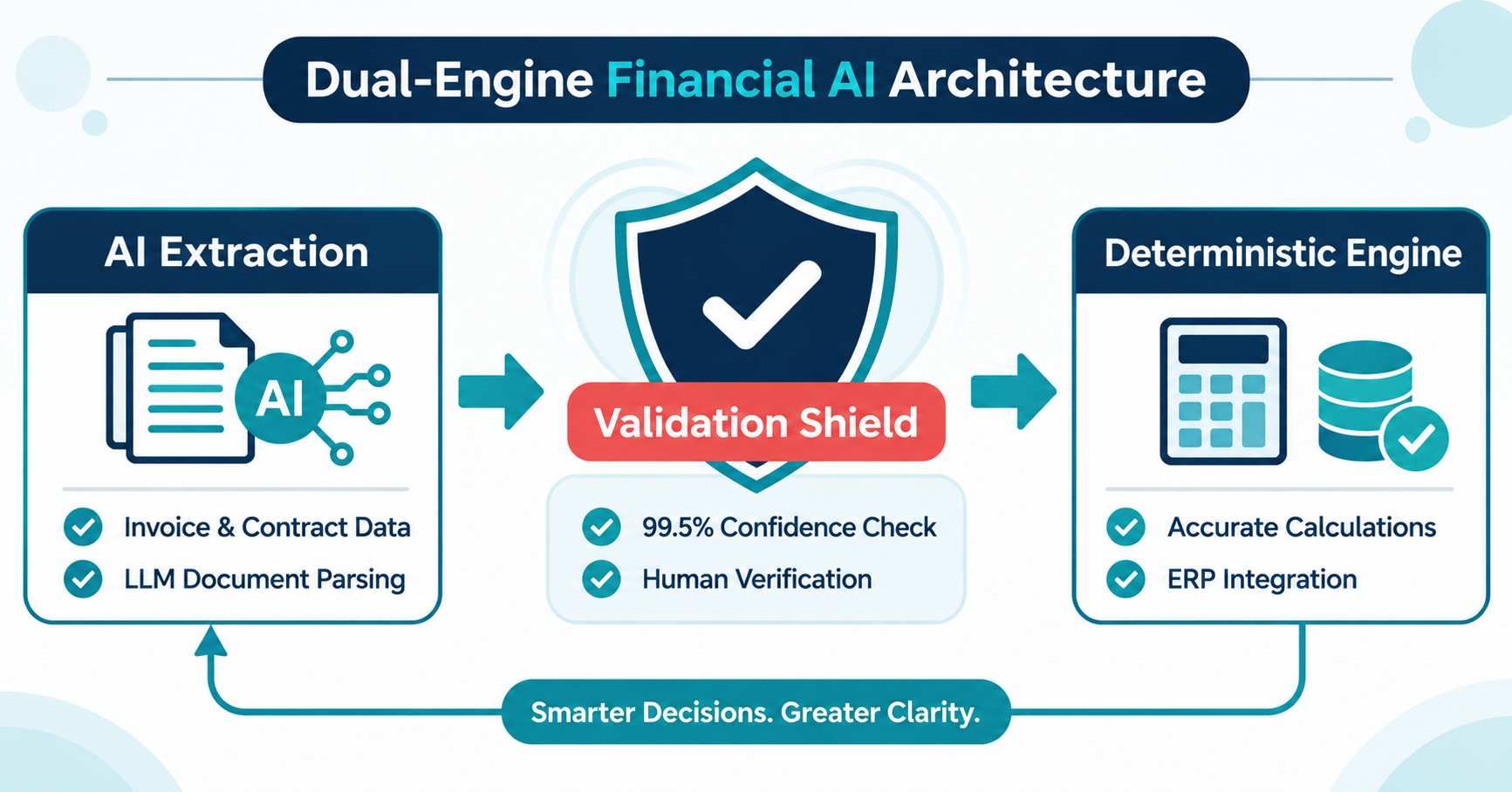
Engine 1: AI-Powered Financial Document Extraction
Traditional Optical Character Recognition (OCR) systems fail when vendors alter invoice layouts, move tax lines, or embed line items in complex multi-page tables. Engine 1 leverages fine-tuned layout-aware transformer models (such as LayoutLMv3 and private-cloud LLMs) to perform contextual document understanding:
Unstructured Ingestion: Intelligently extracts vendor names, payment terms, currency codes, line items, and bank account identifiers across 40+ languages and arbitrary PDF formats.
Semantic Contract Analysis: Reviews Master Service Agreements (MSAs) and vendor contracts to extract negotiated early-payment discounts, volume rebates, and liability clauses.
Strict Boundary Rule: Engine 1 is strictly prohibited from executing arithmetic or posting journal entries directly. It simply extracts entities and passes structured mathematical payloads to the validation shield.
Security and Validation for Financial AI Transactions
Before any extracted transaction touches financial records, it must pass through an automated compliance gate:
Confidence Scoring Threshold: Every single extracted field receives a mathematical confidence score. If the confidence on an invoice total, tax calculation, or vendor tax ID falls below 99.5%, the transaction is instantly diverted to an exception queue with the exact visual discrepancy highlighted for human verification.
Cryptographic PII Vaulting: Sensitive vendor bank accounts, tax numbers, and executive expense receipts are tokenized using AES-256-GCM encryption with cloud Key Management Service (KMS) customer-managed keys.
Engine 2: Deterministic Accounting and Financial Calculations
Once validated, the payload enters Engine 2, an execution environment constructed entirely from deterministic, non-probabilistic code (written in Python, Go, or Java):
Absolute Precision: Every calculation adheres to strict double-entry GAAP/IFRS accounting logic. Debits and credits must balance to the exact fractional cent.
Tax Code Tables: Automatically verifies statutory tax brackets, VAT rates, and withholding requirements across regional jurisdictions without guessing.
Direct ERP Writeback: Communicates with core ERPs (SAP S/4HANA, Oracle NetSuite, Workday Financials) via certified enterprise APIs, ensuring complete transactional consistency.
How Financial AI Can Detect Duplicate Vendor Payments
A global manufacturing conglomerate operating twelve regional subsidiaries used decentralized accounts payable systems connected to a consolidated SAP instance. Over eighteen months, an industrial equipment supplier submitted invoices for machinery maintenance through two billing entities: "Apex Industrial Machinery Ltd" and "Apex Industrial Services Corp". Minor differences in invoice numbers and remit-to bank accounts allowed duplicate invoices to pass standard ERP checks, resulting in $4.2 million in duplicate payments for identical equipment service calls.
The key factors behind the incident included:
Multiple billing entities: The supplier operated under two separate corporate names.
Different invoice numbers: Invoices used slightly altered formats, such as INV-98214 and INV-98214-A.
Different bank accounts: The invoices listed different remit-to bank accounts.
Limitations of ERP checks: Standard duplicate detection relied on exact invoice number and vendor ID matches.
Financial impact: Both sets of invoices passed regular approval workflows, leading to $4.2 million in duplicate payments over eighteen months.
How AI Identifies and Prevents Duplicate Payments
When our team deployed an intelligent financial anomaly detection model:
Entity Resolution: The platform's vector embedding mesh recognized that despite differing corporate entity names, both vendors shared identical physical corporate addresses, tax identification numbers, and contact phone numbers.
Contextual Semantic Matching: The natural language processing engine parsed the underlying line-item descriptions on INV-98214 and INV-98214-A, detecting that the serialized machine part numbers, work orders, and plant technician signatures were 100% identical.
Automated Interception: The system placed an immediate programmatic payment hold on forty-two pending disbursements, notified the Internal Audit team with visual side-by-side evidence, and initiated automated clawback procedures, recovering over $3.8 million in unearned capital.
Ready to Transform Your Finance Operations With AI?

How AI Automates Accounts Payable Operations
Accounts payable (AP) is historically one of the most labor-intensive departments in corporate finance. In an enterprise processing 50,000 invoices per month, junior accountants spend thousands of cumulative hours opening PDF attachments, keying invoice data into ERP fields, and manually cross-referencing Purchase Orders.
Modern financial AI transforms AP from a manual data-entry bottleneck into an autonomous, touchless pipeline:
Five Stages of AI-Powered Three-Way Invoice Matching
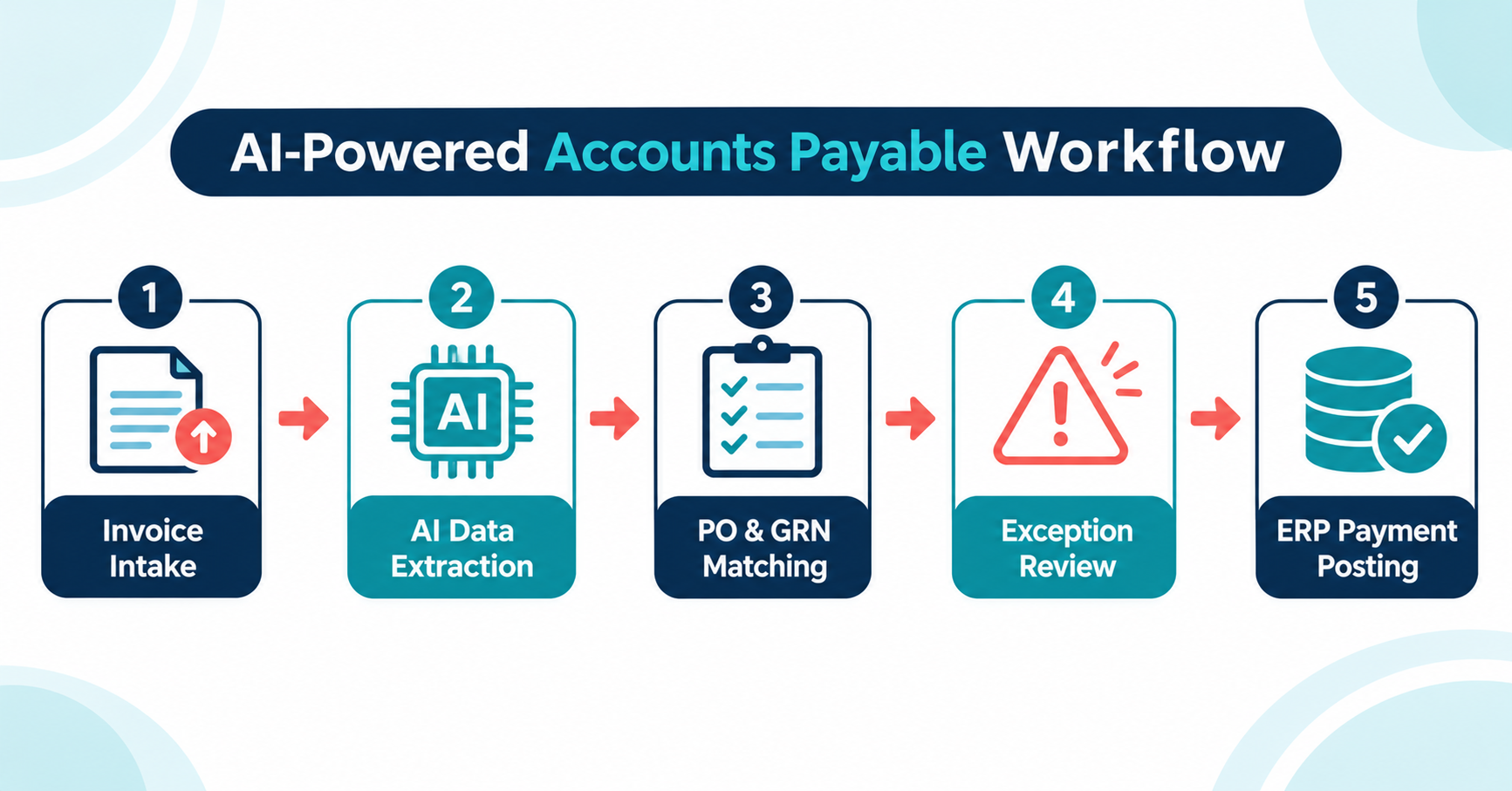
1. Multimodal Invoice Intake and Fraud Screening
Invoices arrive via email, vendor portals, EDI 810 streams, or mobile scans. Before ingestion, the system runs automated security heuristics:
Verifies vendor domain authenticity and SPF/DKIM email records to prevent executive impersonation and wire fraud.
Cross-references vendor bank account numbers against historical payment profiles. If a vendor suddenly requests payment to an offshore routing number without prior multi-factor authentication, the transaction is automatically frozen.
2. AI-Powered Invoice Line-Item Extraction
Transformer-based models parse multi-page tables, distinguishing between freight charges, line-item unit prices, state taxes, and core materials with 99.5%+ accuracy, normalizing foreign currencies and multilingual descriptors.
3. Automated Three-Way Invoice Reconciliation
The deterministic engine pulls the corresponding Purchase Order (PO) from the ERP and the Goods Receipt Note (GRN) from the Warehouse Management System (WMS):
Checks line-item quantities: Does the invoiced quantity match the physically received warehouse count?
Checks unit pricing: Does the invoice unit price match the contractual PO price?
Evaluates price tolerances: If minor shipping variances fall within pre-approved enterprise tolerance limits (e.g., within $5.00), the system automatically allocates the delta to a freight variance GL account.
4. AI-Powered Invoice Exception Management
When a material discrepancy occurs (e.g., 100 items billed, but only 80 received), the system does not fail silently. It opens an exception case in the Controller Workbench:
The AI automatically drafts a polite discrepancy email to the vendor citing the PO number, invoice number, and missing units.
Concurrently, it triggers a Slack or Microsoft Teams notification to the warehouse dock manager asking for quick verification of the missing pallet.
What previously took 5 days of manual phone calls is resolved in an average of 8 minutes.
5. Automated ERP Integration and Payment Posting
When an invoice achieves a validated 3-way match, the system pushes balanced credit and debit entries directly into SAP S/4HANA or Oracle NetSuite via API, links the original PDF to the journal voucher for audit compliance, and queues the payment batch to capture early-settlement cash discounts (such as 2/10 Net 30).
How AI Enables a Faster and More Continuous Financial Close
Ask any corporate controller about their least favorite time of the month, and the answer is unanimous: the month-end close.
In traditional accounting departments, the month-end close is an exhausting 10-day sprint marked by late-night overtime, frantic data chasing across departments, manual spreadsheet reconciliations, and constant fear of missing statutory filing deadlines.
Our team advocates moving away from the periodic close toward a Continuous Financial Close:
Traditional Month-End Close vs. AI-Powered Continuous Close
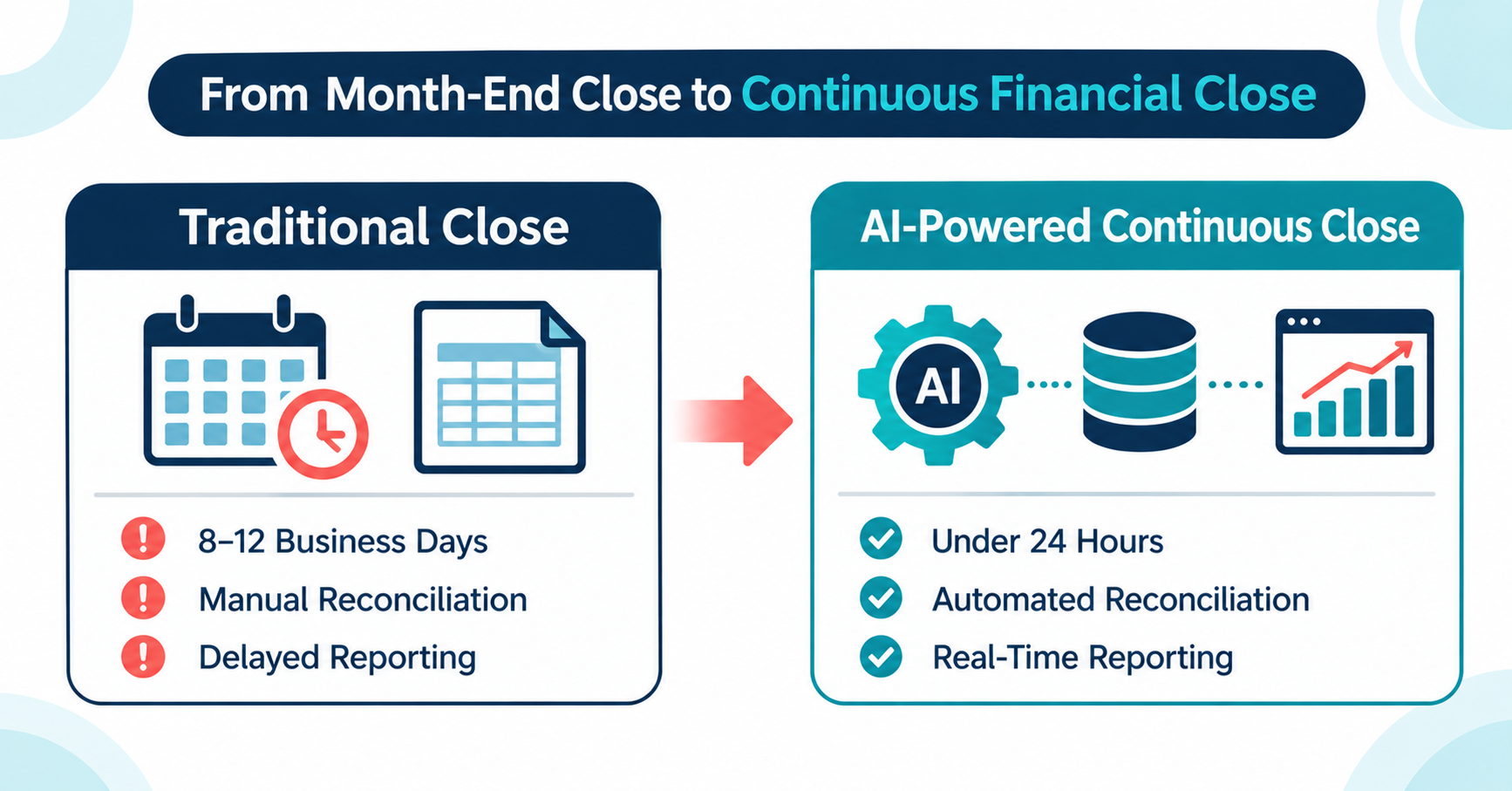
Operational Metric | Traditional 10-Day Month-End Close | AI-Powered Continuous Financial Close |
|---|---|---|
Close Duration | 8 to 12 business days of high-intensity team overtime. | Under 24 hours (continuous daily sub-ledger reconciliation). |
Reconciliation Timing | Batched once a month after period cut-off. | Executed continuously in sub-second background streams. |
Error Discovery | Discovered late on Day 6 or 7, forcing rushed adjustments. | Caught within minutes of transaction posting via anomaly alerts. |
Data Freshness | Executive reports reflect numbers that are 15 to 20 days old. | Real-time P&L, balance sheet, and liquidity dashboards updated daily. |
Team Resource Drain | Approximately 800 to 1,400 hours per monthly cycle. | Cuts operational accounting overhead by 75% to 85%. |
External Audit Friction | Sample-based manual testing causing extensive auditor inquiries. | 100% automated audit trail with cryptographic proof of reconciliation. |
How AI-Powered Continuous Financial Close Works
Real-Time Bank & Ledger Feed Sync: As transactions clear commercial bank accounts, the system matches them against open accounts receivable and accounts payable sub-ledgers in real time.
Automated Amortization & Accrual Engines: Prepaid expenses, depreciation schedules, and software subscription amortizations are calculated and staged autonomously.
Intercompany Elimination Mesh: In multinational enterprises with dozens of operating subsidiaries, the platform continuously pairs intercompany loans, management fees, and cross-charges, flagging imbalances instantly rather than waiting for month-end reconciliation.
Day-1 Close Execution: When the calendar month ends, 92% of all sub-ledgers are already balanced, verified, and reconciled. The controller conducts a streamlined final review and locks the accounting period in less than 24 hours.
Ready to Transform Your Finance Operations With AI?
How AI Strengthens Treasury Management and Financial Fraud Detection
Corporate fraud has grown significantly more sophisticated. Bad actors no longer write fake paper checks; they manipulate approval thresholds, create synthetic shell vendors, and execute targeted business email compromise (BEC) attacks.
Traditional rule-based fraud detection tools look for simple static flags, which generate thousands of false positives while missing sophisticated schemes. Financial AI platforms employ machine learning anomaly detection to protect enterprise liquidity across three key fronts:
1. AI-Powered Split Purchase Order Fraud Detection
Employees attempting to bypass strict management approval limits (such as a $10,000 threshold requiring VP sign-off) often split a $28,000 expense into three separate POs of $9,500, $9,200, and $9,300 submitted across successive days.
Our anomaly detection models use graph pattern matching to identify related purchase orders across identical cost centers, vendor categories, and requester IDs, flagging evasion attempts before orders are committed.
2. Detecting Synthetic Vendors and Ghost Accounts With AI
Fraudulent shell vendors frequently share subtle relational links with internal employees. The AI platform cross-references vendor master data with internal corporate registries, analyzing:
Matching physical mailing addresses, phone numbers, or IP submission origins.
Newly established vendor accounts that receive immediate high-dollar POs without prior bidding history.
Vendors whose bank account details were modified within 48 hours of an invoice disbursement request.
3. AI-Powered Cash Flow Forecasting and Treasury Optimization
Treasury departments frequently struggle with accurate liquidity planning, forcing enterprises to hold excessive idle cash buffers in low-yield operational accounts to cover unpredictable payment runs.
Machine learning models analyze historical customer payment timing, seasonal revenue cycles, and vendor payment terms to generate 30-, 60-, and 90-day cash flow forecasts with 96%+ accuracy:
Predicts precisely which enterprise clients are likely to pay late based on macroeconomic variables and past behavior.
Prescribes the exact timing of vendor disbursements to maximize early-payment cash discounts while maintaining optimal working capital liquidity.
Recommends automated foreign currency (FX) hedging positions to protect profit margins against exchange rate volatility.
Build vs. Buy: Choosing the Right Financial AI Platform
When evaluating financial AI tools, finance departments are frequently courted by point-solution SaaS vendors (such as Tipalti, HighRadius, or Vic.ai). While these tools offer quick out-of-the-box demonstrations, growing enterprises encounter severe strategic limitations as transaction volumes expand:
Commercial Financial AI Software vs. Custom Enterprise Solutions
Decision Factor | Off-The-Shelf Financial Point SaaS | Custom Enterprise Financial AI Platform |
|---|---|---|
Cost & Fee Structure | Punitive transaction taxes ($0.75 to $2.50 per invoice) that escalate directly with corporate volume. | Zero per-transaction fees. Fixed, predictable cloud infrastructure costs and full IP ownership. |
Data Privacy & Governance | Financial data, banking records, and vendor terms reside in third-party vendor clouds. | Deployed within the enterprise's private cloud VPC (AWS/Azure) with zero third-party data retention. |
ERP Integration Depth | Generic, brittle API connectors that struggle with custom ERP fields and complex GL structures. | Deep, native bidirectional integration customized to exact corporate chart of accounts and workflows. |
Proprietary IP Creation | Zero corporate equity value; completely dependent on vendor roadmap. | The enterprise owns the machine learning models, custom workflows, and data assets. |
Audit & SOX Compliance | Dependent on vendor SOC reports and third-party validation schedules. | Direct, immutable audit logs with complete end-to-end transparency for internal and external auditors. |
Our team typically advises building a custom financial intelligence layer when an enterprise processes more than 10,000 invoices per month, manages complex multi-entity consolidation, or operates in heavily regulated industries where financial data cannot leave private enterprise boundaries.
Ready to Transform Your Finance Operations With AI?
Financial AI Implementation Roadmap and Cost Considerations
Deploying artificial intelligence into corporate finance must be executed with extreme operational discipline. Financial operations cannot afford downtime or unverified cutovers.
Our team recommends a structured four-phase agile delivery roadmap spanning 7 to 9 months:
Financial AI Development Phases, Timeline, and Investment
Phase | Duration | Core Engineering Pod | Key Technical Deliverables | Estimated Investment |
|---|---|---|---|---|
Phase 1: Cognitive AP & Ingestion | 8 to 10 Weeks | 1 Lead Architect, 1 Senior BA, 2 NLP Engineers, 1 Backend Dev, 1 QA | Inbound invoice parser setup, LayoutLMv3 table extraction, vendor master entity resolution, 2-way PO matching, SOC 1 compliance audit. | $45,000 - $60,000 |
Phase 2: Tri-Way Match & ERP Writeback | 8 to 10 Weeks | 1 Tech Lead, 2 Senior Backend Developers, 1 ERP Integration Specialist, 1 QA | 3-Way reconciliation engine with WMS/GRN, automated tolerance variance engine, exception workbench, direct SAP/NetSuite GL writeback. | $50,000 - $70,000 |
Phase 3: Audit Shield & Anomaly Detection | 8 to 10 Weeks | 1 ML Engineer, 2 Backend Developers, 1 Security Specialist, 1 QA | Ledger anomaly models, split-PO fraud detection, intercompany reconciliation engine, automated SOX audit trail, treasury liquidity forecasting. | $45,000 - $65,000 |
Phase 4: Continuous Close & FP&A Sandbox | 7 to 9 Weeks | 1 Product Lead, 2 Full-stack Engineers, 1 Frontend Developer, 1 QA | Sub-24-hour financial close workflow, natural language FP&A queries, automated Board slide deck generation, production penetration audit. | $25,000 - $45,000 |
Total Comprehensive Build | 7 to 9 Months | Dedicated Cross-Functional Agile Pod | Full Enterprise-Grade Autonomous Financial AI Platform | $165,000 - $240,000 |
Key Engineering Lessons From Enterprise Financial AI Projects
Throughout our implementations of enterprise financial AI, our team has learned critical lessons about what makes financial transformation succeed or stall:
Lesson 1: Design Financial AI Tools for Accountants
The Mistake: Providing finance teams with raw Python notebooks or complex query builders leads to immediate platform abandonment.
Our Approach: Build intuitive, spreadsheet-compatible interfaces. Accountants love Microsoft Excel and intuitive web workbenches. The platform must provide bi-directional sync with Excel via secure add-ins while handling heavy computation in the cloud.
Lesson 2: Establish Audit Trails Before Implementing AI
The Mistake: Focusing purely on model accuracy while neglecting audit trail architecture leads to instant project cancellation by external auditors (such as the Big Four).
Our Approach: Codify immutable, tamper-evident logging from Day 1. Every extracted field, rule evaluation, and user sign-off must be cryptographically hashed and easily exportable in formats external audit partners expect.
Lesson 3: Prioritize High-Volume Invoice Formats
The Mistake: Spending 6 months trying to achieve 100% automated extraction across obscure, once-a-year mom-and-pop vendor receipts.
Our Approach: Focus model fine-tuning on the top 20% of high-volume corporate vendors who account for 80% of total invoice volume. Route the long-tail exceptions through a high-efficiency human workbench.
The Future of Finance Departments With AI Automation
The future of corporate finance is not about replacing accountants with AI. It is about freeing skilled professionals from repetitive tasks such as manual data entry, ledger reconciliation, and lengthy month-end close processes. An enterprise Financial AI platform can transform finance from an administrative function into a more strategic one by automating routine transactions, maintaining mathematical accuracy, and providing real-time working capital insights.
Our engineering team develops secure, audit-ready data pipelines, intelligent document processing solutions, and high-performance financial systems for enterprise requirements. Whether you are modernizing accounts payable or building a continuous financial close architecture, we bring the technical expertise and domain knowledge to support your goals. Contact us today to schedule an architecture consultation with Zignuts Solution Architects and discuss your financial data requirements, ERP integration needs, and project roadmap.

Mukund Patil
Business Enthusiast | Exploring ideas, trends, and opportunities, turning curiosity into meaningful insights and discovering smarter ways to make an impact.