

In the global commercial landscape of 2026, enterprise supply chain management has evolved from reactive logistics coordination into a predictive, algorithmically orchestrated discipline. Chief Supply Chain Officers (CSCOs), Chief Operating Officers (COOs), Vice Presidents of Global Logistics, and Enterprise IT Architects face unprecedented volatility driven by geopolitical trade disruptions, extreme weather events, shifting consumer demand, and rising freight fuel costs.
Disconnected legacy enterprise resource planning (ERP) systems, static spreadsheets, and manual electronic data interchange (EDI) reconciliations leave organizations vulnerable to costly stockouts, excess inventory, and delivery SLA failures.
Addressing these challenges requires Enterprise AI Solutions integrated with enterprise ERPs such as SAP, Oracle, and Blue Yonder, warehouse management systems (WMS), carrier telematics, and global trade data.
Successful supply chain AI goes beyond theoretical models. It focuses on building high-throughput, event-driven systems that can:
Predict demand more accurately: Use real-time data and machine learning to identify demand patterns and anticipate fluctuations.
Optimize multi-echelon inventory: Dynamically rebalance inventory across warehouses and distribution centers to reduce stockouts and excess stock.
Improve logistics and fleet routing: Analyze traffic, carrier telematics, and delivery conditions to optimize routes and improve on-time performance.
Identify supplier risks: Monitor multi-tier supplier networks and global trade signals to detect potential disruptions earlier.
Connect enterprise systems: Integrate ERP, WMS, carrier platforms, and EDI workflows to create a unified and reliable flow of supply chain data.
Build operational resilience: Use predictive insights and automated workflows to help supply chain leaders respond to disruptions and changing business conditions.
This technical guide explores the core AI supply chain solution archetypes, foundational system architectures, business impact benchmarks, phased implementation lifecycles, and risk mitigation strategies. Drawing on our team's experience building custom supply chain platforms, multi-tenant marketplace portals, and high-throughput financial automation systems, it explains how logistics technology leaders can develop a resilient and scalable supply chain AI ecosystem.
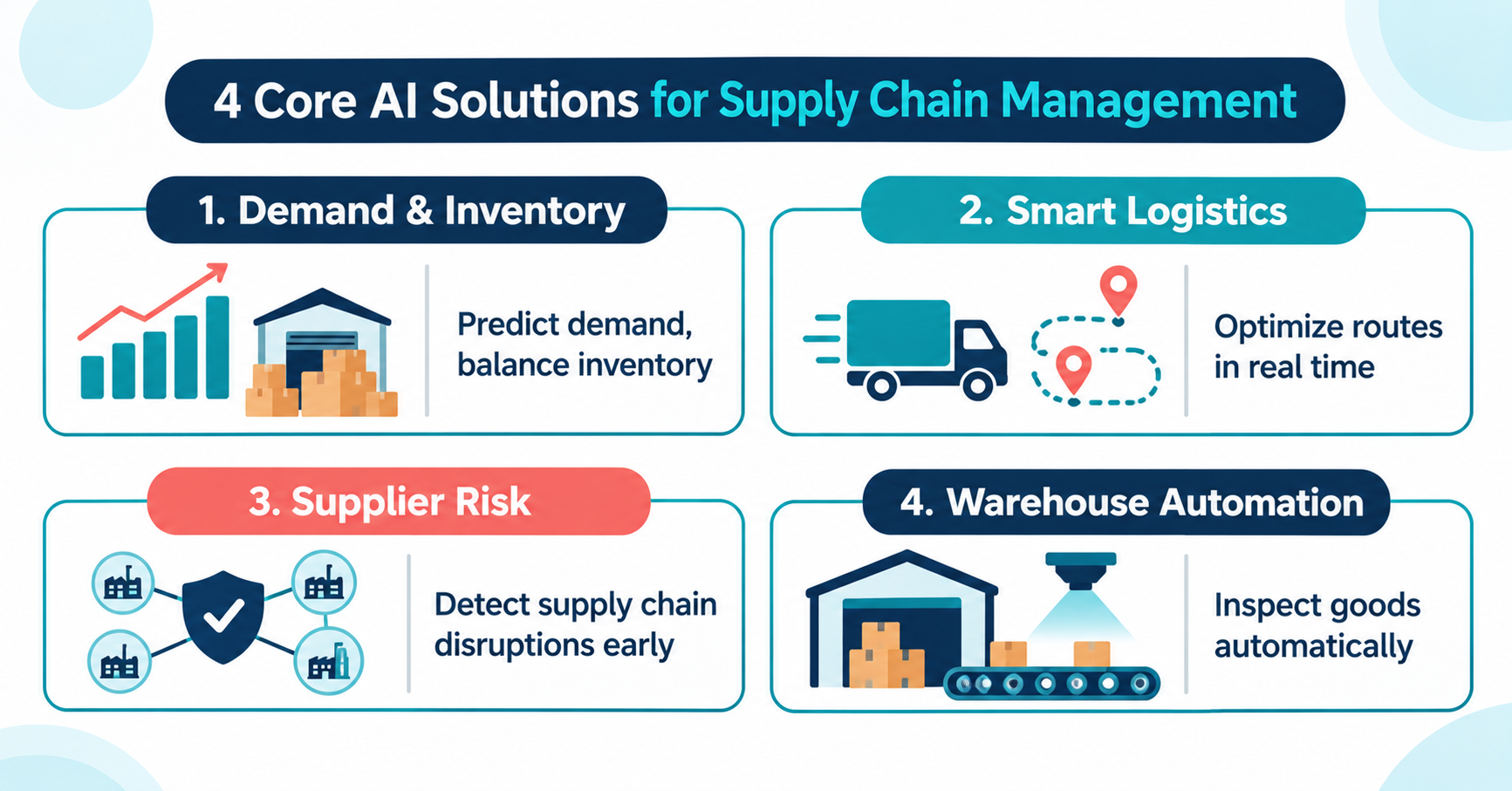
4 Core AI Solutions for Supply Chain Management
Enterprise AI supply chain solutions generally encompass four primary operational archetypes, each resolving specific bottlenecks across the international and domestic fulfillment lifecycle:
Predictive Demand Sensing and Multi-Echelon Inventory Optimization: Machine learning algorithms that ingest point-of-sale (POS) streams, macroeconomic signals, weather forecasts, and marketing spend to predict SKU-level demand with granular accuracy, dynamically positioning safety stock across regional distribution centers to minimize holding costs while eliminating stockouts.
Autonomous Logistics and Dynamic Route Optimization: Reinforcement learning and heuristic optimization engines that evaluate live traffic telemetry, carrier capacity, fuel surcharges, and customer delivery time windows to dynamically adjust vehicle dispatching and freight routing in real time.
Multi-Tier Supplier Intelligence and Disruption Risk Management: Natural language processing (NLP) pipelines that continuously scan global news feeds, regulatory filings, maritime shipping tracking, and supplier financial indicators to identify Tier-1, Tier-2, and Tier-3 supplier risks weeks before disruptions halt manufacturing.
Warehouse Automation and Computer Vision Quality Auditing: Edge computer vision models deployed across warehouse receiving bays and sorting lines to inspect inbound freight for carton damage, verify pallet packing standards, validate barcodes, and optimize warehouse slotting based on item velocity.
Enterprise AI Supply Chain Solutions Comparison & ROI Matrix
AI Solution Category | Core Architectural Components | Primary Operational Bottleneck | Quantified Business Impact |
|---|---|---|---|
Predictive Demand Sensing & Inventory | Temporal Fusion Transformers, multi-echelon inventory models, ERP POS streaming, PostgreSQL. | Bullwhip effect demand distortion, costly stockouts, and excess safety stock carrying costs. | 30% to 50% Reduction in forecasting error; 15% to 25% lower inventory carrying capital. |
Autonomous Logistics & Dynamic Routing | Reinforcement learning dispatchers, vehicle routing algorithms (VRP), telematics API ingestion. | High diesel fuel consumption, missed delivery SLA windows, and empty backhaul mileage. | 12% to 20% Decrease in total fleet mileage and fuel costs; 98.5% on-time delivery rate. |
Supplier Risk & Disruption Sensing | Named Entity Recognition (NER), maritime AIS vessel tracking, graph neural networks (GNN). | Unannounced supplier factory shutdowns, port congestion delays, and single-source dependencies. | 14 to 21 Days Early Warning for supply chain disruptions; automated dual-sourcing execution. |
Warehouse Vision QA & Slotting | YOLOv8 edge inference models, industrial camera streams, WMS automated slotting rebalancers. | Manual receiving bottlenecks, unrecorded freight damage, and inefficient picking routes. | 40% Acceleration in dock-to-stock intake; 99.8% shipping accuracy and automated claim logging. |
Core Engineering Capabilities for AI-Powered Supply Chains
Deploying AI solutions that deliver consistent supply chain ROI requires deep software engineering expertise across five technical disciplines:
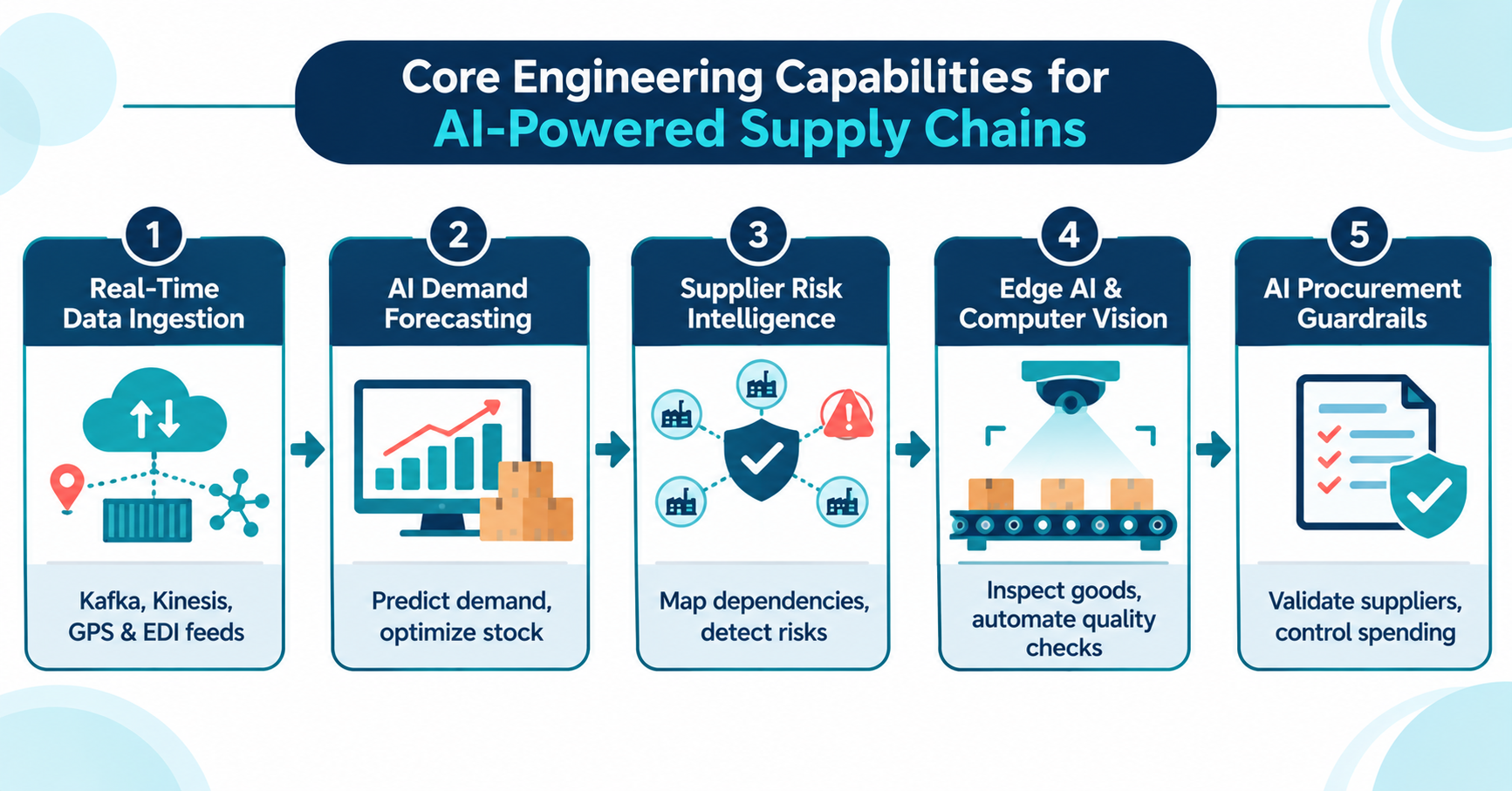
1. Real-Time Data Ingestion and Event Streaming
Supply chain operations span diverse external networks, including ocean carriers, third-party logistics (3PL) providers, customs brokers, and domestic freight truckers.
Event-driven data streaming: Deploy a streaming backbone using Apache Kafka or AWS Kinesis instead of relying on scheduled daily batch transfers.
Real-time data ingestion: Capture GPS coordinates, container AIS signals, and temperature sensor logs.
EDI integration: Ingest EDI feeds, including:
EDI 214 for shipment status.
EDI 856 for advanced ship notices.
Operational visibility: Maintain an up-to-date digital twin of global inventory in motion.
2. AI-Powered Demand Sensing and Forecasting
Traditional demand planning models, such as ARIMA and Holt-Winters, rely primarily on historical internal sales data and may struggle when consumer demand shifts abruptly.
Advanced forecasting models: Deploy Temporal Fusion Transformers (TFT) for demand sensing.
External data integration: Incorporate additional variables, including:
Local weather patterns.
Regional economic indices.
Competitor pricing data.
Digital marketing spend.
SKU-level demand sensing: Identify short-term demand fluctuations at individual SKU and store levels.
Long-term planning: Maintain multi-month manufacturing plans alongside short-term forecasts.
3. Graph Databases for Multi-Tier Supplier Risk Analysis
Supply chain disruptions can originate beyond primary Tier-1 suppliers, extending to Tier-2 component vendors and Tier-3 raw material suppliers.
Graph database modeling: Use platforms such as Neo4j or Amazon Neptune to map multi-tier supplier relationships.
Dependency tracking: Trace recursive dependencies across supplier networks.
Risk detection: Evaluate network centrality and identify hidden single points of failure across Tier-2 vendors.
Automated stress testing: Simulate potential disruptions to identify critical supply chain vulnerabilities.
4. Edge AI and Computer Vision for Warehouse Operations
Computer vision in warehouse cross-docks requires high-throughput edge processing. Streaming multi-camera 4K video over internet connections can increase bandwidth costs and processing latency.
Edge AI architecture: Deploy containerized models such as YOLOv8, optimized with TensorRT.
Local processing: Run models on industrial edge gateways to reduce dependence on cloud-based video processing.
Automated inspections: Use cameras to:
Inspect pallet integrity.
Detect barcode labels.
Verify container seals.
Efficient data transmission: Send structured event metadata and flagged defect clips to cloud management portals instead of continuously transmitting raw video feeds.
5. AI Guardrails and Automated Procurement
AI models can generate replenishment and routing recommendations, but enterprise governance requires controls before they execute financial transactions.
Purchase order controls: Enforce strict spending limits for purchase orders.
Supplier validation: Apply mandatory secondary supplier validation rules.
Human-in-the-loop reviews: Provide review portals for purchases that exceed predefined risk thresholds.
Deterministic guardrails: Ensure automated procurement follows established business rules and approval requirements.
4 Stages of AI Supply Chain Implementation
Executing an enterprise supply chain AI initiative requires a disciplined engineering delivery methodology designed to mitigate operational risk and validate performance early.
Stage 1: Supply Chain Data & Schema Audit (Weeks 1–4)
The first stage focuses on assessing existing supply chain data and systems to establish a reliable foundation for AI implementation.
Key activities include:
Auditing ERP, WMS, and TMS inventory schemas.
Cataloging carrier EDI feeds.
Evaluating data quality and identifying gaps.
Categorizing high-impact SKUs based on business value.
Expected outcome: An approved architectural blueprint identifying the top 20% of high-value SKUs that account for 80% of carrying costs.
Stage 2: Foundation & Demand Sensing MVP (Weeks 5–10)
The second stage establishes the technical foundation and develops a minimum viable product (MVP) for demand sensing.
Key activities include:
Building a Kafka event streaming pipeline.
Training demand sensing models.
Conducting historical data backtesting.
Calibrating safety stock thresholds.
Expected outcome: A production-ready forecasting model demonstrating a 25%+ accuracy improvement over baseline ERP projections.
Stage 3: Logistics & Dynamic Dispatch Pilot (Weeks 11–18)
This stage introduces logistics automation and tests dynamic dispatch capabilities across selected distribution centers.
Key activities include:
Integrating carrier telematics APIs.
Piloting dynamic route optimization.
Setting up automated purchase order (PO) generation webhooks.
Rolling out the driver application.
Expected outcome: Live deployment across selected regional distribution centers, delivering a 15% reduction in freight transit delays.
Stage 4: Autonomous Control Tower & Scaling (Month 5+)
The final stage expands AI capabilities across facilities and brings supply chain operations together through a centralized control tower.
Key activities include:
Deploying a global supply chain control tower.
Implementing multi-tier supplier graph risk monitoring.
Integrating warehouse vision quality assurance.
Connecting executive business intelligence (BI) telemetry.
Expected outcome: Enterprise-wide, multi-facility deployment delivering sustained 20%+ inventory carrying cost reductions.
Real-World Applications of AI and Supply Chain Technology
Building effective AI-powered supply chain solutions requires experience in connecting enterprise systems, automating complex workflows, and developing scalable digital platforms. Our software engineering expertise spans several areas that support these capabilities:
Multi-System Supply Chain and Data Integration: Connecting ERP platforms, warehouse management systems, and real-time tracking feeds to create unified operational visibility, improve data flow, and reduce manual work.
Intelligent Workflow Automation: Developing enterprise automation platforms that connect business processes across systems, streamline task routing, and support faster workflow execution.
Scalable B2B and B2C Marketplace Platforms: Building multi-tenant platforms with advanced product search, dynamic recommendations, and secure catalog management to support efficient digital commerce.
Financial Process Automation: Modernizing accounts receivable workflows through automated invoice validation, reconciliation, and secure financial data management.
Cloud Infrastructure and Cost Optimization: Designing scalable cloud environments with automated resource management, database optimization, and containerized services to support reliable, cost-efficient operations.
Key Takeaways for Implementing AI in Supply Chain Operations
Transition from Static Batches to Real-Time Event Streams: The greatest barrier to effective supply chain AI is latency. Replace once-daily EDI batch uploads with real-time Kafka event streaming to enable dynamic rerouting and immediate disruption response.
Focus Initial AI Deployments on High-Velocity SKUs: Avoid attempting to automate long-tail, unpredictable inventory during initial pilots. Focus demand sensing algorithms on core high-volume products where forecasting improvements yield immediate working capital reductions.
Map Multi-Tier Supplier Dependencies with Graph Databases: Eliminate single points of failure by modeling supplier networks as interconnected graphs, tracking Tier-2 and Tier-3 sub-component vendors rather than relying solely on Tier-1 contractual assurances.
Deploy Computer Vision at the Edge: Implement warehouse receiving and pallet quality inspection models directly on edge industrial gateways to achieve sub-second verification while avoiding massive cloud bandwidth and video streaming costs.
Partner with Experienced Software Engineers: Building custom enterprise supply chain AI solutions requires cross-disciplinary expertise in distributed systems, IoT telemetry streaming, ERP integration, and security governance.
Conclusion
Implementing AI in supply chain operations is not just about adopting advanced algorithms. It requires a strong technical foundation that connects enterprise systems, enables real-time data processing, improves demand forecasting, optimizes inventory and logistics, and identifies supplier risks. By combining predictive intelligence, automation, and secure system integrations, businesses can improve operational visibility, respond to disruptions faster, and make more informed supply chain decisions.
Building a scalable AI-powered supply chain ecosystem also requires the right engineering expertise and a phased implementation strategy. Whether you are modernizing legacy systems, developing custom forecasting models, or automating logistics workflows, Zignuts can help turn your requirements into practical enterprise solutions. Contact us today to discuss your supply chain goals and explore how our enterprise AI development expertise can support your digital transformation journey.

Swati Bais
Business Enthusiast | Curious about how businesses evolve, connecting ideas with insights to discover opportunities and shape better ways of working.