

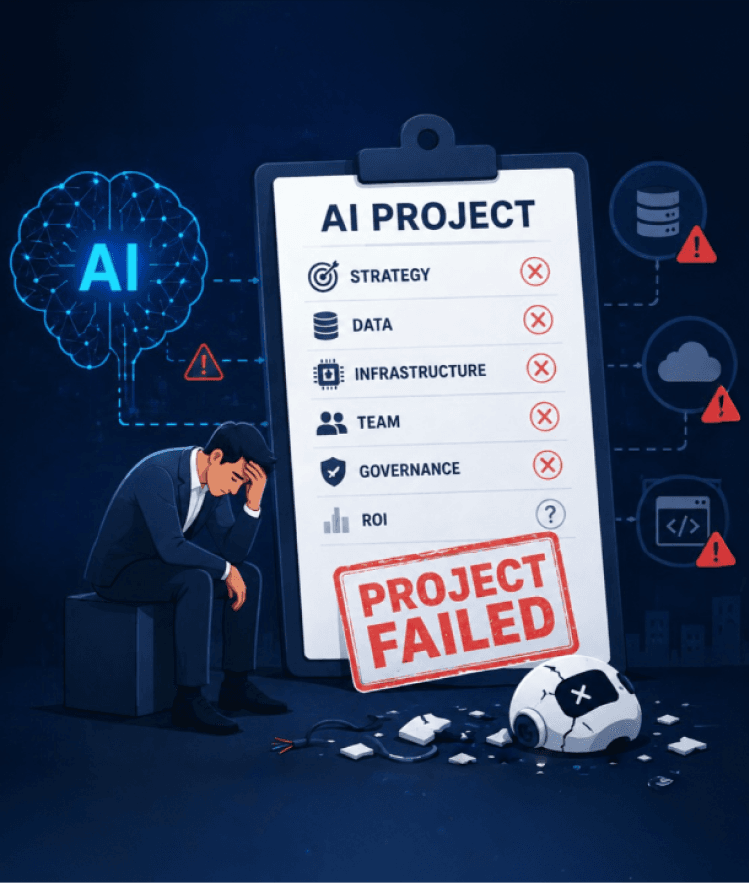
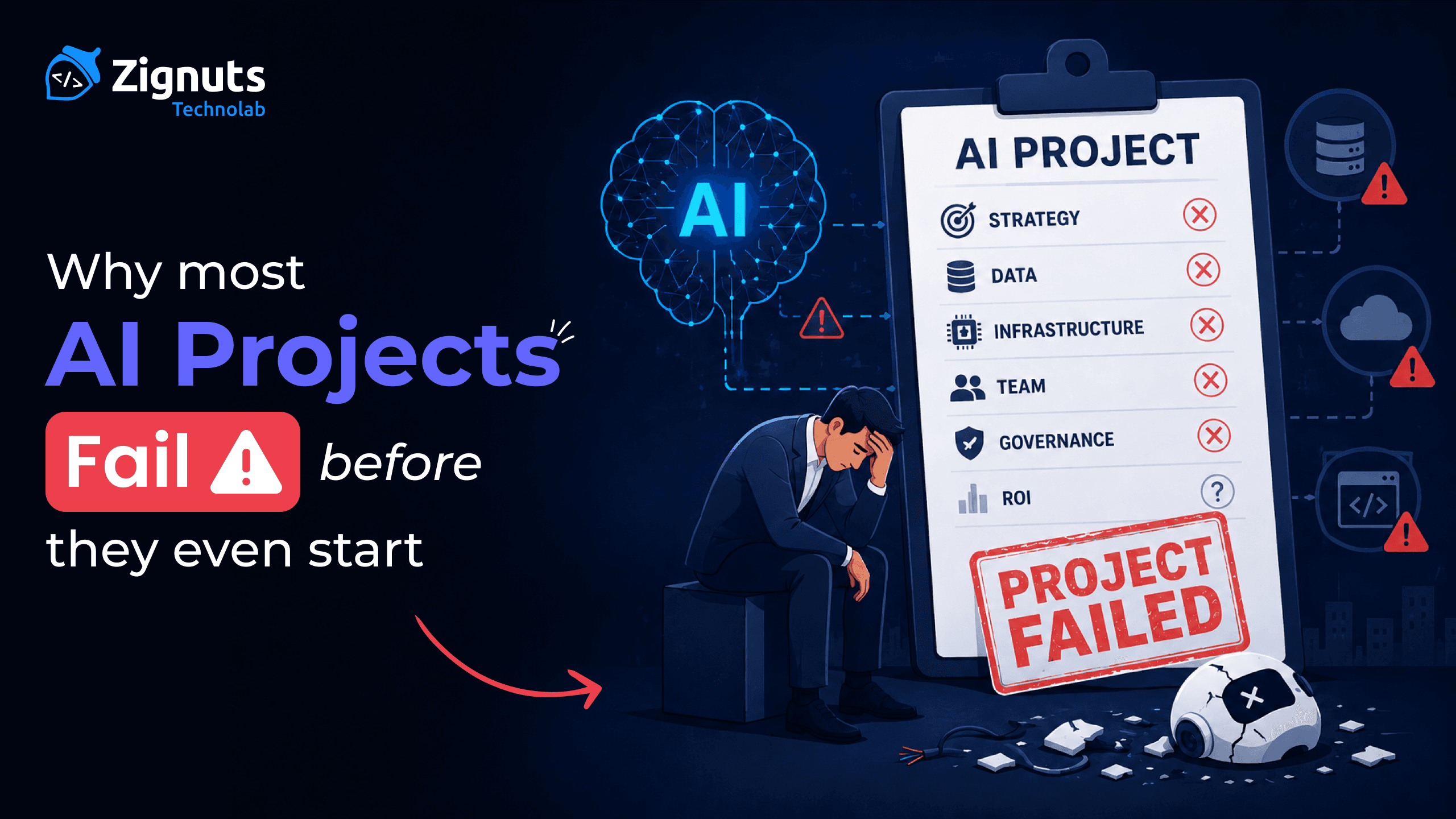
Most AI initiatives do not fail because of weak models or immature technology. They fail long before deployment because the organization lacks the strategic, operational, and technical foundation needed to make AI work at scale.
Enterprise AI is not simply a software implementation; it's a business transformation initiative. Success depends on aligning business objectives, data readiness, governance, software architecture, integration strategy, and organizational ownership before selecting models or writing code.
For CTOs, CIOs, product leaders, and founders, the critical question is no longer "Should we adopt AI?" Instead, it's "Is our business ready to operationalize AI in a way that delivers measurable outcomes?"
Organizations that answer this question early are far more likely to move beyond isolated proofs of concept and build AI capabilities that improve operational efficiency, customer experience, and long-term competitive advantage.
The primary reason AI projects fail early
AI initiatives often begin with a technology ambition rather than a business decision. A leadership team wants a chatbot, recommendation engine, predictive dashboard, document automation system, or generative AI assistant before agreeing on the operational bottleneck it must solve. This creates a gap between experimentation and business value.
A viable AI project should start with a clear outcome: reduce manual review time, improve forecast accuracy, accelerate customer support resolution, detect fraud earlier, personalize user journeys, or automate repetitive knowledge work. Without a measurable objective, teams cannot prioritize data, evaluate models, calculate ROI, or decide whether the solution should be a lightweight automation, a custom AI system, or a broader software modernization program.
What Separates Successful AI Projects from Failed Ones?
One of the biggest differences between successful and unsuccessful AI initiatives is not the model; it is the level of organizational readiness.
Organizations That Succeed | Organizations That Struggle |
|---|---|
Define measurable business outcomes before selecting AI technologies | Begin with a preferred model or AI tool without a business objective |
Establish executive ownership and governance | Leave ownership distributed across multiple departments |
Invest in data quality and system integration | Expect AI to compensate for fragmented or poor-quality data |
Pilot with clear KPIs before scaling | Attempt enterprise-wide deployment immediately |
Continuously monitor performance and improve workflows | Treat AI as a one-time implementation project |
Technology enables AI, but business readiness determines whether it delivers lasting value.
Failure Point Two: Poor Data Readiness
Data readiness is often the largest hidden obstacle in enterprise AI projects. While many organizations possess significant volumes of data, it is frequently distributed across CRM platforms, ERP systems, cloud applications, spreadsheets, legacy databases, and third-party services that were never designed to work together.
Consider a logistics company attempting to build an AI-powered delivery optimization platform. Shipment information may exist within an ERP, customer communication inside a CRM, GPS tracking data through external APIs, and operational reports within spreadsheets. Before AI can generate reliable recommendations, these systems must be integrated into a trusted and governed data foundation.
Enterprise teams should evaluate:
Data quality and completeness
Ownership and stewardship
Update frequency
Integration complexity
Access permissions
Regulatory requirements
Data bias and consistency
Knowledge source reliability
In practice, organizations often spend more effort preparing data than evaluating AI models. Investing in data readiness early dramatically reduces implementation risk and improves long-term AI performance.
Failure point three: treating AI as a standalone feature
AI becomes valuable when it is embedded into business workflows. A model that produces a prediction or a generated response is only one part of the system. The surrounding software must capture inputs, validate outputs, route exceptions, integrate with existing platforms, log activity, manage permissions, and support human review where needed.
This is why AI projects often require custom software development, API integrations, cloud engineering, product design, and enterprise platform thinking. The model may be the most visible component, but the workflow, architecture, and adoption path determine whether users actually trust and use it.
Failure point four: unrealistic proof-of-concept expectations
Many AI projects get trapped in the demo stage. A proof of concept proves technical possibility, not enterprise viability. It may not address scale, latency, security, compliance, model drift, monitoring, cost control, user adoption, or integration with production systems. Executives should treat a PoC as a learning tool, not a launch plan.
A better approach is to define staged validation. First validate business value and data feasibility. Then validate model performance against real workflows. Next, validate architecture, security, and integration requirements. Finally, launch a controlled pilot with measurable KPIs. This reduces risk and prevents teams from over-investing in a solution that cannot survive production conditions.
Failure point five: weak AI governance and risk planning
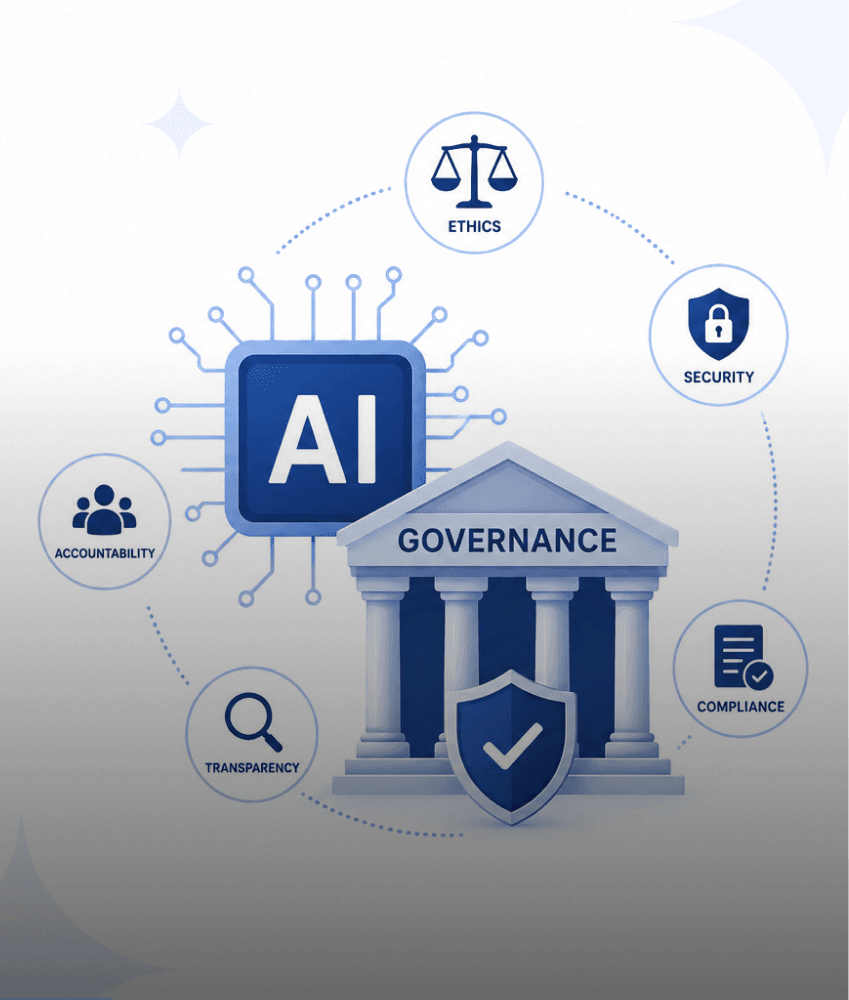
AI introduces new operational and reputational risks. These include inaccurate outputs, data leakage, unauthorized access, biased decisions, hallucinations, regulatory exposure, unclear audit trails, and over-reliance on automation. In enterprise environments, governance cannot be added after launch.
Practical governance includes role-based access, data classification, human-in-the-loop review, output validation, prompt and model version control, monitoring dashboards, escalation paths, compliance documentation, and clear policies for sensitive data. For regulated industries such as fintech, healthcare, insurance, logistics, and enterprise SaaS, governance is often the difference between a usable AI system and an abandoned experiment.
What enterprise teams should define before starting
Business outcome: What metric must improve, and what is the baseline today?
User workflow: Who will use the AI system, when, and what decision or task will it support?
Data landscape: Which systems contain the required data, and how reliable is it?
Integration scope: Does the solution need CRM, ERP, data warehouse, payment, identity, or third-party API connectivity?
Risk boundaries: Which actions can be automated, and where must humans approve?
Technical architecture: Will the project use machine learning, generative AI, retrieval-augmented generation, automation, or a hybrid approach?
Success criteria: What accuracy, time savings, cost reduction, adoption rate, or revenue impact will justify scaling?
Build, buy, or partner: how to choose the right path
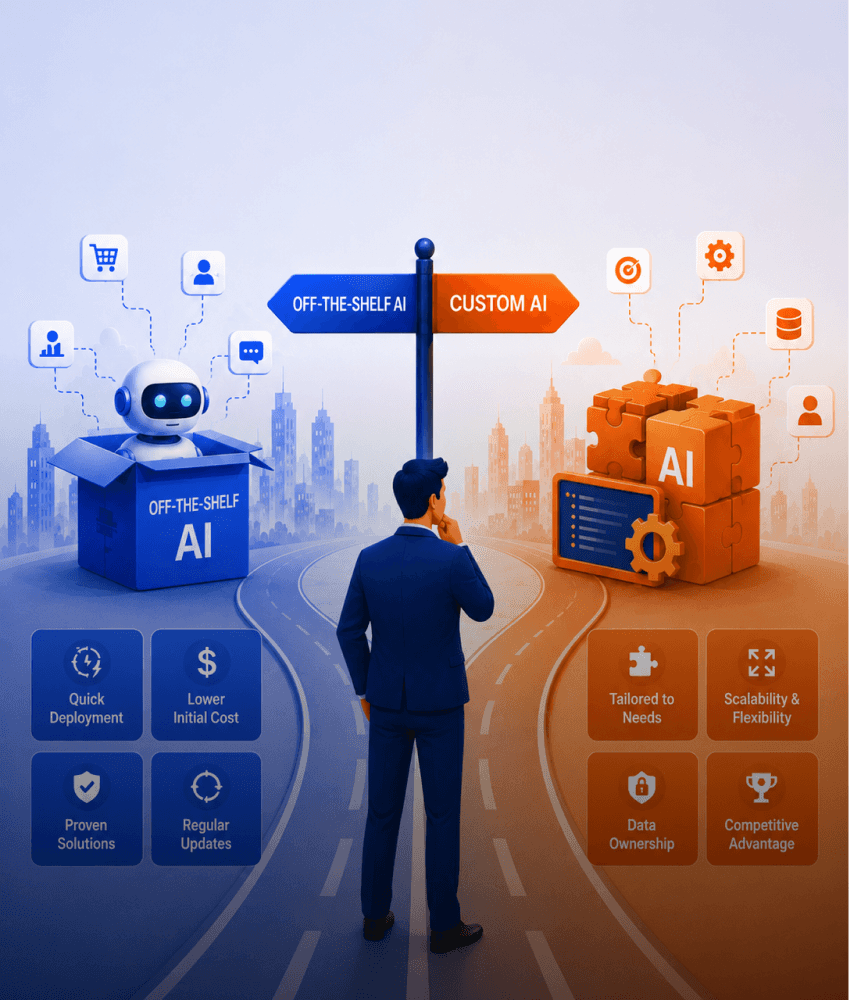
Not every AI initiative requires a fully custom build. Off-the-shelf platforms can work for generic productivity use cases. Low-code tools may support internal automation. However, custom AI development becomes valuable when the use case depends on proprietary data, differentiated workflows, complex integrations, domain-specific logic, security requirements, or product-level user experience.
Enterprise buyers should evaluate whether the AI capability is strategic or supporting. If it directly affects customer experience, operational advantage, margin, or platform differentiation, a tailored architecture is usually more sustainable. If the use case is non-core and standardized, buying may be faster. A strong engineering partner can help assess this objectively before development starts.
{{ctaBanner}}
Signs Your Organization Is Ready for AI
Before committing to implementation, leadership teams should evaluate their organizational readiness.
Your business is likely prepared if you can answer "yes" to most of these questions:
Do we have a clearly defined business outcome?
Are the required data sources accessible and governed?
Can our existing systems integrate through APIs?
Has executive ownership been established?
Do we understand the security and compliance implications?
Have we identified measurable success metrics?
Is there a plan for monitoring, maintenance, and continuous improvement?
If several of these questions remain unanswered, investing in an AI readiness assessment before development may reduce project risk and improve long-term outcomes.
A practical AI readiness framework
1. Problem-value fit
Start with the business pain, not the model. Rank use cases by business impact, frequency, complexity, data availability, risk, and executive sponsorship. The best first AI project is not always the most ambitious; it is the one with clear value, accessible data, and a realistic path to adoption.
2. Data and systems assessment
Map source systems, data quality issues, integration constraints, identity controls, and compliance requirements. This may reveal that the company first needs data engineering, application modernization, or API enablement before AI development can deliver value.
3. Architecture and delivery plan
Decide how the AI system will operate within the existing technology stack. Consider cloud infrastructure, model hosting, vector databases, data pipelines, application interfaces, observability, security layers, and deployment environments. Architecture decisions made early influence cost, scalability, performance, and maintainability.
4. Pilot with measurable KPIs
Move from proof of concept to pilot only when success criteria are defined. Track business and technical metrics together, such as processing time, adoption rate, exception rate, model accuracy, user satisfaction, infrastructure cost, and manual effort reduction.
5. Production operations
AI systems need continuous improvement. Plan for monitoring, model evaluation, prompt updates, retraining where required, support workflows, security reviews, and roadmap ownership. Production AI is a living product, not a one-time deployment.
How to start AI initiatives with less risk
The safest starting point is an AI discovery and readiness engagement. This helps leadership prioritize use cases, estimate technical complexity, identify data gaps, define architecture options, and create a phased roadmap. It also gives finance and operations teams a clearer view of investment, timeline, dependencies, and expected ROI.
For companies exploring AI adoption, custom software modernization, enterprise automation, SaaS product intelligence, or digital transformation, the goal should be practical value rather than experimentation for its own sake. AI succeeds when it is tied to the right problem, supported by reliable data, integrated into real workflows, and governed like any critical enterprise system.
Final Takeaway
Successful AI initiatives begin long before model selection. They start with a clear business objective, reliable data, scalable software architecture, well-defined governance, and measurable success criteria.
Organizations that rush directly into experimentation often discover that integration challenges, fragmented systems, and operational complexity, not AI capability, become the real barriers to success. In contrast, companies that invest in readiness can move confidently from proof of concept to production while delivering measurable business outcomes.
Whether you're modernizing enterprise software, building an AI-powered SaaS platform, or integrating intelligent automation into existing workflows, treating AI as a strategic engineering initiative rather than a standalone technology project significantly improves the likelihood of long-term success.
For businesses evaluating their next step, services such as AI Integration Services, AI Consulting, Custom Software Development, and Enterprise AI Development can help bridge the gap between experimentation and production-ready implementation, ensuring AI delivers lasting business value rather than becoming another unfinished pilot.

Deep Mistry
Digital Marketing Enthusiast | Diving into the world of trends, tools, and strategies, sharing discoveries that help create impactful online experiences.