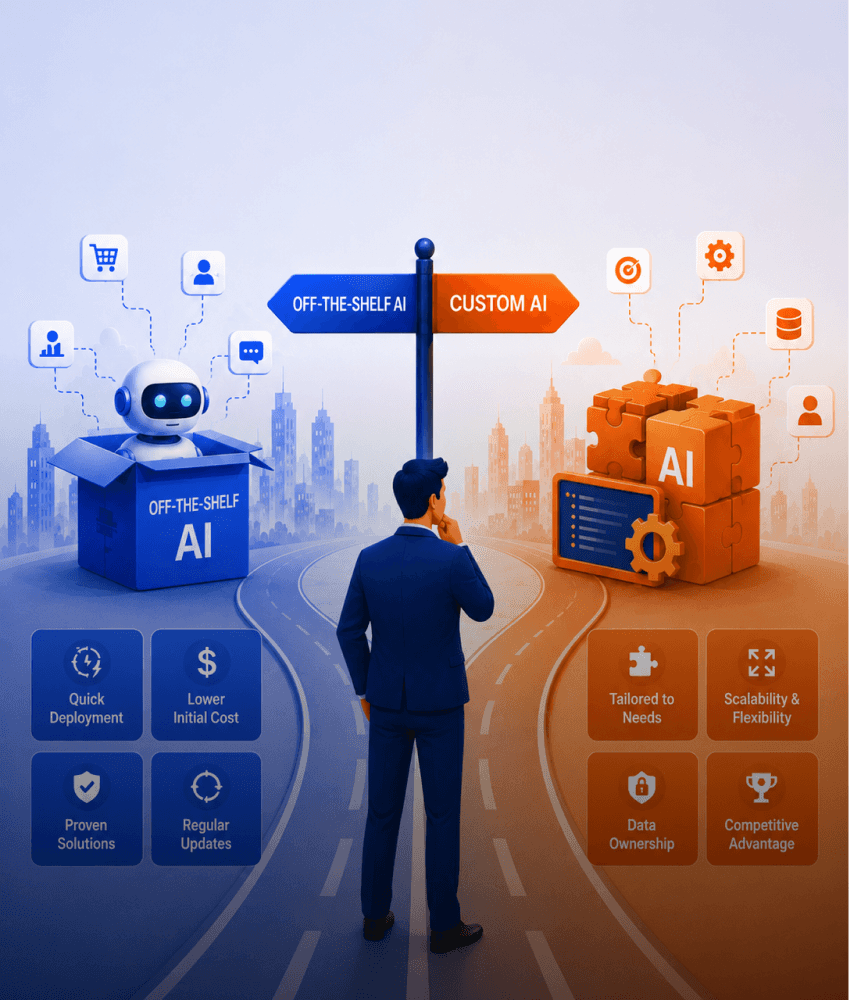


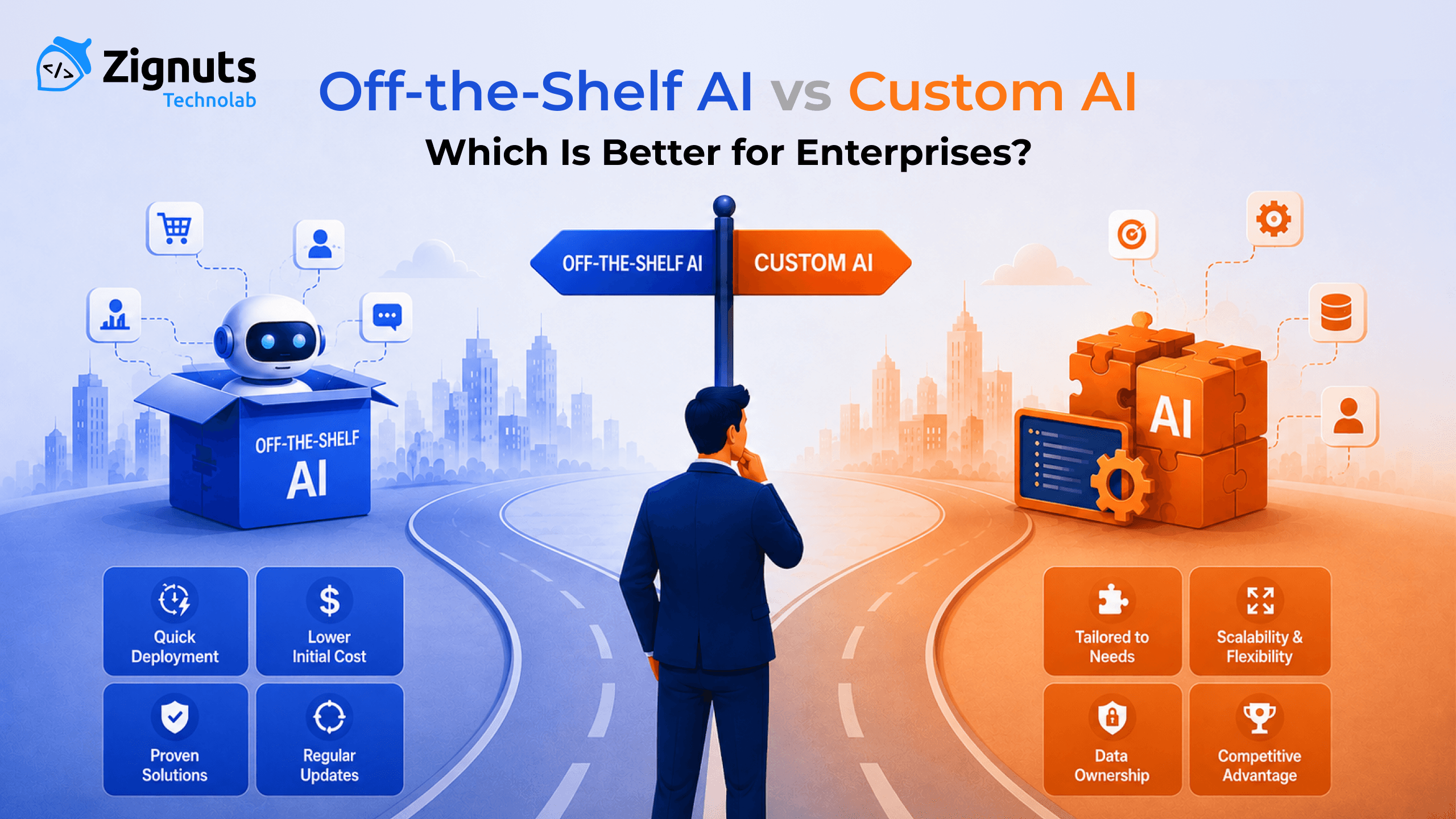
When comparing custom AI vs off-the-shelf AI, enterprise leaders rarely make the decision based on model quality alone. The consequential decision is whether a capability can operate inside real workflows, survive audit scrutiny, and retain its economic value after the first pilot.
A polished assistant that cannot cite its source, respect entitlements, or hand an exception to an accountable employee is not production automation.
The right answer is often a portfolio, not a single platform decision. Off-the-shelf AI can compress time to value for bounded work, while custom AI earns its cost where proprietary data, differentiated decisions, or regulated workflows create durable advantage. The challenge is drawing that boundary before integration spend, and user expectations make it expensive to reverse.
Custom AI vs Off-the-Shelf AI: How to Choose
Most organizations make the same mistake: they begin with a vendor demonstration and only later ask what decision the system is permitted to influence. For a digital bank with 2 million customers, drafting a service response and approving a suspicious transaction are fundamentally different risk categories.
The first may be a useful managed capability; the second requires traceable evidence, threshold controls, human escalation, and retained audit records.
Critical, high confidence: classify each candidate use case by business consequence, data sensitivity, and workflow uniqueness. Choose off-the-shelf AI for common, reversible tasks such as meeting summaries, internal knowledge retrieval, or first-pass document classification.
Consider custom AI when the output changes pricing, eligibility, patient prioritization, fraud action, or another decision that defines the enterprise's operating model.
Not Sure Whether to Build or Buy AI?

The RAIL decision framework
Use RAIL to prevent a feature comparison from becoming an architecture decision by accident: Risk of an incorrect output, Asset uniqueness in data and workflow, Integration depth, and Lifecycle ownership over three to five years.
Score each factor from 1 to 5. A total below 10 usually favors a packaged service; 10 to 15 calls for a hybrid pattern; above 15 merits a custom capability or a tightly governed private deployment.
Custom AI vs Off-the-Shelf AI: Key Differences
RAIL factor | Off-the-shelf fit | Custom AI fit |
|---|---|---|
Risk | Reversible, human-reviewed output | Material financial, clinical, or legal consequence |
Asset uniqueness | Commodity language or public knowledge | Proprietary labels, policies, and decision history |
Integration | One or two standard systems | Core systems, event streams, and exception queues |
Lifecycle | Vendor updates are acceptable | Version control, validation, and long-term ownership required |
Many enterprise pilots fail because they score novelty rather than consequence. A healthcare system may use a general service to summarize administrative correspondence, yet clinical handoff documentation needs source-linked output, role-aware access, and a clear clinician review step. The classification here drives the data and control design that follows.
Note: If an AI output can trigger money movement, care action, or a compliance filing, treat it as a controlled decision service, not a chat feature.
Custom AI vs Off-the-Shelf AI: Cost, Integration & Governance
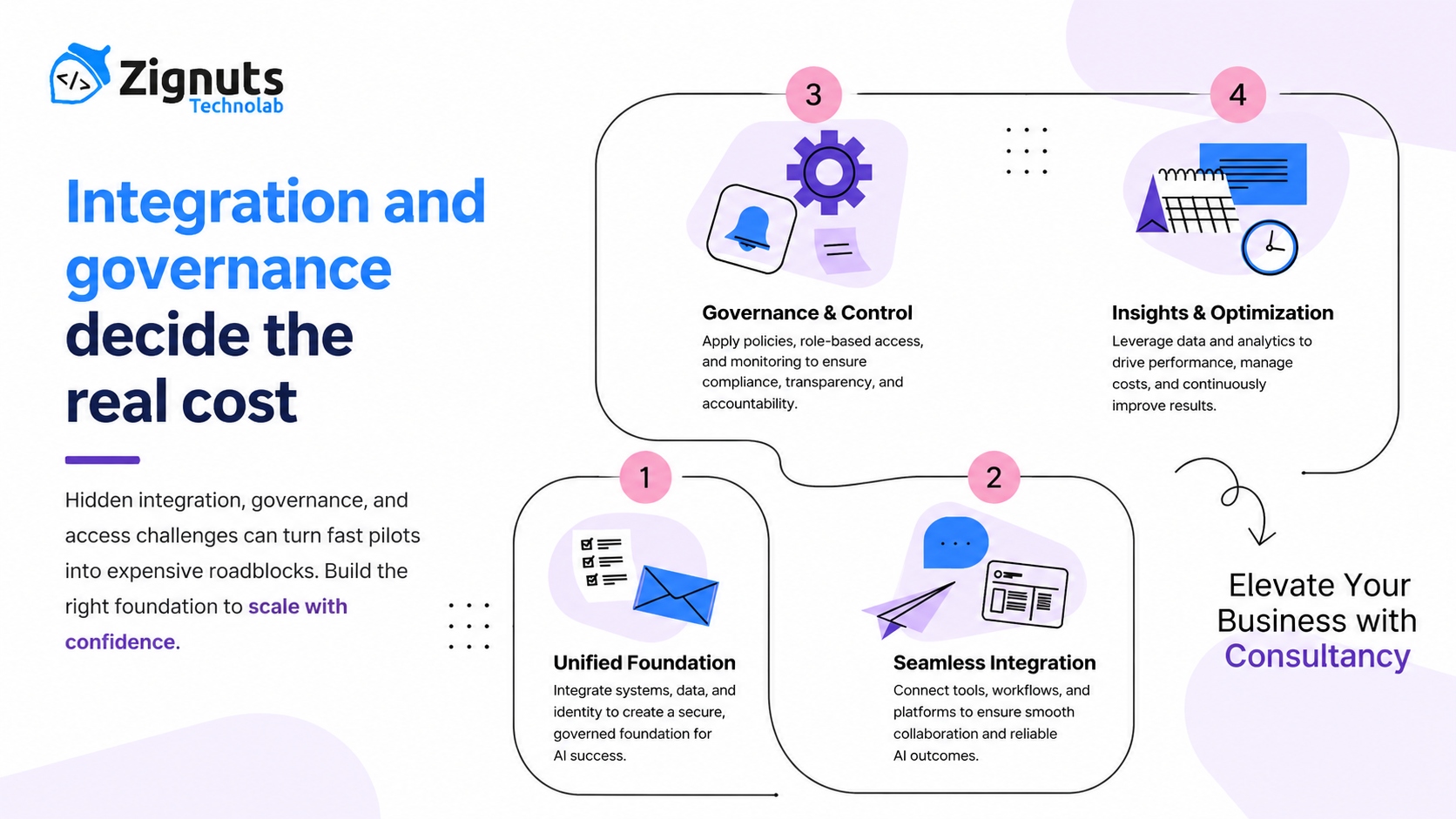
Off-the-shelf products appear inexpensive because subscription pricing excludes the work around them. The hidden bill arrives in identity federation, role mapping, retrieval permissions, retention policy, observability, and change management.
A logistics provider managing 10,000 daily shipments may deploy a vendor assistant in weeks, then discover that dispatch notes, carrier contracts, and customs records have incompatible access rules across six systems.
Custom AI has the opposite cost profile. It requires product ownership, evaluation datasets, model routing, and an incident process from day one, but it can encode the organization's entitlement model and operational exceptions directly.
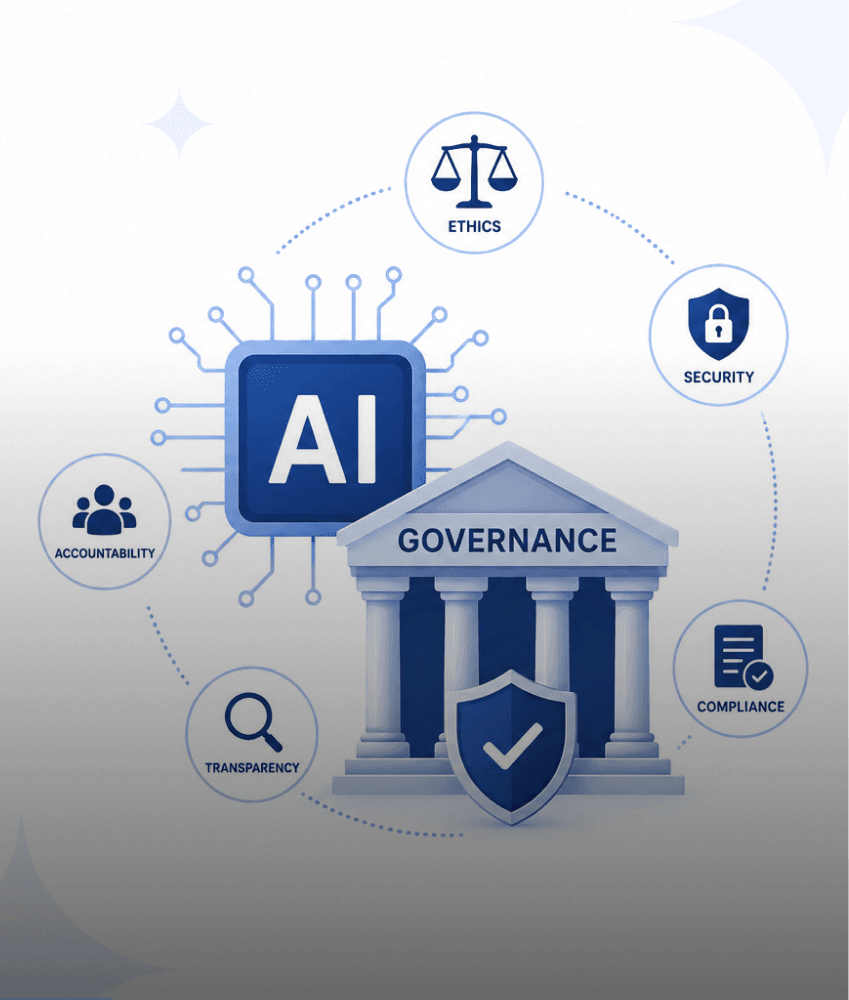
Neither path eliminates governance. A vendor's SOC 2 report does not prove that a user can only retrieve documents they are authorized to see.
Important, high confidence: establish an AI control plane before broad rollout. It should log prompts and outcomes according to policy, enforce identity and data boundaries, test groundedness against approved sources, and provide a kill switch for harmful behavior.
In PCI DSS environments, tokenize payment data before it reaches any model endpoint. In HIPAA workflows, validate business associate obligations and minimum-necessary access. Teams commonly fail six months later because their pilot bypassed the same audit and access patterns required of every other production service.
Custom AI vs Off-the-Shelf AI Cost
As an illustrative planning range, a managed AI rollout for 5,000 employees may incur $150,000 to $500,000 in first-year licenses and integration. A custom, governed capability can require $400,000 to $1.5 million before ongoing data, security, and platform staffing. The lower initial number is not automatically the lower five-year cost, especially where per-seat expansion or usage charges rise with adoption.
When Should You Choose Custom AI Over Off-the-Shelf AI?
The common belief that custom AI means training a model from scratch is usually incorrect. In most enterprises, the better design combines a managed foundation model with private retrieval, deterministic business rules, evaluation services, and workflow-specific interfaces. Fine-tuning or specialized models become justified only when repeated evaluation proves that retrieval and instruction controls cannot meet accuracy, latency, or format requirements.
A wealth platform serving 500,000 investors illustrates the boundary. A packaged model can help analysts summarize public research. Portfolio suitability, however, should remain in a custom decision layer that records input data, policy version, rationale, reviewer action, and final outcome. This separation improves auditability without forcing the organization to own every layer of model infrastructure.
Critical, medium confidence: build custom components where they preserve proprietary process, not where they duplicate commodity capability. Put policy checks before and after model calls; keep deterministic calculations outside generative prompts; route uncertain outputs to specialist queues. For every $1 spent on evaluation and observability, expect to avoid far more in rework, incident investigation, and unsupported operational decisions.
Note: Custom-build the decision boundary; rent the general intelligence behind it unless measured evidence says otherwise.
The trade-off is speed versus control, but it is also maintainability versus vendor dependency. A custom orchestration layer creates ownership obligations, while direct vendor coupling makes model changes, pricing changes, and regional availability someone else's decision. This architecture prepares the organization to measure value rather than merely launch capability.
Custom AI vs Off-the-Shelf AI: ROI and Business Value
AI projects should have baseline measures before implementation. For a prior authorization team, measure touch time, abandonment, rework, denial overturns, and turnaround time.
For an industrial manufacturer with 25 production lines, measure mean time to diagnose quality deviations, false escalation rate, and operator acceptance. Productivity claims without a workflow baseline cannot survive finance review.
Important, high confidence: run a controlled release for 8 to 12 weeks with a defined cohort and a manual fallback. Track acceptance rate, correction rate, latency, cost per completed task, and policy exceptions.
Feature flags are essential because a degradation in one model provider should not halt emergency department triage support or settlement operations.
Organizations often fail by measuring prompts or active users, metrics that reward curiosity rather than operational improvement.
Set a threshold in advance. For example, an AI document intake service should reduce median handling time by at least 25% while maintaining a reviewer correction rate below 10%. If it misses either measure, redesign the data, workflow, or control logic before scaling.
This discipline also exposes whether an off-the-shelf subscription is genuinely cheaper than a focused custom service.
Not Sure Whether to Build or Buy AI?
How to Choose Between Custom AI and Off-the-Shelf AI
The best initial decision is reversible. Start with a small number of high-volume, low-consequence workflows, then graduate only the proven cases into deeper automation.
This keeps procurement, security, operations, and engineering aligned while protecting teams from a broad platform commitment based on a single successful demonstration.
Custom AI vs Off-the-Shelf AI: Questions to Ask Before Choosing
Which business metric will improve, and what is its baseline?
Which workflow steps are mission-critical and require human review?
Which identity, payment, clinical, or ERP integrations cannot fail?
Who owns model evaluation, incident response, and vendor changes after launch?
What would force an architecture redesign within two years?
What is the worst credible failure scenario, and how is it contained?
Custom AI vs Off-the-Shelf AI: Implementation Roadmap
Phase | Duration | Milestone | Success metric |
|---|---|---|---|
Discovery | 4 to 6 weeks | RAIL scores and control design approved | 100% accountable owners assigned |
Pilot | 8 to 12 weeks | One bounded workflow live | 25% cycle-time improvement |
Integration | 8 to 16 weeks | Core systems and audit logs connected | All critical controls tested |
Scale | Ongoing | Portfolio governance operating | Correction rate below agreed threshold |
Critical: classify risk, protect data boundaries, and measure workflow outcomes.
Important: implement evaluation, fallback, and ownership before scaling.
Optional: fine-tuning and specialized infrastructure after evidence supports them.
Future: expand autonomous actions only after auditability and exception handling are proven.
These recommendations carry high confidence for governance and measurement, medium confidence for architecture choices because regulatory exposure, data maturity, and integration count change the answer.
When Is Off-the-Shelf AI Better?
Off-the-shelf AI is often the better choice when a business needs to solve a common problem quickly without building and maintaining a specialized AI capability. For many organizations, the goal is not to create a differentiated AI system but to improve an existing workflow with a proven, readily available tool.
Common Business Tasks
Off-the-shelf AI works particularly well for standardized tasks that many organizations need to perform. Examples include meeting summaries, general-purpose content generation, document summarization, basic customer support assistance, internal knowledge queries, and first-pass document classification.
When the underlying capability is broadly available and does not create a meaningful competitive advantage, purchasing an established solution can be more practical than developing one internally.
Low-Risk Workflows
A packaged AI solution is easier to justify when an incorrect output has limited consequences and a human can easily review or correct it. For example, an AI assistant that summarizes internal meeting notes can typically operate with much less control complexity than a system that influences financial approvals, clinical decisions, or legal outcomes.
The lower the business consequence of an error, the more attractive an off-the-shelf solution can become.
Fast Implementation Requirements
Speed is another reason to choose an off-the-shelf AI product. Businesses can often begin using an established service within weeks instead of spending months designing, developing, evaluating, securing, and maintaining a custom capability.
This makes packaged AI particularly useful when the business has an immediate operational need and the primary objective is to validate whether AI can improve a workflow before committing to a larger engineering initiative.
Limited Internal AI Engineering Resources
Building custom AI requires more than model access. It can require product ownership, evaluation datasets, integration engineering, security controls, monitoring, incident response, and ongoing maintenance.
Organizations with limited internal AI engineering capacity may therefore benefit from a managed solution that provides much of this infrastructure as part of the product. The organization can focus its internal resources on workflow adoption and business outcomes rather than owning every layer of the technology stack.
Predictable Use Cases
Off-the-shelf AI is also a strong fit when the required functionality is well defined and unlikely to change significantly. If a business needs a standardized capability that can be described clearly and does not depend heavily on proprietary workflows or unique decision rules, a packaged solution can provide sufficient functionality without unnecessary customization.
The key question is whether the organization needs to change the underlying capability or simply consume it.
Temporary or Experimental Requirements
Not every AI initiative needs to become a permanent enterprise platform. A business may want to test AI for a limited workflow, validate employee adoption, or run a short-term experiment before deciding whether deeper investment is justified.
In these situations, an off-the-shelf solution can provide a lower-commitment way to test the idea. If the experiment demonstrates measurable value, the organization can later evaluate whether a custom architecture is warranted.
When Differentiation Is Not Important
Custom AI is most valuable when the technology supports something unique about the business. When the capability is effectively a commodity, building it from scratch may simply duplicate something the market already provides.
For example, if two companies need the same basic summarization capability and neither gains a competitive advantage from owning the underlying system, an off-the-shelf product can be the more economical choice.
The practical rule is simple: buy general capabilities when they are good enough, easy to govern, and not strategically differentiating. Build when the workflow, data, controls, or outcome creates a reason to own the capability.
Not Sure Whether to Build or Buy AI?
When Is Custom AI Better?
Custom AI becomes more compelling when the business outcome depends on capabilities that standard AI products cannot provide reliably or securely. The strongest cases typically involve proprietary data, unique workflows, complex integrations, regulatory requirements, or decisions that directly influence the organization's competitive position.
Proprietary Workflows
A custom AI solution is often appropriate when the workflow itself is unique. Standard AI tools are designed to address broad use cases, while custom systems can encode business-specific processes, approval paths, exception handling, policies, and decision logic.
For example, an organization may have a specialized claims process, underwriting workflow, supply chain process, or operational decision system that cannot be adequately represented by a generic AI product.
Proprietary Data
Unique data can create a strong reason to develop a custom capability. If the value of the AI system depends on proprietary documents, historical decisions, internal policies, customer information, or domain-specific datasets, the organization may need tighter control over how that information is retrieved, processed, evaluated, and used.
Custom AI does not necessarily mean training a foundation model from scratch. A custom solution can combine managed foundation models with private retrieval, business rules, evaluation systems, and workflow-specific interfaces.
Complex Integrations
Custom AI is also useful when the system must operate across multiple core enterprise platforms and real-time data sources.
A workflow that depends on ERP systems, CRM platforms, identity services, event streams, internal databases, approval queues, and other enterprise systems may require deeper orchestration than a packaged AI product can provide.
The more tightly AI must operate inside the existing operating model, the stronger the case for custom integration and application logic.
Regulated Workflows
Some workflows require controls that cannot be treated as optional product features. Financial, healthcare, legal, and other regulated environments may require detailed access controls, evidence trails, human review, retention policies, monitoring, and defined escalation procedures.
Where AI outputs can influence a regulated decision or create material business consequences, custom control layers may be necessary even when the underlying model itself is provided by a third party.
Strict Access Controls
Custom AI can be particularly valuable when different users must receive different information or actions based on their roles, permissions, departments, customers, or regulatory responsibilities.
A general-purpose AI assistant may provide useful answers, but an enterprise system may need to enforce document-level permissions, identity boundaries, retrieval controls, audit records, and workflow-specific authorization before an answer can be considered production-ready.
Unique Business Logic
Some business decisions depend on rules that are specific to the organization. Pricing, eligibility, risk thresholds, approval policies, exception handling, and operational calculations may need to remain deterministic and auditable rather than being delegated entirely to a general-purpose model.
In these cases, custom AI can create a controlled layer around the model so that AI generates useful outputs while deterministic business logic and policy controls govern consequential decisions.
Competitive Differentiation
Custom AI is most strategically valuable when the capability itself can help the business operate differently from competitors.
A proprietary recommendation engine, specialized forecasting system, intelligent workflow, domain-specific copilot, or AI-powered decision process may become part of the organization's competitive advantage. In these situations, relying entirely on a generic product can limit differentiation and increase dependence on a vendor's roadmap.
Not Sure Whether to Build or Buy AI?
Long-Term Control
Custom AI also provides greater control over architecture, integrations, evaluation, data handling, deployment choices, and future changes.
That does not mean custom AI eliminates vendor dependency. Most enterprise custom AI systems still use external foundation models, cloud platforms, or specialized infrastructure. The difference is that the organization owns the application, workflow, control layer, and business-specific logic surrounding those services.
The practical rule is: build custom AI when the value depends on proprietary data, unique workflows, complex integrations, strict controls, differentiated decisions, or long-term ownership. In many enterprise environments, the strongest answer is not completely custom or completely off-the-shelf, but a hybrid architecture that buys general intelligence and custom-builds the business-specific layer.