

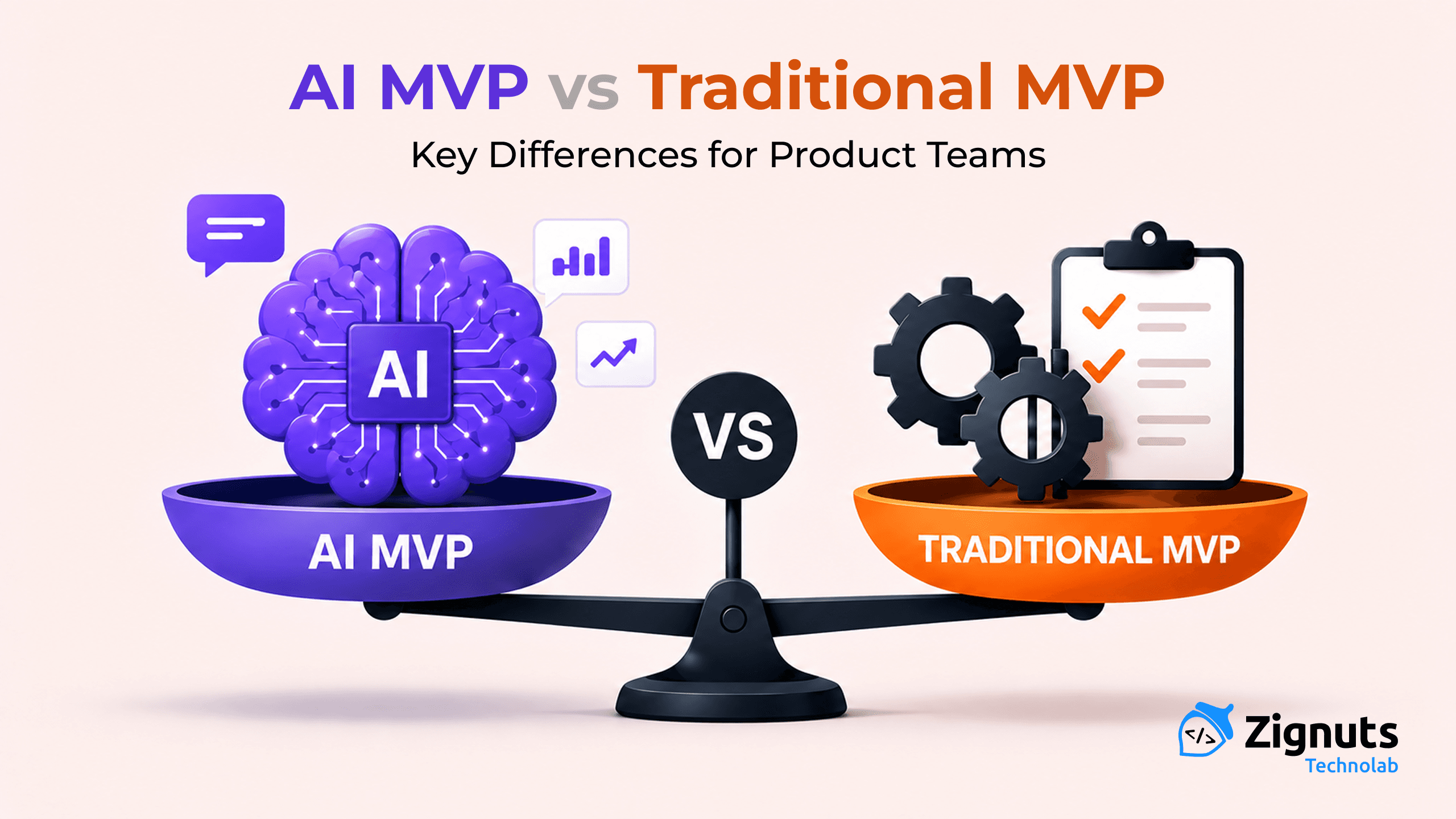
Product teams often treat an AI MVP as a traditional MVP with a model added near the end. That assumption creates expensive surprises. A conventional MVP validates whether users will adopt a defined workflow; an AI MVP must validate the workflow, the data supply, the reliability boundary, and the cost of every production interaction.
For a B2B SaaS platform serving 5,000 enterprise customers, a helpful prototype can still fail procurement if it cannot explain tenant isolation, retention, auditability, or how inaccurate outputs are handled. The decision is not whether AI is fashionable. It is whether probabilistic automation creates enough operational value to justify a different product, data, and governance model.
AI MVP vs Traditional MVP: What Is the Difference?
A traditional MVP reduces market uncertainty. It asks whether a customer will pay for a workflow such as approvals, reporting, or subscription administration. The team can specify expected behavior, test deterministic paths, and estimate operating costs with reasonable confidence.
An AI MVP adds capability uncertainty. A model may produce a useful first draft for 85% of cases yet fail on rare customer terminology, ambiguous policy language, or records outside its context window. For an HR platform supporting a workforce of 25,000 employees, an incorrect leave policy answer is not merely a bad response. It can create payroll disputes, employee relations escalation, and loss of trust in the portal.
Many teams fail because they measure a model demo rather than a business workflow. They show that the system can summarize documents, but never establish who reviews the summary, which source is authoritative, or when the system must abstain. The hidden cost appears six months later, when support staff manually investigate outputs that were never designed for traceability.
Traditional MVP: validate desirability, workflow fit, and willingness to pay.
AI MVP: validate those factors plus data quality, evaluation quality, human oversight, latency, unit economics, and safe failure behavior.
Critical recommendation, high confidence: define the decision an AI feature may influence before selecting a model or vendor.
Note: If a team cannot state what the system should do when confidence is low, it is not ready to automate the workflow.
This distinction changes what evidence matters. Before building broad functionality, product leaders need an evidence plan that connects model behavior to an operational outcome.
How to Validate an AI MVP Before Scaling
The fastest AI MVP is usually not the one with the most polished interface. It is a narrow, instrumented workflow with a measurable human baseline. Consider a contract operations product where legal teams receive 8,000 vendor agreements each month. A useful first release might extract renewal dates and nonstandard indemnity clauses for analyst review. It should not begin by autonomously approving contracts.
Turn Your AI Idea Into a Production-Ready MVP

What Is the SCORE Framework for AI MVP Validation?
Use SCORE to decide whether a use case is ready for a controlled pilot: Scope, select one repeatable decision; Corpus, verify representative and permitted data; Outcome, define a business metric; Review, assign an accountable human reviewer; and Exceptions, design the escalation path. This framework prevents a common enterprise failure: treating a model accuracy percentage as proof of product value.
Scope: limit the first release to one user role and one high-volume task, such as support agents classifying renewal requests.
Corpus: sample at least 200 to 500 real cases, including edge cases, stale documents, and customer-specific vocabulary.
Outcome: target a measurable result, such as reducing average handling time from 12 minutes to 8 minutes without lowering quality scores.
Review: capture acceptance, edits, overrides, and reasons for rejection.
Exceptions: route low-confidence cases to an existing queue, never to an unowned inbox.
A global payment processor handling 10 million daily transactions illustrates why this matters. AI can prioritize suspicious activity investigations, but the MVP must preserve the existing rules engine, case notes, and audit trail. Replacing deterministic controls in the name of experimentation is a poor trade. In regulated workflows, assistance is often valuable before autonomy is defensible.
As a rule of thumb, do not expand an AI pilot until it has processed 1,000 representative decisions and its review outcomes are stable across customer segments. The next question is whether the surrounding architecture can preserve that discipline at scale.
How AI MVP Architecture Differs From Traditional MVP Architecture
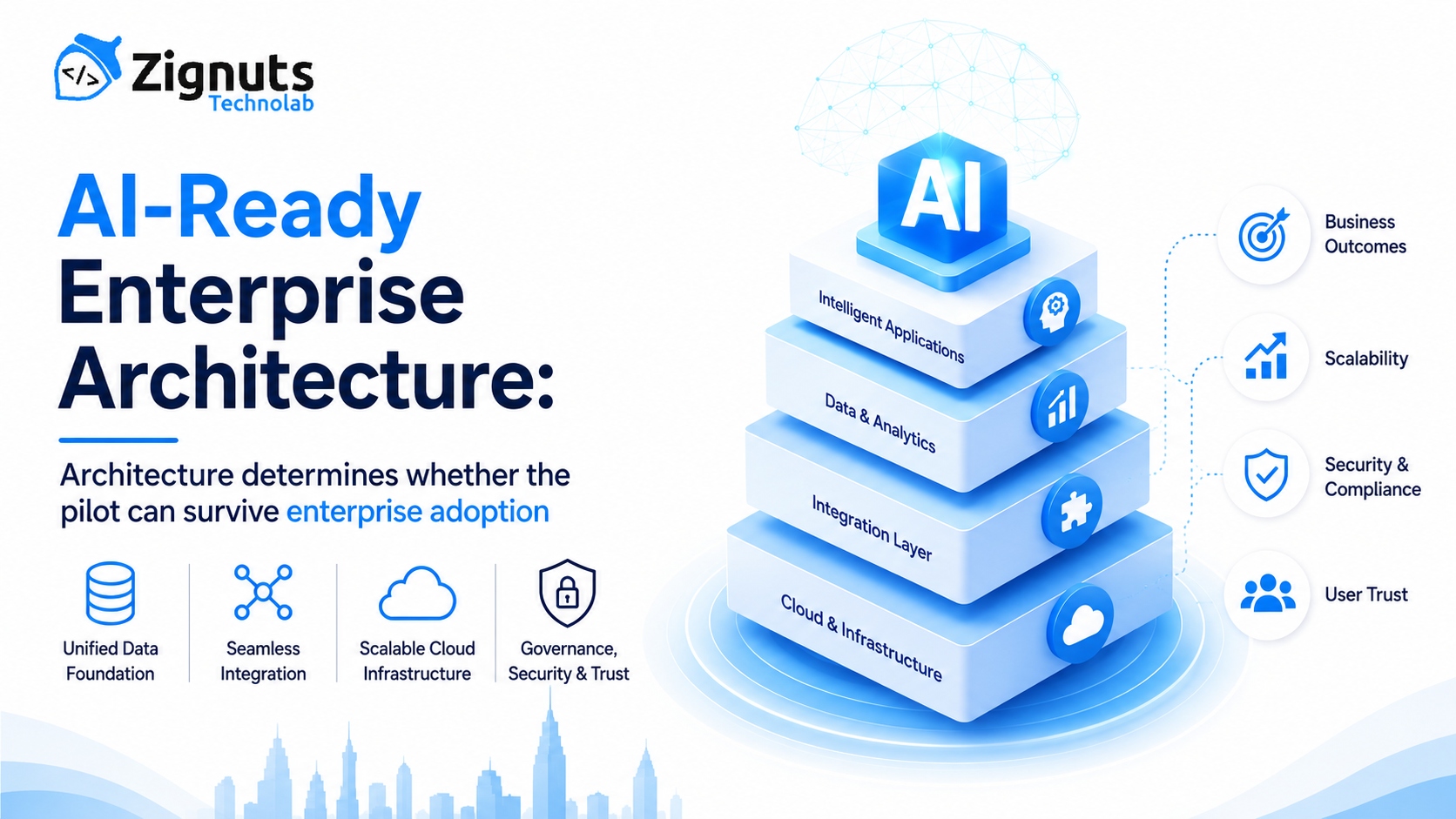
Most AI MVPs do not fail because of the first model choice. They fail because retrieval, authorization, observability, and release controls were deferred as “production work.” In multi-tenant SaaS, those are product requirements from day one. A response that cites another tenant's policy document is a security incident, regardless of how useful the answer appears.
Build a thin but explicit control plane around the model: identity-aware retrieval, source citations, prompt and version records, rate limits, evaluation datasets, and feature flags. The trade-off is a modest early engineering effort against lower rework when enterprise customers demand single sign-on, role-based access control, data residency, and audit exports. Teams that skip it commonly create a prototype that cannot be safely shown to their largest customers.
Turn Your AI Idea Into a Production-Ready MVP
Critical, high confidence: enforce tenant and user permissions before retrieval, not after generation.
Important, high confidence: log model version, retrieved source identifiers, latency, cost, reviewer action, and final user outcome for every material interaction.
Important, medium confidence: use retrieval from approved knowledge sources before fine tuning. Fine-tuning can help with stable terminology, but it does not solve stale content or access control.
Optional, medium confidence: introduce agentic task execution only after read-only assistance has a proven exception rate and clear rollback path.
A CRM product used by 50 sales teams may tolerate a flawed draft email, but it cannot tolerate an AI action that changes account ownership or sends terms without approval. Separate recommendation rights from execution rights. This is both an engineering boundary and a product promise. Once that boundary is clear, leadership can calculate whether the value justifies the full cost of ownership.
How Much Does an AI MVP Cost Compared With a Traditional MVP?
Traditional MVP budgets are dominated by design, application development, and support. AI MVP budgets also include evaluation labor, data preparation, inference variability, monitoring, safety review, and vendor exposure. A low initial model bill can become material when usage grows from 5,000 pilot interactions to 3 million monthly interactions across a customer base.
Cost category | Traditional MVP | AI MVP | Decision implication |
|---|---|---|---|
Initial build | $15K to $400K | $10K to $700K | AI requires evaluation and data controls |
Annual operations | $60K to $180K | $45K to $450K | Usage, review, and monitoring compound |
Data preparation | $1K to $50K | $7.5K to $300K | Often underestimated by product teams |
Security and compliance | $2.5K to $90K | $6K to $200K | Contractual and audit requirements rise |
Five-year range | $200K to $2M | $200K to $4.5M | Compare against labor and retention gains |
These are planning ranges, not vendor quotes. The relevant ROI calculation is avoided work, faster cycle time, retention, and error reduction minus all operating costs. If a support copilot saves 4 minutes on 300,000 annual cases, it creates 20,000 hours of capacity. At a fully loaded $45 per hour, that is $900,000 before accounting for quality review and platform costs.
Do not assume an AI MVP must be built from scratch. A managed model service can accelerate learning, while a custom orchestration layer protects workflow logic and switching options. The constraint is vendor concentration: if prompts, evaluations, and safety rules are embedded in one provider's proprietary tooling, migration can cost more than the initial launch.
Note: Fund evaluation and observability at roughly 15% to 25% of the first release budget. Without them, apparent savings become unmeasured operational risk.
The economics expose a counterintuitive conclusion: a smaller AI MVP can require more product discipline than a larger conventional MVP. That is why launch planning must define ownership rather than merely a release date.
How to Launch and Scale an AI MVP Safely
For enterprise products, the MVP should graduate through permissions and evidence. Begin with internal users, then a design partner cohort, then customers with comparable data and clear success criteria. A logistics platform managing 10,000 daily shipments can pilot AI-generated exception summaries for dispatchers before exposing recommendations to customers. Dispatchers remain accountable, while the team learns whether summaries shorten resolution time during weather disruptions and customs delays.
Turn Your AI Idea Into a Production-Ready MVP
Organizations struggle here because product, security, support, and data teams each assume another group owns quality after launch. Assign a named product owner for outcomes, an engineering owner for reliability, and a business owner for exception policy. Review the evaluation set weekly during the pilot and monthly after general availability. Security is not a launch checklist. It is a production property.
AI MVP Development Checklist: 7 Questions to Ask Before Launch
Which business metric should improve, and what is its current baseline?
Which user workflow is mission-critical, and where must human review remain mandatory?
Which integrations, identity providers, and source systems cannot fail?
Who owns model behavior, incident response, and customer communication after launch?
What evidence would force an architectural redesign within two years?
What is the worst plausible output or data exposure scenario, and how is it contained?
How will success be measured at 3, 6, and 12 months?
Phase | Duration | Milestone | Success metric |
|---|---|---|---|
Discovery | 4 to 6 weeks | SCORE scope approved | Baseline and exception policy agreed |
Foundation | 8 to 10 weeks | Controlled pilot ready | 200 to 500 evaluated cases |
Design partner | 8 to 12 weeks | Workflow in use | 20% cycle time improvement |
Scale | 10 to 16 weeks | Enterprise controls complete | Audit logs, access tests, uptime target met |
Optimize | Ongoing | Expansion decision | Stable quality and positive unit economics |
Turn Your AI Idea Into a Production-Ready MVP
Critical: define the workflow boundary, representative evaluation data, human review, tenant controls, and success metric. Important: add source citations, cost monitoring, feature flags, and recurring governance reviews.
Optional: pursue fine-tuning and broader automation after stable evidence. .
Future: consider autonomous actions only when exception handling, rollback, and accountability are proven. These priorities carry high confidence for regulated or enterprise SaaS environments; the appropriate model and interface remain medium-confidence decisions that depend on the workflow.
The best choice is rarely AI MVP versus traditional MVP in absolute terms. Use a traditional MVP to prove the customer problem and workflow, then use an AI MVP to prove whether probabilistic assistance can improve that workflow safely and economically. That sequence protects learning speed without confusing a compelling demo for a durable product.