



How Much Does SaaS Platform Development Cost?
We were recently advising a founder who had three quotes on the desk for what she described as the same product. The lowest was $48,000. The highest was $390,000. All three vendors had seen the same twelve-page brief. All three had asked intelligent questions. None of them was lying. We see this pattern constantly when delivering SaaS development services, and it is not a market failure.
Our team sees this pattern constantly, and it is not a market failure. It is the market accurately pricing three different products that happen to share a feature list. One vendor was quoting a validated MVP on a starter kit. One was quoting a multi-tenant platform with a SOC 2 path. One was quoting somewhere in between and had assumed the compliance question away.
The feature list does not set the price. The compliance regime and the integration surface set the price, and neither of them is usually in the brief.
Our own benchmarking across client engagements lines up with published 2026 ranges. Depending on who you ask, SaaS development runs from around $1,000 for a no-code build to well past $500,000 for an enterprise platform, with most mid-complexity B2B products landing between $80,000 and $200,000. Enterprise platforms with real compliance requirements routinely exceed $300,000, which is consistent with what we typically see once a client's regulatory scope becomes clear.
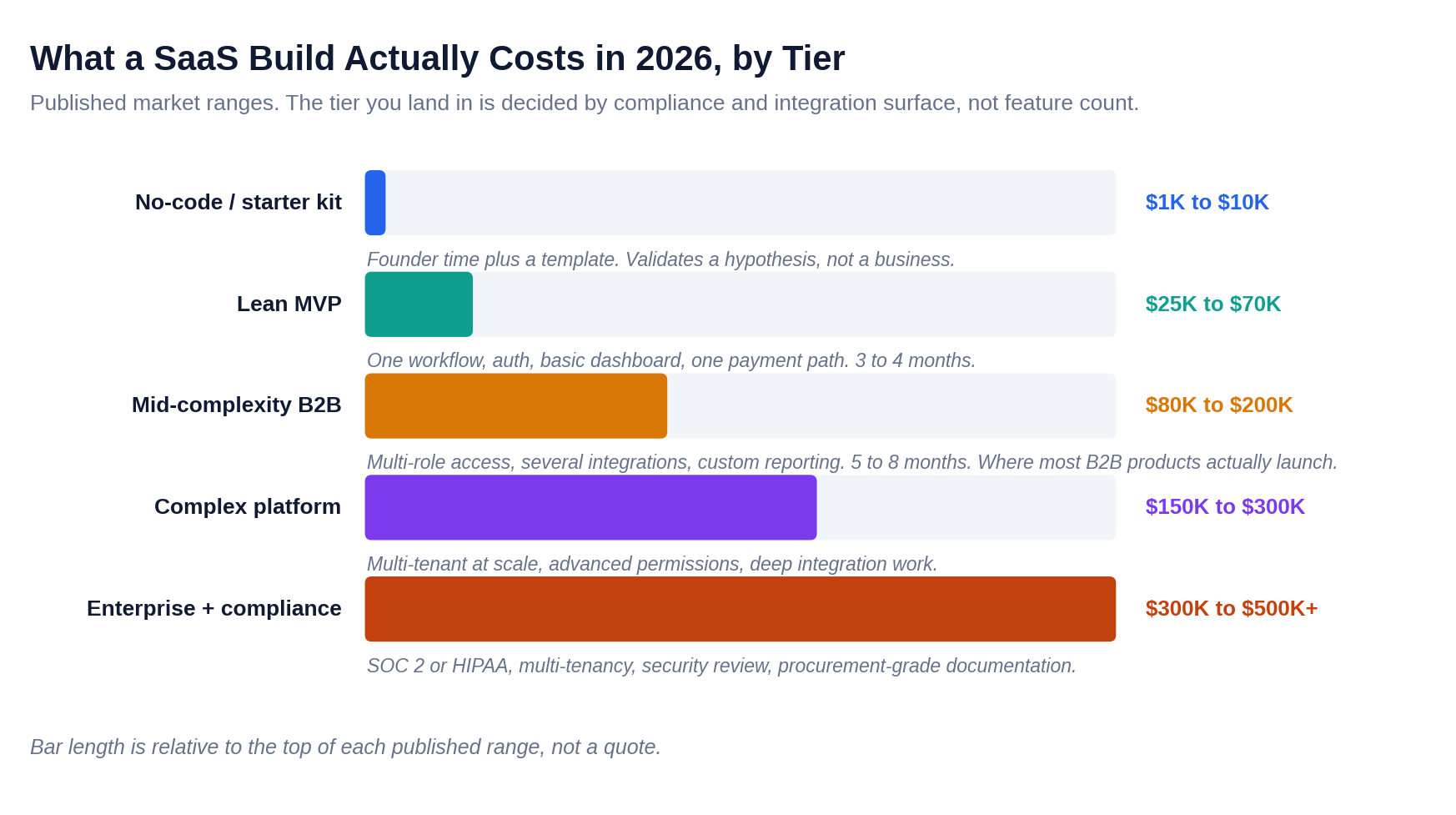
SaaS Development Cost by Project Type
Tier | What you get | What you do not get |
|---|---|---|
No-code / starter kit | A working demonstration of the core idea, live in weeks, on someone else's platform. | Ownership of the runtime, meaningful performance headroom, or a migration path that is not a rewrite. |
Lean MVP | One workflow done properly, auth, a dashboard, one payment path. Three to four months. | Multi-tenancy at scale, a second integration, custom reporting, or an answer to a security questionnaire. |
Mid-complexity B2B | Multi-role access, several integrations, custom reporting. Five to eight months. Where most B2B products actually launch. | A certification, a dedicated tenant tier, or a control plane that provisions customers without an engineer. |
Complex platform | Multi-tenancy designed rather than retrofitted, sophisticated permissions, deep integration work. | Formal compliance attestation unless it was scoped from the start. |
Enterprise + compliance | SOC 2 or HIPAA readiness, security review, procurement-grade documentation, audit trails. | Speed. This tier trades months for the ability to sell to regulated buyers at all. |
Based on our experience scoping these builds, the most common budgeting error is treating these as a continuum you can walk up gradually. You cannot. The gap between a lean MVP and a compliance-ready platform is not more of the same work. It is a different architecture, and the migration between them is where the rebuild stories we get called in to fix come from. We have seen, repeatedly, that skipping architecture planning at the MVP stage to save money is the single most reliable way to make the next tier cost double.
SaaS Development Cost Breakdown
When we ask clients what they think they are paying for, they almost always describe screens. Here is the distribution we typically see a mid-complexity engagement actually follow.
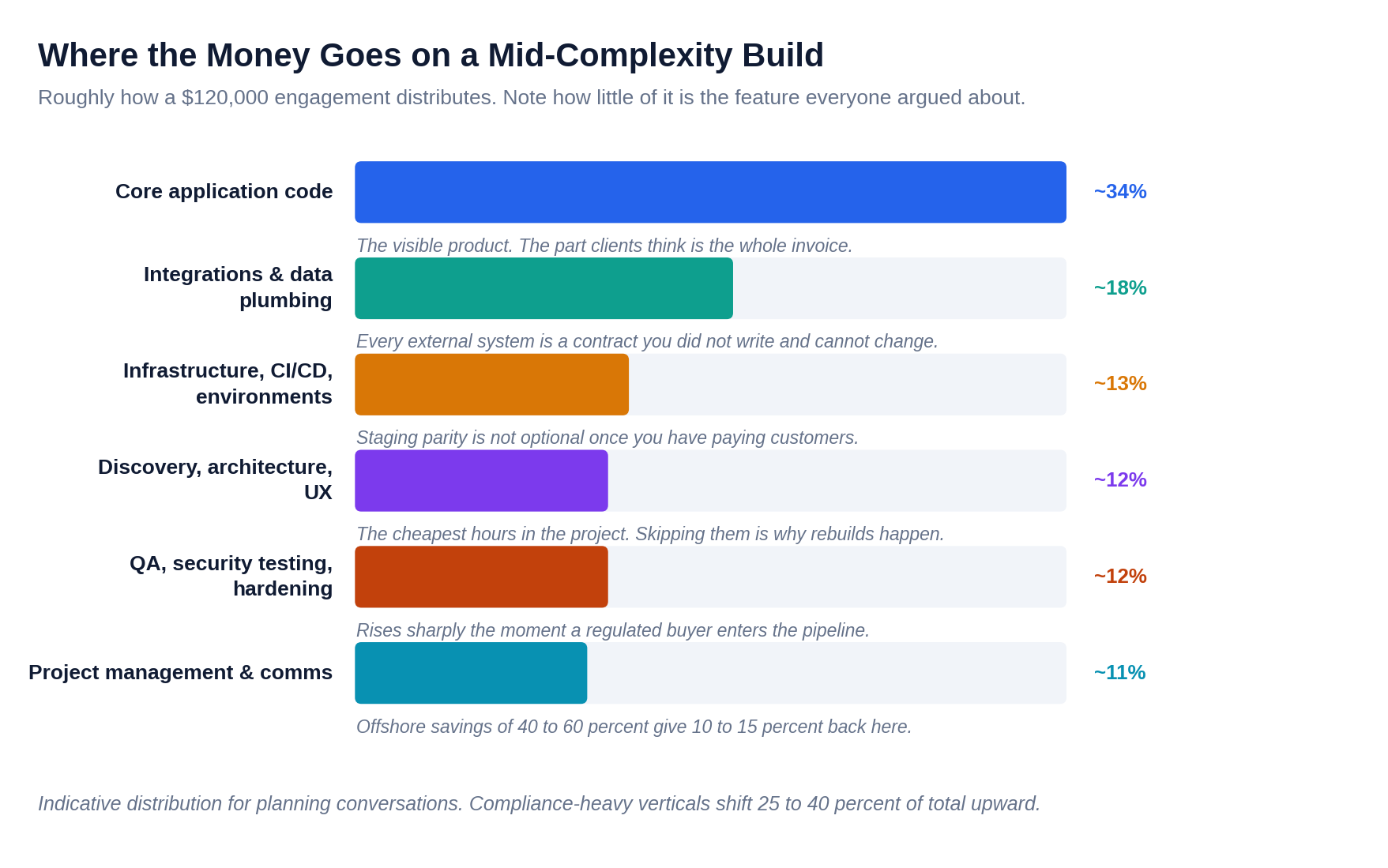
Two lines in that chart are worth flagging from our experience running these builds. Integrations and data plumbing consume close to a fifth of the budget because every external system is a contract you did not write and cannot change. When a payment provider deprecates an endpoint or an ERP changes its authentication scheme, that is your sprint, not theirs.
Discovery, architecture and UX look like the easiest place to economise because they produce no shippable code. In our experience, they are also the cheapest hours in the entire project. An architecture decision made in week two costs a conversation. The same decision made in month eight costs a migration, and we have watched that trade play out on both sides.
How Team Location Affects SaaS Development Cost
Team geography is the single most controllable cost lever, and also the one we see clients miscalculate most often. Offshore and nearshore teams commonly cost 40 to 60 percent less per hour than North American equivalents.
But in our experience running distributed delivery teams, coordination overhead absorbs 10 to 15 percent of that saving, and timezone gaps of five to eight hours slow feedback cycles in ways that show up as calendar time rather than as invoice lines. The saving is real. It is just smaller than the rate card suggests, and it arrives partly as schedule risk, which is exactly why our approach is to build a fixed weekly review into every distributed engagement from week one.
Hidden SaaS Development Costs to Budget For
A quote prices the build. A budget has to price the product. These are the gaps between the two, and in our experience, they are where 40 to 60 percent budget overruns originate.
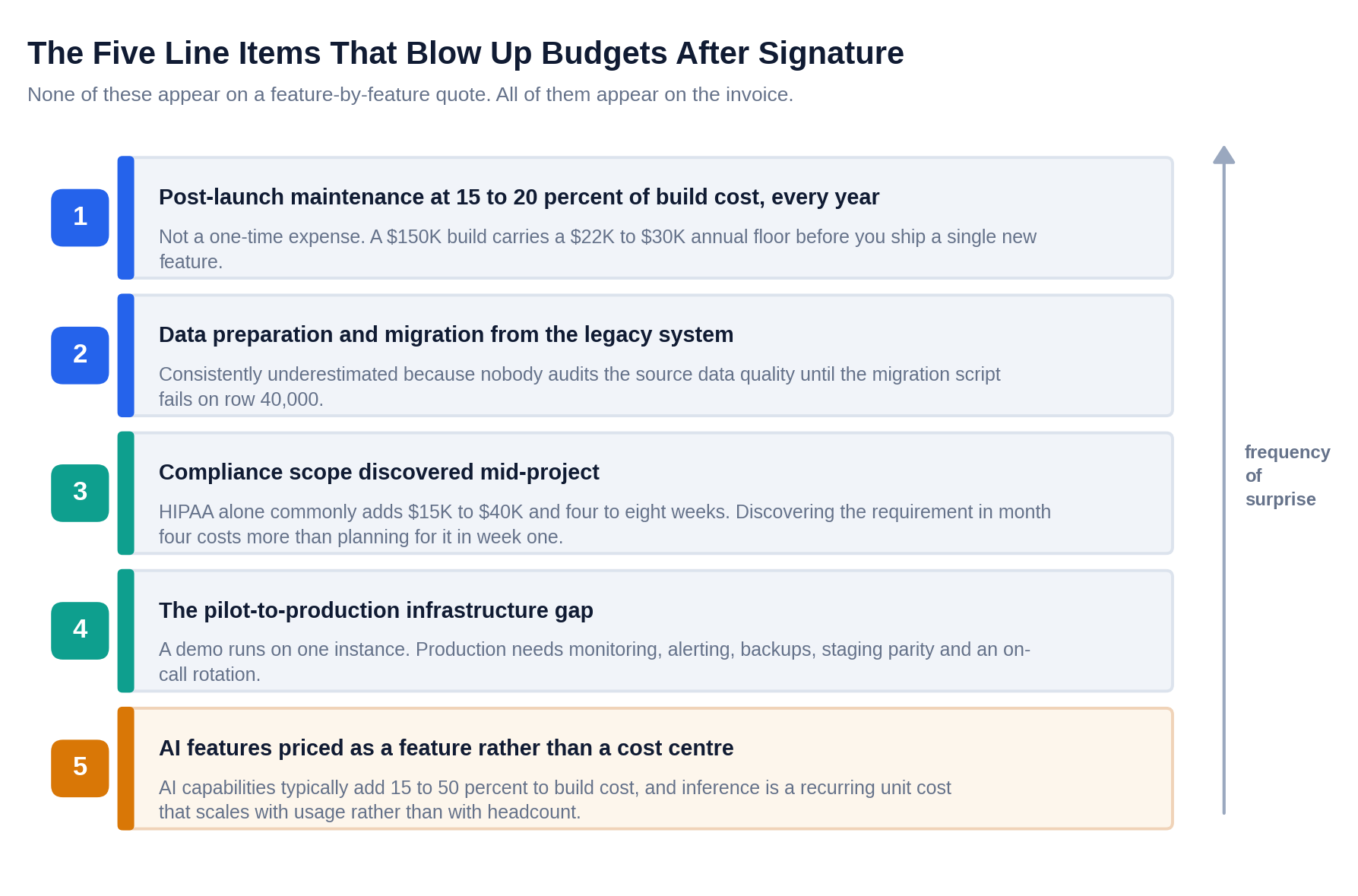
The maintenance figure deserves particular attention because it is structural rather than optional. Our experience across client engagements lines up with the wider industry consensus that post-launch maintenance runs 15 to 20 percent of the original build cost annually. That is dependency updates, security patches, cloud provider deprecations, and bug fixes, before a single roadmap item ships. A $150,000 build carries a $22,000 to $30,000 annual floor from the day it goes live, and we always walk clients through this number before signature so it never arrives as a surprise.
The AI line is newer and behaves differently from everything above it. From our experience working on similar solutions, adding AI features typically increases build cost by somewhere between 15 and 50 percent depending on how much data preparation is involved. But unlike the rest of the build, inference is a recurring unit cost that scales with usage rather than with headcount. A feature that costs $30,000 to build might cost $4,000 a month to run at scale, and our approach is to put that number in the model from the start rather than let a client discover it in a cloud bill.
How to Reduce SaaS Development and Infrastructure Costs
Our approach to AWS cost optimisation engagements follows a consistent shape: an audit framework first, then automated right-sizing, migration of suitable workloads to Spot and Graviton instances, and S3 lifecycle tiering. What we typically find is almost always unglamorous. Unattached EBS volumes, over-provisioned EC2 and RDS instances, and inefficient data transfer topologies account for more waste than any single architectural decision.
The relevance to a build budget is direct, and it is something we raise with every client early. Infrastructure is roughly an eighth of development cost but becomes a permanent operating line the day you launch. In our experience, teams that treat it as an engineering concern during the build rather than a finance report afterwards start their operating cost curve materially lower, and they can attribute cost per customer, which is what turns a cloud bill into a pricing input.
How to Compare SaaS Development Cost Estimates
If you take one practical thing from this article, take this. Our approach, developed across dozens of scoping conversations, is that the reason three quotes diverge by a factor of eight is almost always that the brief left five decisions to the vendor's imagination. We typically recommend clients specify these before they circulate a brief, because the spread collapses once they do.
Name the compliance regime, or state explicitly that there is none: SOC 2, HIPAA, GDPR, PCI. HIPAA alone commonly adds $15,000 to $40,000 and four to eight weeks. A vendor who assumes none and a vendor who assumes some are quoting different products.
List every external system by name and by direction: Not 'integrates with accounting software'. 'Bidirectional sync with NetSuite, read-only pull from Salesforce, webhook out to Slack.' Each direction is separate work.
State your tenancy model, or ask the vendor to state theirs: Single-tenant, pooled multi-tenant, or a bridge model with dedicated environments for enterprise customers. This decision drives architecture more than any feature.
Define what 'done' means for data migration: How many records, from what system, in what condition. 'We'll migrate the existing data' is a blank cheque in either direction.
Ask for the twelve-month total, not the build price: Build plus infrastructure plus maintenance plus third-party licences plus the AI inference line. First-year totals for most startups land between $100,000 and $250,000 once everything is counted, and a vendor who cannot produce that number has not thought about your product past launch.
Hidden SaaS Production Costs to Consider
The pilot-to-production infrastructure gap is the overrun nobody budgets for because it is invisible until the week before launch. We have seen it happen even to well-run projects: a demo runs on one instance with a developer watching it.
Production needs monitoring, alerting, log aggregation, automated backups with tested restores, staging parity, a deployment pipeline that can roll back, and someone contactable at 3 AM. None of that is a feature; all of it is work, and in our experience it typically appears in the schedule at exactly the moment there is no schedule left, which is why our approach builds this into the plan from week one rather than the week before launch.
What Factors Determine SaaS Platform Development Cost
Based on our experience scoping SaaS builds across every tier described above, cost in 2026 is not a function of how big your product is. It is a function of four things, and you can estimate your own tier before you speak to a single vendor.
Driver | Low end | High end |
|---|---|---|
Compliance | No regulated data, no attestation needed | HIPAA, SOC 2, or PCI adds 25 to 40 percent and months |
Integration surface | One payment provider, nothing else | Bidirectional ERP sync, legacy SOAP endpoints, EDI |
Tenancy | Single tenant, one customer at a time | Pooled plus dedicated tiers with automatic promotion |
AI capability | None, or an off-the-shelf API call | Custom pipelines and data preparation, 30 to 50 percent uplift |
We typically recommend getting honest about those four before the first vendor call. Do that, and the quotes you receive will finally be comparable. Which does not make the decision easy, but it does make it a decision rather than a guess, and that is the outcome our approach is built around.

Hard Trivedi
Business Enthusiast | Exploring ideas, understanding business challenges, and turning insights into practical solutions that create meaningful value and growth.