


How Much Does It Cost to Develop an AI Agent?
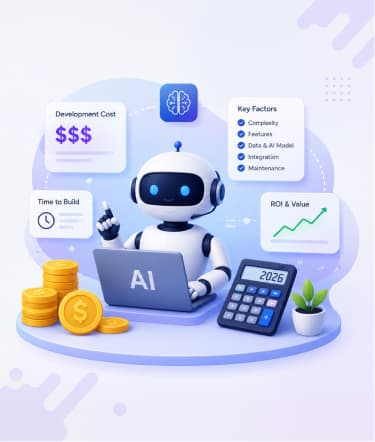
Building a custom AI agent in 2026 ranges from $15,000 for a single-purpose proof of concept to upwards of $250,000 for an enterprise-grade, distributed multi-agent system integrated into core business systems. AI Agent Development Cost ultimately depends on the total cost of ownership, which includes initial capital expenditure (CapEx) for design, engineering, and testing, alongside recurring operational expenditure (OpEx) for token inference, vector storage, compute infrastructure, and continuous observability.
Agent Classification | Typical CapEx | Estimated Timeline | Monthly OpEx | Key Capabilities & Scope |
|---|---|---|---|---|
Tier 1: Single-Task Proof of Concept (PoC) | $15,000 - $35,000 | 3 - 6 weeks | $300 - $1,500 | Single-agent execution, deterministic prompt routing, basic API connector, basic error handling, experimental evaluation. |
Tier 2: Production Workflow Agent | $40,000 - $90,000 | 2 - 3 months | $1,500 - $6,000 | Stateful workflow orchestration, Hybrid RAG context pipeline, 3 to 5 enterprise API integrations, role-based access control (RBAC), automated tracing. |
Tier 3: Enterprise Multi-Agent System (MAS) | $100,000 - $250,000 | 3 - 6 months | $6,000 - $20,000+ | Hierarchical or blackboard multi-agent topology, dynamic tool execution sandboxes, episodic/semantic memory stores, custom guardrail pipelines, SOC 2/HIPAA compliance controls. |
Tier 4: Autonomous Domain-Specific Platform | $250,000 - $500,000+ | 6 - 9+ months | $20,000 - $60,000+ | Fine-tuned domain models/SLM routing, bidirectional ERP/CRM integrations, asynchronous human-in-the-loop checkpoints, enterprise data governance, multi-region high availability. |
AI Agent Development Cost by Type
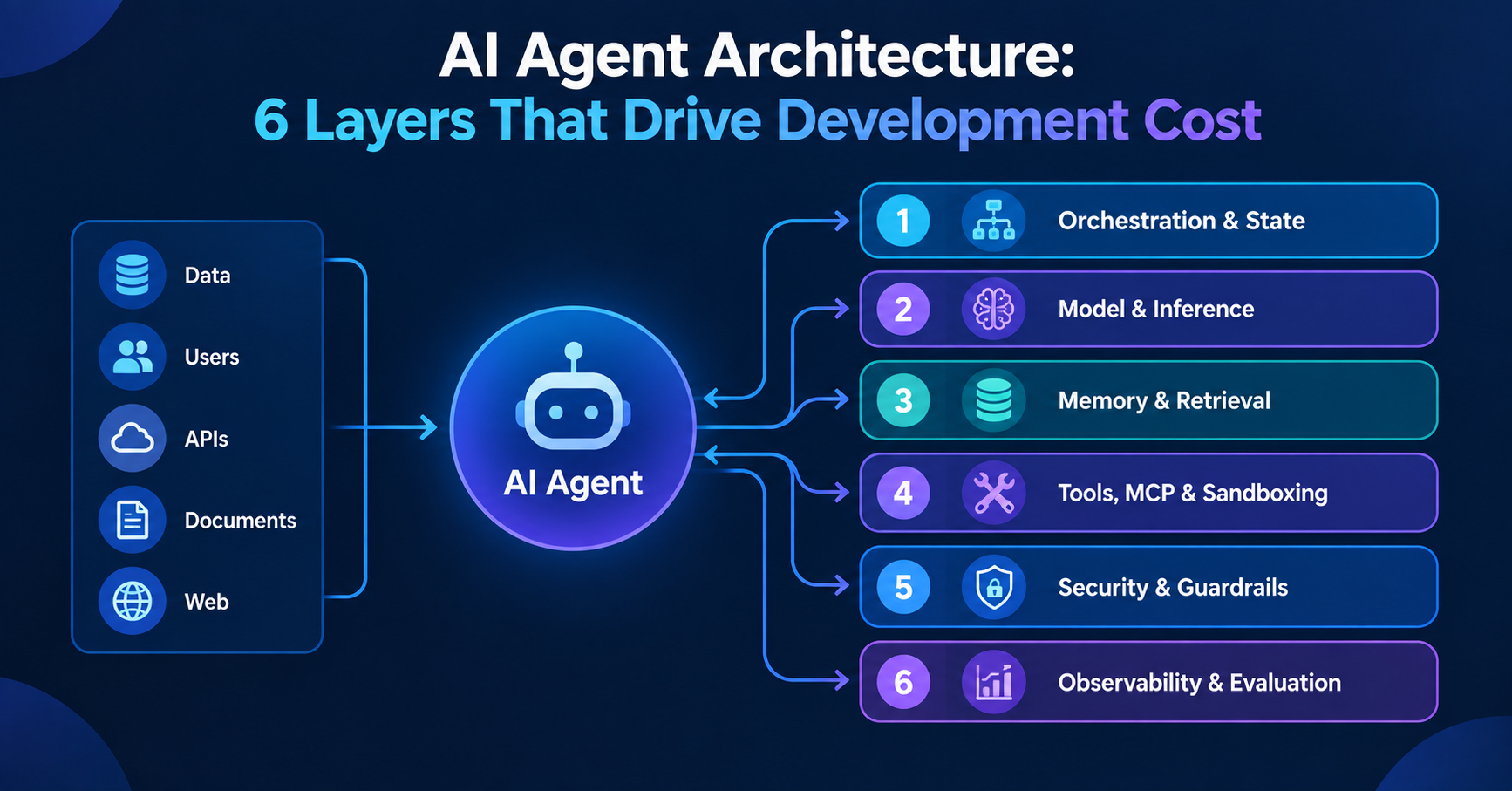
The cost of an AI agent is a direct function of its underlying architectural layers rather than user interface design. Production agent systems require an interconnected stack comprising model inference, stateful orchestration, persistent memory, secure sandboxed execution environments, and robust safety guardrails.
AI Agent Architecture Cost Breakdown
Layer 1: Orchestration and State Engine ($10,000 - $45,000): Simple linear scripts fail in production because autonomous agents encounter edge cases, non-deterministic model outputs, and transient API failures. Production systems require directed cyclical graphs (such as LangGraph), multi-agent frameworks (such as AutoGen or CrewAI), or custom deterministic state machines. Costs scale with the number of states, branch conditions, and cycle recovery algorithms.
Layer 2: Model Strategy and Inference Infrastructure ($8,000 - $50,000 initial setup): Organizations must choose between commercial proprietary APIs (OpenAI GPT-4o, Anthropic Claude 3.5 Sonnet, Google Gemini 1.5 Pro) and self-hosted open-weights models (Llama 3.3 70B, Mistral Large, DeepSeek-V3) deployed via inference engines like vLLM. While proprietary APIs minimize upfront engineering, self-hosting requires provisioning infrastructure, quantization tuning, and auto-scaling for GPU clusters.
Layer 3: Memory and Context Retrieval Architecture ($12,000 - $40,000): Stateless LLMs cannot maintain multi-turn execution histories across enterprise sessions. A production memory stack requires sliding-window context management, structured relational storage for episodic task logs, and hybrid retrieval mechanisms combining dense vector embeddings (pgvector, Qdrant) with sparse lexical search (BM25) and cross-encoder rerankers.
Layer 4: Tool Execution, MCP Connectors, and Sandboxing ($15,000 - $60,000): Equipping an agent to execute database mutations or invoke internal REST APIs requires strict execution sandboxes. Standardizing tool integration using protocols like the Model Context Protocol (MCP) or containerized microVM environments (Docker, Firecracker) prevents unintended side effects and protects internal infrastructure.
Layer 5: Enterprise Guardrails and Safety ($8,000 - $30,000): Enterprise deployment requires real-time prompt injection detection, PII masking, schema adherence enforcement (via Instructor or Outlines), output toxicity filtering, and policy boundary validation using dedicated safety classifiers.
Layer 6: Observability, Tracing, and Eval Harnesses ($10,000 - $35,000): Implementing OpenTelemetry-based tracing (LangSmith, Phoenix, or Arize) alongside synthetic evaluation suites (RAGAS, DeepEval) ensures software reliability before and after production updates, preventing regression as prompts or models evolve.
AI Agent Development Cost Breakdown by Development Phase
Engineering an enterprise AI agent requires a disciplined software development lifecycle spanning discovery, architecture design, integration, safety hardening, and deployment. Bypassing structured testing and governance often leads to expensive architectural rewrites when systems fail under production workloads.
Development Phase | Duration | Focus Areas & Deliverables | Estimated Cost |
|---|---|---|---|
Phase 1: Technical Scoping & Architecture | 1 - 2 weeks | Workflow boundary definition, latency/cost budgets, model selection, tool integration audit, security threat modeling. | $8,000 - $18,000 |
Phase 2: Data Engineering & Context Pipeline | 2 - 4 weeks | Data ingestion, chunking optimization, vector indexing, hybrid search pipelines, metadata filtering schemas. | $15,000 - $40,000 |
Phase 3: Core Orchestration & Tool Integration | 3 - 8 weeks | State machine development, agent role definition, API wrappers, MCP server integration, error recovery loops. | $25,000 - $85,000 |
Phase 4: Safety, Guardrails & Governance | 2 - 3 weeks | Prompt injection mitigation, PII redaction filters, enterprise RBAC, human-in-the-loop review queues. | $12,000 - $35,000 |
Phase 5: Evaluation, Benchmarking & Testing | 2 - 4 weeks | Golden dataset generation, automated unit/regression evals, stress testing, latency and token optimization. | $10,000 - $30,000 |
Phase 6: CI/CD, Observability & Deployment | 1 - 3 weeks | Containerization, Kubernetes deployment, OpenTelemetry pipeline, automated rollback triggers. | $10,000 - $25,000 |
Ongoing AI Agent Costs: Monthly Maintenance and Operations
Operational expenses for AI agents in 2026 differ substantially from traditional SaaS applications because token consumption scales with reasoning depth, intermediate reflection steps, and multi-turn tool loops. A complex autonomous task may require 10 to 30 LLM calls per user transaction, multiplying baseline inference costs.
To accurately budget ongoing expenses, engineering teams must evaluate four distinct OpEx categories:
Token Inference Costs: Reasoning models (o1/o3-mini, DeepSeek-R1) provide superior planning but higher token cost; workhorse models (Claude 3.5 Sonnet, GPT-4o) handle standard tool execution; small language models (Llama 3.3 8B, Phi-4) process high-frequency intent classification cheaply.
Context Storage and Vector Databases: Dedicated vector indexing and hybrid databases scale with vector dimension size, index type (HNSW vs IVF-PQ), and query throughput. Managed services charge per read/write unit, while self-managed databases require allocated CPU/RAM.
Compute and Container Infrastructure: Hosting orchestration runtimes, isolated tool execution sandboxes, background task workers (Celery, Temporal), and Redis caching instances require standard cloud compute.
Ongoing Maintenance and Schema Evolution: APIs change and model checkpoints update. Sustaining agent reliability requires ongoing maintenance for prompt optimization, tool schema updates, and evaluation harness maintenance.
How Much Does It Cost to Run an AI Agent Per Month?
Operating Tier | Monthly Invocations | Avg Calls / Task | Token Spend | Infra & DBs | Monitoring & Maint. | Total Monthly OpEx |
|---|---|---|---|---|---|---|
Low Volume (Internal Automation) | 10,000 | 3 - 5 | $400 - $1,200 | $300 - $600 | $800 - $1,500 | $1,500 - $3,300 |
Medium Volume (Departmental System) | 100,000 | 5 - 10 | $3,500 - $8,500 | $1,200 - $2,500 | $2,500 - $5,000 | $7,200 - $16,000 |
High Volume (Customer-Facing Platform) | 1,000,000+ | 8 - 20 | $25,000 - $60,000 | $5,000 - $12,000 | $8,000 - $15,000 | $38,000 - $87,000+ |
How Technology Choices Affect AI Agent Development Cost
Selecting the right balance of open-source frameworks, proprietary APIs, and vector infrastructure directly impacts both upfront engineering speed and long-term operating margins. A system optimized solely for low initial development cost often accumulates excessive monthly API expenses, whereas building an entirely custom, self-hosted stack introduces substantial upfront infrastructure costs
Technology Category | Available Options | Upfront Dev Cost | Monthly Running Cost | Key Architectural Trade-Offs |
|---|---|---|---|---|
Foundation Models | Proprietary APIs (Anthropic, OpenAI, Google) | Low | Medium to High | Fast implementation, state-of-the-art reasoning, zero GPU management. Higher marginal cost at scale and vendor dependency. |
Foundation Models | Open-Weights Self-Hosted (Llama 3.3, Mistral, DeepSeek) | High | Low to Medium | Full data privacy, zero vendor lock-in, customizable weights. Requires dedicated GPU clusters, inference optimization, and patching. |
Orchestration Framework | LangGraph / Custom FSM | Medium | Low | Fine-grained state control, cycle handling, robust debugging. Requires higher initial engineering discipline. |
Orchestration Framework | High-Level Frameworks (CrewAI, AutoGen) | Low to Medium | Medium | Rapid multi-agent prototyping, built-in collaboration roles. Less deterministic control over token usage and state flow. |
Vector & Memory Store | Managed Vector Cloud (Pinecone, Qdrant Cloud) | Low | Medium to High | Fully serverless, zero maintenance, instant scaling. Recurring cost scales directly with index count and query volume. |
Vector & Memory Store | Relational Hybrid (pgvector on PostgreSQL) | Medium | Low | Unified relational + vector data, cost-effective on existing DB clusters. Requires manual index tuning and memory provisioning. |
Tool Execution | Standard API Direct Call | Low | Low | Simple integration. Lacks process isolation, vulnerable to injection or unvalidated execution. |
Tool Execution | Containerized Sandboxes (Docker / MicroVMs) | High | Medium | Complete network and process isolation, enterprise-grade safety. Requires container lifecycle management and slight latency overhead. |
What Can Increase AI Agent Development Costs?
Unexpected budget overruns in AI agent initiatives rarely stem from basic UI or front-end development. Instead, cost escalation occurs when engineering teams miscalculate the complexities of non-deterministic model behaviors, unstructured edge cases, and enterprise security requirements.
The Autonomous Loop Trap: Unconstrained agent loops (where an agent repeatedly fails a task, attempts self-correction, and retries without hard boundaries) lead to massive token consumption spikes. Production systems require strict recursion limits and budget caps per execution session.
Over-Agentification of Deterministic Workflows: Attempting to solve every sub-task with an autonomous LLM agent increases latency and cost unnecessarily. High-performing engineering teams use traditional deterministic code for known business logic, SQL generation, and schema validation, reserving LLM agent reasoning strictly for ambiguous natural language comprehension.
Underestimating Data Cleaning and Chunking Architecture: Inadequate document parsing, poor PDF extraction, or missing metadata tagging results in poor retrieval quality, prompting teams into expensive prompt re-engineering when the root issue lies in the data ingestion pipeline.
Integration Friction with Legacy Enterprise Systems: Interfacing with legacy on-premises databases, undocumented ERP endpoints, or SOAP interfaces requires custom middleware, translation layers, and robust error-handling wrappers that can double integration timelines.
Lack of Automated Evaluation Frameworks: Refining agent prompts or switching model versions without an automated evaluation dataset is hazardous. Investing early in a synthetic test suite (golden dataset validation with DeepEval or RAGAS) prevents costly production bugs and manual regression testing cycles.
Build vs. Buy vs. Partner for AI Agent Development
Engineering leadership must decide whether to assemble an in-house AI team, adopt commercial vertical SaaS agents, or collaborate with an experienced engineering partner to accelerate time-to-market.
When to Buy Off-the-Shelf: Ideal for non-differentiating business tasks such as basic CRM data entry, standard calendaring, or generic customer service chatbots where custom IP is not required.
When to Build Fully In-House: Viable for large enterprise organizations with existing AI research teams, dedicated MLOps infrastructure, and multi-year product horizons where the agent constitutes the core commercial software product.
When to Partner with an Engineering Specialist: Optimal for enterprise organizations that require custom, compliant, high-performance agentic systems integrated with internal APIs and databases, but wish to avoid lengthy hiring cycles, architectural missteps, and runaway R&D budgets.
AI Agent Development Cost Checklist for Enterprise Teams
Define Objective Boundaries: Is the scope confined to measurable, quantifiable workflow steps, or does it demand open-ended, subjective autonomy?
Establish Latency and Cost Budgets: Have you calculated the maximum acceptable token cost and response latency per user transaction?
Audit Tool and API Readiness: Are internal APIs documented, secured via OAuth/API keys, and equipped with rate-limiting controls?
Determine Data Privacy Requirements: Does the use case require zero-data-retention agreements, on-premises deployment, or HIPAA/SOC 2 compliance?
Architect Human-in-the-Loop Checkpoints: For destructive or financial actions (e.g., executing transactions, deleting records), have you integrated mandatory human approval gates?
Implement Continuous Observability from Day One: Is OpenTelemetry tracing integrated before testing to monitor tool invocation efficiency and cost per run?
AI Agent Development Cost: Key Takeaways
Building enterprise AI agents in 2026 is an architectural discipline that balances reasoning capabilities, execution safety, and operational efficiency. Organizations that succeed approach agent development with clear state machine boundaries, hybrid retrieval pipelines, and rigorous cost governance rather than treating LLMs as magic black boxes.
By aligning architectural complexity with specific business outcomes and partnering with experienced technical architects, enterprises can deploy production-ready AI agents that deliver tangible automation value while maintaining predictable operating costs. Contact us today to discuss your AI agent requirements and explore a scalable approach that aligns technology investment with your business goals.

Mukund Patil
Business Enthusiast | Exploring ideas, trends, and opportunities, turning curiosity into meaningful insights and discovering smarter ways to make an impact.