

Why Enterprise AI Consulting Matters for Modern Businesses
The enterprise AI problem is no longer access to AI; it is converting access into repeatable business value. A 2025 industry survey found that 88% of respondents said their organizations regularly use AI in at least one business function, yet nearly two-thirds had not begun scaling AI across the enterprise and only 39% reported enterprise-level EBIT impact.
That gap explains the role of AI Consulting Services. Enterprise AI sits at the intersection of business process design, data readiness, application integration, model selection, security, governance, user adoption and ongoing operations.
The financial case also needs discipline. A 2025 survey of 1,854 executives found that 85% of organizations had increased AI investment in the previous 12 months and 91% planned to increase it again, while most respondents said satisfactory ROI on a typical AI use case took two to four years.
THE BUYER’S QUESTION |
What Do Enterprise AI Consulting Services Include?
A credible engagement can cover the full path from opportunity discovery to production operations. The exact mix should depend on the use case, not a fixed service catalogue.
Service | What the buyer should receive |
|---|---|
AI strategy & roadmap | Prioritized use cases, value hypotheses, feasibility, dependencies, investment bands and decision gates. |
Data strategy & engineering | Source mapping, quality assessment, pipelines, permissions, lineage and AI-ready data design. |
AI/ML engineering | Model selection, RAG, agents, classical ML, fine-tuning where justified, evaluation and validation. |
AI integration | APIs, ERP/CRM integration, identity, event streams, workflow orchestration and application embedding. |
MLOps / LLMOps | Deployment, versioning, monitoring, evaluation, cost controls, rollback and lifecycle management. |
Governance & security | Risk classification, access controls, privacy, auditability, human oversight, testing and incident response. |
Change & adoption | Workflow redesign, training, stakeholder enablement, operating roles and adoption measurement. |
ROI optimization | Baseline KPIs, business impact measurement, cost-per-task analysis and continuous improvement. |
Ready to Explore AI Consulting Services?

How to Build an Enterprise AI Strategy Around Business Goals
A good consulting process begins with a workflow and its economics. The technical approach comes second. Industry research identifies workflow redesign as a key factor associated with stronger AI impact, while fragmented data, human adoption and broader transformation remain major reasons ROI is difficult to realize.
Constraint | Buyer question | Evidence |
|---|---|---|
Business value | Which KPI should move? | Baseline, target and attribution method |
Data | Is required context accessible and reliable? | Source inventory, quality and permission assessment |
Risk | What happens if AI is wrong? | Risk classification, human review and fallback |
Integration | Where does AI enter the workflow? | Architecture, APIs, identity and event flow |
Economics | What does each completed task cost? | Inference, infrastructure and support model |
Ownership | Who operates it after launch? | Named owner, RACI and runbook |
How to Evaluate Enterprise AI Consulting Services
Score a prospective use case and consulting partner from 1–5 across six dimensions. A low score is not automatically a rejection; it identifies what must be fixed before scaling.
Dimension | What strong looks like |
|---|---|
Alignment | AI is tied to a strategic workflow and measurable business outcome. |
Data readiness | Required data is accessible, governed, fresh enough, and permission-aware. |
Integration | The solution fits existing applications, identity, and operational workflows. |
Governance | Risk, security, evaluation, human review and accountability are designed upfront. |
Economics | Implementation and recurring operating costs are understood at expected volume. |
Nurture & ownership | A named internal owner can operate, measure, and evolve the capability. |
Use the framework twice: first to rank use cases, then to compare providers. This prevents a technically strong vendor from winning a project whose business case or operating model is weak.
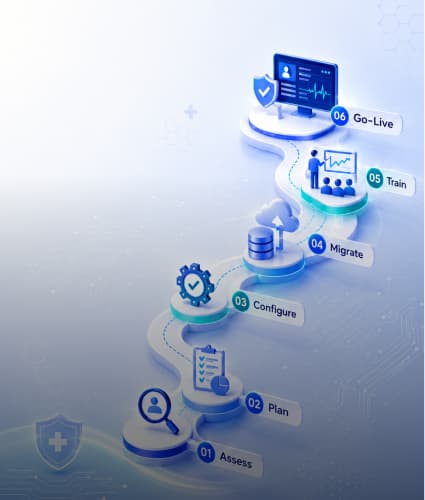
Enterprise AI Implementation Lifecycle: From Strategy to Production
Stage | Primary work | Decision/output |
|---|---|---|
Assess | Maturity, data, architecture, security, existing pilots | Readiness baseline |
Prioritize | Value, feasibility, risk, dependencies, time to value | Ranked use-case roadmap |
Architect | Model strategy, integrations, governance, evaluation | Target architecture |
Validate | Representative data, user testing, evaluation | Proof of value + business case |
Productionize | Security, deployment, monitoring, resilience, UX | Production release |
Scale | Reusable components, governance, cost optimization | Expansion roadmap |
Industry research has warned that poor data quality, inadequate risk controls, escalating costs, and unclear business value can cause GenAI projects to be abandoned after proof of concept; research has also found that 63% of surveyed organizations either lacked or were unsure they had the right data-management practices for AI.
Ready to Explore AI Consulting Services?
How to Choose an Enterprise AI Consulting Firm
There is no single universally “best” enterprise AI consulting firm. The right shortlist depends on transformation scale, industry, technical depth, geography, procurement model and internal capability. Independent industry evaluations can provide useful benchmarks for comparing major providers across strategy, capabilities, delivery strength, and market presence, and can serve as a useful provider-selection aid.
Evaluation area | Evidence to request |
|---|---|
Business understanding | Can the team map workflows and KPIs before proposing technology? |
Production engineering | Show deployment, observability, rollback, resilience, and support patterns. |
AI depth | Explain when to use RAG, agents, fine-tuning, ML, rules, or no AI. |
Data & integration | Demonstrate experience with enterprise data platforms, APIs and identity. |
Governance | Show evaluation, red-team, audit, privacy, and human-review controls. |
Delivery | Identify the actual team, milestones, decision gates and acceptance criteria. |
Commercials | Separate consulting, engineering, infrastructure, model and support costs. |
Evidence | Provide relevant production references and measurable outcomes where permitted. |
For enterprise buyers, “best firms” should therefore be treated as “best fit for the specific transformation.” A global strategy-led firm may suit a multi-country operating-model transformation; a specialist may be better for a focused technical problem; a hybrid team can balance internal ownership with external acceleration.
Build vs. Buy vs. Partner for Enterprise AI
Approach | Best fit | Trade-off |
|---|---|---|
Build internally | Strong AI/data team and strategic need for control | Highest internal capacity requirement |
Buy an AI product | Standardized problem with a mature product category | Less flexibility and potentially weaker differentiation |
Consulting partner | Complex strategy, integration, governance or delivery gap | Requires careful provider and ownership design |
Hybrid | Enterprise wants internal ownership plus external acceleration | Needs explicit responsibility boundaries |
Industry research found 38% of surveyed organizations favored a hybrid approach combining in-house development with external tools, while 32% leaned toward vendor-built solutions and 24% planned to invest in internal build capabilities
Enterprise AI Governance and Security
Governance is a buying criterion, not a compliance appendix. NIST’s AI Risk Management Framework organizes risk management around Govern, Map, Measure, and Manage, providing a useful structure for enterprise AI controls.
Classify data before it reaches models or retrieval systems.
Enforce user and document permissions through the AI workflow.
Define evaluation datasets, quality thresholds, and regression tests.
Test for prompt injection, unsafe outputs, data leakage, and inappropriate tool use.
Log material prompts, outputs, tool calls, and consequential decisions where appropriate.
Define when human approval is mandatory.
Prepare rollback, fallback, and incident-response procedures.
Monitor quality, latency, cost, drift, and anomalous behavior after launch.
Ready to Explore AI Consulting Services?
How Much Does Enterprise AI Consulting Cost?
There is no universal price, but a buyer still needs a planning range. The figures below are illustrative budgeting bands synthesized from current market guides and should be treated as directional, not quotes or industry-standard rates. Complex regulated environments can exceed them substantially.
Engagement | Directional planning band (USD) | Typical duration |
|---|---|---|
Readiness/discovery | $25K–$75K | 2–6 weeks |
Strategy + architecture | $50K–$150K | 4–10 weeks |
Single production use case | $100K–$400K+ | 2–6 months |
Multi-use-case program | $300K–$1M+ | 6–12+ months |
Ongoing advisory | $10K–$50K/month | Ongoing |
Public market guides commonly publish broad ranges; for example, fixed-fee AI projects from roughly $25K to $500K+, hourly consulting around $150–$400, and retainers around $10K–$50K/month. These figures vary significantly by provider and scope, so use them for early budgeting rather than procurement.
Budget separately for model inference, cloud infrastructure, data preparation, security testing, observability, licenses, change management, and internal stakeholder time. At enterprise scale, recurring operating cost can matter as much as the initial build.
A useful procurement test is to ask every bidder for the same five numbers: discovery cost, production build cost, first-year operating cost, cost per completed AI task at expected volume, and cost of a major model/vendor change
How to Measure the ROI of Enterprise AI Consulting
Industry research shows why ROI must be engineered into the engagement: only 6% of surveyed executives reported payback within a year, while most reported satisfactory ROI taking two to four years.
KPI | Examples |
|---|---|
Productivity | Cycle time, hours saved, cases handled per employee |
Quality | Accuracy, first-pass resolution, error and rework rate |
Customer | Response time, CSAT, conversion, retention |
Financial | Cost per transaction, revenue uplift, margin contribution |
Risk | Exceptions detected, compliance findings, incidents |
AI operations | Latency, evaluation score, failure rate, model cost/task |
Adoption | Task completion, active use, recommendation acceptance |
The strongest ROI chain is: AI capability → workflow change → operational metric → financial or strategic outcome. For example, ten minutes saved per ticket only becomes ROI if that time translates into lower cost, greater throughput, faster service, or improved quality.
Common Enterprise AI Consulting Mistakes to Avoid
Choosing a provider because of an impressive demo or model list.
Starting with a model instead of a measurable workflow.
Treating a proof of concept as proof of production readiness.
Ignoring data permissions and source quality.
Leaving governance and security until the final stage.
Underestimating recurring AI operating costs.
Building an agent where deterministic automation would be safer.
Failing to define ownership after go-live.
A 90-Day Enterprise AI Consulting Roadmap
Period | Focus | Output |
|---|---|---|
Days 1–30 | Maturity, data, architecture, risk and use-case assessment | Readiness baseline + opportunity shortlist |
Days 31–60 | Business case, architecture, governance and proof-of-value design | Investment decision + delivery plan |
Days 61–90 | Realistic proof of value using representative data | Go/no-go decision + production roadmap |
The objective is not to automate the enterprise in 90 days. It is to remove enough uncertainty to make a high-confidence production decision.
Enterprise AI Consulting: Key Takeaways
Enterprise AI consulting is not simply about choosing the right AI technology. It is about identifying the right business opportunities, preparing the data, integrating AI into existing workflows, managing security and governance, and building a clear path from proof of value to production. A structured approach helps organizations reduce uncertainty, make informed investments, and create AI solutions that deliver measurable business value.
If you are planning your enterprise AI journey, the right strategy can make the difference between an impressive AI pilot and a solution that delivers lasting results. Contact us today to discuss your AI goals, evaluate your requirements, and build a practical roadmap for successful enterprise AI implementation.

Deep Gondaliya
Business Analyst | Turning business challenges into clear insights, practical solutions, and meaningful improvements that help teams move forward.