

Executive Summary
Business process automation projects typically range from $5,000 for targeted single-workflow automations to over $50,000 for complex, multi-tenant enterprise orchestration platforms. The total investment depends on integration density, data structure variability, custom business logic, and whether probabilistic artificial intelligence models are required. Most mid-market and enterprise implementations fall within the $5,000 to $30,000 range. For businesses considering Business Process Automation Services, these factors can significantly influence the overall investment.
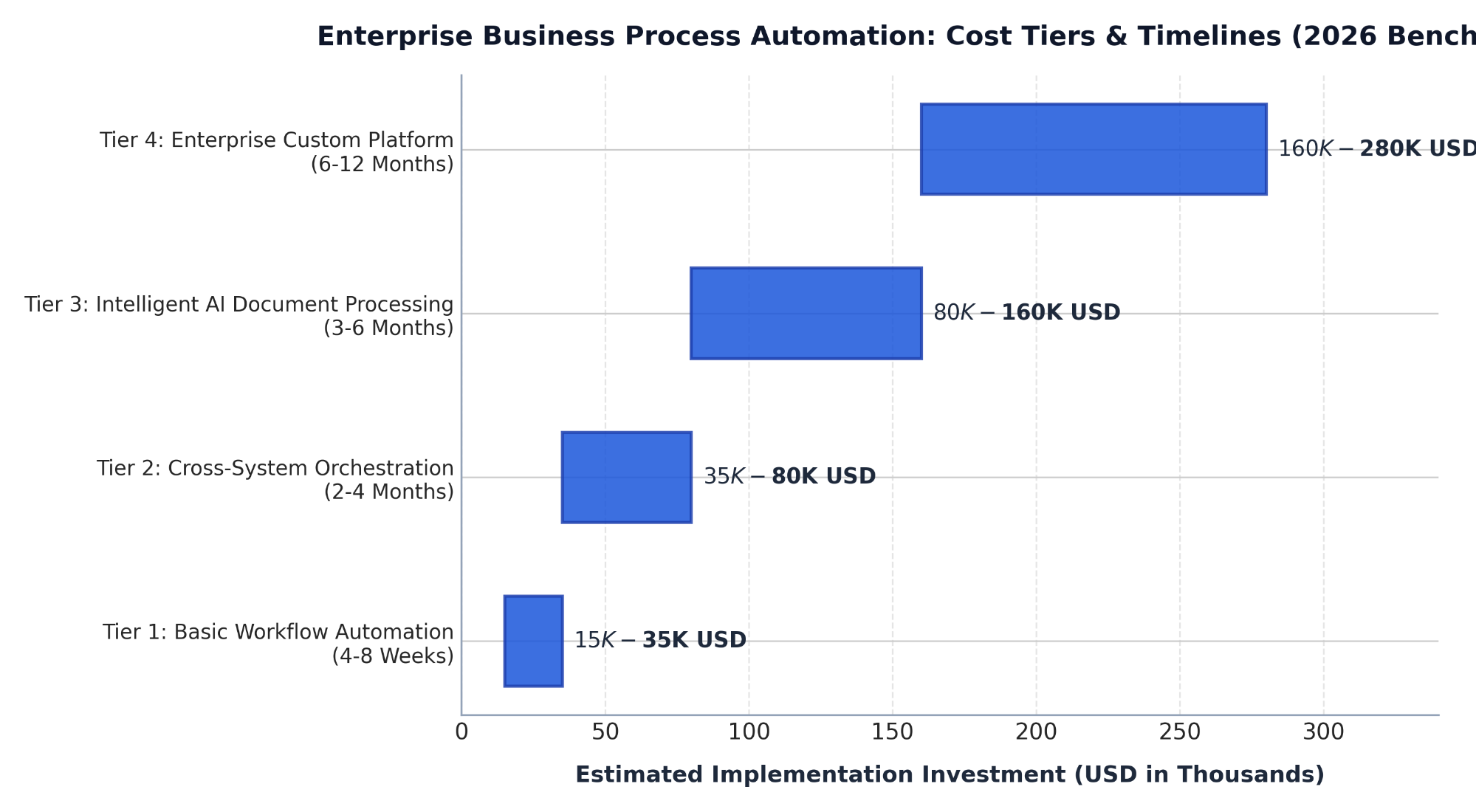
The following table summarizes industry benchmarks for development costs, implementation timelines, and required engineering team profiles across different complexity tiers.
Business Process Automation Cost by Project Type
Automation Scope | Estimated Cost Range (USD) | Delivery Timeline | Core Technology Stack |
|---|---|---|---|
Tier 1: Basic Workflow Automation | 5,000 – 5,000 | 4 – 8 Weeks | Node.js, Python, Webhooks, REST APIs, PostgreSQL, AWS Lambda |
Tier 2: Cross-System Orchestration | 5,000 – 0,000 | 2 – 4 Months | Python/FastAPI, Temporal/Camunda, Redis, Kafka/RabbitMQ, Docker |
Tier 3: Intelligent AI Document & Data Processing | 0,000 – 60,000 | 3 – 6 Months | Python, LangChain/LlamaIndex, OCR Engines, Vector DBs, Fine-Tuned LLMs, React/Next.js |
Tier 4: Enterprise-Grade Custom Automation Platform | 60,000 – 80,000+ | 6 – 12 Months | Microservices (Go/Python/Java), Event-Driven Architecture, Kubernetes, Multi-Cloud Infra |
What Factors Affect Business Process Automation Cost?
The total investment required for business process automation is governed by underlying technical and architectural parameters rather than user interface design. When estimating project scope, our team evaluates five foundational technical drivers that directly dictate engineering hours, infrastructure complexity, and testing overhead:
How Integrations and Legacy Systems Affect Automation Cost
Integrating modern REST or GraphQL APIs with comprehensive documentation is straightforward. However, enterprise automation frequently requires interfacing with legacy Enterprise Resource Planning (ERP) systems, on-premises SQL databases, SOAP endpoints, or systems lacking standardized webhook triggers. Custom connectors, reverse proxy layers, and polling mechanisms increase development time. When systems lack write-capable APIs and require headless browser automation or database-level synchronization, engineering effort increases by 30% to 50% compared to standard REST architectures.
Rule-Based vs. AI-Powered Automation: Cost Differences
Deterministic workflows follow strict, predictable if-this-then-that logic. They are computationally efficient, straightforward to unit test, and cost-effective to deploy using state machines. Conversely, non-deterministic workflows that involve natural language interpretation, exception reasoning, or fuzzy decision-making require machine learning models or Large Language Model (LLM) orchestration. Implementing guardrails, fallback routines, validation layers, and hallucination containment mechanisms adds substantial architectural complexity and ongoing token inference expenses.
How Data Complexity Affects Business Process Automation Cost
The structure of inbound data directly impacts data engineering costs:
Structured Data: Clean JSON, XML, or normalized database rows require minimal pre-processing.
Semi-Structured Data: Invoices, purchase orders, and receipts with varying layouts require Intelligent Document Processing (IDP) pipelines, schema normalization, and automated validation rules.
Unstructured Data: Free-form emails, contracts, and customer support transcripts require optical character recognition (OCR), semantic parsing, and entity extraction layers before business logic can execute.
Security and Compliance Costs in Business Process Automation
Enterprise automation handles critical financial, medical, or employee records. Establishing strict governance requires:
Fine-grained Role-Based Access Control (RBAC) and Attribute-Based Access Control (ABAC).
Immutable audit trails recording every automated transaction, state transition, and user intervention.
End-to-end data encryption in transit (TLS 1.3) and at rest (AES-256 with KMS key rotation).
Compliance certifications including SOC 2 Type II, HIPAA, or GDPR.
Building compliance-grade auditability typically accounts for 15% to 20% of the overall engineering budget.
How Scale and Performance Requirements Affect Automation Cost
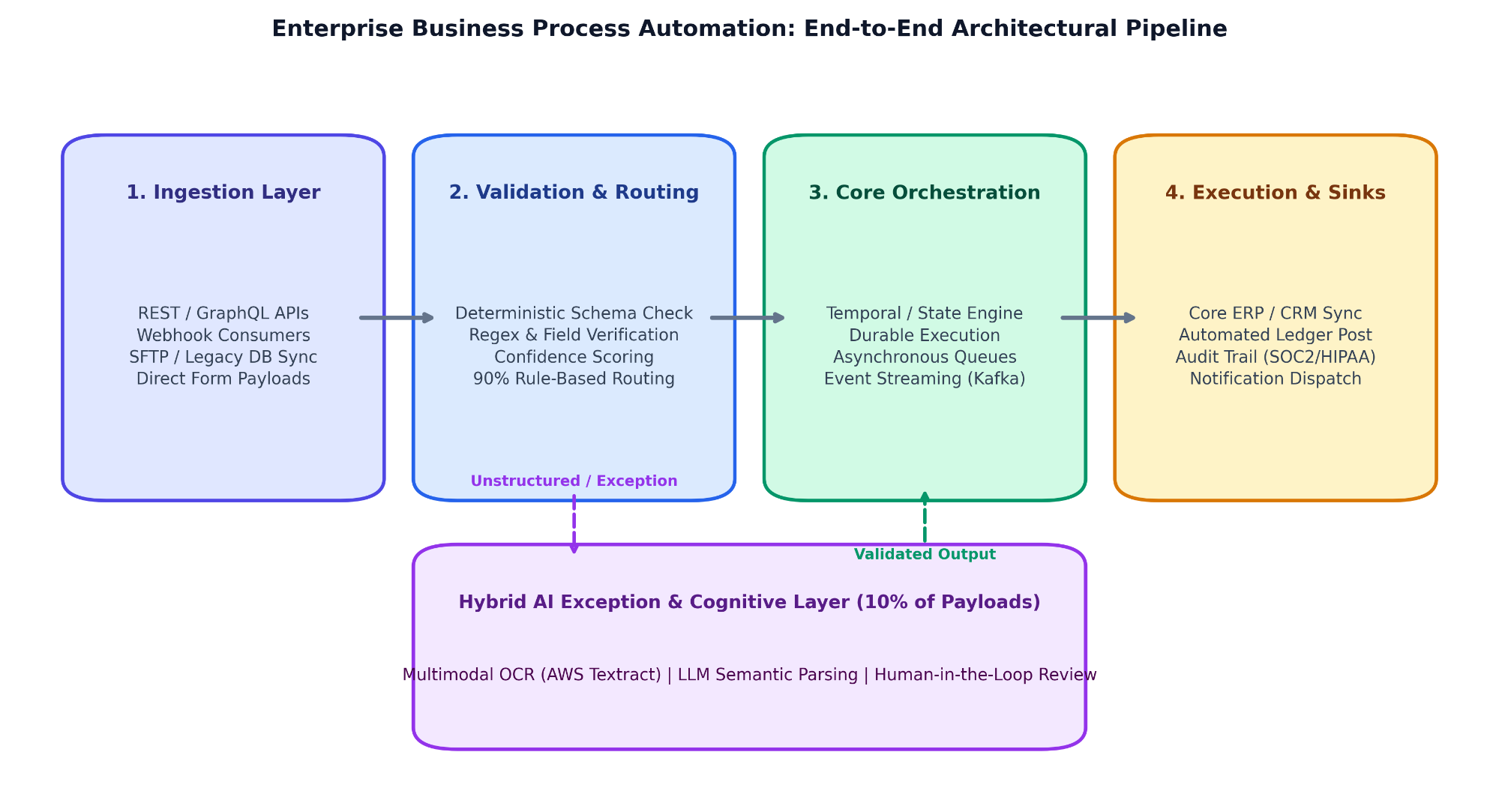
Automating low-volume batch jobs executed once daily requires minimal infrastructure resilience. In contrast, building high-throughput, event-driven pipelines that process thousands of transactions per minute with sub-second response times demands distributed message queues (such as Apache Kafka or AWS SQS), distributed locking mechanisms (Redis Redlock), and horizontal auto-scaling compute clusters.
Business Process Automation Cost Breakdown by Implementation Tier
Basic Workflow Automation Cost
Automations focus on eliminating repetitive manual tasks between two to three modern web applications. These solutions solve specific departmental bottlenecks with predictable, linear business logic.
Typical Use Cases: Automated lead routing between marketing tools and CRMs, scheduled database backups with Slack notifications, and basic customer intake form processing.
Architecture: Serverless functions (AWS Lambda or Google Cloud Functions), standardized webhook consumers, basic relational data stores (PostgreSQL), and third-party communication APIs (Twilio, SendGrid).
Implementation Duration: 4 to 8 weeks.
Cost Distribution:
Architecture & API Schema Definition: 20% (,000 – ,000)
Backend Scripting & Logic Implementation: 45% (,750 – 5,750)
Error Handling & Integration Testing: 20% (,000 – ,000)
Deployment & CI/CD Pipeline Setup: 15% (250 –250)
Multi-System Business Process Automation Cost
Automations coordinate asynchronous, multi-step workflows across disparate core business systems, such as ERPs, CRMs, billing gateways, and inventory databases. These systems require durable execution engines to manage long-running transactions and state persistence.
Typical Use Cases: End-to-end employee onboarding workflows, multi-stage approval hierarchies, synchronized inventory updates across multiple e-commerce channels, and automated invoice reconciliation against bank feeds.
Architecture: Workflow orchestration frameworks (Temporal, Camunda, or AWS Step Functions), message brokers (RabbitMQ or Redis Streams), transactional databases with connection pooling, and dedicated administrative monitoring dashboards.
Implementation Duration: 2 to 4 months.
Cost Distribution:
System Architecture & State Machine Design: 25% (750 – 0,000)
Custom API Connectors & Data Mappers: 35% (2,250 – 8,000)
Durable Execution & Failure Recovery Logic: 20% (,000 – 6,000)
Admin Portal & Dashboard Engineering: 10% (,500 – ,000)
Automated QA, Load Testing, and Deployment: 10% (500 –,000)
AI-Powered Business Process Automation Cost
Projects incorporate artificial intelligence, machine learning, and natural language processing to automate cognitive tasks that previously required human decision-making and document validation.
Typical Use Cases: Intelligent invoice and contract parsing, automated financial compliance verification, claims processing with document validation, and contextual customer support ticket triage.
Architecture: Multi-model AI pipelines utilizing specialized OCR engines (AWS Textract, Azure Document Intelligence), vector embeddings for semantic search, prompt orchestration frameworks, fine-tuned domain models, and human-in-the-loop (HITL) review interfaces built in React or Vue.js.
Implementation Duration: 3 to 6 months.
Cost Distribution:
Data Pipeline & Model Selection Architecture: 20% (6,000 – 2,000)
OCR, Parsing & Feature Extraction Engine: 25% (0,000 – 0,000)
Core Business Logic & Automated Verification: 20% (6,000 – 2,000)
Human-in-the-Loop (HITL) Exception Interface: 15% (2,000 – 4,000)
Model Evaluation, Benchmarking & Security Hardening: 20% (6,000 – 2,000)
Enterprise Business Process Automation Platform Cost
Encompasses centralized, proprietary automation platforms built from the ground up to serve as the technological backbone for an organization's core operations. These platforms support multi-tenancy, dynamic visual workflow builders, and complex custom integrations.
Typical Use Cases: Proprietary FinOps reconciliation platforms, end-to-end logistics tracking and automated dispatch engines, enterprise contract management and risk analysis suites, and unified compliance monitoring portals.
Architecture: Microservices architecture deployed on Kubernetes (EKS/GKE), distributed event streaming (Apache Kafka), polyglot persistence (PostgreSQL for transactional data, MongoDB/DynamoDB for dynamic schemas, Elasticsearch for operational logs), comprehensive API gateways, SSO/SAML integration, and high-availability infrastructure.
Implementation Duration: 6 to 12 months.
Cost Distribution:
Enterprise Architecture, Domain Modeling & Security Blueprint: 20% (2,000 – 6,000)
Core Engine Microservices & Distributed Execution: 30% (8,000 – 4,000)
Dynamic Integration Fabric & Connector Libraries: 20% (2,000 – 6,000)
Multi-Tenant Administrative UI & Configuration Portal: 15% (4,000 – 2,000)
DevOps, Kubernetes Orchestration, CI/CD & Pentesting: 15% (4,000 – 2,000)
Custom vs. SaaS vs. RPA Automation Cost: 3-Year TCO
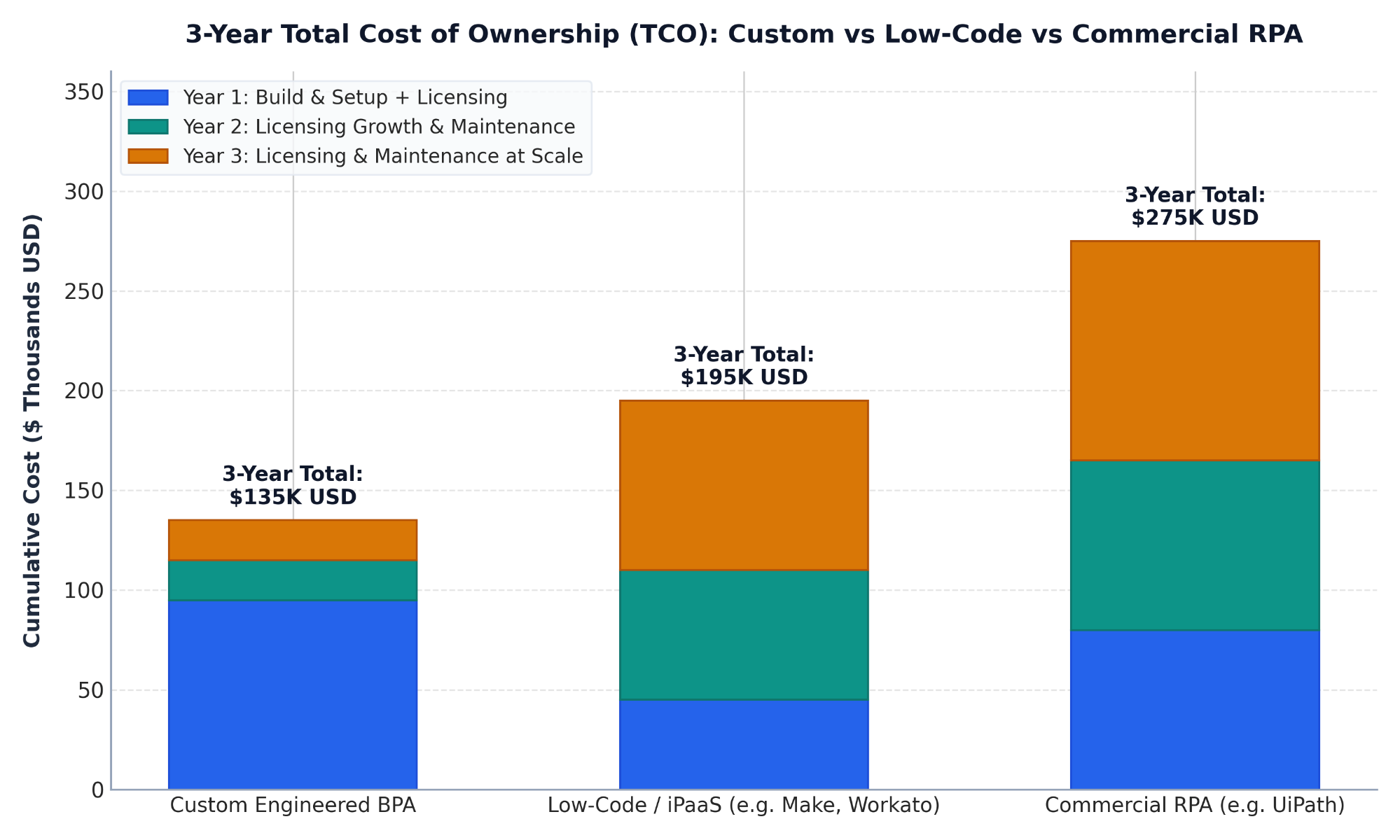
When engineering leaders choose an automation pathway, evaluating upfront build costs in isolation leads to misleading budget projections. Off-the-shelf SaaS tools and low-code/RPA platforms feature lower initial onboarding friction but introduce recurring per-user, per-bot, and per-execution licensing models that scale exponentially as automation volume grows.
3-Year Total Cost of Business Process Automation
Cost Component | Custom Engineered BPA | Low-Code / iPaaS Platforms | Commercial RPA Platforms |
|---|---|---|---|
Year 1: Upfront Build & Setup | 0,000 – 20,000 (Initial Custom Build) | 0,000 – 0,000 (Consulting & Setup) | 0,000 – 5,000 (Workflow Scripting) |
Year 1: Software Licensing | /usr/bin/bash (Open-Source Core Stack) | 5,000 – 0,000 / year | 5,000 – 0,000 / year (Bot Licenses) |
Year 2: Licensing & Usage Growth | /usr/bin/bash (Self-hosted or Cloud Native) | 5,000 – 5,000 (Volume Overage) | 5,000 – 20,000 (Additional Bots) |
Year 2: Maintenance & Ops | 5,000 – 5,000 (DevOps & Minor Updates) | 5,000 – 0,000 (Workflow Adjustments) | 5,000 – 5,000 (UI Breakage Fixes) |
Year 3: Licensing & Scaling | /usr/bin/bash (Infrastructure Only) | 0,000 – 10,000+ | 0,000 – 50,000+ |
Year 3: Maintenance & Ops | 5,000 – 5,000 | 0,000 – 5,000 | 0,000 – 0,000 |
Estimated 3-Year Total TCO | 00,000 – 70,000 | 65,000 – 60,000 | 35,000 – 30,000 |
Scalability Bottlenecks | None; scale horizontally on the cloud | Plan execution limits and API caps | Desktop UI changes and bot license caps |
IP Ownership | 100% Owned Proprietary Asset | Zero (Platform Dependent) | Zero (Platform Dependent) |
When Custom Business Process Automation Makes Financial Sense
High Transaction Volume: When processing hundreds of thousands of operations per month, per-transaction SaaS costs quickly exceed the cost of dedicated cloud infrastructure.
Proprietary Business Logic: Unique business workflows and competitive advantages cannot always be modeled using rigid off-the-shelf templates.
Deep Integration with Internal Databases: Direct access to proprietary schemas and distributed microservices requires low-latency database queries and custom security protocols.
Elimination of Vendor Lock-In: Custom solutions grant full ownership of intellectual property, eliminating dependency on third-party pricing changes.
When Low-Code and SaaS Automation Tools Are More Cost-Effective
Rapid Prototyping: Validating automation feasibility within 2 to 3 weeks before committing to custom development.
Standard SaaS-to-SaaS Connections: Connecting common tools like Salesforce, HubSpot, and Google Workspace without complex data transformations.
Low Execution Volumes: Departmental processes operating at modest volumes where tier-based SaaS pricing remains low.
Ongoing Business Process Automation Costs
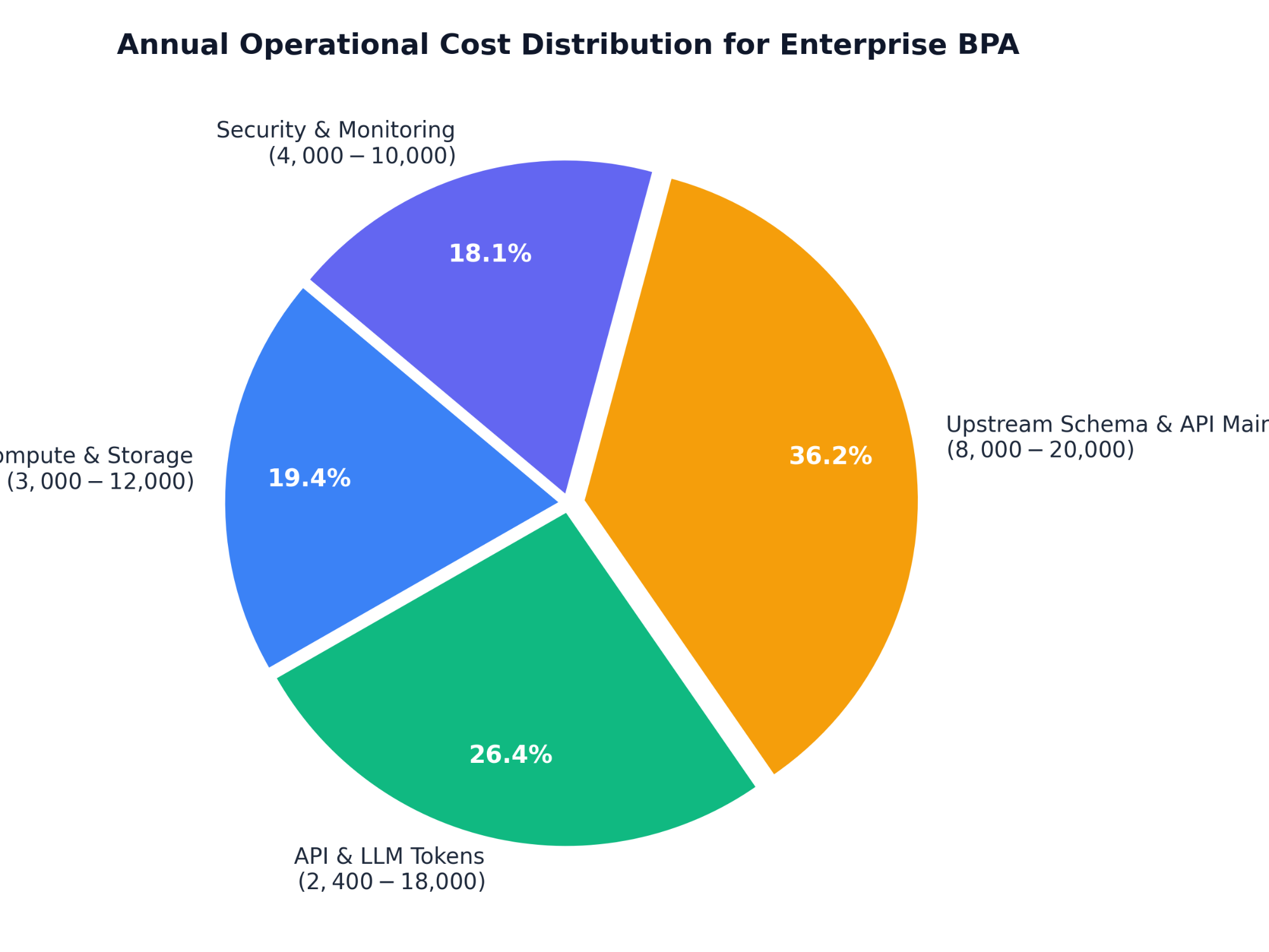
A realistic automation budget must account for annual maintenance, cloud consumption, and operational support. For production systems, ongoing operational expenses (OpEx) typically range between 15% and 25% of the original build cost annually.
Cloud Infrastructure Costs for Business Process Automation
Operating a reliable automation pipeline requires dedicated cloud infrastructure:
Compute Engines: Serverless invocations (AWS Lambda) or container orchestration (AWS ECS / EKS) range from 50 to 00 per month depending on concurrency.
Message Brokers and Queues: Managed queue services (AWS SQS, Google Cloud Pub/Sub, or managed Kafka) cost between 0 and 00 monthly for standard enterprise volumes.
Database and Cache Instances: Managed relational instances (Amazon RDS PostgreSQL) and caching layers (Redis ElastiCache) average 00 to 00 monthly for high-availability multi-AZ configurations.
API and AI Model Costs in Business Process Automation
When integrating external APIs or AI models, runtime consumption scales with business volume:
OCR and Document Parsing: Services such as AWS Textract or Azure Document Intelligence cost approximately .50 to 0.00 per 1,000 pages processed.
LLM Token Ingestion: Using foundational models for complex reasoning, classification, and extraction typically ranges from 00 to 500 monthly for mid-sized enterprise workloads when prompts and context windows are properly optimized.
API Maintenance and Integration Costs
External software providers frequently update API endpoints, deprecate authentication methods, or alter JSON payload schemas. Without proactive version handling, downstream automation pipelines can fail. Allocating 5 to 10 engineering hours per month for pipeline maintenance, regression testing, and dependency updates prevents workflow interruptions.
Monitoring, Error Handling and Maintenance Costs
Production automation requires proactive monitoring to detect anomalies before they impact operations:
Monitoring Stacks: Distributed tracing, metrics aggregation, and centralized logging (Datadog, AWS CloudWatch, or OpenTelemetry with Grafana) typically cost between 00 and 00 per month.
Dead-Letter Queue (DLQ) Management: When a third-party endpoint times out, the automation engine must route failed payloads to a DLQ, trigger alerts, and execute automated retry logic.
How to Measure Business Process Automation ROI
To justify capital expenditure for business process automation, engineering leaders must demonstrate quantifiable financial returns. Automation delivers value across three primary dimensions: direct labor reduction, cycle time acceleration, and error reduction.
Parameter / Metric | Baseline Manual Process | Post-Automation Implementation | Net Annual Impact |
|---|---|---|---|
Team Time Allocation | 4 Full-Time Employees (FTEs) spending 60% of their time | 1 FTE overseeing exceptions (15% of their time) | 2.25 FTEs reallocated to higher-value initiatives |
Direct Labor Expense | 80,000 / year (at 5,000 / FTE burdened) | 1,250 / year in supervision | 68,750 Annual Labor Savings |
Transaction Processing Time | 48 to 72 hours per document | 45 seconds automated processing | 99.8% Cycle Time Reduction |
Error and Rework Rate | 4.2% data entry and reconciliation errors | Less than 0.1% exception rate | ~5,000 saved in billing corrections |
Annual Operating Expenses | /usr/bin/bash software maintenance | 4,000 / year (Cloud + Maintenance) | -4,000 Annual OpEx |
Net First-Year Benefit | Baseline | 79,750 net annual savings | Net Benefit: 79,750 / year |
Implementation Cost | None | 5,000 one-time build cost | Payback Period: |
How to Reduce Business Process Automation Costs
Using Modular Architecture to Reduce Automation Costs
We decouple integration connectors from the core workflow state machine. Utilizing durable workflow orchestration patterns ensures that if an external ERP or payment gateway experiences downtime, the automation pipeline does not crash. Instead, it pauses execution state, persists context, and resumes automatically once downstream availability is restored. This eliminates data loss and reduces manual engineering intervention.
Using Rule-Based Automation to Reduce AI Costs
A common mistake in modern automation design is routing every data payload through expensive Large Language Models. In our implementations, we utilize lightweight, deterministic validation rules (such as regex matching, schema checkers, and mathematical reconciliation) for 80% to 90% of standard payloads. We route data to LLMs and semantic parsers only when unstructured text or layout anomalies require cognitive reasoning. This hybrid approach reduces monthly API token expenses by up to 75%.
How Asynchronous Processing Improves Automation Efficiency
Enterprise pipelines must handle fluctuating traffic volumes without dropping transactions. We implement asynchronous ingestion architectures using distributed message brokers. Payloads are placed into durable queues, processed by auto-scaling worker pools, and routed to DLQs with detailed error logs if processing fails after automated exponential backoff retries.
Business Process Automation Implementation Roadmap
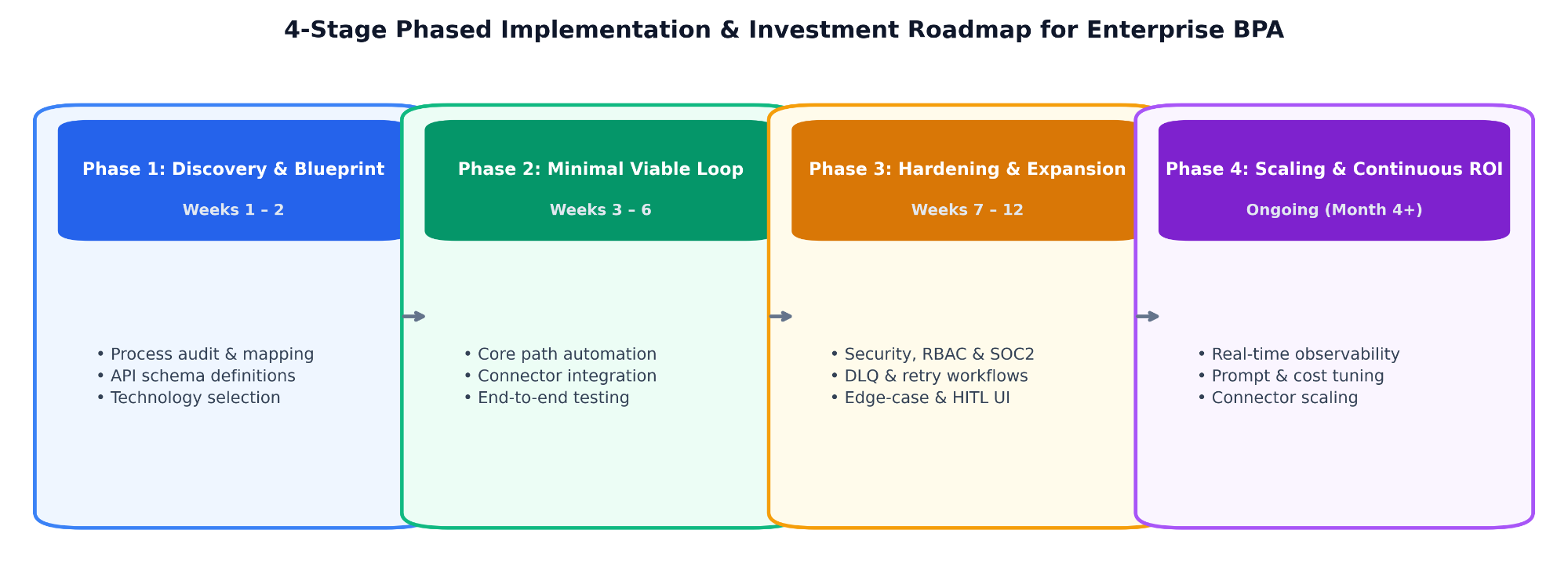
To control financial risk and deliver measurable business value quickly, we advise clients to follow a four-stage deployment roadmap:
Phase 1: Technical Discovery & Architecture Blueprint (Weeks 1 – 2): Audit existing workflows, map data dependencies, define schema definitions, and select the optimal technology stack.
Phase 2: Proof of Concept / Minimal Viable Automation (Weeks 3 – 6): Build and validate the core end-to-end automation loop for the highest-priority business path.
Phase 3: Production Hardening & Integration Expansion (Weeks 7 – 12): Implement edge-case exception handling, RBAC security, audit logging, and automated CI/CD testing pipelines.
Phase 4: Optimization, Monitoring & Scaling (Ongoing): Monitor real-time throughput, refine model prompts, optimize database query latency, and expand connector coverage.
Business Process Automation Examples and Implementation Lessons
Production automation projects across different enterprise domains highlight several practical implementation lessons:
Scalable Workflow Automation: Decoupling business logic from external API providers allowed multi-step, cross-platform workflows to run with sub-second execution speeds while reducing manual handling overhead. The AI Workflow Automation Platform provides additional context on this workflow architecture.
Financial Operations and Reconciliation: Hybrid parsing pipelines that combine deterministic table extraction with targeted AI verification helped automate invoice data entry while maintaining audit-compliant accuracy. The Accounts Receivable Automation Platform Case Study and Financial Document Management System Project provide further details on this approach.
Workspace Integration and Productivity: Enterprise workspace automation highlighted the importance of reliable OAuth token handling, distributed queue management, and asynchronous webhook ingestion. The Google Workspace Automation Tool Case Study covers these implementation considerations in more detail.
Business Process Automation Cost: Key Takeaways
Evaluate 3-Year Total Cost of Ownership: Low-code and RPA platforms offer rapid initial setup but often incur higher long-term costs through escalating licensing fees, execution caps, and fragile UI-based integrations.
Prioritize Modular, Event-Driven Architecture: Decoupling integration layers from workflow state engines protects systems from third-party API failures, minimizes technical debt, and ensures predictable horizontal scalability.
Leverage AI Selectively: Maximize efficiency by applying deterministic rules to structured data first, reserving AI models for unstructured text, complex document parsing, and exception management.
Partner with Experienced Software Engineers: Building reliable, secure, and maintainable automation platforms requires deep expertise across distributed systems, API integration, and cloud architecture. Working with an experienced engineering partner helps mitigate architectural risks and delivers faster time to value.

Swati Bais
Business Enthusiast | Curious about how businesses evolve, connecting ideas with insights to discover opportunities and shape better ways of working.