


What Factors Affect LLM Development Cost in 2026?
“How much does it cost to build an LLM application?” is one of the first questions every CTO asks when considering LLM Development Services, and one of the hardest to answer honestly. The honest answer is that it depends on which of four very different cost categories you're asking about. Most budgeting mistakes happen because teams price one of them and assume it covers the rest.
The honest answer is that it depends on which of four very different cost categories you're asking about. Most budgeting mistakes happen because teams price one of them and assume it covers the rest.
A simple RAG assistant built on top of an existing, well-organized knowledge base can realistically run $15,000–$60,000 in development effort and take a few weeks of engineering time.
A multi-agent system integrated across a dozen internal tools, with fine-tuning, compliance controls, and production monitoring, can run $150,000–$400,000+ and take several months.
The same underlying technology can result in a completely different budget conversation depending on the project's scope.
In 2026, foundation model pricing has continued to drop on a per-token basis. Some frontier-class models are now priced 60–80% lower per million tokens than their 2024 equivalents, which has made part of the cost equation cheaper than it used to be.
At the same time, integration, evaluation, and governance work has become a larger share of total project cost because enterprise expectations for reliability have risen faster than model prices have fallen.
This guide breaks down what actually drives LLM development costs in 2026, where teams consistently underestimate, and how to build a realistic budget before committing to a build, vendor, or development partner.
A note on the numbers in this guide: Every dollar figure, percentage, and range below is a directional estimate drawn from typical patterns across mid-size enterprise LLM engagements, not a quote from any specific vendor or a guaranteed outcome.
Actual costs depend on several factors:
Team rates
Region
Existing infrastructure
How well-defined the requirements are going in
Use these numbers to sanity-check a proposal or build an internal estimate, not as a substitute for a scoped quote from the team that will actually do the work.
Ready to Build Your LLM Solution?

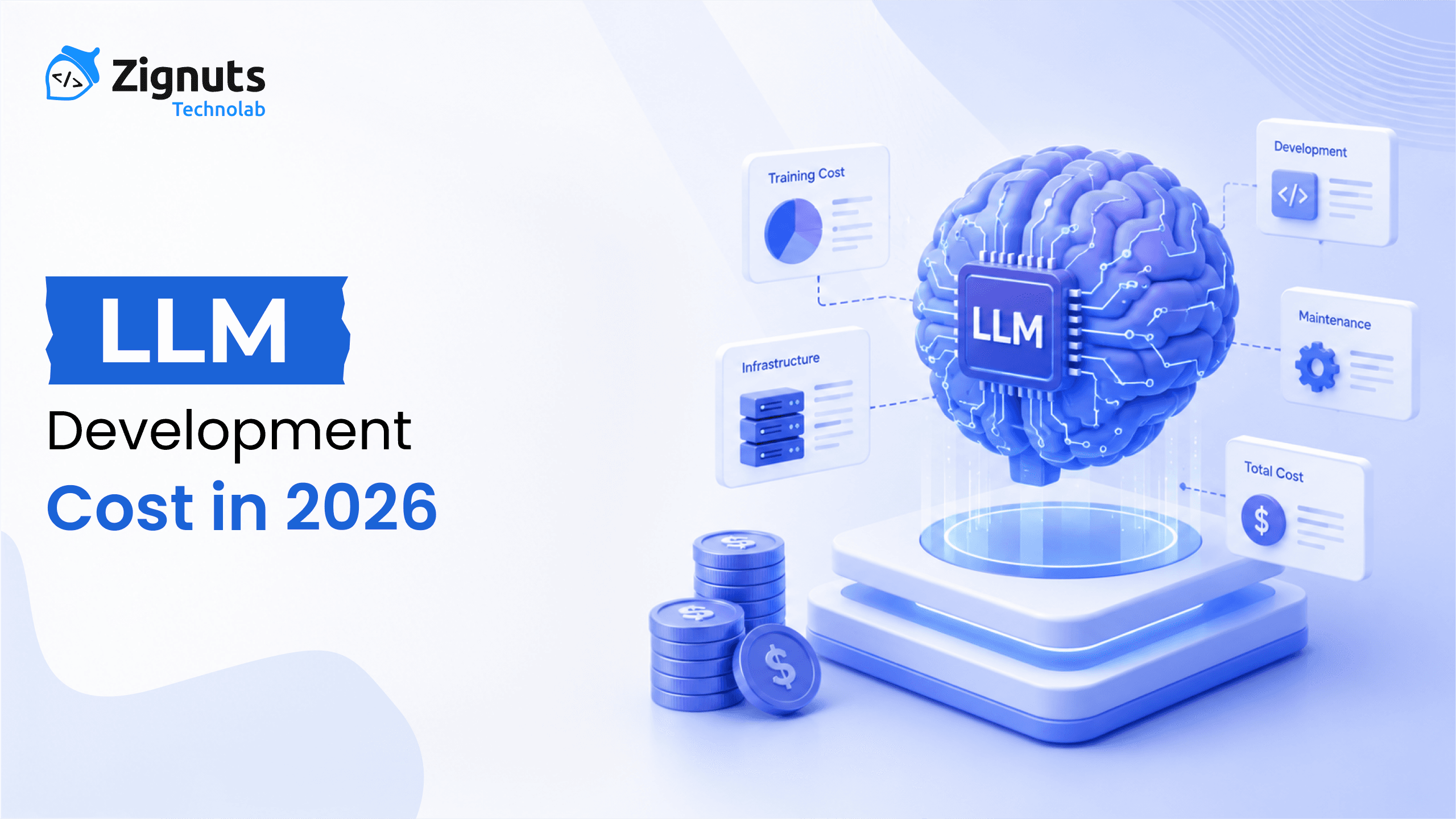
What Are the Main LLM Development Cost Categories?
Cost Category | What It Covers | Typical Share of Year-1 Total |
|---|---|---|
LLM Application Development Cost | One-time engineering investment to design and build the system: data pipelines, retrieval architecture, fine-tuning where applicable, agent orchestration, integration with existing tools. | 50–70% |
LLM Inference Cost | Ongoing usage-based cost of running the model through a metered API or self-hosted infrastructure. Scales with production usage. | 5–20% (pilot) → 20–40% (at scale) |
LLM Infrastructure and Hosting Cost | Vector database hosting, application servers, self-hosted model infrastructure where applicable, and surrounding cloud resources. | 5–15% |
LLM Maintenance and Optimization Cost | Ongoing evaluation, retraining or reindexing, integration updates, monitoring, and cost management. | 15–25%, recurring every year |
Development cost is the number most vendors quote, and the number most executives assume is the total. Inference can be close to zero during a proof of concept and become the largest line item within 6–12 months of production rollout. Infrastructure is more predictable but still needs realistic capacity planning. Maintenance is the most consistently omitted line item in initial budgets, despite being permanent for as long as the system runs.
Ready to Build Your LLM Solution?
What Factors Determine LLM Development Cost?
Cost Driver | Impact on Development Cost |
|---|---|
Architecture Type | RAG on a clean knowledge base is the cheapest starting point. Fine-tuning typically adds 30–60% on top of a comparable RAG build, mostly in dataset curation and evaluation. Agentic systems typically run 2–4x a comparable RAG build, driven by state management, error handling, and failure-mode testing. |
Data Environment Complexity | Clean, centralized, labeled data keeps RAG implementation near the low end. Data scattered across legacy systems, inconsistent formats, and unclear ownership can push data preparation to 40%+ of total development time, often the single largest line item on the project. |
Integration Surface Area | A standalone internal tool is the cheapest to build. Each additional enterprise system requiring authentication, permission enforcement, or write access to a system of record (CRM, ERP) typically adds 10–20% to development cost. |
Compliance & Security | Audit logging, access-control enforcement at the retrieval layer, and deployment within boundaries like HIPAA or SOC 2 commonly add 15–30% on top of the base build. |
Practical budgeting rule: Architecture type sets a baseline, data and integration complexity multiply it, and compliance requirements add a further increment on top of that multiplied figure.
LLM Development Cost Example: RAG Application
A mid-size company wants an internal support assistant that answers questions from a 5,000-document knowledge base, integrates with its existing helpdesk tool, and does not involve regulated data.
Architecture baseline (RAG, standalone): ~$25,000
Data complexity: Documents are reasonably well-organized but need cleanup, adding ~15% → ~$29,000
Integration surface area: One helpdesk integration with read/write access, adding ~15% → ~$33,000
Compliance: None required, so no additional increment
Estimated development cost: ~$33,000, with roughly 5–7 weeks of engineering time
If the same company later adds a second system integration and requires SOC 2-aligned audit logging, that figure would realistically move into the $45,000–$55,000 range. The compliance and integration increments stack; they do not replace each other.
Multi-Agent LLM Development Cost Example
Contrast that with a healthcare operations team building a multi-agent system that triages incoming requests, pulls patient scheduling data from an EHR, and writes updates back to a CRM, with HIPAA-scoped access control required throughout.
Architecture baseline (multi-agent, 3x a comparable RAG build): ~$25,000 × 3 = ~$75,000
Data complexity: Scheduling and CRM data span two legacy systems with inconsistent formats, adding ~35% → ~$101,000
Integration surface area: Two systems (EHR read access, CRM read/write), adding ~2 × 15% → ~$131,000
Compliance: HIPAA-scoped audit logging and access control, adding ~25% → ~$164,000
Estimated development cost: ~$160,000–$175,000, with roughly 4–5 months of engineering time
The same underlying framework is used as the RAG example baseline, then multiplied for complexity, with compliance added on top. However, the compounding effect of agentic architecture, multi-system integration, and regulated data pushes the total to more than 5x the narrow-assistant case.
This is why architecture type alone is a poor predictor of cost. The combination of development drivers determines where an LLM project actually lands.
Ready to Build Your LLM Solution?
How Much Does LLM Inference Cost in 2026?
Foundation model API pricing has continued to decline on a per-token basis into 2026, driven by provider competition and continued efficiency improvements in model serving.
This shifts the key question from whether inference is affordable to which combination of model size, context length, and query volume produces the best cost-to-quality ratio.
How Production Scale Affects LLM Inference Costs
The most common budgeting mistake is extrapolating from proof-of-concept usage.
A pilot with a handful of internal users generating a few hundred queries a day can look inexpensive under almost any architecture, often costing under $200/month at current API pricing.
However, production deployment can change the cost significantly:
Thousands of employees or customers
Longer retrieved contexts
Higher query volume per user
Increased usage after launch
A system costing $150/month during a pilot can reach $8,000–$20,000/month at full production scale, depending on query volume and context length.
This is the single most common inference cost that blindsides finance teams after launch.
How Model Selection Affects LLM Inference Costs
Model selection also plays an important role in controlling inference costs. Routing every query to the largest available model can waste 40–60% of inference spend on queries that a smaller, less expensive model could handle just as effectively.
Enterprise systems increasingly use tiered model routing, where:
Straightforward queries are sent to smaller, lower-cost models.
More complex queries are routed to larger models.
Frontier-tier models are reserved for queries that genuinely require deeper reasoning.
This approach helps enterprises balance cost and response quality as usage scales.
LLM Inference Cost Estimation Checklist
Before estimating production inference costs, consider:
Projected production queries per user per day
Expected number of users or customers at 3, 6, and 12 months after launch
Average input and output token volume per query
Retrieved context length
Model tier assigned to each query class
Expected growth in usage after launch
Cost monitoring and alert thresholds
Self-Hosted LLM vs. API: LLM Cost Comparison
Factor | Hosted API | Self-Hosted Open-Source Model |
|---|---|---|
Low to moderate volume | Typically cheaper; cost scales with usage, with no infrastructure overhead. | Often more expensive; GPU infrastructure must be provisioned even when underutilized. |
High sustained volume | Can become expensive as per-token usage scales linearly. | Can become more cost-effective once fixed infrastructure costs are amortized over large, predictable query volumes. |
Operational burden | Provider manages model-serving infrastructure. | Organization manages serving infrastructure, capacity, updates, monitoring, and peak-load provisioning. |
Decision principle | Best when simplicity and flexible usage economics matter. | Best when sustained volume and control justify operational complexity. |
When Is Self-Hosting an LLM More Cost-Effective?
Rather than relying on a rule of thumb, run the comparison using your own numbers:
Monthly API cost = (tokens processed per month / 1,000,000) × API price per million tokens
Monthly self-hosting cost = GPU rental or amortized hardware cost
(engineer hours/month on serving & updates × loaded hourly rate)
Monitoring & operations overhead
Self-hosting is worth pursuing once Monthly self-hosting cost < Monthly API cost, and that gap is expected to hold for the next 6–12 months of projected volume, not just at a single point in time.
As a directional anchor, this typically only happens once a workload is processing several million tokens per day, sustained. Below that, the fixed infrastructure and engineering overhead usually outweigh the per-token savings.
Plug in your provider's actual per-token pricing and a real GPU rental quote before treating either side of this as final. The formula is the point, not the anchor number.
Hidden Costs of Self-Hosting LLMs
Engineering time for model serving
Peak-load provisioning for traffic spikes
Ongoing engineering costs of migrating to better model versions as they're released
These are costs that an API-based approach gets essentially for free.
Ready to Build Your LLM Solution?
Hidden and Recurring LLM Development Costs
LLM Evaluation and Testing Costs
A reliable system needs a representative test set and an objective scoring process. This is real engineering work and is frequently built reactively only after production quality issues appear.
Initial build: 1–3 weeks of engineering time
Ongoing: A few days per month to maintain and re-run against new test cases
LLM Retraining and RAG Reindexing Costs
Fine-tuned models need retraining as requirements or underlying data shift. RAG systems require reindexing as source data changes.
Reindexing: Often weekly to monthly, depending on data velocity
Retraining: Typically quarterly, or triggered by a measurable drop in output quality
LLM Prompt and Integration Maintenance Costs
Model-provider updates can silently change prompt behavior. Independent changes to connected internal tools can also break integrations without warning.
Review cycle: Commonly monthly
Additional work: Ad hoc fixes when a provider ships a model update
LLM Monitoring and Observability Costs
Tracking cost per query, output quality, and latency requires tooling beyond standard application monitoring.
Initial setup: 1–2 weeks
Ongoing: Mostly passive, with periodic dashboard review and alert tuning
Across these four items, a realistic maintenance budget for a mid-size production system typically lands at 15–25% of the original development cost per year. This is the number most initial proposals leave out entirely, and it's the one worth pinning down before signing off on any budget.
Ready to Build Your LLM Solution?
LLM Development Cost by Project Type
Project Type | Development Cost | Cost Profile |
|---|---|---|
Narrow RAG Assistant | $15,000–$60,000 | Lower-cost option using an existing, organized knowledge base and straightforward integration. Focuses mainly on retrieval quality and prompt design. |
Fine-Tuned Domain-Specific Model | $40,000–$120,000 | About 30–60% above a comparable RAG build, mainly due to training-data curation and evaluation. |
Multi-Agent Workflow System | $100,000–$300,000+ | About 2–4× a comparable RAG build before compliance. Requires internal integrations, state management, error handling, and human-review checkpoints. |
Enterprise-Grade Compliant System | +15–30% | Adds 15–30% to the cost of any architecture for requirements such as audit logging, access control, and specific deployment environments. |
Build vs. Buy vs. Partner for LLM Development
When to Buy an LLM Solution
Buying shifts the cost from large upfront development to an ongoing subscription. It is usually the lowest total-cost option when an existing product genuinely fits without significant customization.
Main consideration: Lower flexibility if requirements diverge from the product roadmap.
When to Build an LLM Application In-House
Building in-house shifts the cost toward internal engineering time. It can look cheaper on paper when the team is already employed, but it carries real opportunity costs and rework risks for teams without prior production LLM experience.
Main consideration: Evaluation, retrieval quality, integration, and learning-curve costs are the pieces most often left out of the internal estimate.
When to Hire an LLM Development Company
Partnering shifts the cost toward a defined engagement with an experienced development team. It can reduce the total cost of reaching a reliable production system by avoiding common mistakes and rework cycles.
Main consideration: The visible engagement cost may look higher than the theoretical internal estimate at the outset, but the internal estimate rarely includes rework.
The comparison that actually matters isn't the sticker price of each option; it's the total cost to reach a production-reliable system, including the mistakes and rework that show up after the first version ships.
LLM Development Cost Estimate: Vendor Quote Red Flags
Before comparing prices across proposals, check what's actually included:
Development cost only: No mention of evaluation or maintenance is a strong signal the quote covers month one and nothing after.
No stated model tier or routing strategy: Usually means inference cost hasn't been modeled at production volume, only pilot volume.
Flat integration estimate: Integration cost should visibly scale with how many systems you're connecting to and what access they require.
No line item for reindexing or retraining cadence: For RAG or fine-tuned systems, this is a recurring cost, not optional maintenance.
A proposal missing two or more of these isn't necessarily dishonest, but it's incomplete, and the gap usually surfaces as an unbudgeted cost six months into production.
Ready to Build Your LLM Solution?
How to Estimate LLM Development Cost
Start with the business process, not the technology. Define the task the system must complete and what a correct output looks like.
Estimate development cost based on architecture type. Then adjust upward for data-environment complexity and integration surface area, using the ranges in Section 7 as a starting anchor.
Model inference cost at projected production volume, not pilot volume. Use realistic queries per user per day and expected context length, as outlined in the checklist in Section 4.
Budget infrastructure based on the deployment model. Include peak-load provisioning for self-hosting or expected API spend at scale.
Add a maintenance budget as a permanent recurring cost from year one. A 15–25% annual budget of development cost is a reasonable starting anchor covering evaluation, retraining or reindexing, and monitoring.
Add a compliance and security increment when the system touches regulated data. Scope it to the specific framework the organization must satisfy.
This produces a materially more realistic total than pricing development alone and assuming everything else is negligible.
LLM Development Cost: Key Takeaways
LLM cost has four separate, ongoing categories: development, inference, infrastructure, and maintenance, not one number.
Inference cost should be modeled at production volume, not pilot volume. A 10–100× jump from pilot to production is common, not exceptional.
Self-hosting only becomes cost-competitive with API access at meaningful, sustained volume, and its operational cost is frequently underestimated.
Maintenance, evaluation, retraining, and monitoring typically run 15–25% of development cost per year and are the categories most often left out of initial budgets.
Architecture type, data complexity, integration surface area, and compliance requirements together determine development cost, and they stack multiplicatively rather than simply adding up.
The real build-vs-buy-vs-partner comparison is total cost to reach a reliable production system, not the initial engagement price.
LLM Development Cost: Final Considerations
LLM development cost in 2026 is best understood as an ongoing operating decision, not a one-time budget line. Falling API prices have made inference more affordable at the margin, but the total cost of a reliable production system is still shaped primarily by architecture choice, data and integration complexity, and the ongoing discipline of evaluation and maintenance.
Organizations that budget for all four cost categories from the start and choose an architecture and deployment model based on realistic production volume rather than pilot-stage usage consistently end up closer to their original estimate than those that price development cost alone. If you're planning an LLM project and need help estimating the right development approach, contact us today to discuss your requirements and build a realistic budget for production.

Virang Kori
Business Analyst | Analyzing business needs, processes, and data to uncover insights, improve efficiency, and support smarter business decisions.