

Business Process Automation Company: What Enterprise Buyers Should Look For
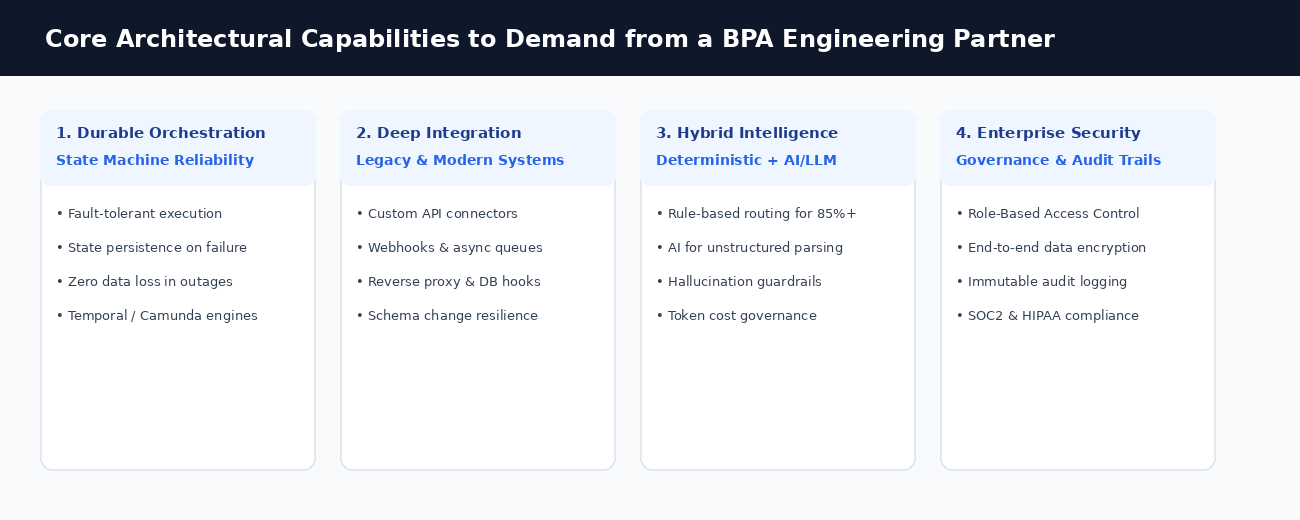
To avoid brittle automations and rising licensing costs, enterprises should choose partners with durable orchestration engineering that separates business logic from external API failures. They should also have deep legacy and modern API integration capabilities without depending entirely on fragile UI scraping, along with hybrid processing architectures that combine deterministic rules with guarded AI models to control inference costs. Business Process Automation Services should align with these core capabilities.
Strong partners should provide enterprise security and audit governance, including SOC 2, HIPAA, role-based access control, and immutable logs. Finally, enterprises should prioritize full intellectual property ownership without proprietary platform fees or lock-in.
Ready to Automate Your Business Processes?

Why Choosing the Right Business Process Automation Company Matters
Selecting a Business Process Automation (BPA) company is one of the most critical operational and architectural decisions an enterprise technology leader will make. When automation succeeds, it eliminates manual friction, reduces operational cycle times by 60% to 80%, improves cross-system visibility, and frees valuable human capital for strategic growth. However, when automation initiatives fail, they can create brittle point-to-point scripts, unmonitored shadow IT pipelines, cascading data corruption, and severe vendor lock-in that limits future agility.
The enterprise automation market in 2026 is crowded, with vendors ranging from traditional Robotic Process Automation (RPA) tool resellers and low-code integrators to global management consultancies and specialized custom software engineering firms. For Chief Technology Officers (CTOs), Chief Operating Officers (COOs), and Enterprise Architects, navigating these options requires evaluating partners beyond high-level marketing claims.
Leaders must rigorously assess:
Engineering depth
Legacy integration capabilities
Fault-tolerant orchestration architecture
Security compliance
Long-term total cost of ownership (TCO)
This strategic guide provides a comprehensive framework to evaluate, vet, and select the right business process automation partner. Based on our engineering experience building scalable workflow engines, financial automation systems, and enterprise data pipelines, it outlines:
Foundational technical capabilities to demand
Critical red flags to avoid
Delivery model trade-offs
An actionable five-stage selection playbook
Why Business Process Automation Projects Fail
Many organizations experience initial enthusiasm during automation vendor demos, only to encounter severe operational disruption within 6 to 12 months of deployment. In our consulting engagements, we frequently observe four systemic causes behind automation failure:
The UI Scraping Trap: Many RPA-centric vendors rely heavily on front-end graphical user interface (GUI) recording and surface-level bot automation. While fast to prototype, UI-based bots break whenever an underlying application updates a button position, changes CSS selectors, or modifies an authentication screen. Top-tier engineering partners prioritize robust API-level integration, webhook ingestion, and database-level connectors, using UI automation only as a last resort for completely closed legacy systems.
Lack of Durable State Orchestration: Basic automation scripts execute sequential HTTP calls. If a third-party CRM, ERP, or payment gateway experiences a momentary network timeout, the entire process terminates midway, leaving databases in an inconsistent state and requiring manual data cleanup. Experienced BPA companies build on durable workflow state machines (such as Temporal or Camunda) that pause execution state, persist transaction context, and resume automatically upon upstream recovery.
Uncontrolled Artificial Intelligence Token Expenses: Inexperienced vendors often attempt to solve complex workflows by routing entire document streams and routine data payloads through general-purpose Large Language Models (LLMs). This creates massive recurring inference bills, introduces hallucination risks, and slows down processing throughput. Engineering-led partners deploy hybrid architectures, using deterministic schema parsers for 85%+ of standard transactions and invoking AI models solely for complex, unstructured exceptions.
Proprietary Platform Lock-in and Escalating TCO: Certain vendors force clients into proprietary low-code platforms that charge steep per-user, per-bot, or per-workflow execution fees. As transaction volumes expand, annual software licensing costs skyrocket, and organizations find themselves unable to migrate their custom workflows to open cloud infrastructure.
Ready to Automate Your Business Processes?
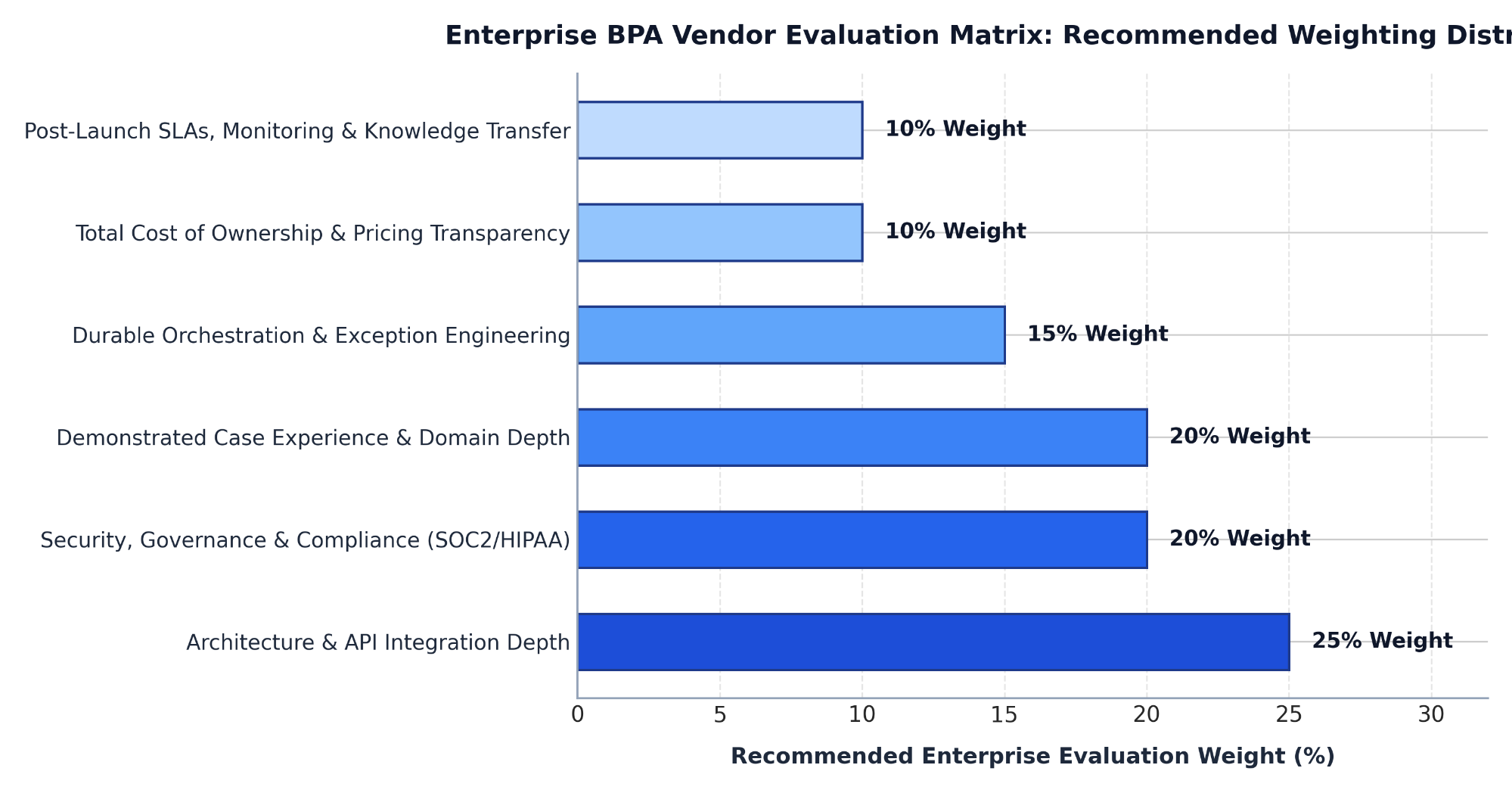
6 Key Criteria for Choosing a Business Process Automation Company
To systematically compare potential automation partners, enterprise evaluation committees should score vendors across six technical, operational, and commercial pillars.
1. Business Process Automation Architecture and API Integration
Enterprise business processes rarely live inside a single ecosystem. Workflows must orchestrate data across legacy ERPs (SAP, Oracle, NetSuite), modern cloud CRMs (Salesforce, HubSpot), database clusters (PostgreSQL, MongoDB), messaging systems, and external banking or logistics APIs. Ask candidates how they handle:
Bidirectional Synchronization: Maintaining data consistency across distributed systems without generating race conditions or duplicate record creations.
Rate Limiting and Backpressure: Buffering inbound transaction spikes using distributed message queues (Kafka, RabbitMQ, AWS SQS) to prevent downstream system crashes.
Schema Drift Resilience: Implementing automated schema validation and contract testing so that upstream API changes are caught before breaking live production workflows.
2. Deterministic vs. AI-Powered Business Process Automation
The ideal automation partner knows when to write deterministic code and when to introduce machine learning models. For structured business rules (such as discount calculations, tax compliance checks, and approval routing), deterministic state machines provide 100% mathematical precision and sub-millisecond execution speeds. For unstructured data (such as parsing non-standard supplier invoices, extracting clauses from legal contracts, or classifying customer intent), the partner should demonstrate deep expertise in Optical Character Recognition (OCR), Retrieval-Augmented Generation (RAG), and fine-tuned domain models with strict validation guardrails.
3. Business Process Automation Security, Governance and Compliance
Automation engines process confidential financial ledgers, customer Personally Identifiable Information (PII), proprietary contracts, and employee payroll data. A qualified BPA partner must adhere to rigorous enterprise security standards:
Access Controls: Enforcing granular Role-Based Access Control (RBAC) and Attribute-Based Access Control (ABAC) to restrict sensitive execution triggers.
Data Encryption: Ensuring end-to-end encryption for data in transit (TLS 1.3) and data at rest (AES-256), with customer-managed encryption key options.
Immutable Audit Trails: Generating tamper-proof execution logs recording every data transformation, API payload, human override, and system timestamp for regulatory compliance (SOC 2 Type II, HIPAA, GDPR, ISO 27001).
4. Business Process Automation Company Experience and Case Studies
Generalist agencies often lack the nuanced domain knowledge required to automate industry-specific workflows. For example, automating healthcare claims requires deep familiarity with HL7 and FHIR data standards, while automating accounts receivable requires understanding two-way and three-way invoice matching rules, ERP ledger posting protocols, and payment reconciliation cycles. Demand verified case studies that illustrate real architectural complexity, production throughput volumes, and quantifiable business outcomes rather than conceptual slide decks.
5. Business Process Automation Pricing and TCO Transparency
Evaluate how the vendor structures their delivery model and commercial terms. Ensure complete transparency regarding upfront engineering costs, recurring cloud infrastructure estimates, third-party API dependencies, and ongoing support retainer fees. Insist on full ownership of all custom source code, documentation, CI/CD scripts, and data models to prevent vendor lock-in.
6. Business Process Automation Support, Monitoring and Knowledge Transfer
Automation platforms require continuous observability to monitor throughput, latency, and error rates. Top-tier BPA partners implement centralized telemetry using industry-standard monitoring stacks (Datadog, Prometheus, Grafana, OpenTelemetry) with automated alerting for failed jobs and unhandled exceptions. Furthermore, evaluate whether the partner offers comprehensive documentation, developer training, and structured knowledge transfer to empower your internal engineering team to maintain and extend the automation platform post-launch.
Ready to Automate Your Business Processes?
Business Process Automation Company Evaluation Matrix
The following evaluation matrix outlines the specific technical capabilities, operational benchmarks, and critical red flags to assess when vetting prospective automation companies.
Enterprise Business Process Automation Vendor Evaluation
Evaluation Dimension | Key Criteria to Assess | What Top-Tier Partners Deliver | Critical Red Flags to Avoid |
|---|---|---|---|
Architectural Foundation | State management, fault tolerance, transaction rollback, and distributed orchestration. | Durable execution state machines (Temporal, Camunda); decoupled worker microservices; automated retry mechanisms with exponential backoff. | Monolithic cron scripts; point-to-point unbuffered webhooks; systems that lose execution state upon server restarts. |
Integration Depth | Legacy ERP connectivity, custom API connectors, database hooks, and webhook ingestion. | Direct REST/GraphQL connectors; custom database adapters; asynchronous message brokers (Kafka/RabbitMQ); resilient schema contract validation. | Exclusive reliance on front-end screen scraping or GUI recording; inability to interface with on-premises or non-REST legacy systems. |
Data & AI Strategy | Handling structured vs. unstructured data, OCR, NLP, token cost control, and validation guardrails. | Hybrid pipeline combining fast deterministic parsing with targeted LLM exception reasoning; automated hallucination detection; strict cost governance. | Routing 100% of payloads through commercial LLMs; lack of output validation; no strategy for handling corrupted or non-standard document layouts. |
Security & Governance | SOC2, HIPAA, GDPR compliance, RBAC/ABAC permissions, credential vaults, and audit logs. | Hardware-backed secrets management (AWS Secrets Manager, HashiCorp Vault); zero-trust network policies; immutable, searchable audit logs. | Hardcoded API tokens in configuration files; shared administrative credentials; absence of detailed data modification logging. |
Code & IP Ownership | Source code licensing, repository access, architecture documentation, and portability. | 100% client ownership of all custom source code, infrastructure as code (Terraform), Dockerfiles, and CI/CD pipelines. | Proprietary vendor runtimes; closed IP locks; restrictive licensing fees that mandate ongoing retainer contracts to execute workflows. |
Observability & SLAs | Real-time telemetry, dead-letter queue (DLQ) alerts, uptime guarantees, and incident escalation. | Centralized dashboards (Grafana, Datadog); automated DLQ alert triggers via Slack/PagerDuty; defined sub-1-hour critical issue SLA response times. | No centralized error tracking; relying on end-users to report broken automations; vague support terms without contractual uptime SLAs. |
Ready to Automate Your Business Processes?
Business Process Automation Company Delivery Models
When selecting an automation partner, organizations typically choose between four primary engagement models. Understanding the architectural and financial trade-offs of each model is critical to aligning your choice with organizational objectives.
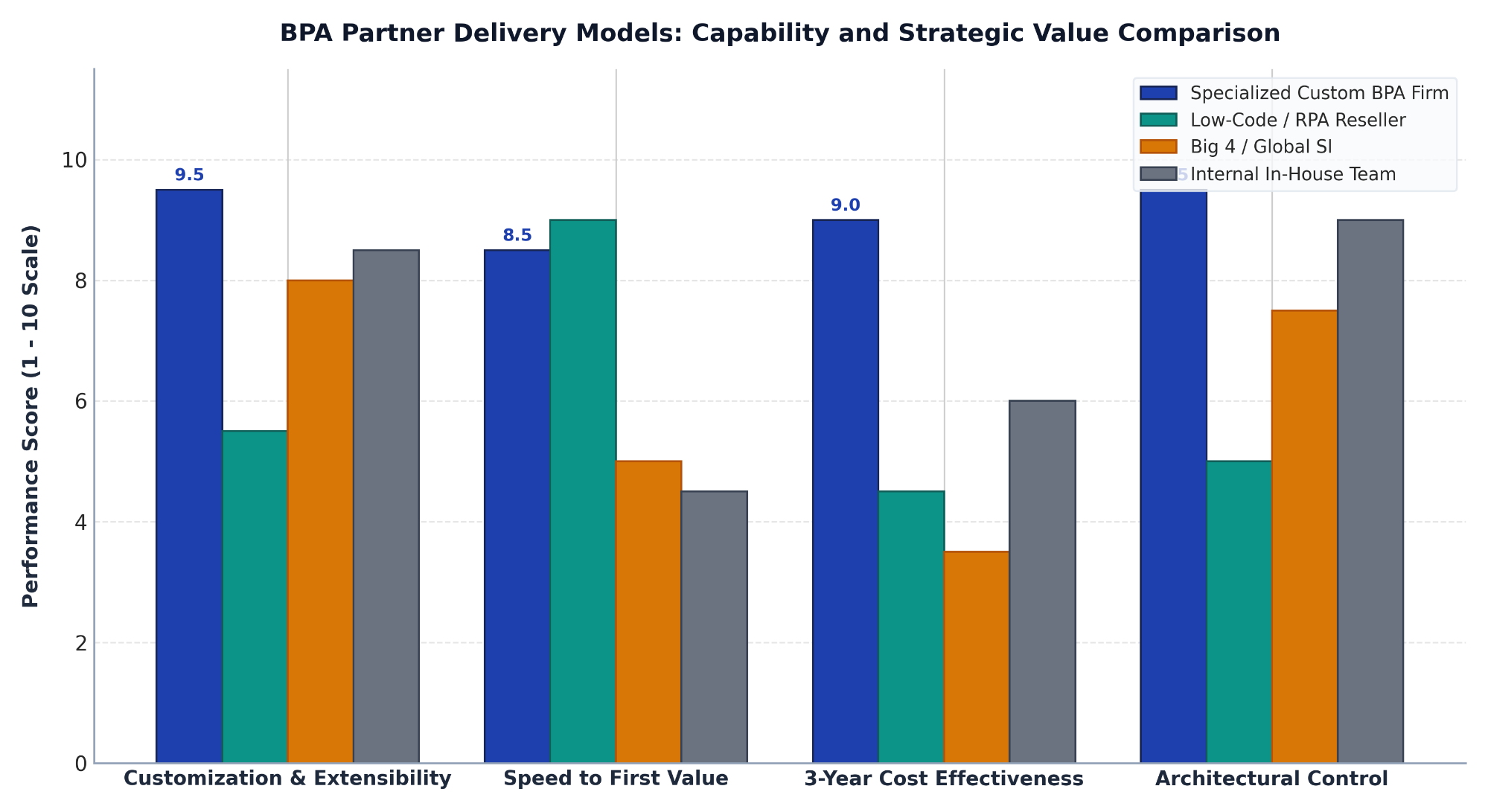
Business Process Automation Delivery Model Comparison
Partner Delivery Model | Primary Strengths | Primary Limitations | 3-Year TCO Profile | Ideal Fit For |
|---|---|---|---|---|
Specialized Custom BPA Engineering Firm | High architectural flexibility; deep custom API and legacy integration; zero platform licensing fees; 100% IP ownership; optimized for scale. | Requires defined technical discovery; higher initial upfront investment than basic no-code setup. | Lowest 3-Year TCO: Upfront build cost with minimal recurring cloud infrastructure expenses as volume scales. | Mid-market and enterprise organizations with complex data workflows, legacy dependencies, or high transaction volumes. |
Low-Code / RPA Platform Reseller | Rapid visual prototyping for simple workflows; drag-and-drop interfaces for non-technical users. | Brittle front-end bots; severe platform vendor lock-in; steep pricing tiers based on user seats or execution counts; poor custom logic support. | High 3-Year TCO: Low initial build cost offset by aggressively escalating annual platform subscription fees. | Small businesses or departmental teams needing simple, isolated automations across standard modern SaaS tools. |
Global System Integrator (GSI) / Big 4 | Massive global headcount; enterprise change management frameworks; broad executive stakeholder alignment. | Extremely high billing rates; slow delivery velocity; reliance on junior offshore staffing; heavy process overhead. | Highest Overall TCO: Multi-million dollar consulting retainers with lengthy implementation cycles. | Fortune 500 enterprises requiring multi-country regulatory transformation and extensive organizational restructuring. |
Internal In-House Development | Direct organizational alignment; immediate internal product knowledge; full strategic control. | High opportunity cost; internal engineers diverted from core product roadmap; long recruiting and ramp-up cycles. | Moderate to High TCO: High ongoing engineering salaries, benefits, and maintenance overhead. | Companies whose core competitive differentiator is proprietary automation intellectual property. |
Ready to Automate Your Business Processes?
Questions to Ask a Business Process Automation Company
During the vendor vetting and Request for Proposal (RFP) process, ask direct, scenario-based technical questions to separate experienced software engineering partners from surface-level integrators.
Evaluation Category | Specific Question to Ask Candidate Vendors | What an Experienced Engineering Partner Will Answer |
|---|---|---|
Fault Tolerance & Retries | How does your automation platform handle a scenario where a downstream ERP API goes offline for 4 hours during a batch transaction? | We utilize durable execution state machines with persisted workflow state. Transactions pause automatically, buffer inbound payloads in message queues, and resume with exponential backoff once the ERP is healthy, preventing duplicate executions or data loss. |
Legacy System Integration | Our core database is an on-premises legacy SQL server without modern REST endpoints. How do you interface with it securely? | We deploy lightweight, containerized edge agents or secure site-to-site VPN tunnels that establish read/write replicas or event-driven change data capture (CDC) pipelines, avoiding risky direct schema writes or brittle UI scraping. |
AI Cost & Accuracy Governance | How do you prevent Large Language Model hallucinations and control token costs when processing thousands of semi-structured PDF invoices monthly? | We implement a hybrid extraction pipeline: deterministic OCR and regex anchors parse 85%+ of standardized layouts instantly. For edge-case layouts, we pass sanitized text to compact, fine-tuned models with strict JSON schema validators and confidence scoring. |
Security & Access Governance | How do you manage secret keys, multi-tenant isolation, and compliance audit trails across multi-department workflows? | All secrets are managed via enterprise key management vaults (AWS KMS, Vault). Workflows enforce strict RBAC/ABAC boundaries. Every payload modification and human override is recorded in an immutable, append-only audit log. |
Handover & Knowledge Transfer | What artifacts do we receive at the conclusion of the project, and how do you ensure our internal developers can maintain the system? | You receive full ownership of clean, documented Git repositories, automated CI/CD deployment scripts, infrastructure-as-code definitions, comprehensive API documentation, architecture blueprints, and hands-on developer training sessions. |
How to Evaluate a Business Process Automation Company: 5-Step Process
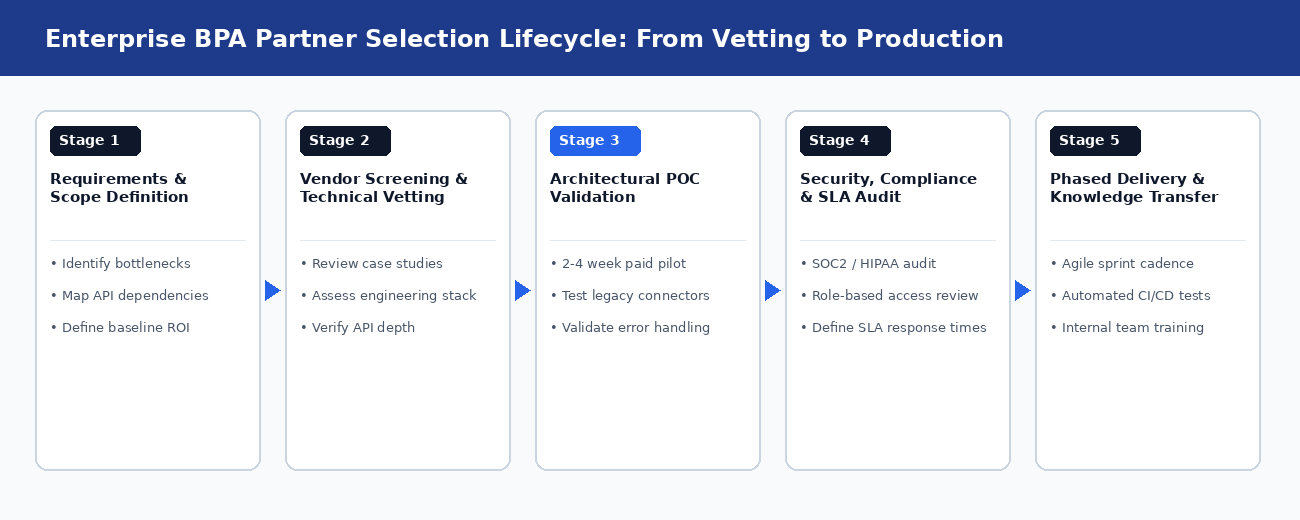
To maximize project success and minimize financial risk, enterprise decision-makers should follow a structured five-stage evaluation playbook when selecting an automation partner.
Stage 1: Internal Workflow Mapping and Objective Definition: Before reaching out to vendors, document your highest-friction business processes. Identify core system dependencies, estimate current manual labor hours, define concrete target KPIs (such as 70% processing time reduction or 99.5% accuracy), and establish a clear budgetary baseline.
Stage 2: Technical Screening and Architecture Deep-Dive: Shortlist 3 to 5 candidate firms based on demonstrated engineering depth and relevant domain experience. Conduct an in-depth technical interview with the partner's lead software architects, evaluating their proposed technical stack, database design, and failure-handling strategies rather than meeting only with sales representatives.
Stage 3: The 2-4 Week Architectural Proof of Concept (POC): Engage the top 1 or 2 finalists in a paid, time-boxed Proof of Concept. Require the vendor to build a functional end-to-end automation for your single most complex edge-case workflow. Evaluate their communication cadence, code quality, testing rigor, and error-handling capabilities on live data.
Stage 4: Security, Compliance, and SLA Audit: Review the vendor's security certifications, data privacy policies, and disaster recovery procedures. Ensure contractual agreements include precise Service Level Agreements (SLAs) for critical incident response times, data recovery windows, and clear IP assignment clauses.
Stage 5: Phased Production Rollout and Internal Enablement: Structure the production rollout in iterative, agile phases. Deploy the minimal viable automation to a controlled user group, validate transaction integrity, and execute structured knowledge transfer sessions with your internal engineering and operations teams before full organizational rollout.
Ready to Automate Your Business Processes?
Business Process Automation Company Case Studies and Experience
The following case studies provide practical examples of how the architectural and operational challenges discussed in this guide can be addressed in real-world automation projects. They cover orchestration, financial data processing, document management, and cloud ecosystem connectivity.
Scalable Orchestration and Cross-Platform Automation: An AI workflow automation platform can use decoupled orchestration pipelines and durable state execution with Temporal and state machines, along with automated retries and centralized telemetry for high-throughput cross-platform tasks.
Hybrid Financial Data Extraction and ERP Synchronization: An accounts receivable automation platform can combine deterministic data parsing with machine learning validation to support automated invoice reconciliation and ERP ledger synchronization.
Intelligent Document Parsing and Secure Governance: A financial document management system can use intelligent document parsing and OCR pipelines with SOC 2 and RBAC security controls to protect sensitive enterprise records.
Cloud Ecosystem Connectivity and Resilient Ingestion: A Google Workspace automation tool can implement OAuth token lifecycle management, asynchronous webhook ingestion, and distributed message queue buffering for multi-tenant cloud environments.
Business Process Automation Company Selection: Key Takeaways
Look Beyond Sales Demos: Prioritize engineering depth, durable state management, and robust API architectures over superficial drag-and-drop bot recordings that fail under production stress.
Control Long-Term Total Cost of Ownership: Custom-engineered automation platforms built on open, scalable cloud infrastructure provide significantly lower 3-year TCO and eliminate recurring per-user or per-bot licensing penalties.
Demand a Hybrid AI Strategy: Choose partners that apply deterministic validation logic to the vast majority of standard transactions, reserving expensive cognitive AI models strictly for unstructured data extraction and complex exception reasoning.
Validate with a Paid Architectural POC: Test candidate vendors on your most demanding integration edge case during a 2- to 4-week proof of concept before committing to an enterprise-wide rollout.
Secure Complete Code and Data Ownership: Ensure your enterprise retains 100% intellectual property ownership of all custom software, connectors, deployment scripts, and architectural documentation.
Conclusion
Choosing the right Business Process Automation Company goes beyond automating repetitive tasks. Enterprises should evaluate partners based on their architecture, integration capabilities, security, AI strategy, TCO transparency, and long-term maintainability. A technical proof of concept can further confirm whether the proposed solution can handle real-world workflows, system failures, and enterprise-scale requirements.
By treating BPA as a long-term engineering investment, organizations can reduce operational risks, avoid unnecessary vendor lock-in, and build automation that scales with business needs. Contact us today to discuss your business process automation requirements and explore a secure, scalable solution aligned with your enterprise goals.

Swati Bais
Business Enthusiast | Curious about how businesses evolve, connecting ideas with insights to discover opportunities and shape better ways of working.