

AI Agent Development Company: What to Look For
Choosing an AI Agent Development Company in 2026 requires vetting vendors as distributed systems engineering partners rather than prompt-writing agencies. Production-grade autonomous agents depend on cyclical state machines such as LangGraph or Temporal, Model Context Protocol (MCP) tool sandboxing, hybrid retrieval pipelines, deterministic guardrails, and automated trajectory evaluation harnesses. Over 40% of enterprise agent initiatives stall when built on naive prompt loops. Engineering leaders must evaluate partners across seven architectural pillars, demand production-tested case studies, and enforce full IP code ownership with zero black-box lock-in.
How to Identify a Reliable AI Agent Development Company
For enterprise technology executives, 2026 marks the end of experimental AI vanity projects. As organizations move toward autonomous, production-ready systems, AI Agent Development Services are increasingly focused on building reliable agents that can operate across complex enterprise environments. The conversation among CTOs, VPs of Engineering, and Chief Digital Officers has shifted from conversational chat interfaces to autonomous, multi-agent systems that:
Reason across stateful graphs
Execute tool calls against internal microservices
Interact with core databases
Automate multi-step operational workflows
Yet, hiring the right engineering partner to build these systems has become a minefield.
The technology services market is flooded with 'agent washing': traditional software shops and marketing agencies rebranding simple prompt-chaining scripts as 'enterprise autonomous agents.'
These superficial wrappers look impressive during a scripted sales demonstration, but they fail catastrophically once exposed to real-world production environments.
Why AI Agent Development Companies Need Production-Ready Architecture
When an agent is deployed into production, it encounters:
Non-deterministic model outputs
Dirty enterprise data
Transient network errors
Malicious prompt injections
A naive ReAct (Reason + Act) loop running without state invariants quickly:
Falls into recursive loops
Burns through thousands of dollars in wasted tokens
Corrupts backend database records
What to Expect From an AI Agent Development Company
Industry analysts at Gartner project that over 40% of agentic AI initiatives will be abandoned by 2027 due to:
Uncontrolled operational costs
Lack of deterministic guardrails
Absent evaluation harnesses
Building reliable AI agents is not a prompt-crafting exercise; it is an advanced branch of distributed systems software engineering.
Choosing the right development partner means finding a team that builds hardened, fault-tolerant execution harnesses around probabilistic models.
Common Production Risks in AI Agent Development |
Ready to Build a Production-Ready AI Agent?

7 Key Criteria for Choosing an AI Agent Development Company
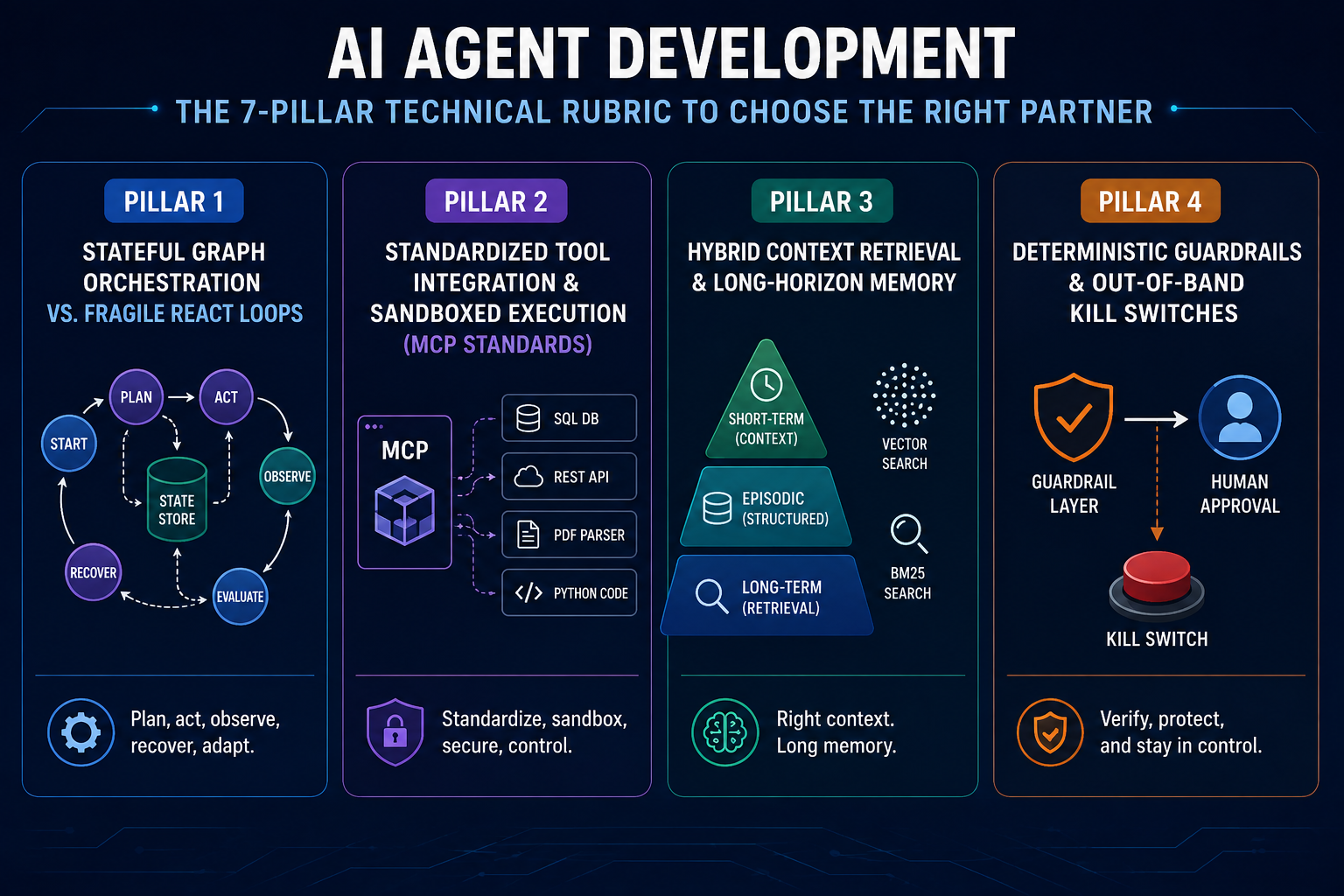
To filter out superficial agencies and identify true production-grade engineering partners, enterprise technical leaders should evaluate candidates against seven concrete architectural pillars:
Pillar 1: Stateful AI Agent Architecture and Orchestration
Autonomous agents cannot rely on simple linear scripts. Real-world workflows require planning, tool dispatching, intermediate result reflection, and error recovery. A competent AI development company designs cyclical state machines using battle-tested frameworks like LangGraph, Microsoft Semantic Kernel, or custom Finite State Machines (FSMs).
Ask prospective vendors: How does your architecture handle branching logic, state serialization, cyclic loop limits, and automated rollback when a sub-agent fails? If their answer revolves around 'we ask the LLM to try again in the prompt,' they lack production systems experience.
Pillar 2: MCP Tool Integration and Sandboxed AI Agent Execution
Agents derive their operational power from calling tools: querying SQL databases, triggering REST APIs, parsing PDFs, or executing Python code. Giving an LLM direct, unconstrained access to production infrastructure creates massive operational and security risks.
Top-tier development firms standardize tool integration using the open Model Context Protocol (MCP) and isolate tool execution inside containerized microVMs (such as Docker, Firecracker, or gVisor). They implement least-privilege Role-Based Access Control (RBAC) and idempotency keys to ensure an agent cannot accidentally trigger duplicate financial transactions or mutate database schemas.
How Constrained Decoding Improves AI Agent Tool Reliability |
Pillar 3: Memory and Context Retrieval for AI Agents
Stateless foundation models cannot retain historical context across long-running enterprise tasks. A production agent requires a three-tiered memory architecture:
sliding-window context compression for immediate turn-by-turn reasoning,
structured relational storage for episodic task logs, and
hybrid retrieval engines pairing dense vector embeddings (pgvector, Qdrant) with sparse lexical search (BM25) and cross-encoder rerankers.
Vendors must demonstrate how they prune irrelevant tokens, prevent context poisoning, and implement semantic caching (via Redis) to cut operational expenses on repetitive sub-tasks.
Pillar 4: AI Agent Guardrails, Security and Kill Switches
Prompt-based instructions (e.g., 'Never reveal confidential data') fail under direct and indirect prompt injection attacks. Enterprise-ready AI partners implement out-of-band deterministic guardrail layers (such as NeMo Guardrails, Llama Guard, and regex PII filters) that validate inputs before the model sees them and sanitize outputs before they reach the user or database.
Crucially, they architect independent, out-of-the-loop kill switches and mandatory Human-in-the-Loop (HITL) approval gates for consequential or financial actions.
Why Production AI Agents Need Independent Security Controls |
Pillar 5: AI Agent Testing and Evaluation
In traditional software, automated CI/CD unit tests verify deterministic code. In AI agent engineering, testing requires synthetic evaluation harnesses (such as DeepEval and RAGAS) that measure answer relevancy, faithfulness, tool selection accuracy, and multi-step trajectory completion.
A serious engineering partner delivers a comprehensive test suite alongside the application, running automated regression evals before every production model update or prompt modification.
Pillar 6: AI Agent Observability and Cost Management
Traditional Application Performance Monitoring (APM) tools track server latency and HTTP error codes, but they cannot measure reasoning drift, token expenditure, or hallucination rates. Professional AI developers instrument every execution step with OpenTelemetry-compliant distributed tracing (using LangSmith, Phoenix, or Langfuse).
In addition, they implement intelligent model routing: dispatching high-speed, cost-effective Small Language Models (SLMs) for intent classification and schema parsing, while reserving expensive frontier reasoning models exclusively for complex execution graphs.
Pillar 7: AI Agent Development Company Experience and IP Ownership
Never accept generic claims of AI capability without inspecting concrete client case studies that demonstrate measurable operational ROI. Ensure the development partner guarantees 100% intellectual property ownership, transferring all orchestration code, prompt assets, custom evaluation harnesses, and infrastructure blueprints directly to your organization.
AI Agent Development Architecture for Scalable Multi-Agent Systems
When interviewing potential engineering partners, ask them to diagram their target system architecture.
A robust, production-grade enterprise multi-agent platform should clearly separate concerns across five distinct structural layers:
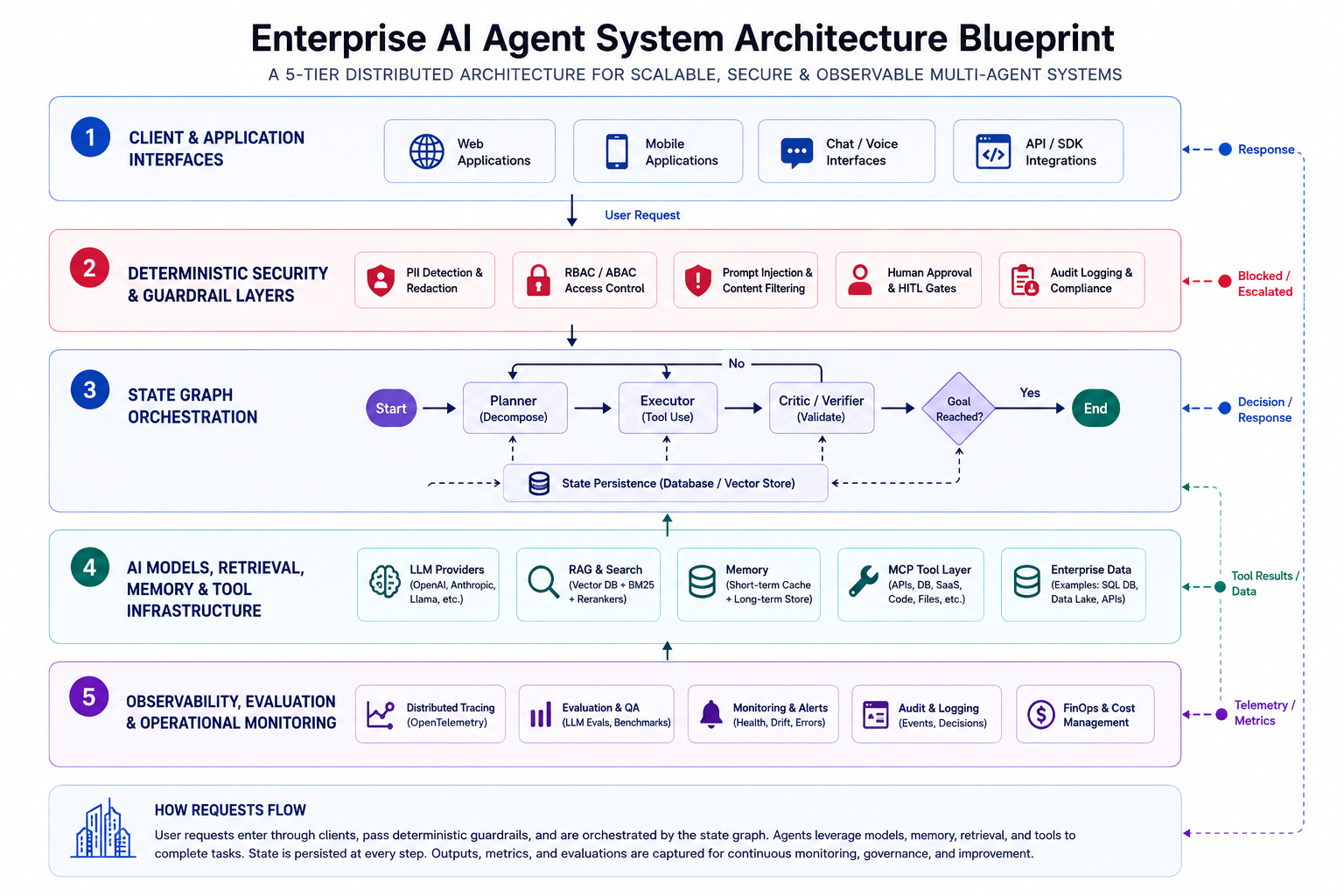
Client and application interfaces
Deterministic security and guardrail layers
State graph orchestration
AI models, retrieval, memory, and tool infrastructure
Observability, evaluation, and operational monitoring
Enterprise AI Agent Architecture Blueprint
A 5-tier distributed architecture spanning client interfaces, deterministic guardrails, state graph orchestration, multimodal infrastructure, and OpenTelemetry observability.
The architecture should demonstrate how user requests move through the system, how state is persisted, how agents interact with enterprise tools, and where security, evaluation, monitoring, and human approvals are enforced.
This is one of the clearest ways to distinguish genuine AI Agent Development expertise from a collection of prompt wrappers.
A capable partner should be able to explain not only how an agent generates an answer, but how the entire system behaves when tools fail, models drift, data is incomplete, or a workflow requires human intervention.
Ready to Build a Production-Ready AI Agent?
AI Agent Development Company RFP Scorecard: 100-Point Evaluation Framework
To objectively compare proposals and avoid emotional sales pitches, engineering leadership should apply this structured 100-point evaluation rubric during technical due diligence:
Evaluation Domain | Weight | Key Technical Verification Criteria | Red Flag Warning |
|---|---|---|---|
Architecture & State Management | 25 Points | Explicit DAG/FSM state machine, cyclical loop handling, state persistence, rollback on failure. | Linear prompt chains or raw AutoGen/ReAct scripts without state controls. |
Tool Sandboxing & MCP | 20 Points | Model Context Protocol (MCP), ephemeral container isolation, strict schema binding. | Direct unsandboxed API calls with hardcoded credentials or unbounded DB write access. |
Memory & Context Optimization | 15 Points | Hybrid BM25 + dense vector search, context compression, Redis semantic prompt caching. | Full-text dumping into the prompt window resulting in context saturation. |
Security, Safety & Governance | 15 Points | Out-of-band guardrails, PII masking, RBAC, external kill switches. | Reliance solely on system prompts for compliance and safety. |
Evaluation Harnesses & CI/CD | 15 Points | Synthetic evaluation suites, trajectory regression benchmarks, automated CI/CD. | Manual playground testing with no regression baselines. |
IP Ownership & Commercials | 10 Points | Full transfer of code, prompts, configurations, and models with transparent milestone-based pricing. | Proprietary vendor lock-in, recurring per-seat costs, or closed-source runtimes. |
6 Red Flags to Avoid When Choosing an AI Agent Development Company
During vendor discovery calls, watch out for these six common red flags that indicate a team lacks the systems engineering maturity required for production AI agents:
Red Flag 1: Unrealistic AI Agent Autonomy Claims
What the Vendor Claims:
"Our agents are 100% autonomous and handle everything from day one."The Production Reality & Risk:
Dangerous overpromising. Production agents require Human-in-the-Loop checkpoints for high-risk and financial operations.
Red Flag 2: No Automated AI Agent Testing
What the Vendor Claims:
"We test our prompts thoroughly in OpenAI playground and verify outputs."The Production Reality & Risk:
Complete absence of automated evaluation harnesses. Any model update will silently break workflows without regression detection.
Red Flag 3: Using Expensive Models for Every Task
What the Vendor Claims:
"We route every task to GPT-4o or Claude 3.5 to ensure maximum intelligence."The Production Reality & Risk:
Runaway token expenses. High-performing systems use multi-tier model routing, dispatching SLMs for routine classification.
Red Flag 4: Proprietary AI Agent Platform Lock-In
What the Vendor Claims:
"You must host the agent on our proprietary cloud platform and pay per seat."The Production Reality & Risk:
Loss of intellectual property and data sovereignty. Enterprises should compose on open frameworks and own all source code.
Red Flag 5: Uncontrolled AI Agent Tool Permissions
What the Vendor Claims:
"The agent has access to your database and can update records dynamically."The Production Reality & Risk:
Catastrophic data corruption risk. Tools must be sandboxed, schema-constrained, and governed by strict RBAC.
Red Flag 6: No AI Agent Cost or Observability Tracking
What the Vendor Claims:
"We will check server logs if an error or unexpected output happens."The Production Reality & Risk:
Zero visibility into decision trajectories, token cost per task, latency bottlenecks, or intermittent hallucinations.
AI Agent Development Company Pricing and Engagement Models
Engagement Model | Optimal Use Case | Cost Predictability | Delivery Velocity | Strategic Risk Profile |
|---|---|---|---|---|
Fixed-Price Architecture & PoC | Discovery, feasibility validation, and initial 4- to 6-week prototype development. | High (Capped milestone budget) | High (Fast initial proof) | Low risk; validates technical feasibility before committing to large CapEx. |
Dedicated Co-Development Squad | Full-scale production build, multi-agent scaling, and enterprise ERP/CRM integration. | High (Predictable monthly sprint cost) | Maximum (Full agile team velocity) | Minimal risk; pairs senior architects with in-house teams while transferring full IP. |
Staff Augmentation (T&M) | Filling niche skills (e.g., adding one MLOps engineer to an existing mature AI team). | Medium (Variable hourly billing) | Medium (Requires internal management) | High risk if internal team lacks senior AI systems architecture leadership. |
Ready to Build a Production-Ready AI Agent?
AI Agent Development Company Case Studies and Experience
A credible AI Agent Development partner should demonstrate a track record of solving real-world engineering challenges across different enterprise domains. The following case studies highlight practical applications of AI agents, workflow automation, legal research, and healthcare technology, along with the engineering challenges and outcomes involved.
1. Custom AI Agent Platform Development
Business Challenge:
Enterprise technology organizations faced developer friction, architectural instability, and rising infrastructure costs when orchestrating custom multi-agent workflows across disconnected internal services.
AI Agent Development Solution
The platform was designed around a modular architecture that brought together:
Visual Directed Acyclic Graph (DAG) state orchestration
Standardized LLM routing pipelines
Persistent vector memory stores
Containerized tool execution sandboxes
Business Impact
Accelerated enterprise agent deployment velocity by 4x
Reduced initial development CapEx by over 50%
Eliminated redundant prompt token consumption across multi-turn reasoning loops
2. AI Agent Workflow Automation Platform
Business Challenge
A multi-departmental enterprise was dealing with fragmented SaaS tools, manual data re-entry, and fragile legacy RPA scripts that failed whenever input formats changed.
AI Workflow Automation Solution
Our engineering team designed an intelligent process automation engine combining:
NLP intent routing
Automated event triggers
Custom webhook connectors
Resilient state machines with automatic rollback capabilities
Business Impact
Replaced brittle RPA scripts with self-healing intelligent workflows
Reduced operational exception handling by 60%
Enabled real-time synchronization across departments
3. AI Legal AI Agent Development Case Study
Business Challenge
Legal practitioners and corporate compliance teams faced high query latency and significant hallucination risks when working with large databases of statutory codes, case precedents, and complex agreements.
AI Legal Research Solution
The solution used a domain-specific Hybrid RAG architecture that combined:
Dense vector embeddings
BM25 keyword search
Contextual citation graphs
Fine-tuned legal embeddings
Hallucination verification guardrails in the AI Contract Review Platform
Business Impact
Eliminated citation hallucinations in regulatory outputs
Cut document audit turnaround times by 75%
Reduced token context retrieval costs by 45% through precision chunking
4. AI Healthcare Agent Development Case Study
Business Challenge
A digital health provider required an intelligent clinical triage and symptom monitoring assistant while addressing strict HIPAA, GDPR, and clinical data governance requirements.
AI Healthcare Solution
The solution included:
End-to-end encrypted data exchange pipelines
Real-time PII de-identification filters
FHIR/HL7 interoperability interfaces
Role-based access control
Immutable audit logging
Business Impact
The solution was designed to support regulatory compliance from day one, helping reduce the risk of costly post-deployment security refactoring and compliance issues.
How to Choose an AI Agent Development Company: 5-Step Selection Process
To move from evaluation to execution, engineering leaders can follow this five-step roadmap:
1. Define Your AI Agent Use Case and Scope
Avoid open-ended autonomy for your first deployment. Start with a high-frequency, business-critical process that has clear, measurable KPIs, such as ticket resolution speed or invoice processing throughput.
2. Evaluate the AI Agent Development Company's Technical Expertise
Give each candidate vendor the 100-point scorecard and ask their lead architect to walk through their approach to state management, MCP sandboxing, and evaluation methodologies.
3. Start With an AI Agent Architecture and Discovery Sprint
Before committing to a multi-month build, fund a focused discovery phase. The vendor should deliver a comprehensive Technical Architecture Document (TAD), cost model, and working proof of concept.
4. Set AI Agent Evaluation and Performance Baselines
Make sure the vendor defines golden test datasets and measurable accuracy metrics before production orchestration logic is developed. This gives your team a baseline for evaluating system performance.
5. Ensure Full AI Agent Source Code and IP Ownership
Ensure that all source code, prompt configurations, Docker containers, and CI/CD pipelines remain within your organization's private repositories. This protects long-term ownership and reduces dependency on the development partner.
Conclusion
Choosing the right AI Agent Development partner means looking beyond prototypes and evaluating architecture, security, scalability, testing, cost control, and IP ownership.
Use the technical rubric and evaluation framework in this guide to make a confident decision and reduce production risks. Planning to build a secure, scalable AI agent? Contact us today to discuss your requirements with Zignuts.

Mukund Patil
Business Enthusiast | Exploring ideas, trends, and opportunities, turning curiosity into meaningful insights and discovering smarter ways to make an impact.