

Enterprises rarely fail with AI because a model cannot generate an answer. They fail because nobody can explain which data it used, who approved its use, what happens when it is wrong, or who owns the incident. That gap becomes expensive once copilots, predictive models, and automated decisions move from a controlled pilot into customer, employee, clinical, or financial workflows.
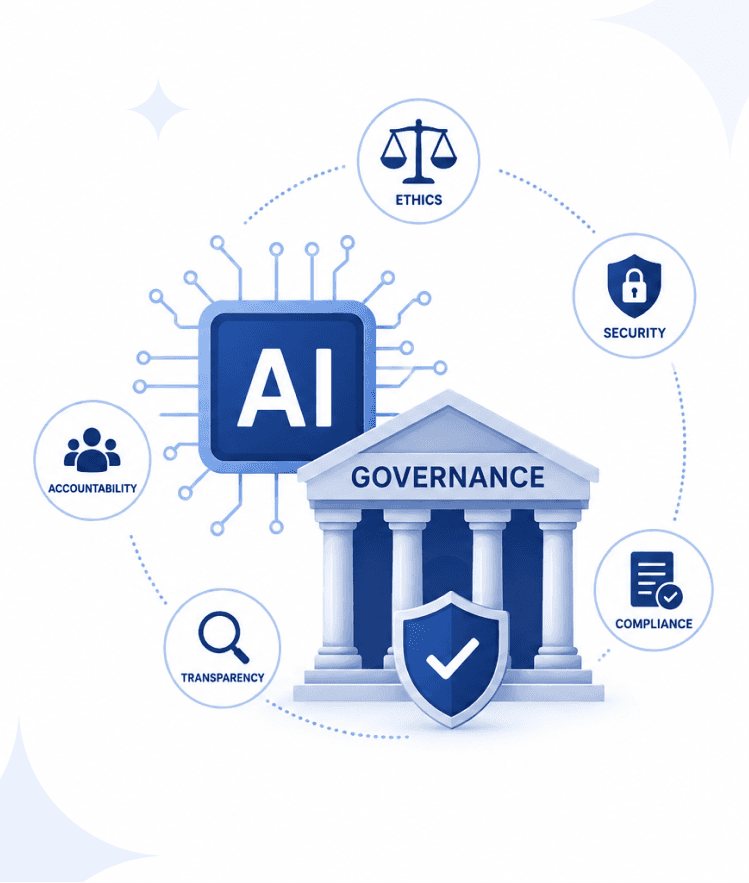
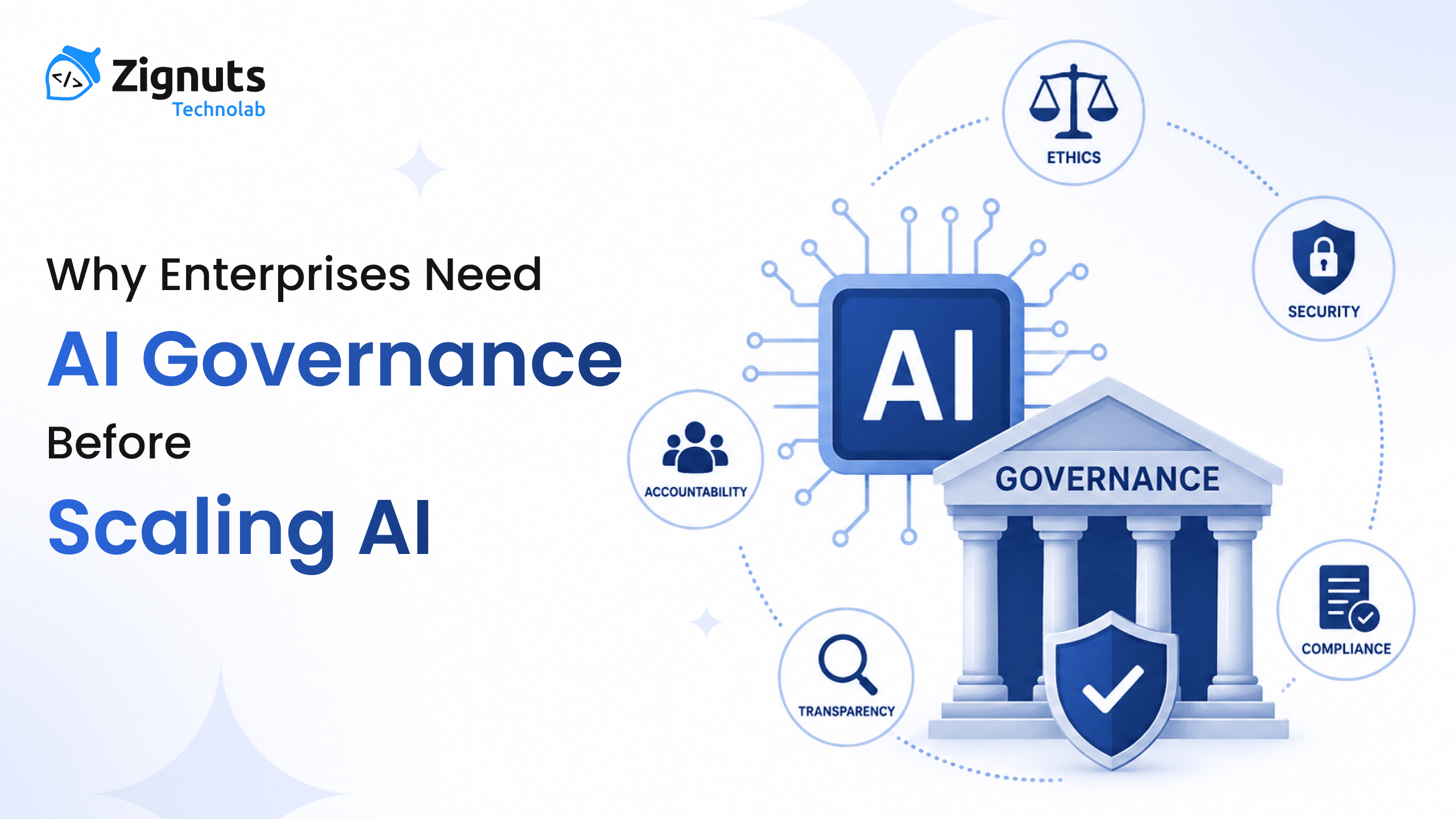
AI governance is the operating system around AI delivery: decision rights, risk controls, evidence, monitoring, and escalation. It should begin before broad deployment, not after a regulator, auditor, or affected customer asks difficult questions. For a global insurer processing claims, a hospital network supporting triage, or a bank screening transactions, the same principle applies: a useful model without accountable controls creates unmanaged operational risk.
The goal is not to slow innovation. A proportionate governance model gives product teams approved patterns, reusable assessments, and clear boundaries, so low risk work moves quickly while high impact use cases receive the scrutiny they deserve.
Why AI Governance Becomes Critical When Enterprises Scale AI
A pilot can succeed with a small, expert team and a clean dataset. Production changes the economics. A B2B SaaS platform with 5,000 enterprise customers may introduce AI features into support, sales intelligence, and administration within two quarters.
Each feature can have different data residency needs, retention rules, user permissions, and failure consequences. Governance must manage the portfolio, not merely certify a single model.
Most organizations struggle here because they treat governance as a security review at launch. Six months later, prompt templates have changed, a vendor has updated its model, users have discovered unintended workflows, and the original risk assessment no longer describes reality. The hidden risk is model and workflow drift, not only model accuracy.
Start by assigning an accountable business owner, a technical owner, and a risk owner to every production use case. The business owner accepts the operational outcome, the technical owner maintains interfaces and observability, and the risk owner confirms controls remain appropriate.
This is Critical, with high confidence. Shared responsibility without named decision rights is usually no responsibility.
Note: If a team cannot name the human who can suspend an AI workflow within 30 minutes, that workflow is not ready for high impact production use.
Many leaders assume a central AI committee should approve every experiment. That approach creates a queue and encourages teams to work around it. A better pattern is centralized policy with distributed execution: preapproved low risk patterns for internal summarization, and formal review for systems that influence eligibility, pricing, diagnosis, hiring, payments, or legal outcomes. This distinction prepares the organization to classify risk consistently.
How Should Enterprises Classify AI Risk?
The same foundation model can present radically different risk depending on its role. Summarizing public product documentation is not equivalent to drafting prior authorization recommendations for 5 million health plan members.
In healthcare, an inaccurate summary may be inconvenient; an incorrect recommendation can delay care, create a clinical safety event, and contaminate handoff documentation. In financial services, an automated explanation may be benign while a transaction block can create a customer harm and a reconciliation exception.
AI Governance Risk Assessment Framework: The TRACE Model
Use TRACE to decide the level of governance required: Trigger, Rights, Accountability, Consequence, and Evidence. Trigger asks what initiates the AI action. Rights asks whether sensitive, regulated, or customer data is involved. Accountability identifies the person who can override the outcome. Consequence measures the impact of a wrong or unavailable result. Evidence defines the logs, evaluations, approvals, and records required to prove responsible operation.
TRACE dimension | Question | Practical control |
|---|---|---|
Trigger | Does AI initiate or only assist a task? | Separate recommendation from automated execution |
Rights | Which data and user rights apply? | Data classification, consent, access boundaries |
Accountability | Who can override or stop it? | Named owner and tested escalation route |
Consequence | What is the cost of an error? | Human review, fallback workflow, thresholds |
Evidence | What must be demonstrated later? | Versioned logs, evaluation results, approvals |
A practical rule is simple: the more a workflow can alter a person’s rights, health, money, or access, the less acceptable it is to rely on a single opaque output. This is Critical for regulated decisions and Important for internal productivity tools. Teams commonly fail by scoring the model once, rather than scoring the complete chain of input data, retrieval sources, user interface, human review, and downstream action.
Classification also prevents waste. Requiring the same documentation for a meeting note assistant and an automated fraud hold drains specialist capacity. With the risk tier defined, the next concern is making data and architecture enforce those decisions.
Planning to scale AI across your organization?

Why Data Governance Is Critical for Enterprise AI
Most enterprises believe model selection is the key architectural decision. In practice, data access and identity boundaries determine whether an AI program can scale safely.
A 15 hospital regional health system may have protected health information in electronic records, DICOM imaging repositories, nursing notes, and call center transcripts.
Sending all of it to a general purpose service without purpose limitation and auditability is not an AI strategy. It is an uncontrolled data transfer.
Build a governed path from source to response: classify data before retrieval, enforce role based access at query time, minimize fields sent to the model, and retain an event record that links user, policy, model version, source set, and outcome.
For a payer’s prior authorization assistant, that record should support clinical review, privacy investigation, and appeal handling. For a payment processor handling 10 million daily transactions, it should support transaction reconciliation and fraud investigation without exposing full account data.
There is a trade off. Centralizing all data behind one retrieval platform improves consistency but can become a bottleneck for 8 to 10 independent engineering teams. Federated retrieval is faster for domain teams but requires common identity, metadata, and logging standards.
Choose central enforcement with federated domain ownership when data estates are large. This recommendation has high confidence.
Note: Do not connect a production model to a data source unless its owner can answer who may access it, for what purpose, for how long, and how that access is revoked.
Why do implementations fail after launch? Teams often log prompts but omit retrieved documents, policy decisions, and tool calls. During an incident, they can see what the user asked but cannot reconstruct why the system responded. Observability must cover the workflow end to end. That evidence becomes essential when governance moves from design review to continuous assurance.
How to Implement AI Governance in Enterprise AI Systems
Policies that exist only in slide decks do not control production systems. Establish a model and use case inventory with owner, purpose, risk tier, approved data classes, vendor, version, geographic processing location, evaluation status, and retirement date. Treat this inventory as a service catalog, integrated into release management rather than maintained manually in a spreadsheet.
For high-impact workflows, evaluate before release and continuously afterward. Test factual grounding, harmful output, privacy leakage, prompt injection resistance, latency, cost per completed task, and human override rates. Set thresholds appropriate to the workflow.
A customer support drafting assistant might require 95 percent grounded answers on a representative test set, while a clinical workflow should require much stricter validation, controlled scope, and explicit clinician review. No aggregate score removes the need for scenario testing.
Critical: Require versioned evaluations and approval before changing a model, prompt, retrieval corpus, or autonomous tool permission.
Important: Monitor quality, refusal rate, latency, token cost, and override rate by business workflow, not only by model.
Important: Run quarterly access and incident response exercises, including vendor outage and unsafe output scenarios.
Optional: Create a reusable policy as a service layer that blocks disallowed tools or data classes at runtime.
The counterintuitive point is that a fully autonomous approval path is often not the best return on investment. A well-designed human review queue for the 5 percent of uncertain cases can preserve speed for the majority while avoiding costly exceptions.
If 20 analysts each save 30 minutes a day, the benefit is meaningful, but only if review work does not simply shift to another team. Measure net workflow time, not generated output volume.
How Much Does Enterprise AI Governance Cost?
Budgets often cover a proof of concept and omit evaluation, monitoring, legal review, identity integration, and change management. Those omissions explain why an apparently inexpensive tool becomes difficult to govern at scale.
The ranges below are illustrative for a mid-sized enterprise program with several production workflows; regulated environments and complex legacy integration can exceed them.
Cost category | Annual planning range | Commonly missed expense |
|---|---|---|
Platform and model usage | $100,000 to $500,000 | Peak volume and failed requests |
Integration and engineering | $250,000 to $1.2 million | Identity, source permissions, fallback paths |
Governance and assurance | $100,000 to $400,000 | Evaluations, audit evidence, incident exercises |
Operations and support | $150,000 to $600,000 | Human review and user training |
Security and compliance | $75,000 to $300,000 | Third-party assurance and data residency review |
For every dollar spent on architecture and controls early, enterprises can avoid several dollars in rework, duplicated integrations, and incident remediation later. The exact multiple varies, but the direction is reliable.
The business case should compare baseline cycle time, error cost, compliance exposure, and adoption against the full operating cost over three years. This is Important with high confidence, because AI value depends on sustained workflow adoption, not a launch announcement.
Governance also changes vendor selection. Ask vendors for exportable audit data, regional processing commitments, incident notification terms, model change notices, data retention controls, and a practical route to exit.
A vendor that cannot support evidence requirements can impose a larger future migration cost than its subscription price suggests. With ownership and economics explicit, implementation can proceed in measured phases.
How to Build an Enterprise AI Governance Framework
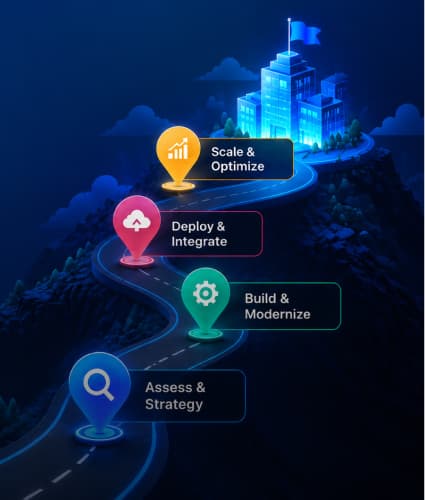
A phased approach reduces disruption and creates evidence before enterprise-wide commitments. Begin with two or three use cases that have measurable value and manageable risk, such as internal knowledge assistance with approved sources or agent assist with human review. Do not begin with automated employment, credit, clinical, or payment decisions simply because they appear to offer the largest theoretical savings.
Phase | Duration | Milestone | Success metric |
|---|---|---|---|
Discovery and planning | 4 to 6 weeks | Owners, inventory, risk tiers approved | 100 percent stakeholder alignment |
Foundation | 8 to 12 weeks | Identity, logging, evaluations operational | Two governed workflows live |
Integration | 12 to 16 weeks | Critical systems connected | All approved controls evidenced |
Scale and optimize | 8 to 12 weeks | Portfolio monitoring established | Target adoption and cycle time met |
Your AI Is Scaling. Is Your Governance Ready?
Enterprise AI Governance Checklist: 6 Questions to Ask Before Scaling AI
Which business metric will improve, and what baseline proves it?
Which workflows are mission-critical, and which integrations cannot fail?
Who owns the platform, the model risk, and incident decisions after launch?
What would force an architectural redesign in two years?
What is the worst-case scenario, and has the fallback process been tested?
How will success be measured at 3, 6, and 12 months?
Priority summary: Critical items are named accountability, risk classification, data access controls, audit evidence, and release gates. Important items are continuous evaluations, workflow metrics, vendor due diligence, and quarterly exercises.
Optional items include a dedicated policy platform and advanced automation for low-risk tasks. Future work includes controlled autonomous agents after override, monitoring, and exception handling are proven. Governance before scale is not a compliance tax. It is the discipline that allows enterprise AI to create durable operational value.

Deep Mistry
Digital Marketing Enthusiast | Diving into the world of trends, tools, and strategies, sharing discoveries that help create impactful online experiences.