

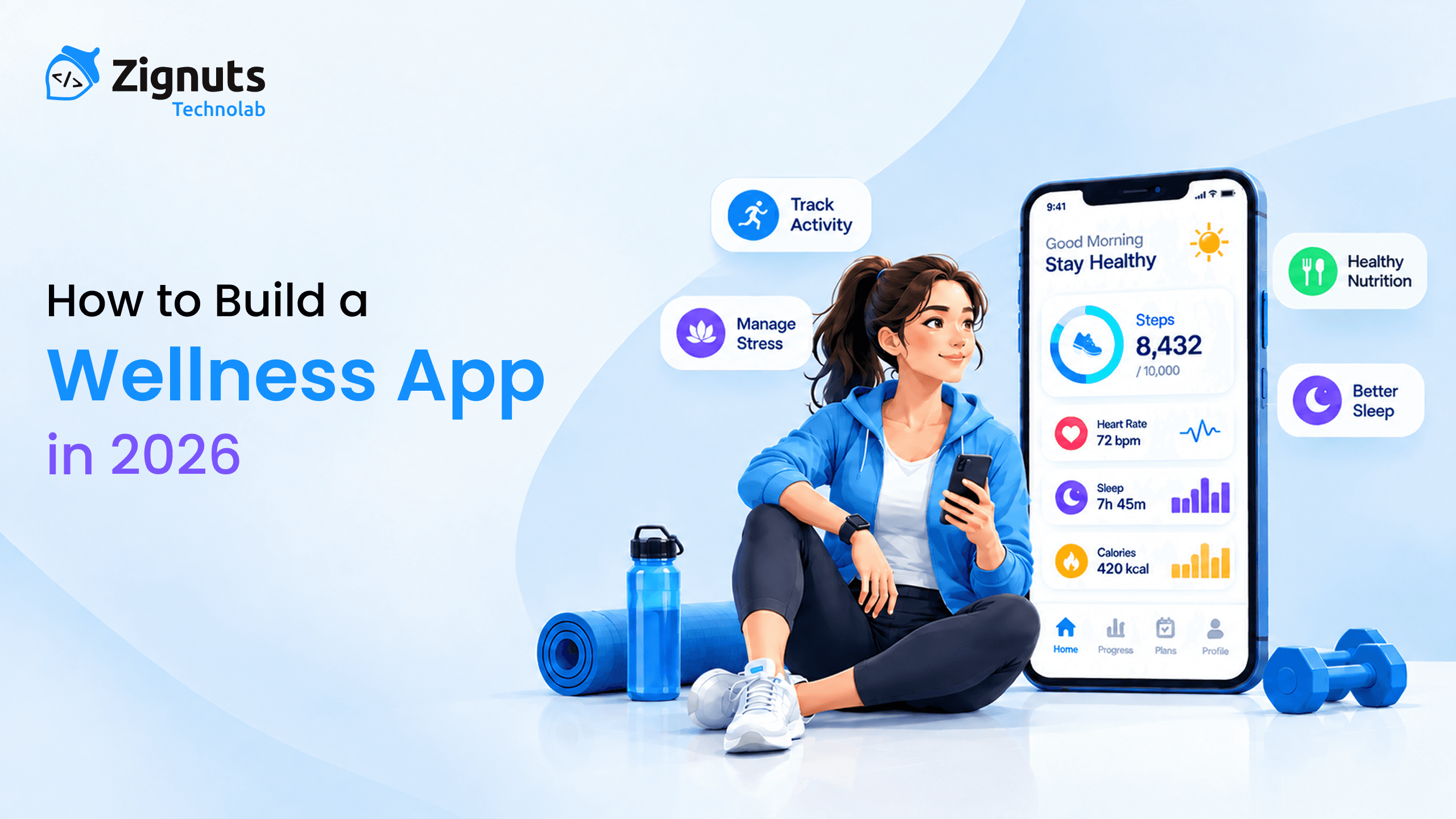
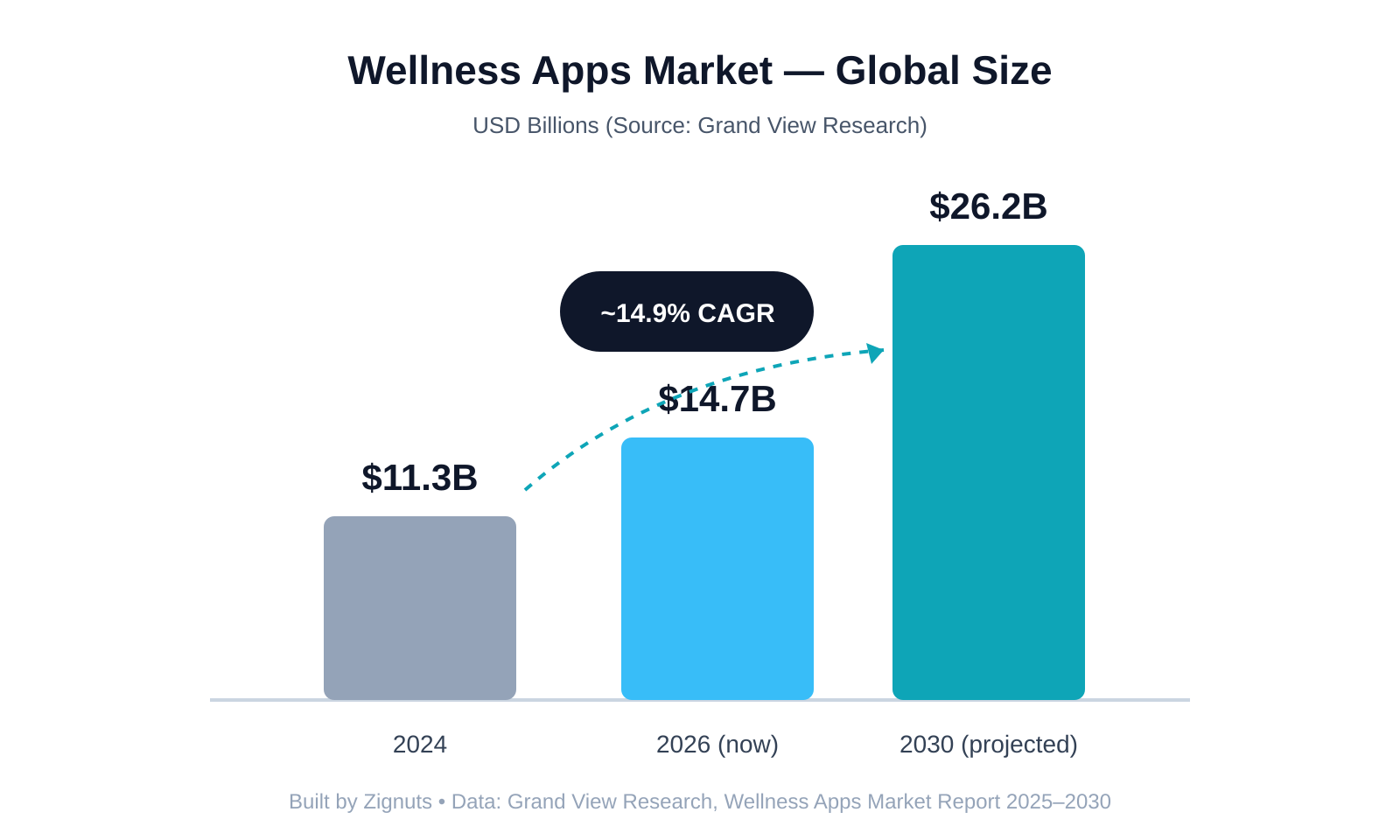
Most people now carry a gym, a therapist, a nutritionist, and a sleep coach in their pocket. They just call it their phone. The wellness app market grew from nothing to over $11 billion in annual revenue in roughly a decade, and it’s still accelerating. Grand View Research puts the market at $26.2 billion by 2030, growing at nearly 15% a year.
The opportunity is real. But so is the graveyard of wellness apps that launched, got downloaded once, and never opened again. Wellness app development that drives long-term retention is a completely different challenge from building an app that simply gets downloaded. In this guide, we’ll walk through what it actually takes: the six main app types, the features that drive daily habits, the monetization models that sustain a business, the 2026 tech trends reshaping the category, and how Zignuts approaches wellness builds from day one.
Ready to Build a More Engaging Wellness App?

What Is a Wellness App?
“Wellness app” is a broad umbrella. It covers anything that helps someone actively manage their physical health, mental health, nutrition, sleep, or overall lifestyle as opposed to reactive healthcare, which kicks in after something goes wrong. The best wellness apps don’t just track data; they change behaviour. They build habits. And the ones that do that well tend to have three things in common: personalisation (the app feels like it was built for you), feedback loops (you can see progress), and friction removal (it’s easier to use the app than not to).
6 Types of Wellness App Development
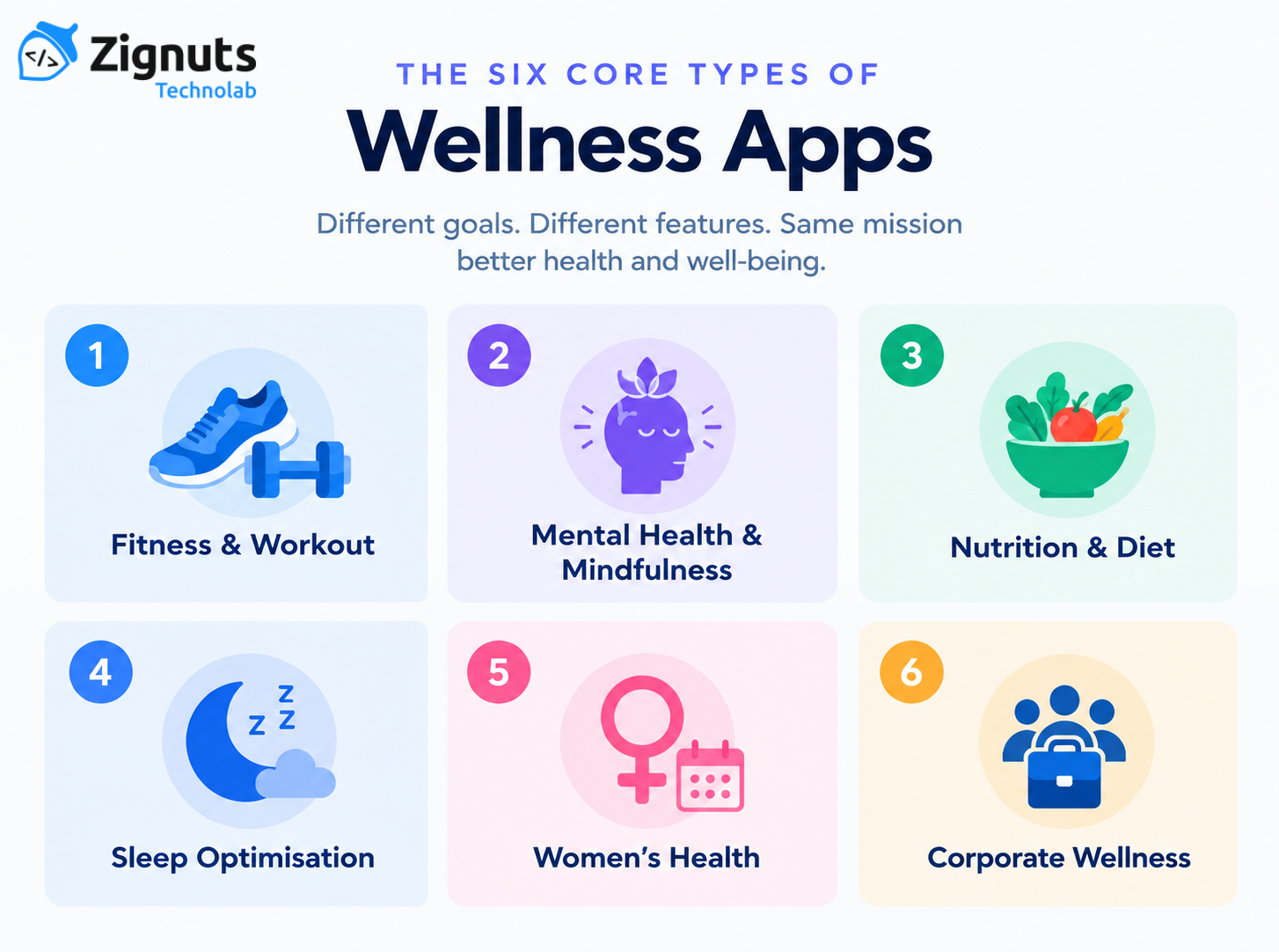
1. Fitness & Workout Wellness Apps
Personalised workout plans, guided sessions, progress analytics, and increasingly, AI-powered form correction via the phone’s camera. The segment still holds over 34% of the total wellness app market. Examples: Nike Training Club, Peloton, Freeletics.
2. Mental Health & Mindfulness Wellness Apps
Guided meditation, CBT-based exercises, mood journals, and breathing tools. This segment has seen the sharpest growth since 2020, and importantly for builders, it’s the one where compliance requirements (HIPAA in the US, NHS digital standards in the UK) are most closely scrutinised. Examples: Calm, Headspace, Woebot.
3. Nutrition & Diet Tracking Wellness Apps
Calorie logging, macro tracking, barcode scanning, AI-generated meal plans, and increasingly, integration with continuous glucose monitors for real-time metabolic feedback. Over 160 million Americans are tracking their diet at any given time, a massive baseline audience. Examples: MyFitnessPal, Noom, Lifesum.
4. Sleep Optimization Wellness Apps
Sleep has moved from a passive tracking metric to a central health indicator. Apps in this space now connect to wearables for detailed sleep-stage analysis, offer personalised wind-down programs, and flag long-term patterns that correlate with other health risks. The global sleep aids market alone is projected to reach $95 billion by 2033. Examples: Sleep Cycle, Oura, Whoop.
5. Women’s Health & Wellness Apps
Cycle tracking, fertility windows, pregnancy progression, and perimenopause support. This is one of the fastest-growing sub-segments, with strong retention because the use cases are genuinely recurring and life-stage specific. Examples: Clue, Ovia, Flo.
6. Corporate Wellness Platforms
Employer-funded wellness programs, typically featuring step challenges, stress management tools, mental health support, and integration with HR systems. The B2B2C model (employer pays, employee uses) makes monetisation significantly more predictable than consumer-direct apps. Examples: Personify Health, Wellable, Vantage Fit.
Ready to Build a More Engaging Wellness App?
Wellness App Development Features That Drive User Retention
A wellness app with 10 features and low retention is worth less than one with 5 features and a daily active user habit. Here’s what we consistently see drive real day-to-day use:
Personalised onboarding: users who feel the app ‘gets them’ from day one are significantly more likely to return on day 7. This means health goals, preferred activity types, and time availability are captured upfront and reflected immediately in the experience.
Progress visualisation: streaks, badges, weekly trends, and body-metric charts. Not because gamification is a silver bullet, but because seeing movement is one of the most reliable triggers for continued use.
Smart reminders: not generic push notifications (‘Don’t forget to log!’), but contextually timed nudges based on the user’s actual patterns.
Wearable sync: Apple Health, Google Fit, Garmin, Fitbit, Oura. Users who sync a wearable show meaningfully higher retention because the data flows automatically, with no manual logging friction.
AI-powered recommendations: workout adjustments based on recovery data, meal suggestions based on logged nutrition gaps, content recommendations based on mood history.
Community & social features: group challenges, friend leaderboards, and peer accountability. Research consistently shows social commitment devices increase follow-through on health goals.
Offline mode: workouts and content that function without a connection. This is particularly important in markets with variable connectivity and for gym use where signal is unreliable.
Ready to Build a More Engaging Wellness App?
Wellness App Monetization Models: Choosing the Right Strategy
The wrong monetisation model can kill an app that has excellent features. Here’s how the major models play out in practice:
Model | Best for | Example apps |
|---|---|---|
Freemium | Consumer apps needing mass adoption | Headspace, Calm, MyFitnessPal |
Subscription | Premium features, daily habit apps | Noom, Peloton, Whoop |
In-app purchases | One-off content or equipment add-ons | Fitbit, Nike Run Club |
B2B / Corporate | Employer wellness programs | Personify Health, Wellable |
Marketplace | Connecting users with coaches/therapists | BetterHelp, Woebot |
Most successful wellness apps today combine two models: typically freemium for consumer acquisition paired with a B2B corporate wellness channel for revenue stability. If you’re building for a specific niche (e.g., post-surgical rehab, chronic condition management), a pure subscription model with a clinical referral pathway tends to have the strongest LTV.
Ready to Build a More Engaging Wellness App?
2026 Trends in Wellness App Development
These aren’t aspirational. These are the things showing up in actual feature requirements from clients building wellness platforms right now:
AI hyper-personalisation: not just recommendation engines but adaptive programs that change week-to-week based on a user’s progress, sleep quality, stress signals, and engagement patterns. The platforms pulling ahead are those that can deliver better decisions, not just more features.
GLP-1 companion apps: a fast-emerging category. As GLP-1 medications (Ozempic, Wegovy) become mainstream, users need structured nutrition, exercise, and monitoring support. This is a significant whitespace for wellness app builders targeting the weight management space.
Wearable-native experiences: designing for the wrist first, not retrofitting a phone app to a smartwatch. As Oura Ring, Apple Watch Ultra, and Whoop 5.0 collect richer physiological data, apps that consume and act on that data natively have a clear UX advantage.
Mental health parity: mental wellness is no longer a separate module bolted onto a fitness app. Users expect stress, sleep, mood, and cognitive performance to be treated as first-class metrics alongside physical activity.
FTC Health Breach Notification Rule: updated in 2024 and increasingly enforced, this regulation catches most wellness apps that handle health data, even those that don’t meet the HIPAA covered-entity threshold. At $51,744 per violation, it’s not one to discover post-launch.
Voice & conversational interfaces: logging a meal or a mood via voice while cooking or commuting removes the single biggest retention killer: manual data entry.
Wellness App Development Compliance Considerations
A lot of wellness apps launch without thinking carefully about compliance, then face expensive retrofits. The key frameworks that apply in 2026:
HIPAA (US): Applies if your app handles protected health information and you’re a covered entity or business associate. Many pure wellness apps don’t meet that threshold, but the FTC HBNR (below) likely applies instead.
FTC Health Breach Notification Rule: Applies to most apps collecting personal health information, even without HIPAA status. Requires notifying users and the FTC in the event of a data breach.
GDPR (EU/UK): If you have any European users, health data is ‘special category’ data under GDPR with stricter consent and handling requirements.
App Store health guidelines: Both Apple and Google have specific review criteria for apps making health claims. Apps with clinical-sounding language get rejected or flagged more frequently than developers expect.
At Zignuts, compliance is part of the architecture conversation, not a review item at the end of development. The data model, encryption choices, and consent flows are all shaped by the regulatory profile of the target market before a single screen is designed.
Ready to Build a More Engaging Wellness App?
Our Wellness App Development Process
We’ve built AI-powered health and fitness platforms, nutrition tracking tools, and corporate wellness products for clients across the US, Germany, and the UK. Our fitness app development services and AI/ML development capabilities are the two most commonly combined service lines in our healthcare projects because the best wellness apps today are inseparable from intelligent personalisation.
Our typical wellness app engagement follows these steps:
1. Discovery: We define your target user, their core retention trigger (habit loop), and the minimum feature set that delivers that loop reliably. We also scope compliance requirements for your target markets.
2. Design sprint: UX wireframes and a clickable prototype, tested with real users before any engineering begins. Wellness apps live or die on onboarding, so we spend more time here than most projects.
3. MVP build: Agile sprints, typically 12–16 weeks for a solid MVP. Security, encryption, and data compliance frameworks are implemented at sprint one, not as a phase-two project.
4. Wearable & third-party integrations: Apple HealthKit, Google Fit, Garmin Connect, Oura API, and others depending on your user profile.
5. Launch & iteration: We stay involved post-launch to act on early retention data, not just bug reports.
If you’re not ready for a full build, we also offer a scoping engagement: a focused discovery session that gives you a clear feature roadmap, tech stack recommendation, and realistic cost estimate you can take to investors or internal stakeholders.
Ready to Build a More Engaging Wellness App?
Wellness App Development Cost in 2026
Cost varies widely depending on scope, but here’s a realistic ballpark:
Basic MVP (core tracking + one feature loop): $35,000–$60,000. Suitable for validating a concept with real users before committing to the full build.
Mid-complexity app (personalisation + wearable sync + basic AI): $60,000–$120,000. The range most funded early-stage wellness startups operate in.
Full-featured platform (AI coaching + video + corporate B2B + full compliance): $120,000–$250,000+. The range for Series A+ companies building for scale.
The largest cost variables are AI/ML features, video streaming infrastructure, and the number of third-party integrations. We always recommend starting with the smallest feature set that creates a genuine daily habit, then expanding based on retention data rather than assumptions.
Ready to Start?
The wellness app space is crowded, but most of it is mediocre. Apps that understand behaviour change, build for retention from the architecture stage, and treat compliance as infrastructure rather than a checkbox have a genuine competitive moat. If you have a wellness app idea you’re ready to scope, get in touch with our team, and we’ll help you figure out the right starting point.

Milap Paneri
A detail-oriented tech consultant specializing in building smart, reliable solutions. Combines strategic insight with technical knowledge to deliver high-impact results across projects.