

Why This Matters for Your Bottom Line
In our experience at Zignuts, we often meet founders who feel "stuck" with a software product that isn't working. They've already spent $50k or $100k, and the fear of "wasting" that money keeps them pouring more into a broken system.
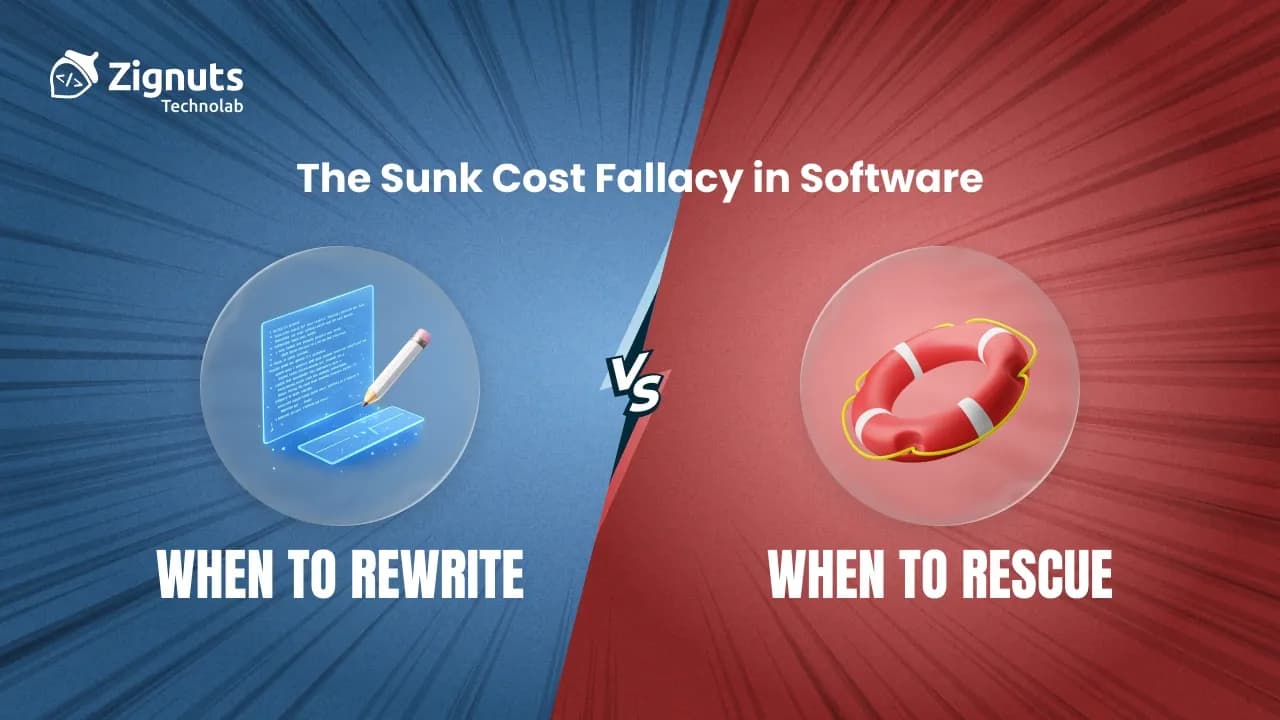
This is the Sunk Cost Fallacy. In software development, the money you’ve already spent is gone. The only thing that matters now is the Future Cost of Ownership. If your current code costs $5k/month to maintain but a new system would cost $500/month, the "expensive" rewrite actually pays for itself in less than a year.
1. Diagnostic: Is Your Software a "Money Pit"?
Before making a decision, you must audit the technical health of your project. Based on our recovery projects, here are the three major "red flags" that suggest your project is failing:
- The 1:2 Bug Ratio: For every one bug your team fixes, two new ones appear in unrelated parts of the app. This signals "Spaghetti Code" where components are too tightly coupled.
- Onboarding Friction: It takes a new senior developer more than 3 weeks to push their first line of code. This usually indicates a lack of documentation or an overly complex environment.
- Framework Obsolescence: Your app is built on a version of Node, PHP, or Python that is no longer receiving security patches. This isn't just a performance issue; it’s a massive legal and security liability.
2. Comparison: Rescue vs. Rewrite
Choosing the path forward requires balancing speed, risk, and budget. Use this table to evaluate your current situation:
| Feature | Software Rescue (Refactoring) | Software Rewrite (Greenfield) |
|---|---|---|
| Best For | Solid architecture with "messy" execution. | Obsolete tech stack or flawed logic. |
| Time to Value | Immediate (Incremental updates). | Slow (Nothing works until the MVP is ready). |
| Initial Cost | Lower (30%–40% of a full build). | High (100% of a new build). |
| Long-term Risk | Residual technical debt remains. | Risk of "Scope Creep" and losing features. |
| Disruption | Low. Users keep using the same app. | High. Users must migrate to a new system. |
3. The "Rescue" Framework (Step-by-Step)
If your core logic is good, a Software Rescue is the most efficient choice. At Zignuts, we follow a specific 3-phase protocol for Software Repair and Recovery:
- The Deep Audit: We don't just look at the code; we look at the infrastructure, CI/CD pipelines, and database architecture to find the bottleneck.
- Stabilization: Before adding new features, we implement automated testing. This "safety net" ensures that fixing the code doesn't break the business.
- Incremental Refactoring: We replace the "bad" parts of the code piece-by-piece. This allows your business to stay operational while the software improves in the background.
4. When the "Sunk Cost" Wins: The Case for a Rewrite
Sometimes, the most "diplomatic" thing to say is that the project cannot be saved. A full rewrite is necessary if:
- The original developers left no source code or documentation.
- The database architecture cannot handle your current user load (Scalability Wall).
- The cost of fixing a single bug is higher than the cost of building that feature from scratch.
Expert Tip: If you choose to rewrite, do not try to replicate every single feature of the old system at once. Focus on a Modern MVP that solves the 80% of your users' needs, then sunset the old system gradually.
Ready to Stop the Bleeding?
Don't let the Sunk Cost Fallacy hold your business back. Whether you need a surgical rescue or a fresh start, our team can provide a neutral, expert audit of your codebase.
Get a Free Software Health Audit from Zignuts →

Deep Mistry
Digital Marketing Enthusiast | Diving into the world of trends, tools, and strategies, sharing discoveries that help create impactful online experiences.