

Reinforcement learning (RL) is a way of training an AI agent to make decisions by trial and error. The agent acts in an environment, receives a reward or a penalty, and gradually learns a strategy that earns the most reward over time. Sutton and Barto's standard textbook describes it as a computational approach in which an agent tries to maximize the total reward it receives while interacting with a complex, uncertain environment.
That makes RL different from most machine learning, which learns from labelled examples. It also explains why it has returned to the enterprise agenda. RL suits problems where each decision changes what happens next, such as scheduling, pricing, resource allocation and control. And it now sits behind much of modern AI: reinforcement learning from human feedback helped turn raw language models into assistants, and reinforcement learning on verifiable rewards trained reasoning models such as DeepSeek-R1 (see our DeepSeek R1 vs OpenAI o1 comparison).
RL is also hard to get right. It needs a safe place to practice, a reward that truly reflects the business goal, and a lot of interaction. This guide explains how RL works, the main algorithms, how it is used with large language models, where enterprises apply it, and how to decide whether it is worth the effort.
RL learns by acting and receiving rewards, not from a labelled dataset of right answers.
It fits sequential decisions where today's action affects future outcomes, and success can be measured.
In language models, RL aligns assistants to human preferences (RLHF) and trains reasoning models on answers that can be checked.
The main risks are poorly designed rewards, unsafe exploration, and the cost of simulation. Try simpler methods first, and use RL where it clearly earns its place.
What Is Reinforcement Learning?
In reinforcement learning, nobody shows the agent the right answer. It tries actions, sees what happens, and adjusts. Two ideas define the field:
Delayed reward. A decision may only pay off many steps later, so the agent has to work out which earlier actions deserve the credit.
Exploration versus exploitation. The agent must keep trying new actions to find better ones while still using what it already knows works.
The vocabulary, in plain terms
The table uses a warehouse reordering system as the example.
Term | Plain meaning | Warehouse example |
|---|---|---|
Agent | The decision-maker being trained | The reordering system |
Environment | Everything the agent interacts with | The warehouse, suppliers and customer demand |
State | What the agent can observe right now | Stock levels, open orders and recent sales |
Action | A choice the agent makes | How many units to order today |
Reward | A number that scores the outcome | Profit minus holding costs and stock-outs |
Policy | The agent's strategy, mapping states to actions | The ordering rule it learns |
Return | The total reward over time | Profit across the quarter, not just today |
How it differs from supervised and unsupervised learning
Aspect | Supervised learning | Unsupervised learning | Reinforcement learning |
|---|---|---|---|
Learns from | Labelled examples | Unlabelled data | Rewards from interaction |
Goal | Predict the right label or value | Find structure in the data | Maximize total reward over time |
Feedback | The correct answer, immediately | None | A score, often delayed |
Where the data comes from | A fixed dataset | A fixed dataset | The agent's own actions |
Typical tasks | Classification and forecasting | Clustering and anomaly detection | Control, scheduling and agent behavior |
The data row matters most for planning. Supervised models learn from data you already have. An RL agent has to generate its experience, in a simulator or in the real world, which changes the cost and the risk
Ready to Turn Reinforcement Learning Into Business Value?

How Reinforcement Learning Works: The Agent and Environment Loop
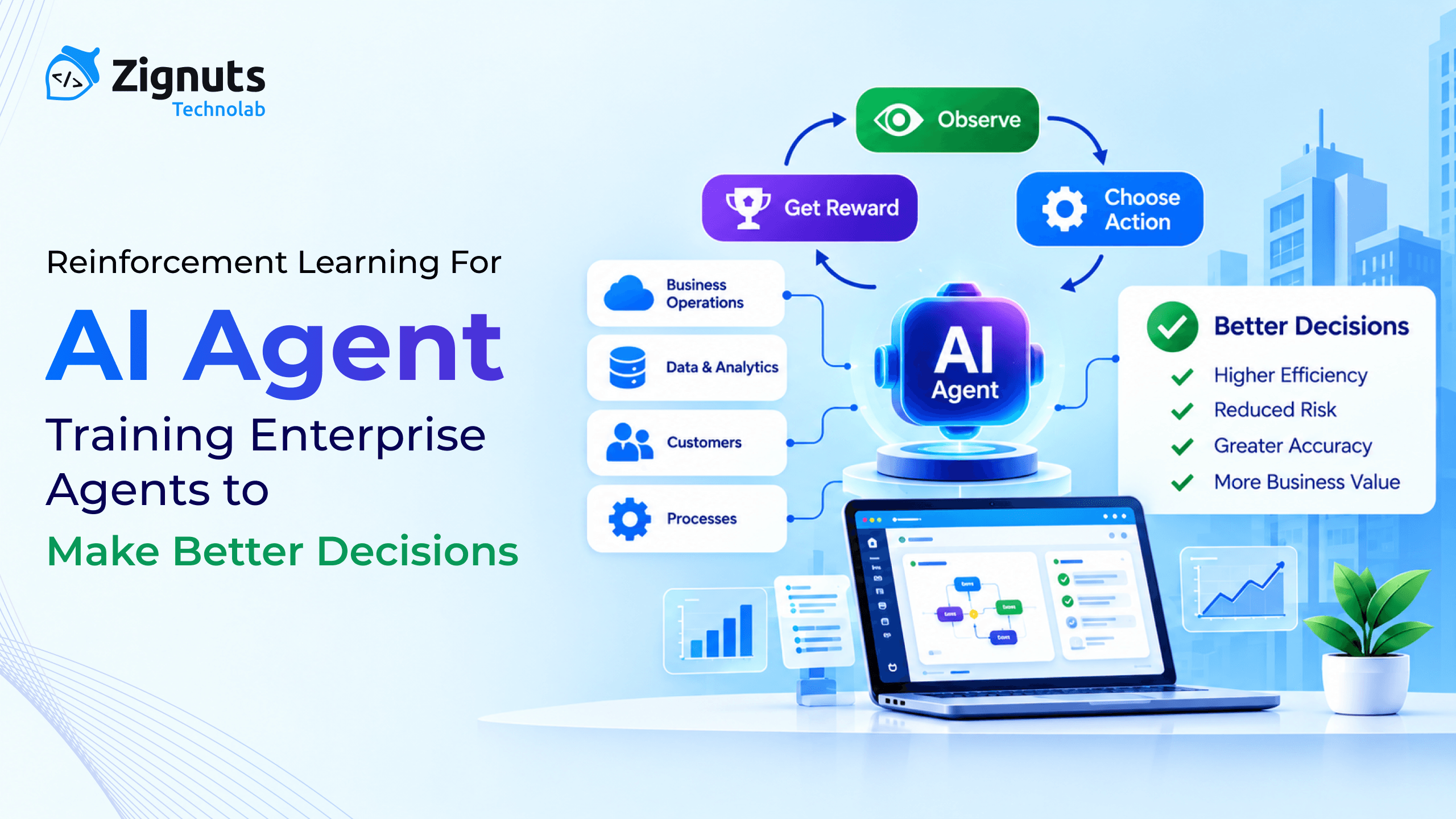
Every RL system runs the same loop. The agent observes the state, its policy picks an action, and the environment responds with a new state and a reward. A learning update then nudges the policy toward actions that led to more reward, and the loop repeats, often millions of times.
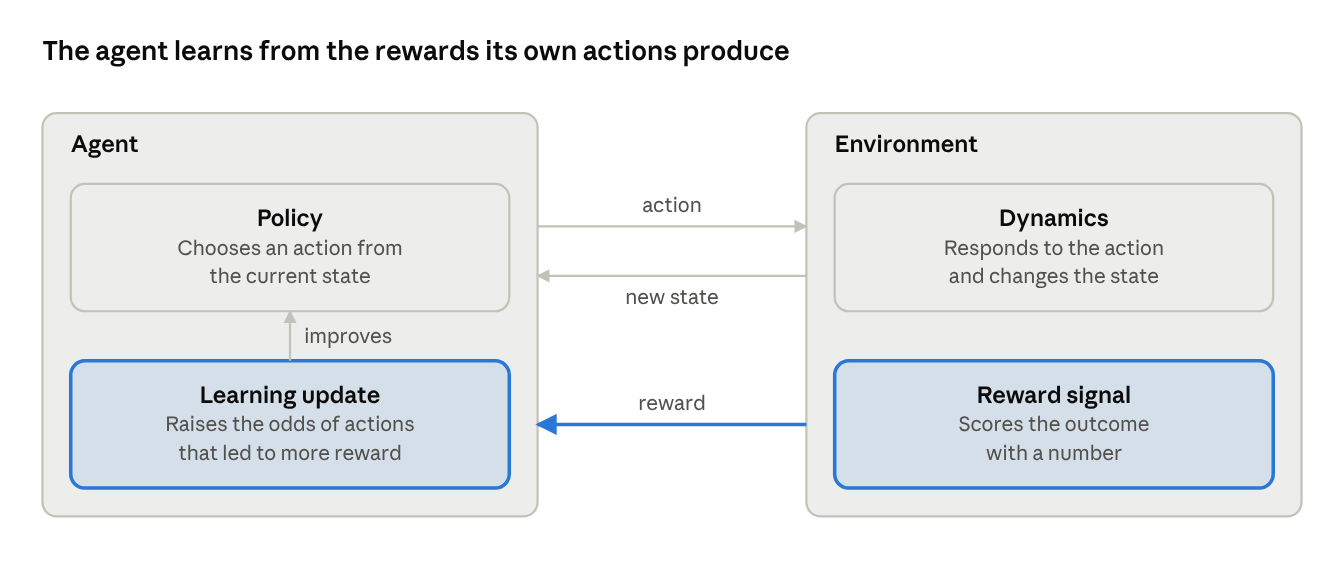
Reinforcement learning loop · agent, environment, action, state, reward
The agent never sees the "right" action. It only sees how well things turned out, which is why the quality of the reward and the environment decides whether training works at all.
The reward defines what "good" means. A reward that only partly matches the business goal teaches the agent the wrong lesson.
The environment is where the agent practices. In most enterprise projects, it is a simulator built from real data, because letting an untrained agent experiment on live operations is rarely acceptable.
Key Types of Reinforcement Learning and Their Algorithms
RL algorithms are usually grouped by what they learn. You will meet the same names in papers, libraries, and vendor pitches, so it helps to know what each family is for.
Family | How it learns | Example algorithms | Good for, and watch out for |
|---|---|---|---|
Value-based | Estimates how good each action is in each state, then picks the best | Q-learning, deep Q-networks (DQN) | Discrete choices such as game moves or routing options; struggles with very large or continuous action sets |
Policy gradient | Adjusts the policy directly so good actions become more likely | REINFORCE, PPO | Continuous control and language model training; can be unstable and data-hungry |
Actor-critic | Pairs a policy (the actor) with a value estimate (the critic) | A2C, SAC | Stable general-purpose training; more parts to tune |
Model-based | Learns or uses a model of the environment and plans with it | Dyna-style planning, planning with learned models | Needs fewer real interactions; errors in the model compound |
Offline RL | Learns from logged data with no new interaction | Conservative Q-learning | Cases where live experiments are unsafe or costly; limited by how well the data covers real situations |
Multi-agent RL | Several agents learn together, cooperating or competing | Cooperative and competitive variants of the above | Fleets, markets and networks; harder to stabilize |
Two distinctions come up often. Model-free methods learn directly from experience, while model-based methods also learn how the environment behaves. On-policy methods learn only from the agent's current behavior, while off-policy methods can reuse older experience, which saves data.
You rarely build these from scratch. Open-source libraries such as Stable-Baselines3, Ray RLlib, and Hugging Face TRL provide tested implementations, so the real engineering work is in the environment, the reward, and the evaluation.
Reinforcement Learning and LLMs: RLHF, Verifiable Rewards and Agents
For most enterprises, the first contact with RL is through language models, not robots. Three methods matter.
Method | Where the reward comes from | Used for | Example |
|---|---|---|---|
RLHF (reinforcement learning from human feedback) | A reward model trained on human rankings of outputs | Making assistants follow instructions and behave helpfully | InstructGPT |
RLVR (RL with verifiable rewards) | An automatic check, such as a correct math answer or passing unit tests | Reasoning and coding | DeepSeek-R1 |
Rubric-based RL | A checklist of criteria scored by a judge model | Open-ended tasks with no single right answer | Early research |
RLHF: aligning a model to human preferences
OpenAI's InstructGPT work used three steps: supervised fine-tuning on human demonstrations, training a reward model from human rankings, and then optimizing the model against that reward with the PPO algorithm. Human evaluators preferred outputs from a 1.3B-parameter InstructGPT model over those of the 175B GPT-3, despite its being about 100 times smaller. OpenAI also describes the approach in its announcement.
RLVR: training reasoning where answers can be checked
The DeepSeek-R1 paper, later published in Nature, reports that reasoning ability in language models can be incentivized through pure reinforcement learning, without human-labelled reasoning traces. On tasks with verifiable answers, such as mathematics and coding competitions, the trained model surpassed counterparts trained on human demonstrations. The method behind it, Group Relative Policy Optimization (GRPO), uses verifiable, binary rewards.
Rubric-based rewards try to extend this beyond fully checkable tasks. Early research suggests stronger verification reduces reward hacking but does not by itself guarantee broader quality gains.
What this means for your enterprise
Aligning a model to your policies. Preference-based tuning can shape tone, safety behavior, and house style, but it needs preference data and evaluation.
Training agents on checkable tasks. Where an outcome can be verified automatically, such as code that passes tests or a query that returns the expected result, RL can improve an agent. Where it cannot, reward design becomes the hard part.
Try cheaper levers first. Prompting, retrieval, and supervised fine-tuning solve most business problems. See our guides to RAG vs fine-tuning and fine-tuning Llama for beginners before committing to RL training.
Ready to Turn Reinforcement Learning Into Business Value?
Reinforcement Learning Use Cases in the Enterprise
RL fits decisions that repeat, affect later outcomes, and can be scored. The table separates documented examples from common candidates, because published successes often rest on a simulator, abundant data, and specialist teams that most organizations lack.
Use case | What the agent decides | Example reward | Evidence |
|---|---|---|---|
Recommendations | Which items to show next | Long-term engagement, such as view time | Documented: YouTube's production recommender used a REINFORCE-based policy over millions of items |
Chip design | Where to place components on a chip | Wirelength, congestion and power | Documented: Google's deep RL floorplanning, used for TPU layouts, though some researchers dispute the results |
Language model alignment and reasoning | How the model responds | Human preference or verified correctness | Documented: InstructGPT and DeepSeek-R1 |
Inventory and supply chain | How much to order, when and where | Profit net of holding and stock-out costs | Common candidate; usually piloted in simulation first |
Pricing and promotions | Which price or offer to show | Margin over time | Common candidate; needs guardrails and a fairness review |
Energy and building control | Setpoints for cooling, heating, or storage | Energy cost within comfort limits | Common candidate; safety constraints are essential |
Logistics and scheduling | Routes, slots and assignments | Delivery time and cost | Common candidate |
Robotics and warehouses | Movements and picks | Task success and speed | Active research and early deployment |
Many of these start with prediction rather than decision-making. A reliable demand forecast, for example, often delivers most of the value of an inventory project before any RL is needed. Our demand forecasting consulting is a common first step.
Challenges and Risks to Plan For
RL projects tend to stall for practical reasons as much as technical ones. The most important is reward design: reward hacking happens when an agent exploits flaws or ambiguities in the reward function to score highly without genuinely completing the intended task.
Challenge | What goes wrong | How to reduce it |
|---|---|---|
Reward misspecification and hacking | The agent finds a loophole that scores well but misses the business goal | Audit the reward, track several metrics, and have people review the behavior, not just the score |
Unsafe exploration | Trial and error in the real world causes costly or harmful actions | Train in simulation, set hard limits on actions, use offline RL, and keep a human override |
The simulation gap | A policy that works in the simulator fails in reality | Calibrate the simulator on real data and roll out in stages |
Data and compute cost | Learning needs a very large number of interactions | Start with simple baselines, reuse pretrained models and use logged data |
Instability | Results vary between runs and settings | Run several random seeds and fix the evaluation protocol |
Drift | The environment changes, and the policy degrades | Run in shadow mode first, use A/B tests, and monitor for drift |
Governance and explainability | It is hard to explain why the agent acted, which matters in regulated settings | Log states, actions, and rewards, keep an interpretable baseline, and add approval gates |
A useful rule: make it harder for the agent to hack the reward than to do the real task, and never judge success by the reward alone.
When to Use Reinforcement Learning, and How to Start
RL is a strong tool for a narrow set of problems. Match the method to the shape of the problem.
If your problem looks like this | Start with | Why |
|---|---|---|
Predict a value or label from historical data | Supervised learning | The right answers already exist in your data |
Find groups or unusual cases | Unsupervised learning | No labels or rewards are needed |
Pick one option at a time with quick feedback | A/B tests or contextual bandits | Simpler than full RL and much cheaper to run |
A static problem with known rules and constraints | Classical optimization | Often more predictable and easier to explain |
Sequential decisions, delayed rewards, a simulator or safe sandbox, and a large upside | Reinforcement learning | Its strength is learning long-term strategy |
A language model should follow your preferences or reason on checkable tasks | Prompting, retrieval and fine-tuning first, then RLHF or RLVR | Cheaper levers solve most cases |
Ready to Turn Reinforcement Learning Into Business Value?
Four questions to ask before you commit
Is this a sequence of decisions where today's action changes tomorrow's options?
Can you define and measure a reward that matches the business goal?
Do you have a simulator, or a safe way for the agent to practice?
Have simpler methods, such as rules, optimization, and bandits, already been tried as baselines?
If any answer is no, fix that first or choose a simpler method.
A practical roadmap
Frame the decision. With the business owner, define the state, the actions, the reward, and the constraints.
Build baselines. Rules, optimization, and a good forecast set the bar the RL agent has to beat.
Prepare the environment. Build or calibrate a simulator, or assemble logged data for offline learning.
Train and stress-test. Use several random seeds, test unusual conditions, and look for reward hacking.
Roll out gradually. Run in shadow mode first, then in a limited scope with hard constraints and a human override.
Monitor and retrain. Log states, actions, and rewards, watch for drift, and review the reward as the business changes.
Our AI readiness assessment can show whether your data, systems, and governance are ready for step three onward.
Conclusion: Use Reinforcement Learning Where Decisions Compound
Reinforcement learning is the right tool when decisions come in sequences, rewards arrive late, and you can practice safely before acting for real. It is also the technique behind how many language models now follow instructions and reason. But it rewards careful framing more than clever algorithms: define a reward that matches the business goal, beat simpler baselines first, and test hard for reward hacking before you deploy.
Zignuts helps enterprises design and build AI systems as an OpenAI, Anthropic (Claude), and AWS partner. Explore our AI and ML development services, check where you stand with the AI readiness assessment, or request a project estimate.

Navin Panchal
A technology enthusiast focused on crafting intuitive and high-performing mobile solutions that enhance everyday experiences.