

Businesses have access to more data than ever.
Sales transactions, customer interactions, operational records, financial activity, supply chain events, equipment data, and digital behavior all generate signals about what may happen next.
The challenge is turning those signals into useful decisions.
This is where predictive analytics becomes valuable.
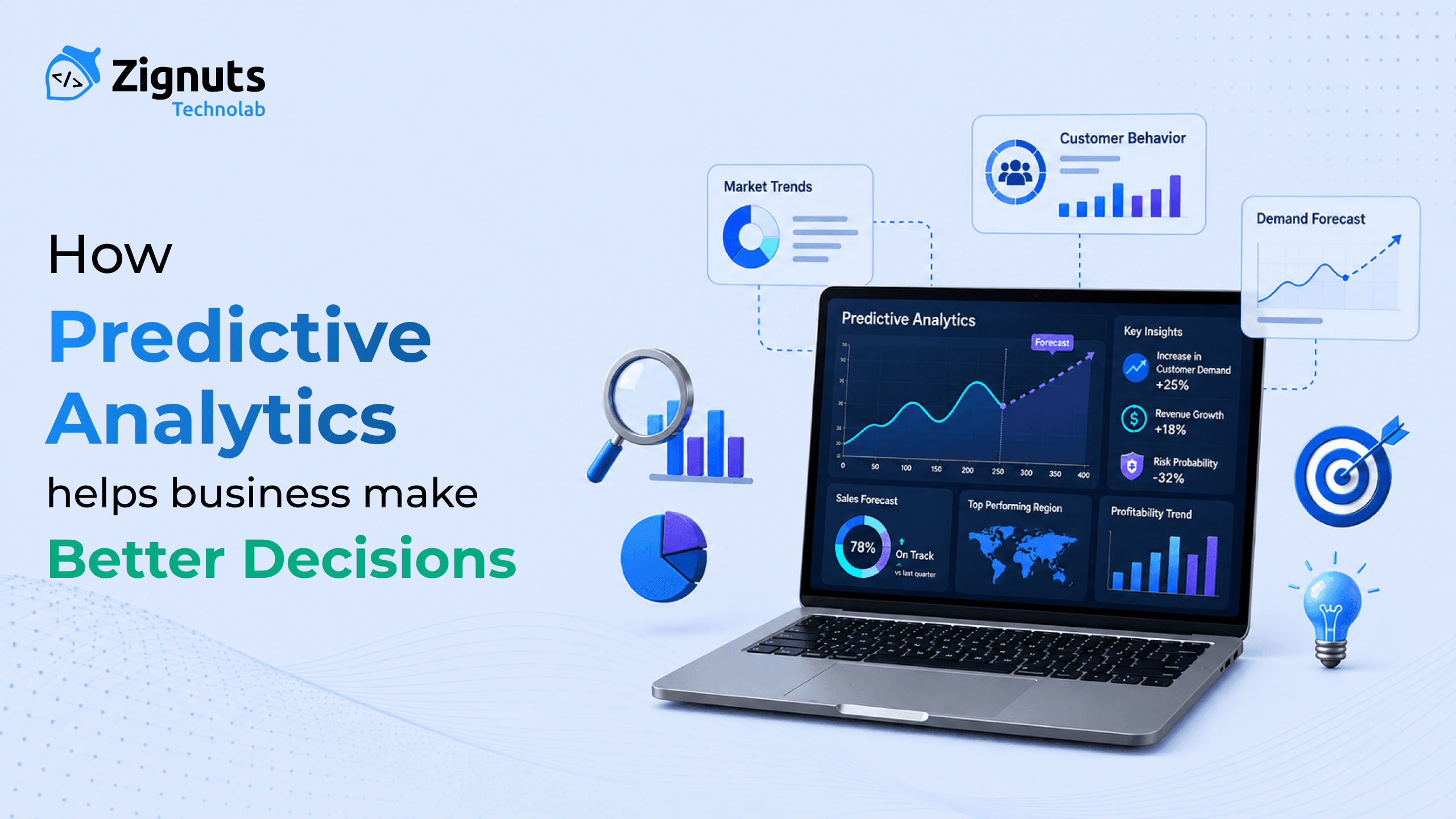
Predictive analytics uses historical data, statistical methods, machine learning, and real-time signals to estimate future outcomes. Businesses can use predictive analytics to forecast demand, predict sales, identify customer churn, assess risk, detect anomalies, optimize operations, and improve resource planning.
The real value of predictive analytics is not simply predicting the future.
It is helping teams make better decisions before an outcome occurs.
Zignuts develops predictive analytics solutions that convert business data into forecasts, risk scores, demand signals, and next-best actions. Its approach includes machine learning pipelines, feature stores, MLOps, cloud-native architectures, and integrations with ERP, CRM, data warehouses, IoT platforms, and customer systems.
This article explains how predictive analytics helps businesses make better decisions, where predictive analytics creates measurable value, how production-ready predictive analytics systems are built, and what business leaders should evaluate before investing in predictive analytics.
What Is Predictive Analytics and How Does Predictive Analytics Help Businesses?
Predictive analytics analyzes existing data to estimate what is likely to happen next.
A predictive analytics system may use:
Historical data
Customer behavior
Transaction data
Operational data
Market signals
Sensor data
Seasonality
Real-time events
Business rules
Machine learning models
The output can be a forecast, probability, score, alert, recommendation, or predicted event.
For example:
A retailer may use predictive analytics to forecast demand.
A subscription business may use predictive analytics to identify customers who are likely to churn.
A logistics company may use predictive analytics to anticipate delays.
A finance team may use predictive analytics to forecast revenue and cash flow.
A manufacturer may use predictive analytics to identify the probability of equipment failure.
The important difference is between reporting and prediction.
Traditional reporting asks:
"What happened?"
Predictive analytics asks:
"What is likely to happen next?"
Decision intelligence goes one step further:
"What should we do about it?"
That progression makes predictive analytics especially useful for organizations that need to move from reactive decision-making to proactive decision-making.
How Predictive Analytics Improves Business Decision-Making
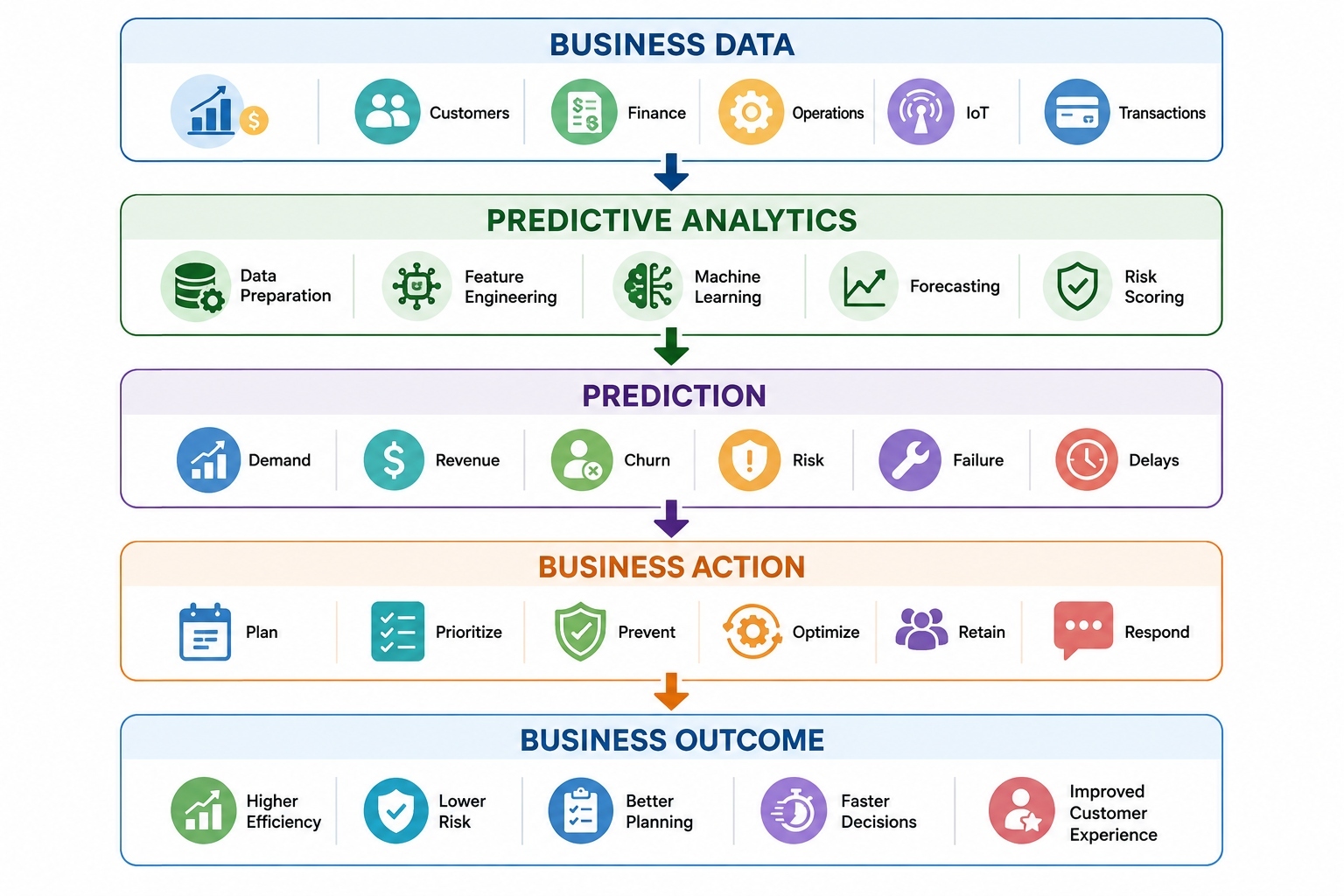
Predictive analytics improves decision-making by helping teams act earlier.
Without predictive analytics, a business may wait until a problem becomes visible.
Inventory becomes too low.
A customer cancels.
A machine fails.
A payment becomes overdue.
A shipment is delayed.
Revenue misses the forecast.
By the time the problem appears in a traditional report, the opportunity to prevent it may already be smaller.
Predictive analytics changes that workflow.
Instead of waiting for the event, businesses can identify signals that suggest the event is becoming more likely.
That creates time for intervention.
For example:
Historical customer activity → Predictive analytics model → Churn probability → Customer success alert → Retention action
Or:
Historical sales → Demand forecasting model → Expected demand → Inventory planning → Procurement decision
This is the core business value of predictive analytics.
It creates decision time.
Empower Smarter Decisions with Predictive Analytics

How Predictive Analytics Helps Businesses Forecast Demand
Demand forecasting is one of the most practical applications of predictive analytics.
Businesses need to estimate how much demand they may receive before committing inventory, staff, production capacity, logistics resources, or purchasing budgets.
Zignuts provides predictive analytics services for AI-based demand prediction using historical and real-time data, inventory optimization, supply planning, and forecasting models tailored to business requirements.
A predictive analytics demand forecasting system may consider:
Historical sales
Seasonality
Promotions
Customer behavior
Product categories
Regional demand
Pricing changes
External market signals
Current sales velocity
The output can help teams estimate future demand.
For retailers, that can improve inventory planning.
For manufacturers, it can support production planning.
For distributors, it can improve purchasing decisions.
For logistics businesses, it can support capacity planning.
The important point is that a forecast should be connected to an operational decision.
A demand forecast that does not influence inventory, procurement, or workforce planning has limited value.
How Predictive Analytics Improves Sales Forecasting
Sales teams often rely on spreadsheets, historical averages, and individual judgment when estimating future revenue.
Predictive analytics can make sales forecasting more systematic.
Zignuts' predictive analytics services include revenue and sales prediction using machine learning models, trend analysis, and data-driven insights for sales planning and growth.
A sales forecasting model may analyze:
Historical sales performance
Pipeline activity
Conversion rates
Customer segments
Deal stages
Seasonality
Regional patterns
Product performance
Sales velocity
The output can help leaders understand expected revenue under current conditions.
Predictive analytics can also help sales leaders identify where forecasts are uncertain.
That matters because a forecast is not always a single number.
In many enterprise environments, it is more useful to have:
Expected outcome
Confidence range
Key prediction drivers
Risk factors
This creates a more useful decision-support system.
How Predictive Analytics Helps Reduce Customer Churn
Customer churn is another important predictive analytics use case.
A business does not want to discover a customer is leaving after the customer has already cancelled.
Predictive analytics can identify patterns associated with higher churn risk.
Zignuts builds churn prediction and propensity scoring systems that analyze customer behavior and engagement patterns to help businesses identify at-risk customers and support targeted retention strategies.
Potential predictive signals include:
Reduced usage
Lower engagement
Support activity
Product adoption
Purchase frequency
Customer tenure
Changes in interaction patterns
A predictive analytics system can assign a churn probability or risk score.
Customer success teams can then prioritize their efforts.
The important engineering principle is not to automate every retention action.
A better approach is to provide useful signals to the team responsible for the customer relationship.
That makes the model part of the workflow.
How Predictive Analytics Supports Risk Management
Risk prediction is another area where predictive analytics can improve decision-making.
Organizations often have large amounts of transactional and operational data that can contain early warning signals.
Predictive analytics can identify unusual patterns and assign risk scores.
Potential applications include:
Credit risk
Operational risk
Payment risk
Compliance exceptions
Equipment failure
Cybersecurity signals
Transaction anomalies
Zignuts describes predictive risk models for fraud detection, credit risk, operational failures, quality issues, cybersecurity signals, compliance alerts, and transaction anomalies.
The benefit is earlier intervention.
Instead of reviewing every transaction with the same level of attention, teams can prioritize higher-risk events.
That can improve both speed and resource allocation.
Risk prediction also highlights why explainability matters.
A risk score should ideally be accompanied by information about the factors contributing to the prediction.
That makes it easier for users to understand, challenge, and act on the result.
How Predictive Analytics Improves Financial Decision-Making
Financial planning is another strong use case for predictive analytics.
Finance teams need to estimate:
Revenue
Expenses
Budget requirements
Working capital
Future financial performance
Zignuts' predictive analytics services include revenue, cash flow, and expense forecasting, financial trend analysis, and predictive insights for budgeting and strategic planning.
A predictive analytics platform can combine historical financial data with current operational signals.
This creates a more dynamic view of financial performance.
For example, instead of updating a financial forecast once every month, an organization can continuously refresh predictions as new business data arrives.
That can help leadership detect changes earlier.
Empower Smarter Decisions with Predictive Analytics
How Predictive Analytics Supports Predictive Maintenance
Equipment failure creates both operational and financial consequences.
Unexpected failures can interrupt production, increase maintenance costs, and affect delivery schedules.
Predictive analytics can estimate the likelihood of equipment problems before failure occurs.
Zignuts' predictive analytics services include equipment failure prediction using sensor and operational data, real-time monitoring, anomaly identification, and maintenance optimization.
A predictive maintenance architecture may combine:
Sensor readings
Equipment history
Maintenance records
Operating conditions
Temperature
Pressure
Usage patterns
Failure history
The model can then estimate failure probability or identify abnormal operating behavior.
Maintenance teams can use those predictions to prioritize inspections or interventions.
This can shift the organization from reactive maintenance toward condition-based planning.
How Predictive Analytics Helps Businesses Optimize Operations
Predictive analytics can improve more than individual decisions.
It can also optimize entire operational processes.
Zignuts describes predictive analytics applications for demand planning, routing, resource utilization, downtime prevention, and operational cost reduction.
Examples include:
Predicting shipment delays
Optimizing delivery routes
Forecasting workforce demand
Predicting inventory shortages
Estimating service demand
Prioritizing operational tasks
Identifying process anomalies
The best opportunities usually appear where a business repeatedly makes the same type of decision.
If a decision happens thousands of times, even a modest improvement in decision quality can create significant operational value.
Predictive Analytics for Logistics and Supply Chain Decision-Making
Supply chain management is a strong example of where predictive analytics and real-time data can work together.
Zignuts developed a Supply Chain Visibility Platform that consolidates shipment, inventory, and logistics data into a real-time control tower. The platform provides predictive delay and disruption alerts, AI-powered logistics optimization, supplier and carrier integrations, and automated reporting. The published case study reports 70% faster disruption detection, 60% improved inventory accuracy, 40% reduction in operational delays, and 3x faster decision-making.
This illustrates an important distinction.
Predictive analytics becomes more useful when predictions are integrated into operational systems.
A supply chain team does not only need to know that a shipment may be delayed.
It needs to know:
Which shipment is at risk?
Why is it at risk?
How severe is the risk?
What is the expected impact?
What action should be considered?
That is how predictive analytics supports business decisions rather than simply generating another report.
Predictive Analytics for Fleet and Transportation Decisions
Transportation operations generate continuous streams of data.
Location, route, vehicle activity, fuel usage, maintenance records, and driver behavior can all contribute to predictive models.
Zignuts' published AI-powered fleet management case study combines live GPS tracking, route optimization, predictive maintenance, driver behavior analytics, geofencing, automated dispatching, and IoT connectivity. The case study reports 99% GPS tracking accuracy, 25% fuel cost reduction, 40% faster dispatch operations, and 30% lower vehicle downtime.
The example shows how predictive analytics can become part of a larger operational system.
Instead of predicting an event in isolation, the system can connect the prediction to dispatching, routing, maintenance, and monitoring.
That creates a much stronger business workflow.
Predictive Analytics and Financial Operations
Predictive analytics can also help financial operations teams work more proactively.
Zignuts' AI-powered accounts receivable automation and FinOps platform combines financial workflow automation, reconciliation, payment operations, and accounting integrations. The published case study reports 98% AI accuracy, support for more than 50 currencies, 95% reduction in manual processing, and more than 300 records processed per batch.
The broader lesson is that data-driven automation becomes more useful when it is embedded into the financial process.
Predictive analytics can complement these workflows by helping organizations identify:
Payment risk
Collection priorities
Cash flow patterns
Anomalous transactions
Likely payment behavior
The prediction can then become an input into financial operations.
Predictive Analytics vs Traditional Business Reporting
Predictive analytics does not replace reporting.
The two serve different purposes.
Business Analytics Approach | Main Question | Typical Output | Decision Value |
Descriptive Analytics | What happened? | Reports and dashboards | Understand past performance |
Diagnostic Analytics | Why did it happen? | Root-cause analysis | Explain outcomes |
Predictive Analytics | What is likely to happen? | Forecasts and risk scores | Prepare for likely outcomes |
Prescriptive Analytics | What should we do? | Recommendations and actions | Guide decisions |
Organizations often benefit from combining these approaches.
A dashboard can show current performance.
Diagnostic analysis can explain a problem.
Predictive analytics can estimate what comes next.
Prescriptive logic can recommend the next action.
The strongest enterprise systems connect these layers.
How Predictive Analytics Works in an Enterprise Environment
A production predictive analytics system typically contains several components.
Data sources feed into an ingestion layer.
The data is cleaned and transformed.
Features are generated.
The predictive model runs inference.
The result is stored or delivered through an API.
The prediction is then surfaced through a dashboard, application, workflow, or alert.
A simplified architecture looks like this:
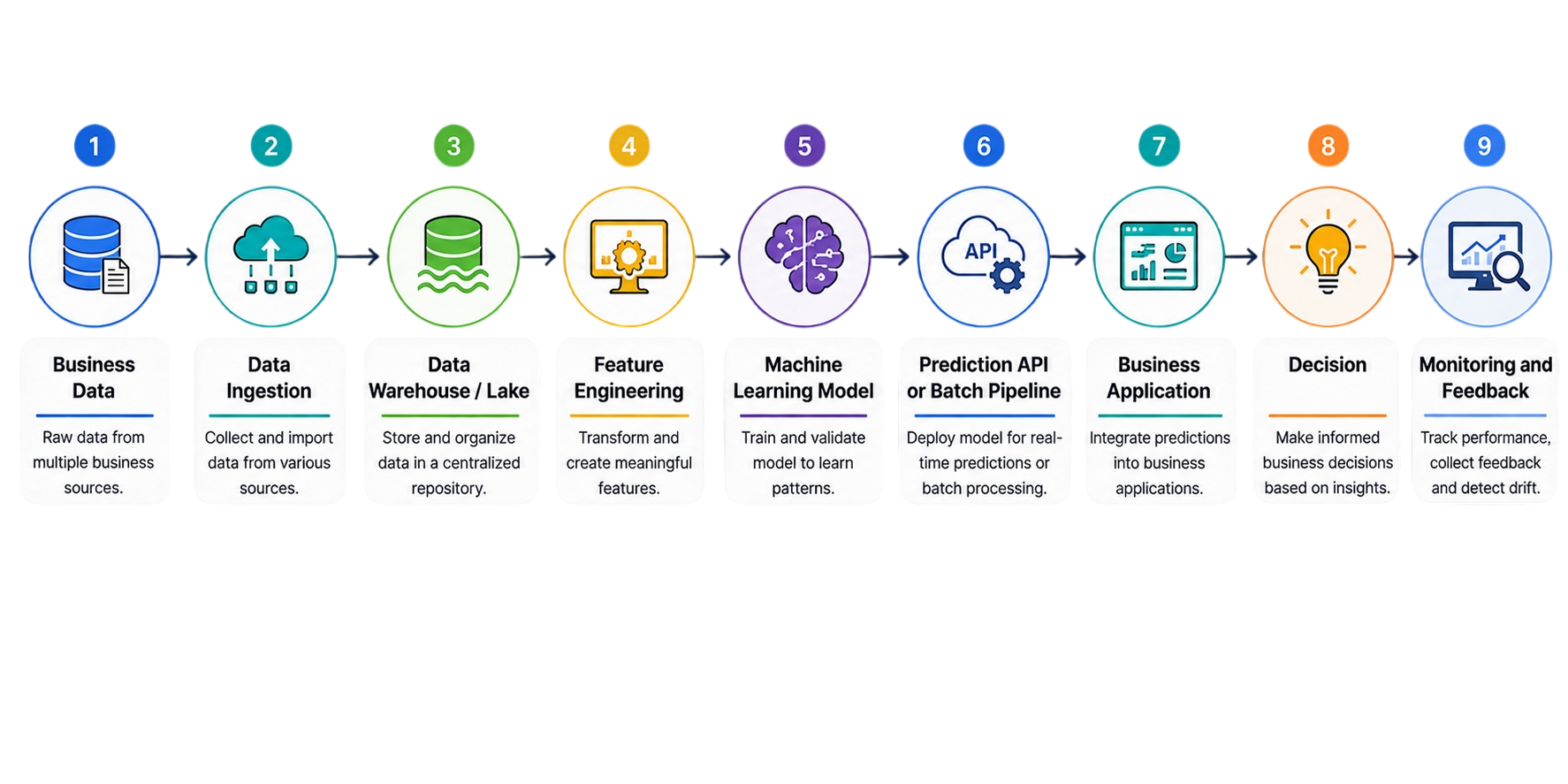
The architecture should be designed around the required decision cycle.
A system that needs predictions every few seconds may require real-time inference.
A monthly financial forecast may be more suitable for batch processing.
This is an important architectural trade-off.
Predictive Analytics with Real-Time Data
Not every predictive analytics system needs real-time predictions.
There are two common patterns.
Batch prediction calculates predictions at scheduled intervals.
Real-time prediction produces an output when an event occurs.
For example:
Daily demand forecasting can run as a scheduled batch process.
Fraud scoring may need real-time inference.
Predictive maintenance may process sensor events continuously.
Customer churn scoring may run daily or weekly.
Zignuts supports both real-time and batch predictive analytics pipelines using APIs, event streams, data warehouses, feature stores, containerized services, and cloud-native ML platforms.
The correct choice depends on the business decision.
Real-time infrastructure can increase complexity and cost.
Batch processing can be simpler and more economical when immediate predictions are not required.
Empower Smarter Decisions with Predictive Analytics
Predictive Analytics Model Selection
There is no single machine learning model that is best for every predictive analytics problem.
Possible approaches include:
Statistical forecasting
Linear models
Decision trees
Gradient boosting
Neural networks
Time-series models
Classification models
Regression models
The model should be chosen based on:
Data volume
Data quality
Prediction objective
Interpretability requirements
Accuracy requirements
Infrastructure
Maintenance requirements
Zignuts states that its AI engineers use technologies including Python, R, SQL, Spark, TensorFlow, PyTorch, scikit-learn, XGBoost, LightGBM, Prophet, MLflow, Kubeflow, Airflow, dbt, Kafka, Docker, Kubernetes, Snowflake, BigQuery, Redshift, Databricks, AWS SageMaker, Azure Machine Learning, and Google Vertex AI.
Technology selection should therefore follow the business problem.
Predictive Analytics and Explainable AI
A prediction without context can be difficult to use.
Consider a churn score of 82%.
The business user may immediately ask:
Why is the score so high?
Which signals influenced it?
Is the customer showing lower usage?
Did payment behavior change?
Has engagement declined?
Zignuts describes predictive analytics dashboards that include confidence scores, driver analysis, recommendations, and model explanations.
Explainability becomes particularly important when predictions influence financial decisions, customer treatment, compliance workflows, or operational interventions.
The goal is not to expose every internal detail of a machine learning model.
The goal is to provide enough useful context for responsible decision-making.
Predictive Analytics Data Quality and Data Readiness
Predictive analytics cannot compensate for unreliable source data.
Poor data can produce poor predictions.
Before building a model, organizations should examine:
Missing values
Duplicate records
Inconsistent definitions
Historical changes
Data gaps
Incorrect timestamps
Outliers
Changes in business processes
Data leakage
Label quality
A company may have millions of records and still lack data suitable for a particular predictive analytics use case.
That is why data readiness should be assessed before model development.
Predictive Analytics Monitoring and MLOps
A model that works today may not work equally well tomorrow.
Business behavior changes.
Customer behavior changes.
Products change.
Markets change.
Operational processes change.
This can introduce model drift.
Zignuts describes production-ready predictive analytics systems with automated data pipelines, feature engineering workflows, model versioning, CI/CD, API or batch inference, monitoring, drift detection, retraining strategies, security controls, and documentation.
Monitoring should cover:
Prediction quality
Input data quality
Model drift
Latency
Failure rates
Infrastructure health
Business outcomes
Retraining requirements
The goal is to make the predictive analytics system maintainable over time.
Empower Smarter Decisions with Predictive Analytics
Predictive Analytics Security and Governance
Enterprise predictive analytics often uses sensitive business data.
That can include:
Customer information
Operational data
Employee information
Transaction data
Healthcare data
Predictive analytics architecture should therefore include appropriate security controls.
These may include:
Authentication
Authorization
Encryption
Audit logging
Role-based access
Data governance
Model governance
Controlled data retention
Security requirements vary by industry and use case.
A production predictive analytics platform should be designed with governance requirements from the beginning.
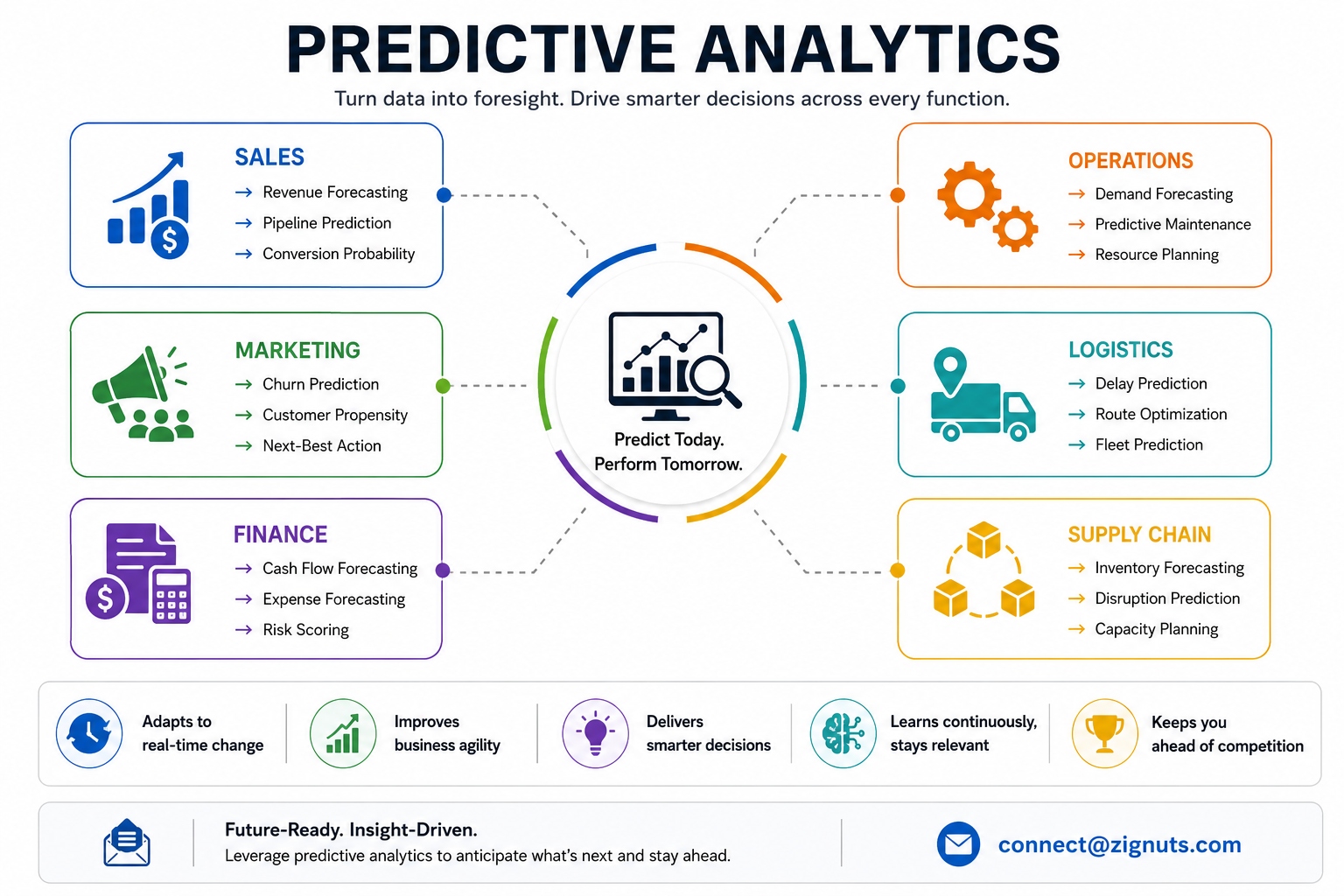
Predictive Analytics Use Cases by Business Function
Common Predictive Analytics Implementation Mistakes
Predictive analytics projects often struggle because of business and engineering decisions made before deployment.
Mistake 1: Starting With the Model
The first question should be:
"What decision are we trying to improve?"
Not:
"Which machine learning model should we use?"
A strong business objective makes the technical design easier.
Mistake 2: Using Historical Data Without Context
Historical patterns are useful.
But historical patterns can become misleading when business conditions change.
Models should account for relevant changes in customer behavior, products, pricing, markets, and operating processes.
Mistake 3: Ignoring Prediction Uncertainty
A prediction is not always certain.
Users should understand confidence and uncertainty where it matters.
Mistake 4: Building a Prediction Without a Workflow
A prediction that sits inside a dashboard may not change behavior.
The system should define what happens after a prediction is created.
Mistake 5: Measuring Model Accuracy Alone
Business outcomes matter.
The organization should also track:
Revenue impact
Time saved
Risk avoided
Conversion improvement
Operational efficiency
Decision speed
Mistake 6: Ignoring Model Drift
The model must be monitored after deployment.
Without monitoring, performance can degrade silently.
Predictive Analytics Decision Framework for CTOs and Business Leaders
Before investing in predictive analytics, leaders should answer several questions.
What business decision needs improvement?
What data is available?
Is the data reliable?
How frequently does the decision occur?
Does the prediction need to happen in real time?
What happens when the model is wrong?
How much does a false positive cost?
How much does a false negative cost?
Does the prediction need to be explainable?
Where should predictions appear?
Which business systems need to consume the prediction?
Who owns model monitoring?
Who owns retraining?
What security and compliance requirements apply?
What is the expected return on investment?
These questions help determine whether the predictive analytics project is technically feasible and commercially valuable.
Predictive Analytics and ROI
The business case for predictive analytics should be connected to measurable outcomes.
Potential value drivers include:
Reduced inventory waste
Lower customer churn
Lower operational costs
Reduced downtime
Improved sales forecasting
Faster decision-making
Reduced manual analysis
Better resource utilization
Reduced financial risk
The strongest business cases usually begin with a decision that happens frequently and has measurable economic consequences.
For example:
If an organization makes thousands of inventory decisions every month, even a modest improvement in planning can create meaningful value.
The same principle applies to customer retention, logistics, financial operations, and maintenance.
How Zignuts Builds Predictive Analytics Solutions
Zignuts approaches predictive analytics as a production engineering discipline.
Its services cover demand forecasting, sales forecasting, customer churn prediction, risk prediction, financial forecasting, and predictive maintenance.
The broader platform approach includes:
Custom forecasting models
Customer propensity scoring
Risk scoring
Anomaly detection
Real-time prediction
Batch prediction
Explainable AI dashboards
Decision workflows
MLOps
Model monitoring
We also supports several delivery models, including dedicated AI engineering teams, project-based predictive analytics delivery, proof of concept to production, and modernization and model optimization.
Its documented work in logistics, fleet management, financial operations, supply chain systems, and other data-intensive platforms provides relevant engineering context for building predictive decision systems.
For example, the fleet management case study combines predictive maintenance with GPS tracking, route optimization, driver analytics, geofencing, dispatching, and IoT connectivity.
The supply chain visibility case study combines predictive disruption alerts with shipment tracking, inventory monitoring, carrier integrations, and a centralized control tower.
The accounts receivable platform combines AI-powered financial processing with workflow automation, reconciliation, payment operations, and accounting integrations.
These examples reinforce a central principle.
Predictive analytics becomes more valuable when prediction is connected to the operational system that acts on it.
What Is the Future of Predictive Analytics?
Predictive analytics is moving from static forecasting toward continuous decision intelligence.
Businesses increasingly want systems that can:
Understand current conditions
Estimate future outcomes
Identify risks
Recommend actions
Trigger workflows
Learn from new data
This does not mean every decision should be fully automated.
Some decisions require human judgment.
The strongest enterprise predictive analytics systems can combine machine predictions with human expertise.
The system identifies patterns.
The human evaluates the context.
The organization takes action.
The outcome becomes new data.
That creates a continuous decision loop.
Empower Smarter Decisions with Predictive Analytics
Key Takeaways About Predictive Analytics
Predictive analytics helps businesses move from reactive decisions toward proactive decisions.
Predictive analytics can forecast demand, revenue, customer churn, financial performance, equipment failures, supply chain disruptions, and operational risks.
Predictive analytics creates the most value when predictions are embedded into business workflows.
Real-time prediction is useful when decisions need immediate responses. Batch prediction can be better for scheduled planning and lower operational complexity.
Model accuracy is important, but business outcomes matter more.
Explainability helps business users understand why a prediction was generated.
MLOps, monitoring, model versioning, and drift detection are essential for long-term reliability.
The strongest predictive analytics projects start with a clear business decision and work backward toward the data and model architecture.
Conclusion: How Predictive Analytics Helps Businesses Make Better Decisions
Predictive analytics gives businesses a way to act before an event becomes a problem.
It can help organizations forecast demand before inventory runs short.
It can identify customer churn before the customer leaves.
It can identify equipment risk before a failure occurs.
It can detect potential logistics disruptions before delivery performance suffers.
It can help finance teams understand future cash flow and revenue patterns.
But predictive analytics is not simply about building a machine learning model.
A successful predictive analytics system needs reliable data, thoughtful feature engineering, appropriate model selection, scalable infrastructure, secure integrations, monitoring, and a clear decision workflow.
The goal should always be business action.
A forecast should improve planning.
A churn score should improve retention.
A risk score should improve prioritization.
A maintenance prediction should improve asset reliability.
A logistics prediction should improve response time.
That is when predictive analytics becomes a business capability rather than another analytics tool.
Zignuts builds predictive analytics systems that connect forecasts, risk scores, demand signals, and next-best actions with enterprise applications and operational workflows. Its approach spans model development, data pipelines, MLOps, cloud infrastructure, APIs, dashboards, and production deployment.
For businesses evaluating predictive analytics, the most important starting point is not choosing a model.
It is identifying the decision that needs to become faster, more accurate, or more proactive.
Once that decision is clear, the data, architecture, model, and workflow can be designed around it.

Parth Trivedi
Co-founder and CTO of a global software agency, I lead innovative IT solutions across industries, focusing on scalable architectures and agile methodologies. Let’s connect to scale your digital initiatives!