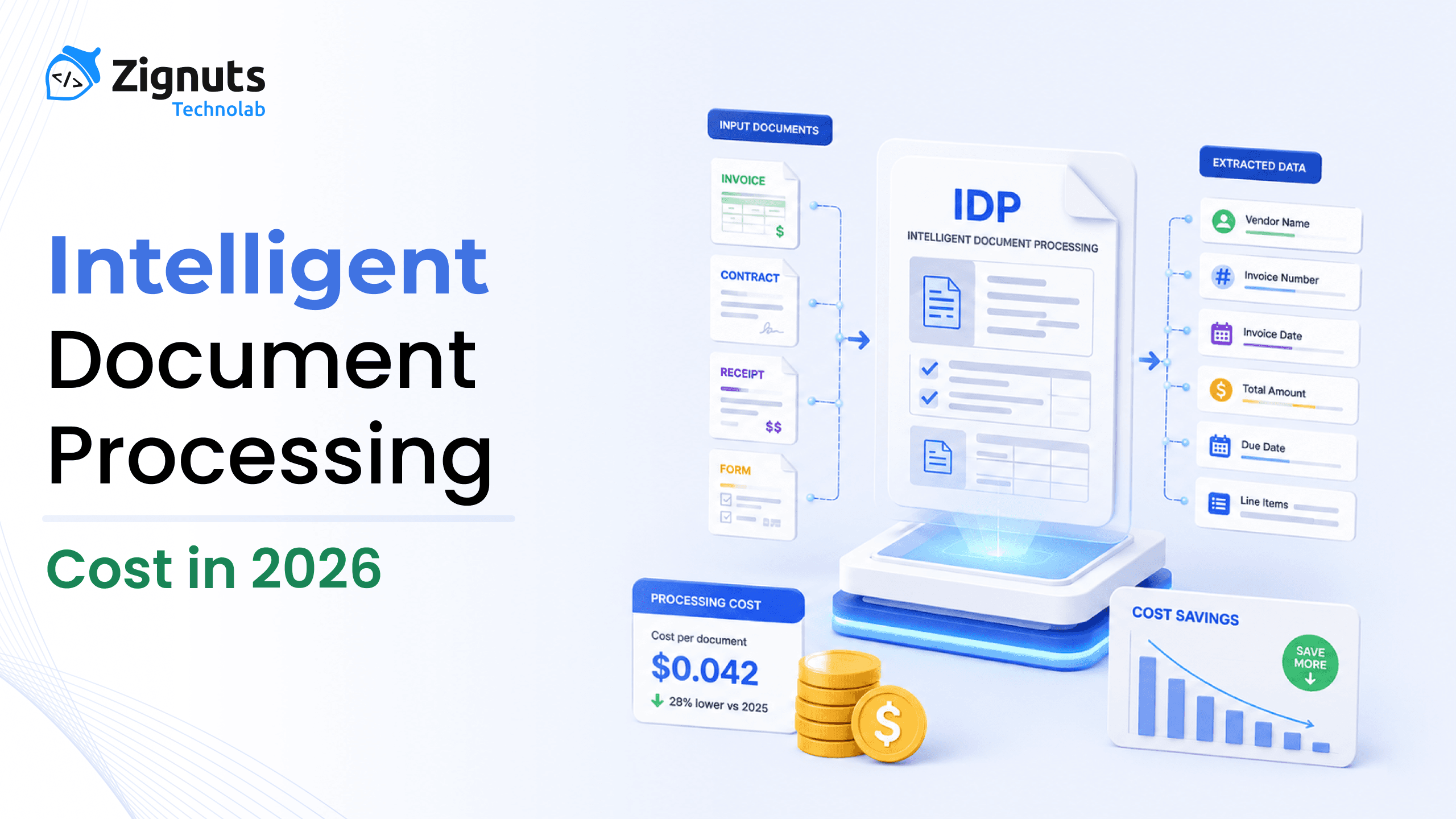
Intelligent Document Processing Cost: Executive Overview
The cost of intelligent document processing in 2026 depends less on a single OCR price and more on how much of the end-to-end workflow an enterprise wants to automate. Cloud document platforms typically charge based on pages processed, processor type, model, region, or purchased capacity, while the overall solution also includes infrastructure, workflow automation, integrations, human review, security, and ongoing operations. This is why Intelligent Document Processing Services can have significantly different total costs depending on the complexity of the workflow.
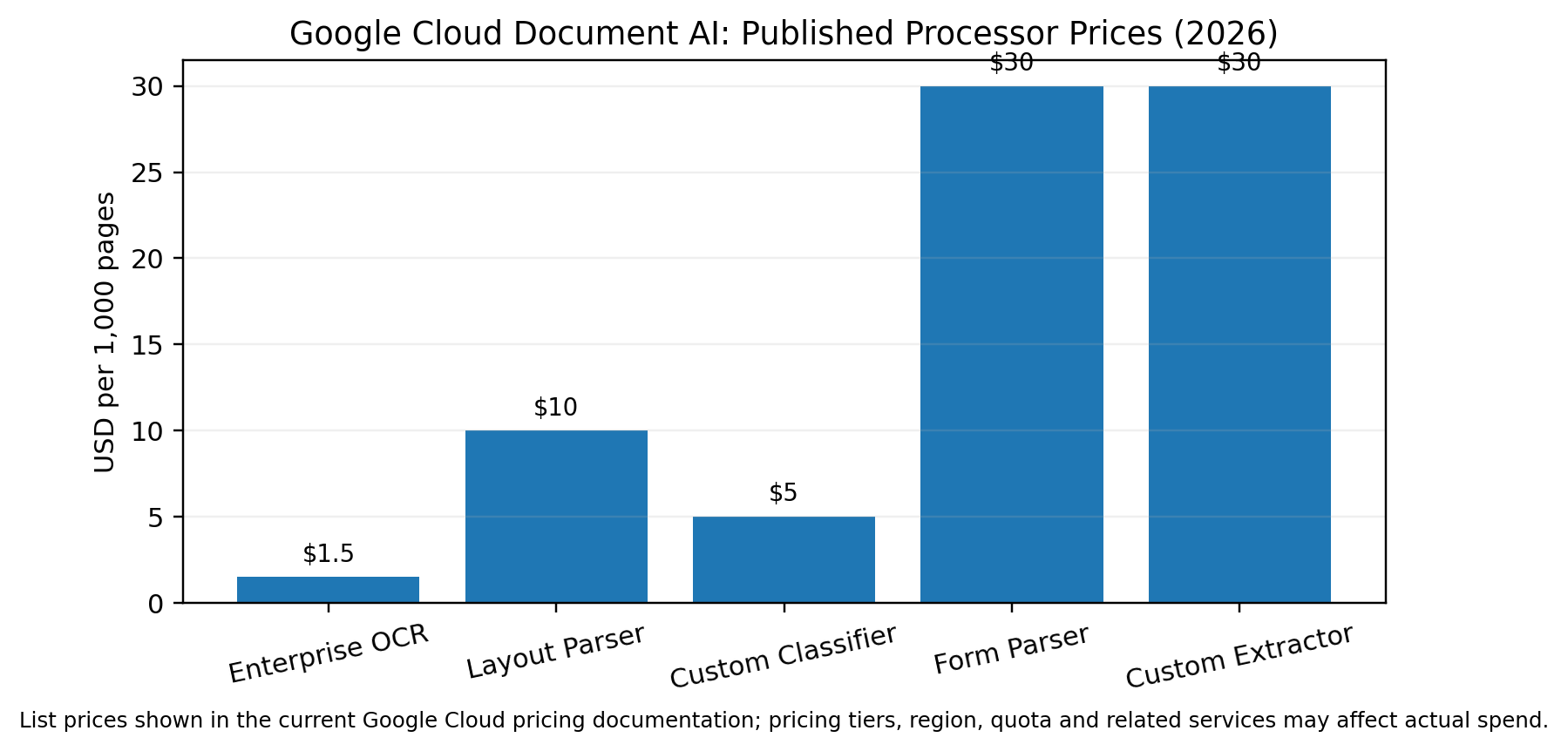
Current published pricing shows the difference clearly. Google Cloud lists Enterprise Document OCR at $1.50 per 1,000 pages for its stated volume band, while Layout Parser costs $10 and Form Parser and Custom Extractor cost $30 per 1,000 pages.
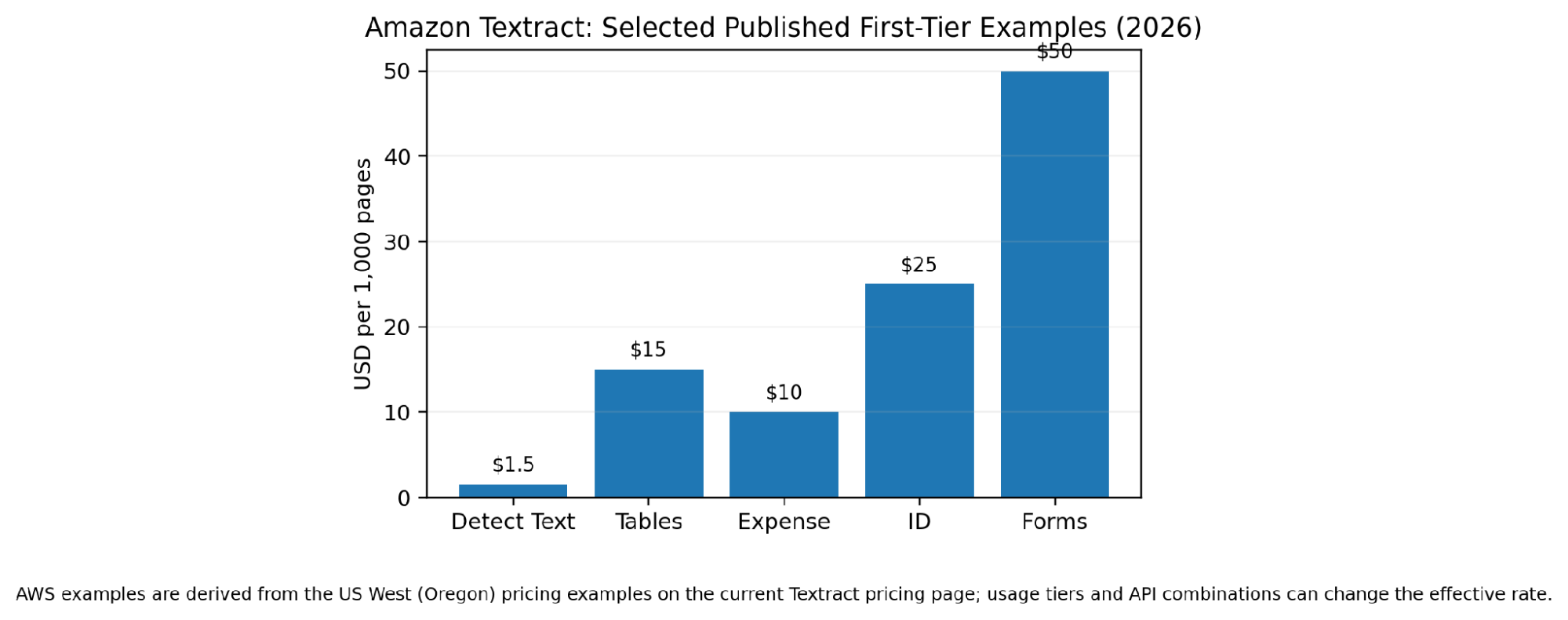
AWS lists Detect Document Text at $1.50 per 1,000 pages in its first million-page tier, along with $10 for Analyze Expense, $25 for Analyze ID, $15 for Tables, and $50 for Forms in its published examples.
These are processor-level prices, not the total cost of running an enterprise IDP solution.
Microsoft's current documentation also shows that Document Intelligence costs depend on the model type and number of pages analyzed. Actual costs can vary based on factors such as region, payment option, instance, and the specific document formats being processed.
What Does Intelligent Document Processing Cost in 2026 Include?
For 2026, the most useful way to answer "How much does IDP cost?" is to separate published processor pricing from solution implementation cost. A document-processing API can charge by page, but an enterprise system must also ingest documents, classify them, extract fields, validate them, route exceptions, write data into business systems, and operate securely at scale.
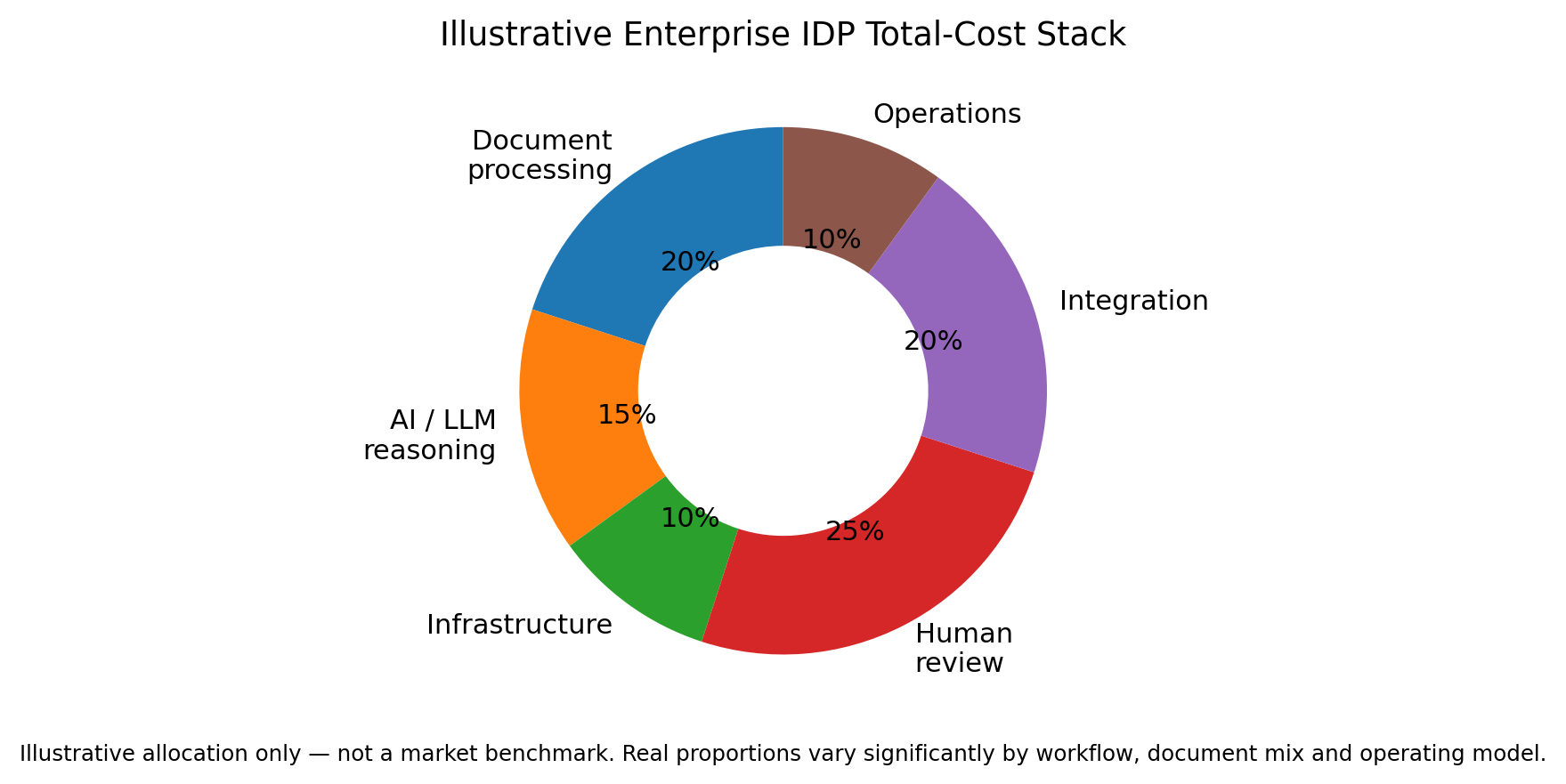
Intelligent Document Processing Cost: A Realistic Cost Model
Machine processing: OCR, layout, classification, and extraction charges.
AI reasoning: Optional LLM or multimodal inference where semantic understanding is needed.
Application platform: Storage, queues, compute, APIs, databases, and observability.
Human review: Exception handling for low-confidence or high-risk documents.
Integration: ERP, CRM, DMS, workflow, API, RPA, or data-platform connections.
Security and governance: IAM, encryption, isolation, audit, retention and controls.
Implementation: Discovery, architecture, schemas, validation rules, UI, integrations and evaluation.
Operations: Monitoring, model updates, support, incident response and optimization.
Ready to Optimize Your Document Processing Costs?

Intelligent Document Processing Cost: Processing, Platform, and Operations
Enterprise IDP costs are easiest to control when they are modeled in three layers. The first layer is variable processing spend. The second is the platform and integration architecture that enables processing. The third is the ongoing operating model that keeps the system accurate, secure, and usable.
Cost Layer | Typical Components | Main Cost Driver |
|---|---|---|
Layer 1 Processing | OCR, document AI, classification, extraction, AI reasoning | Usually variable with page/document volume and processor/model choice |
Layer 2 Platform | Storage, queues, databases, APIs, workflow, review UI, integrations | Architecture, uptime, volume, integrations and security |
Layer 3 Operations | Support, monitoring, model evaluation, change management, human review | Exception rate, business criticality, release cadence and service model |
Intelligent Document Processing Cost: Cloud Pricing in 2026
Cloud pricing is one of the few areas where enterprises can obtain current, auditable numbers directly from vendors. These rates should be treated as list-price reference points because region, volume tier, processor combination, commitments, taxes, and related services can change the final bill.
Google Cloud Intelligent Document Processing Pricing Examples
Google Cloud's current pricing page states that Document AI pricing is based on processed pages per month, the relevant quota, and any purchased capacity reservation. Its published list includes Enterprise Document OCR at $1.50 per 1,000 pages for 1–5,000,000 pages per month; Layout Parser at $10 per 1,000 pages; Custom Classifier and Custom Splitter at $5; and Form Parser and Custom Extractor at $30 per 1,000 pages in the stated volume ranges.
Amazon Textract Intelligent Document Processing Pricing Examples
AWS publishes multiple API families rather than one flat Textract price. Its current examples show Detect Document Text at $0.0015 per page for the first one million pages in US West (Oregon), Analyze Expense at $0.01 per page, Analyze ID at $0.025 per page, Tables at $0.015 per page, and Forms at $0.05 per page for their stated first-tier examples. AWS also shows lower rates above certain monthly thresholds.
Microsoft Azure Intelligent Document Processing Pricing
Microsoft's current pricing documentation uses the number of analyzed pages and the selected model type as key billing dimensions. Its cost-estimation guidance directs customers to use Azure portal processed-page metrics with the pricing calculator, selecting region, payment option, and instance. Azure also notes that page counting differs by document type and format. For example, each PDF page is counted as a page, while Word and HTML documents may be counted in blocks of 3,000 characters for supported models.
Why Microsoft Azure Document Processing Costs Differ
A page-counting rule can materially change the effective cost when the workload mixes PDFs, images, Word files, HTML, or other formats. Always model the actual source-document mix.
Intelligent Document Processing Cost: Key Pricing Takeaways
The current provider landscape shows why "IDP cost per page" is not one universal number. The same 100,000-page workload can use a low-cost OCR processor, a more expensive structured extractor, or multiple processors in sequence. Enterprises should therefore forecast cost from the processing path, not only the number of pages.
Ready to Optimize Your Document Processing Costs?
Intelligent Document Processing Cost by Document Type and Complexity
Document complexity is one of the biggest cost multipliers. A simple typed page that needs OCR can be processed differently from an invoice that requires tables and fields, and both differ again from a contract requiring semantic analysis across many pages.
Complexity | Processing Pattern | Relative Cost Pressure | Typical Examples |
|---|---|---|---|
Simple digitization | Text capture, OCR, indexing | Lower processing complexity | Scanned archival documents, basic text search |
Semi-structured extraction | Forms, key-value fields, tables | Moderate | Invoices, receipts, standard applications |
Document classification + extraction | Classify, split, route, extract multiple schemas | Moderate to high | Mixed document packages, onboarding bundles |
Custom extraction | Business-specific fields and schemas | High | Specialized forms, enterprise-specific documents |
Semantic/multimodal AI | Reasoning across long, visual, or narrative documents | Variable and potentially high | Contracts, complex reports, narrative-heavy documents |
Why Invoice Processing Can Cost More Than Basic OCR
An invoice workflow may require OCR, table recognition, key-value extraction, supplier matching, arithmetic validation, duplicate detection, and ERP integration. The processor charge is only one part of that flow. The enterprise business case should therefore compare the full workflow cost against the current manual handling process.
Why Long Contracts Can Increase Document Processing Costs
Contracts can contain many pages but only a small number of decision-relevant fields. A cost-efficient architecture may combine layout/OCR with targeted extraction or LLM reasoning rather than applying the same heavy model to every page. This is one reason document segmentation and selective processing can materially influence total cost.
Artificial Intelligence and Large Language Model Costs in Intelligent Document Processing
In 2026, enterprises increasingly evaluate LLMs and multimodal models as part of document understanding. Their cost is usually additive to the document-processing layer rather than a replacement for it.
Use OCR/document AI where the problem is text, layout, tables, or known document schemas.
Use LLMs or multimodal models when interpretation depends on semantics, cross-section reasoning, or complex visual context.
Minimize model calls by classifying and routing documents first.
Pass only the relevant text, pages, or fields into a reasoning model when the workflow allows it.
Use structured outputs and validation rather than unconstrained natural-language extraction.
Cache or reuse repeated context where supported.
Monitor token, model, and tool usage independently from page-processing cost.
Current OpenAI pricing, for example, illustrates that model inference is billed separately from the application layer and can vary substantially by model tier, cached input, and output. The current pricing page also distinguishes regional-processing uplifts and other service-specific charges.
A Cost Optimization Rule for Intelligent Document Processing
Do not send every page to a premium reasoning model. Build a routing layer that uses the cheapest reliable method for each document class and escalates only when complexity requires it.
Ready to Optimize Your Document Processing Costs?
Intelligent Document Processing Cost Formula for Enterprises
Intelligent Document Processing Cost Formula
Total monthly IDP cost = processing + AI inference + infrastructure + human review + integration + security/governance + support/operations |
Variable Intelligent Document Processing Costs
Pages or documents processed.
Number and type of processors called per document.
LLM or multimodal calls.
Human review cases and average review time.
Storage and data-transfer usage.
Fixed and Semi-Fixed Intelligent Document Processing Costs
Application hosting and monitoring.
Workflow and review applications.
Enterprise connectors and middleware.
Security controls and private-network requirements.
Model evaluation and maintenance.
Support and service management.
One-Time Intelligent Document Processing Implementation Costs
Process discovery and requirements.
Architecture and platform setup.
Document taxonomy and schema design.
Prompt/model/rule development.
Data labeling and evaluation.
UI, integrations, and workflow automation.
Testing, security review and deployment.
Intelligent Document Processing Cost Scenarios for 10,000, 100,000, and 1 Million Pages
Scenario modeling makes vendor pricing much easier to understand. The examples below are not total enterprise project quotes; they show how published processor rates can translate into direct processing spend before other costs.
Volume | Published-Rate Example | Monthly Processing Cost | What It Excludes |
|---|---|---|---|
10,000 pages | Google Enterprise OCR @ $1.50/1K | $15 | Processing only |
100,000 pages | Google Enterprise OCR @ $1.50/1K | $150 | Processing only |
1,000,000 pages | Google Enterprise OCR @ $1.50/1K | $1,500 | Processing only |
10,000 pages | Google Form Parser @ $30/1K | $300 | Processing only |
100,000 pages | Google Form Parser @ $30/1K | $3,000 | Processing only |
1,000,000 pages | Google Form Parser @ $30/1K | $30,000 | Processing only |
10,000 pages | AWS Analyze Expense @ $10/1K | $100 | Processing only |
100,000 pages | AWS Analyze Expense @ $10/1K | $1,000 | Processing only |
1,000,000 pages | AWS Analyze Expense @ $10/1K | $10,000 | Processing only |
These calculations apply the cited provider list-price examples directly; they do not include infrastructure, review, integration, tax, discounts/commitments, or other application-level charges. AWS also shows a free tier for eligible new customers and volume-based pricing tiers, while Google lists a first 1,000-page free tier for some Document AI processors. Enterprise planning should generally model contracted or steady-state pricing rather than assuming the free tier.
Ready to Optimize Your Document Processing Costs?
Human Review and Exception Costs in Intelligent Document Processing
Human review is frequently the highest "hidden" cost in IDP. An extraction system can appear inexpensive at the API level and still have a high total cost if many documents require manual correction.
How to Calculate Human Review Costs
Monthly review cost = documents sent to review × average review minutes per document × fully loaded reviewer hourly cost ÷ 60 |
Review rate: What percentage of documents require human attention?
Review time: How many fields or pages must a person inspect?
Skill level: Basic data review versus specialist underwriting, legal, or compliance review.
Queue management: How much operational overhead is needed to balance workloads?
Rework: How often do downstream failures create a second review cycle?
How Human Review Can Affect Total Processing Cost
Reducing model error is not automatically the cheapest path. Sometimes a slightly lower extraction score with faster targeted review produces a better total cost than forcing every case through an expensive model.
Intelligent Document Processing Integration, Security, and Compliance Costs
An enterprise IDP application becomes expensive when integration and controls are treated as add-ons. ERP, CRM, DMS, workflow, SSO, audit, retention and private-network requirements can exceed the direct document-processing charge in complex environments.
Cost Area | Typical Scope |
|---|---|
ERP/CRM integration | Field mapping, APIs, authentication, retries, idempotency |
DMS/ECM | Metadata, indexing, document lifecycle and permissions |
Workflow | Approvals, routing, escalation and task management |
Identity | SSO, RBAC/ABAC, service identities and least privilege |
Security | Encryption, private networking, secrets, vulnerability management |
Compliance | Audit, retention, deletion, residency and policy enforcement |
Observability | Logs, metrics, tracing, dashboards and alerting |
Business continuity | Backups, disaster recovery, retry and failover |
Microsoft's documentation, for example, directs customers to consider region, payment option, and instance when estimating Document Intelligence cost; it also documents page-counting behavior by input format. This illustrates why architecture and deployment choices belong in the cost model rather than only in the implementation plan.
Ready to Optimize Your Document Processing Costs?
Build vs. Buy vs. Managed Intelligent Document Processing
The financial decision is not simply "API versus custom software." The real question is how much of the document-processing stack an enterprise wants to own.
Approach | Best Fit | Financial Advantage | Financial Risk |
|---|---|---|---|
Managed service | Standard document classes, faster time-to-value | Lower model and platform engineering burden | Usage dependency; less control |
Platform + custom workflow | Enterprise integrations, custom validation and review | Balances speed and control | Integration and governance still require engineering |
Custom IDP platform | Strategic differentiation or highly specialized workflows | Maximum control and reuse | Highest engineering and operating burden |
Factors That Affect Intelligent Document Processing Cost
Document volume and variability.
Expected workflow lifetime.
Required customization and integration depth.
Compliance and data-residency constraints.
Internal engineering and AI capabilities.
Need for portability across cloud providers.
Operational criticality and SLA expectations.
Intelligent Document Processing Cost Optimization Strategies
The best IDP cost optimization strategy is selective processing: spend more only where additional intelligence changes the business outcome.
Strategy | Why It Can Reduce TCO |
|---|---|
Classify before extracting | Avoid expensive extraction on documents that do not belong to the workflow. |
Split mixed files | Process each document with the simplest suitable route. |
Use tiered models | Rules → OCR/document AI → custom models → LLM only when necessary. |
Reduce context | Send targeted pages or fields to advanced models where possible. |
Validate deterministically | Use cheap business rules after inference instead of repeated model calls. |
Batch where supported | Use asynchronous or batch modes for non-urgent workloads when economics permit. |
Cache repeatable work | Avoid recomputing unchanged content when the architecture allows it. |
Measure review causes | Fix recurring exception patterns instead of repeatedly paying humans. |
Monitor cost per successful transaction | Optimize end-to-end business cost, not only API price. |
Ready to Optimize Your Document Processing Costs?
How to Build an Intelligent Document Processing ROI Model
An ROI model should compare the new system with the current process, not with an abstract "cost per page." Start with the existing workflow and quantify what happens today.
Annual document volume by document type.
Average pages per document.
Current manual processing time.
Current error and rework rate.
Fully loaded labor cost.
Cycle time and business value of faster processing.
Current system and support cost.
Expected automation and review rates from a representative pilot.
New platform, processing, review, and integration costs.
Expected maintenance and model-management cost.
Intelligent Document Processing ROI Formula
Annual net value = baseline process cost − new annual IDP run cost − annualized implementation cost + measurable value from faster cycle times or reduced errors.
Measure Cost per Successfully Completed Business Transaction
The strongest KPI is often "cost per successfully completed business transaction," because it captures extraction, validation, review, integration, and rework in one number.
Common Intelligent Document Processing Costing Mistakes
Mistake | Better Costing Approach |
|---|---|
Using a vendor's lowest OCR price as the total IDP price | Model the complete processing path. |
Ignoring pages per document | Two document sets with the same document count can have radically different page volumes. |
Ignoring processor combinations | Classification + splitting + extraction can create multiple billable operations. |
Assuming every document needs the same model | Use routing and tiered processing. |
Treating human review as zero-cost | Measure exception rate and review time. |
Ignoring integration engineering | ERP/CRM/API work can be material. |
Ignoring security and governance | Sensitive workflows often require significant control design. |
Using demo accuracy in the cost model | Pilot with representative documents and measure review/rework. |
Ignoring peak loads | Capacity, concurrency, and queueing can affect infrastructure and service requirements. |
Locking the business case to today's model price | Keep the architecture adaptable as model pricing and capabilities change. |
Ready to Optimize Your Document Processing Costs?
How to Estimate Enterprise Intelligent Document Processing Costs
Before asking for a fixed project quote, prepare the inputs that drive the estimate. A good discovery package reduces the risk of comparing proposals that use different assumptions.
Document inventory: Classes, formats, pages, languages, and monthly volume.
Source channels: Email, upload, scanners, cloud storage, APIs or shared drives.
Extraction requirements: Fields, tables, line items, entities and evidence.
Business validation: Master-data lookups, arithmetic checks, policy rules.
Human review: Expected review triggers, specialist roles and approval needs.
Integrations: ERP, CRM, DMS, workflow, data warehouse, RPA and APIs.
Security: SSO, roles, tenant boundaries, residency, encryption and audit.
Availability: Business hours versus 24/7 processing.
Evaluation: Representative sample, acceptance thresholds and edge cases.
Operating model: Who owns monitoring, model changes, support and exception queues.
What an Intelligent Document Processing Cost Estimate Should Include
One-time implementation scope.
Recurring platform and processing assumptions.
Volume tiers and major third-party dependencies.
Human-review assumptions.
Integration and security assumptions.
Out-of-scope items.
Change-request mechanism.
Model/vendor price assumptions and validity date.
Intelligent Document Processing Vendor Cost Evaluation Checklist
Does the vendor expose transparent usage metrics?
Can the platform report pages processed by model/processor?
Can the vendor estimate cost for the customer's real document mix?
Can different document classes be routed to different processing strategies?
Are custom extraction and classification supported where required?
Can human review be built into the workflow?
Can the platform export audit and processing logs?
Can the solution integrate with existing enterprise systems?
What happens when the provider changes models or prices?
Can business rules remain independent from a specific provider?
Can the customer test with its own representative documents?
Are costs for storage, review, integration, and support clearly separated?
Intelligent Document Processing Cost by Industry
Industry | Typical Drivers | Where Cost Pressure Appears |
|---|---|---|
Finance / Banking | Large document volumes, strict controls, KYC/underwriting workflows | Model choice + audit + review + data security |
Insurance | Claims evidence, variable layouts, high exception value | Document diversity + human review + workflow |
Healthcare | Sensitive information and strict access requirements | Security + residency + review + integration |
Legal | Long documents and semantic extraction | Advanced reasoning + selective processing + review |
Logistics | Operational documents with high throughput | Volume + integrations + peak capacity |
Retail / AP | Invoices, suppliers, receipts and ERP workflows | Structured extraction + validation + ERP integration |
HR | Identity, onboarding and employee documents | Privacy + access control + retention |
Ready to Optimize Your Document Processing Costs?
Intelligent Document Processing Cost: Key Takeaways
"Cost per page" is only the first layer of an enterprise IDP business case.
Current 2026 cloud pricing shows large differences between OCR, layout, forms, expense, ID, and custom extraction processors.
Document complexity, processor combinations, and AI model choice can materially change variable processing cost.
Human review, integrations, security and operations can be significant components of total cost.
Route documents by complexity and use advanced AI selectively.
Model cost per successfully completed business transaction, not just cost per API call.
Use representative documents and measured pilot outcomes before committing to a large-scale business case.
Keep the architecture adaptable so model pricing and capabilities can evolve
Hire Now!Ready to Optimize Your Document Processing Costs?
Bring your document automation goals, processing challenges, or cost concerns to our experts. We’ll help you build a scalable intelligent document processing solution that delivers measurable business value.
Conclusion
Intelligent document processing cost in 2026 is not determined by OCR or API pricing alone. The total cost depends on document volume and complexity, AI model usage, infrastructure, human review, integrations, security, and ongoing operations. A practical cost model should therefore consider the complete workflow and measure the cost of successfully processing each business transaction.
For enterprises, the most cost-effective approach is to use the right processing method for each document type, automate routine validation, minimize unnecessary AI calls, and continuously monitor review rates and operational costs. Building a clear cost and ROI model before implementation can help you choose the right architecture and avoid unexpected expenses as document volumes grow.
If you're planning an IDP workflow and want to understand the implementation, integration, and operating costs for your specific requirements, contact us today to discuss your project.

Hard Trivedi
Business Enthusiast | Exploring ideas, understanding business challenges, and turning insights into practical solutions that create meaningful value and growth.