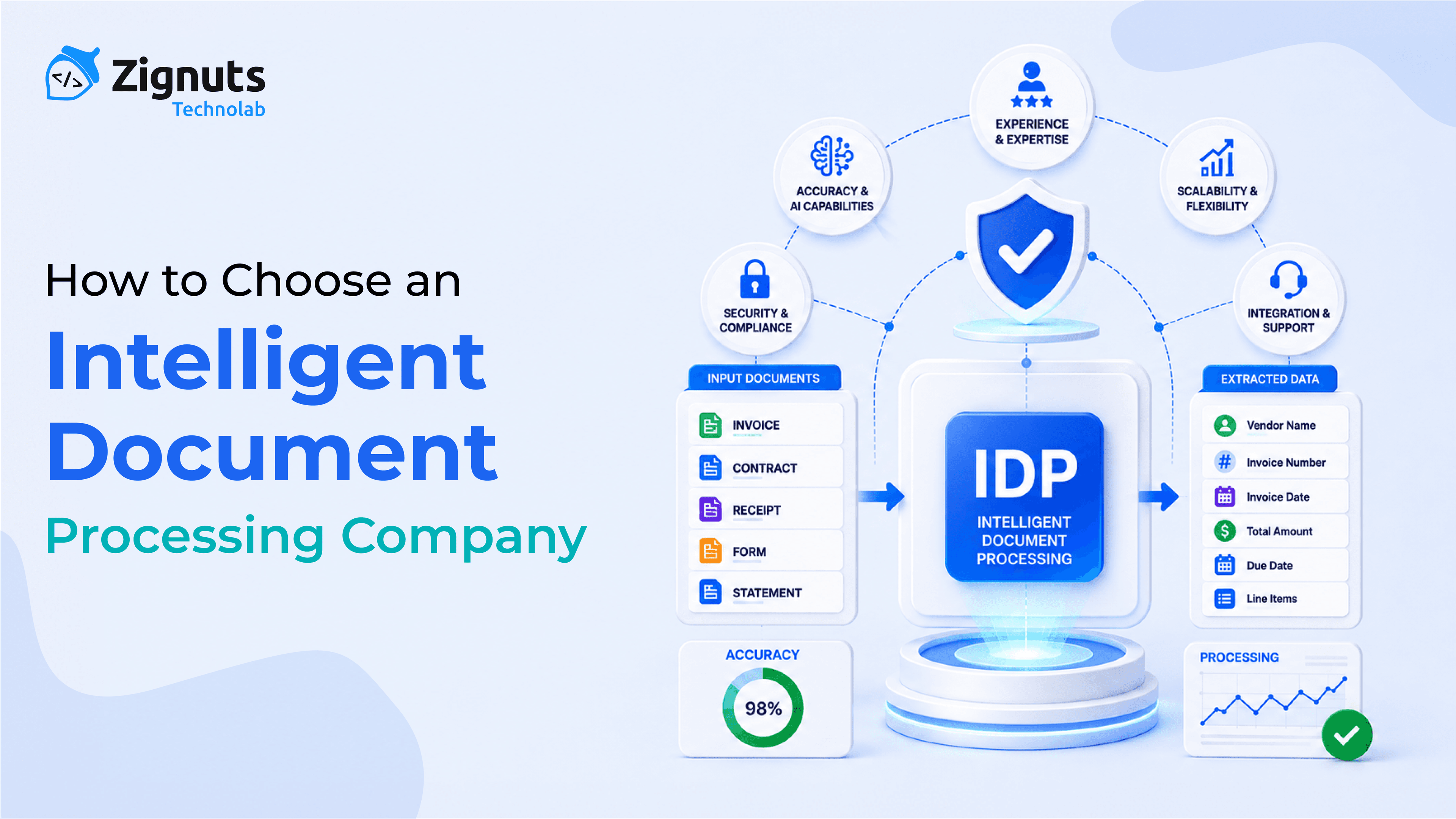
Intelligent Document Processing Vendor Selection: Key Considerations
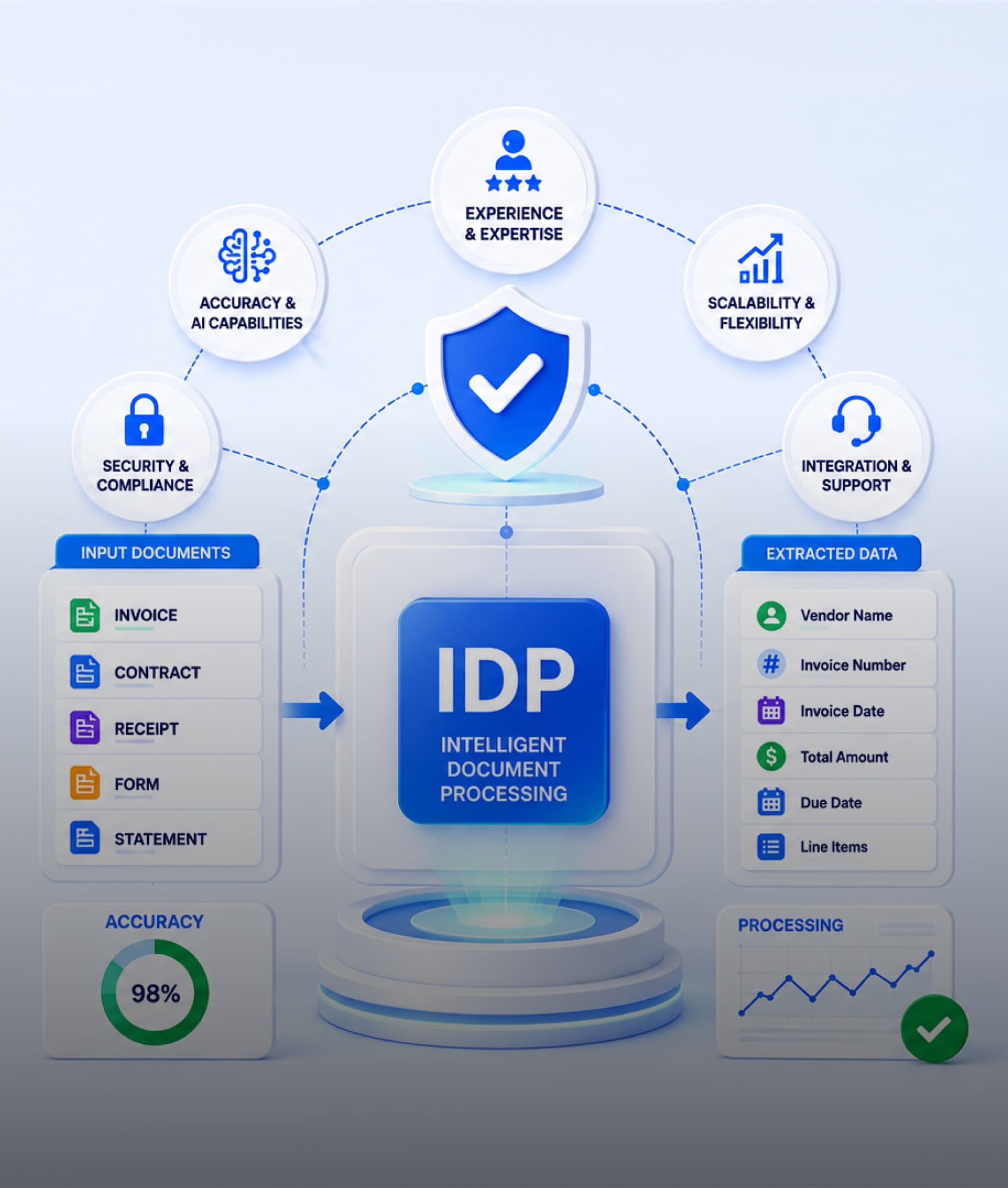
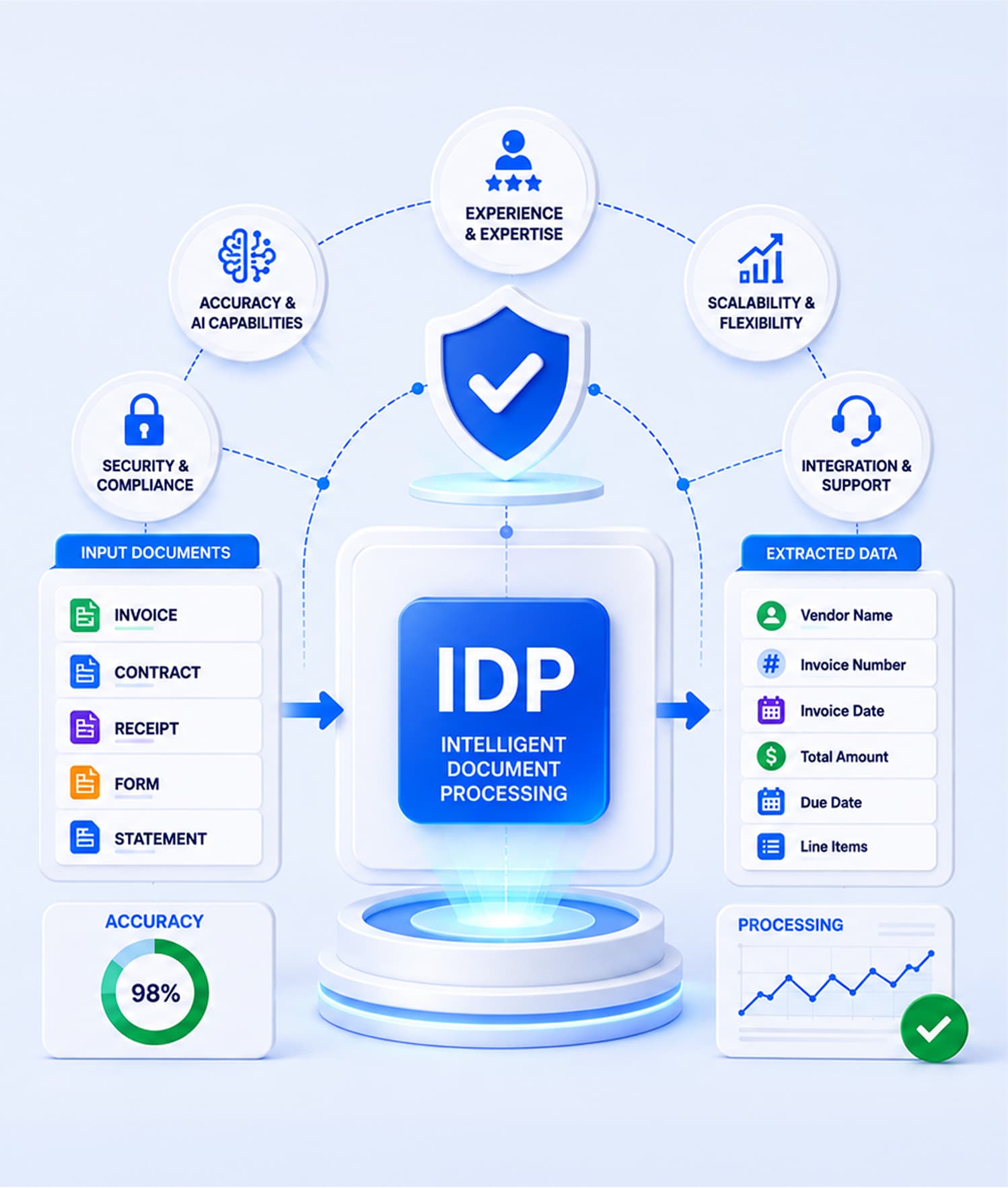
An Intelligent Document Processing (IDP) company helps organizations convert documents such as invoices, forms, claims, contracts, applications, and reports into structured, validated information that can move through business workflows. Intelligent Document Processing Services can support this process, but a good selection process must evaluate accuracy and operational fit together: extraction alone is not the same as a dependable end-to-end process.
Decision area | What to establish before signing |
|---|---|
Business outcome | Which workflow is being improved, what is the baseline, and how will success be measured? |
Document fit | Can the solution handle your actual layouts, languages, scans, tables, handwriting, and exceptions? |
Trust & controls | Where is data processed and retained? Who can access it? What can be audited or deleted? |
Workflow & integration | Can validated results reach the right ERP, CRM, case system, data store, or API safely? |
Economics | What is the full cost per successfully processed document, including review and rework? |
Operational ownership | Who maintains models, rules, connectors, monitoring, and exception queues after launch? |
Define Your Workflow Before Choosing an Intelligent Document Processing Company
The best IDP choice depends on the decision or transaction the document supports. Before comparing companies, define the current process from document arrival to accepted business outcome.
That boundary prevents a common mistake: selecting a tool for OCR quality while leaving manual routing, validation, exception handling, and system updates unresolved.
Create a baseline for a representative period: Record document types and volumes, average handling time, rework, exception rates, duplicate submissions, downstream rejection rates, and the cost of a bad extraction.
Separate routine documents from rare but high-risk cases; a blended average can hide serious failure modes.
List the documents and variants: native PDFs, scans, mobile photos, multi-document bundles, tables, handwritten fields, different languages, and supplier-specific templates.
Map each extracted field to its destination and business rule: An invoice total, for example, may need arithmetic checks, purchase-order matching, tax validation, and duplicate detection.
Classify risk: A wrong address may be easy to correct; a wrong bank account, claim decision, or regulated record can have much higher consequences.
Agree on acceptance criteria before demonstrations: Define field-level precision/recall or exact-match measures, critical-field thresholds, review rates, throughput, latency, and audit requirements.
Best Practices for Evaluating Document Processing Accuracy
Evaluate on a holdout set of real, representative documents. Include difficult cases and measure errors by document type and field not only one overall accuracy number.
Ready to Improve Your Document Processing?

What an Intelligent Document Processing Company Should Provide
IDP is usually a combination of document ingestion, OCR/layout analysis, classification, extraction, validation, workflow orchestration, human review, and integration. Providers differ in how much of this stack they supply natively and how much the buyer must build.
Capability layer | Questions to ask |
|---|---|
Capture & ingestion | Can it receive documents from email, scanners, portals, SFTP, cloud storage, and APIs? How are malware, duplicates, and corrupt files handled? |
OCR & layout | Does it preserve reading order, tables, key-value pairs, checkboxes, page coordinates, and multilingual text? |
Classification & splitting | Can it identify document types and split mixed bundles before extraction? How are uncertain classifications handled? |
Extraction | Are there prebuilt models, custom schemas, rules, or LLM-assisted extraction? Can results be grounded to source text or page regions? |
Validation & review | Are confidence scores field-specific? Can business rules trigger human review? Can reviewers correct results with an audit trail? |
Workflow & integration | Are APIs, webhooks, queues, connectors, retries, idempotency, and error recovery available? |
Governance & operations | Are model versions, access controls, retention, logs, evaluations, and change approvals manageable? |
Official platform documentation illustrates why requirements matter. Google Cloud Document AI describes OCR, extraction, classification, splitting, and integrations as distinct capabilities. AWS Textract exposes text, forms, tables, queries, and specialized document workflows. Microsoft distinguishes document models for structured or semi-structured extraction from tools intended for more varied or multimodal content. These are examples of platform approaches, not a ranking of providers.
Choosing the Right Intelligent Document Processing Solution
Option | Often fits when | Trade-offs to validate |
|---|---|---|
Specialist IDP platform | Document-centric workflows need configurable extraction, review queues, and business-process tooling. | Check licensing, model portability, integration depth, and dependence on proprietary workflow features. |
Cloud AI document services | Your team wants APIs and can build the surrounding workflow in its cloud environment. | The service may not include a complete operations console or end-to-end process; confirm what must be engineered. |
RPA-led document automation | Document handling is one step in an established robotic process, and desktop/system automation matters. | UI automation can be brittle; distinguish robust APIs from screen-level automation. |
Custom-built IDP workflow | Requirements are unusual, proprietary, or tightly coupled to business rules and existing systems. | You own model evaluation, exception handling, security, upgrades, monitoring, and long-term maintenance. |
Hybrid architecture | A managed extraction engine is combined with custom validation, orchestration, and human review. | Requires clear ownership boundaries, observability, and integration testing across components. |
Do not assume a single provider must own every layer. A composable architecture can reduce lock-in and allow a specialist extraction model to feed an internal workflow. The trade-off is that your team must operate the integration and end-to-end reliability.
Ready to Improve Your Document Processing?
How to Evaluate Intelligent Document Processing Accuracy With a Proof of Concept
A proof of concept should answer whether the solution can meet the business acceptance criteria on your documents, under realistic conditions. A polished demo with curated examples is not evidence of production performance.
Build a representative sample: routine cases, edge cases, low-quality scans, multiple layouts, long documents, and critical exceptions. Keep a separate holdout set for final evaluation.
Define a field schema and ground truth: Document the correct value, acceptable normalization, and the business impact of each error.
Measure field-level outcomes: Use exact match for discrete values where appropriate; use suitable normalization for dates, currencies, and text. Report critical-field failures separately.
Test confidence calibration: Confirm that low-confidence or conflicting results route to review rather than silently passing through.
Test drift and change: Introduce a new supplier layout, a revised form, or a changed policy and observe how updates are made, evaluated, approved, and rolled back.
Run the full process: not just the extraction API. Include queueing, validation, human review, retries, downstream write-back, and reconciliation.
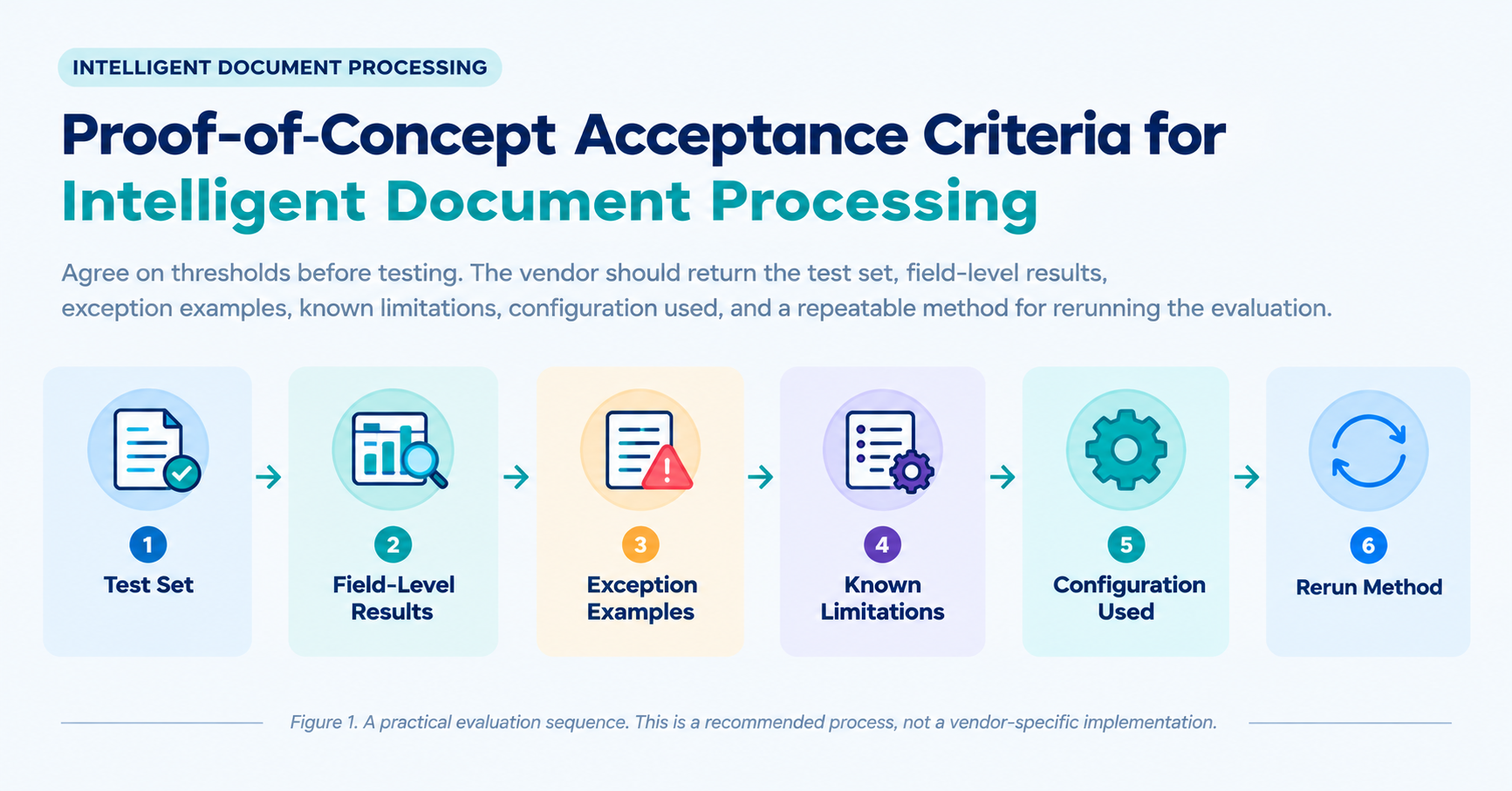
Proof-of-Concept Acceptance Criteria for Intelligent Document Processing
Agree on thresholds before testing. The vendor should return the test set, field-level results, exception examples, known limitations, configuration used, and a repeatable method for rerunning the evaluation.
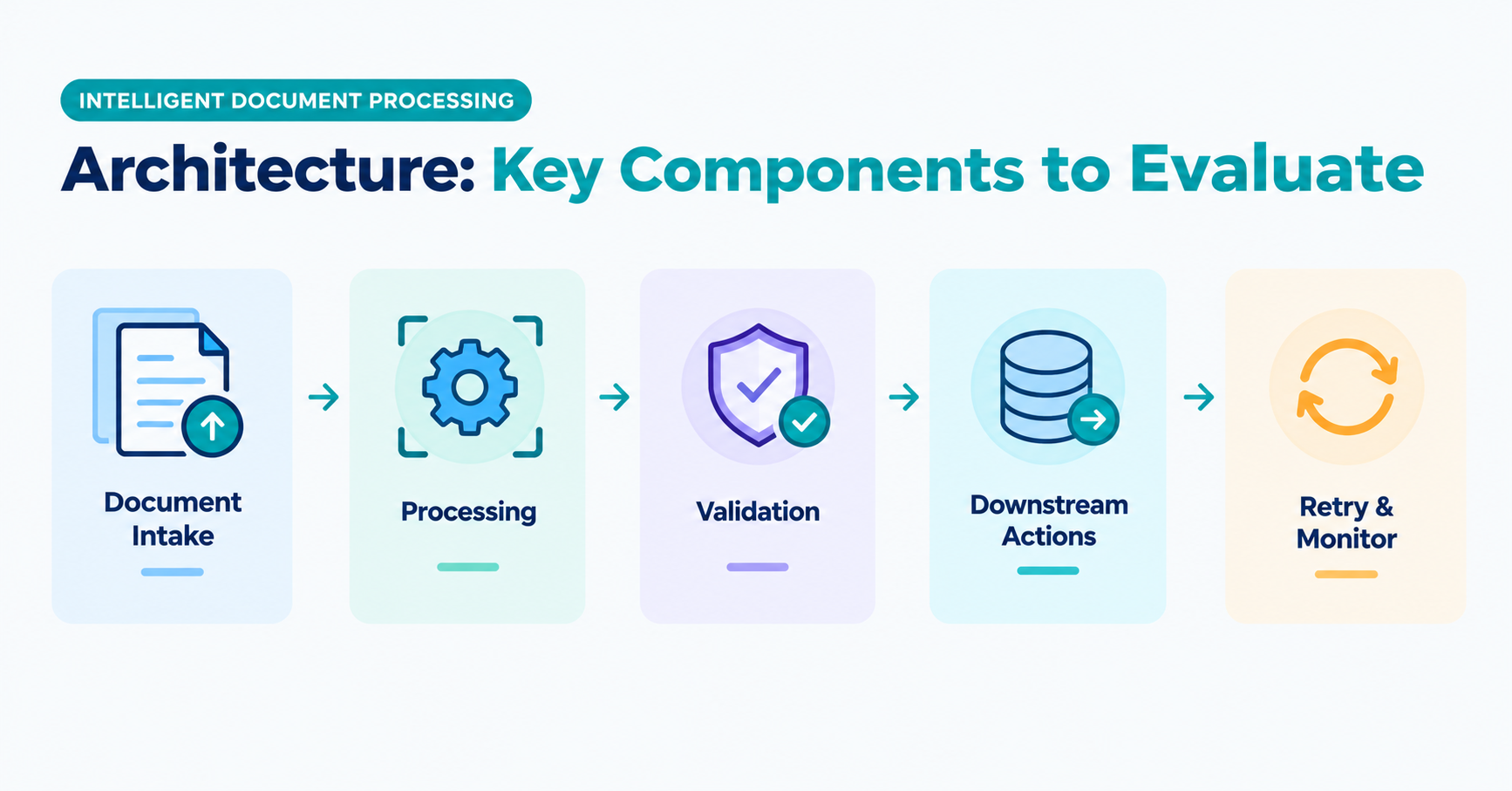
Intelligent Document Processing Architecture: Key Components to Evaluate
A production-ready IDP workflow should separate document intake, processing, validation, and downstream actions. This makes it easier to retry failures, investigate incorrect outputs, protect sensitive data, and change a model without rewriting the entire business process.
Important Architecture Decisions for Intelligent Document Processing
Use asynchronous queues for large or bursty workloads where immediate responses are not required. Define retries, dead-letter queues, idempotency keys, and replay procedures.
Keep business validation separate from model extraction. A model may read a total correctly while the business system still needs to verify tax, currency, purchase-order matching, or policy constraints.
Preserve lineage. Link each output field to the source document, page or region where available, model/version, validation outcome, reviewer changes, and downstream transaction.
Choose storage and retention intentionally. Avoid keeping duplicate copies of sensitive documents and extracted fields without a business or legal reason.
Design for partial failure. A document may be extracted successfully while the ERP write-back fails; the workflow must reconcile state rather than blindly repeat the transaction.
Make operations observable. Track processing time, backlog, exception rate, model/version, API errors, cost, and business outcomes. Alert on changes in error distribution, not only system uptime.
Ready to Improve Your Document Processing?
Intelligent Document Processing Security, Privacy, and Compliance Requirements
Ask the vendor to demonstrate how controls work in your intended deployment and contract, not merely provide a security logo or a generic compliance list. The correct controls depend on your data classification, jurisdictions, industry obligations, and risk appetite.
Control area | Evidence to request |
|---|---|
Data location & retention | Processing regions, storage locations, backup behavior, retention/deletion schedule, and documented exceptions. |
Identity & access | SSO, MFA, role-based access, least privilege, service identities, tenant isolation, and periodic access review. |
Encryption & keys | Encryption in transit and at rest, key management options, rotation, and responsibility boundaries. |
Model/data usage | Whether customer documents or outputs are used for model training or service improvement; contractual terms and opt-out controls. |
Auditability | Logs for document access, processing, exports, model changes, reviewer actions, and administrative operations. |
Compliance | Current independent reports and scope statements relevant to your requirements; verify product, region, and service coverage. |
Incident & continuity | Incident notification commitments, backup/restore, disaster recovery, vulnerability management, and support escalation. |
For example, Google Cloud documents data-residency controls, VPC Service Controls, customer-managed encryption keys, and compliance resources for Document AI.
AWS documents encryption and security controls for Textract. Such vendor documentation is a starting point, not a substitute for reviewing the precise service terms, region, configuration, and contractual commitments that apply to your use case.
For Indian organizations, map the workflow against applicable Indian data-protection requirements and sector-specific rules with qualified legal or compliance advisers. Do not infer that hosting data in India alone establishes compliance.
Intelligent Document Processing Vendor Evaluation Scorecard
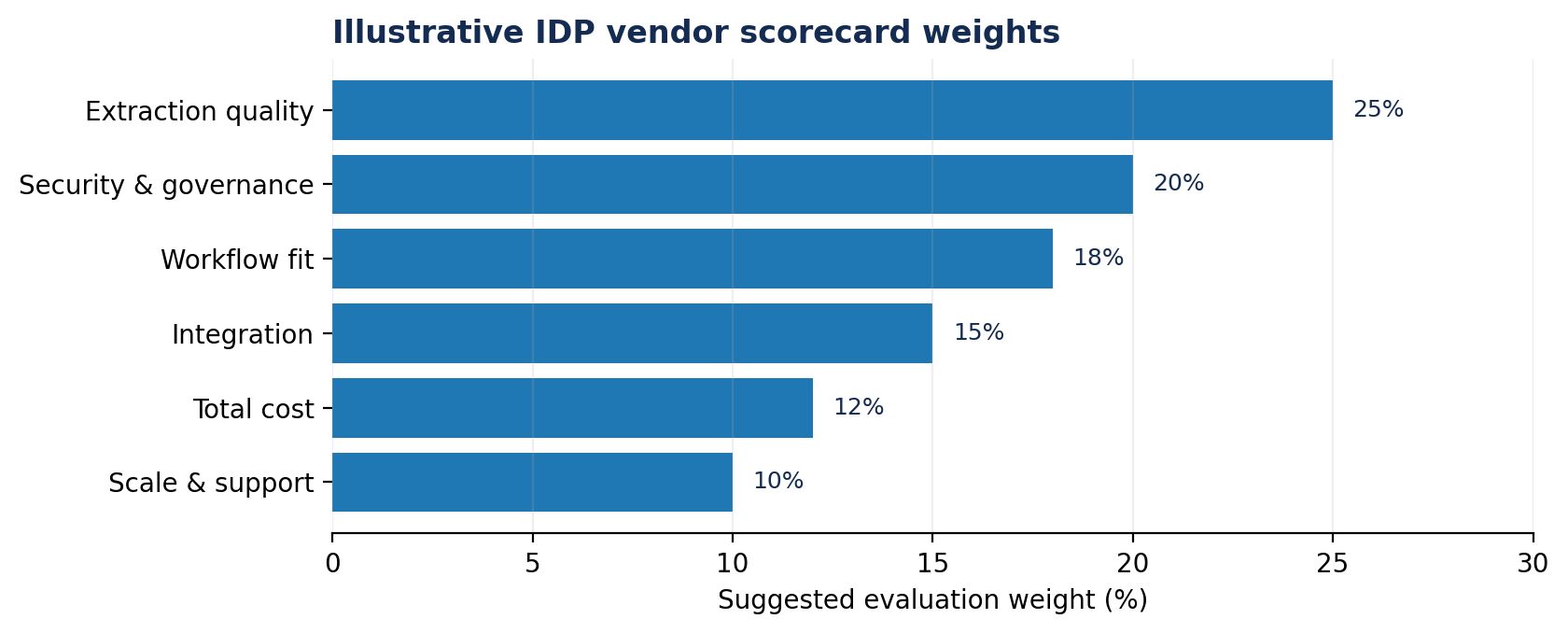
Use a weighted scorecard to make trade-offs explicit. The weights below are illustrative starting points, not industry benchmarks; adjust them to the risk and economics of your workflow. Apply hard gates for non-negotiable requirements such as data residency, required certifications, or minimum critical-field accuracy.
Criterion | What a strong answer looks like | Suggested weight |
|---|---|---|
Extraction quality | Results meet pre-agreed thresholds on the holdout set; errors are categorized and traceable. | 25% |
Security & governance | Controls and contract terms meet data, access, retention, audit, and compliance needs. | 20% |
Workflow fit | Exception paths, human review, business rules, and operational hand-offs are supported. | 18% |
Integration | Documented APIs/connectors; reliable retries, idempotency, monitoring, and write-back. | 15% |
Total cost | Quote covers usage, licenses, review, storage, implementation, support, and change costs. | 12% |
Scale & support | Capacity, SLAs, support model, upgrade path, and operational ownership are credible. | 10% |
Score each vendor on a consistent scale, retain evidence beside each score, and document any assumptions. A weighted total should not override a failed hard gate or a serious risk in a critical workflow.
Ready to Improve Your Document Processing?
Intelligent Document Processing Cost: Understanding Total Cost of Ownership
The headline API or subscription price is only one part of IDP cost. A lower-cost extraction engine can become more expensive if it requires extensive custom development, frequent manual correction, or a fragile integration.
Licensing and usage: Per page, document, transaction, model, seat, or capacity tier; minimum commitments and overage rates.
Implementation: Discovery, schema design, model configuration, integrations, migration, security review, testing, and change management.
Human review: Staffing, exception handling, quality assurance, and the cost of correcting model errors.
Operations: Monitoring, storage, network transfer, observability, support, model evaluation, and upgrades.
Change costs: New document types, supplier layouts, policy changes, additional regions, or new downstream systems.
Risk costs: Incorrect transactions, compliance exposure, delays, reprocessing, and business interruption.
A useful internal metric is cost per successfully completed business transaction, not cost per page. Include the share of documents that need review and the effort needed to resolve them. Estimate with your own volumes and vendor quotations; avoid generic ROI claims.
Intelligent Document Processing Requirements by Industry
Industry/workflow | Requirements to emphasize |
|---|---|
Banking & financial services | Identity checks, audit trails, sensitive financial data, traceability, fraud controls, and strict exception handling. |
Insurance | Claim-package splitting, policy and claim matching, document completeness, evidence lineage, and human review for consequential decisions. |
Healthcare | Sensitive personal data, access controls, retention, auditability, document provenance, and clinical safety boundaries. |
Retail & accounts payable | Invoice/receipt extraction, tax and currency rules, duplicate detection, purchase-order matching, and ERP integration. |
Manufacturing & logistics | Purchase orders, bills of lading, customs and shipping documents, varied supplier layouts, and resilient integrations. |
Legal & professional services | Contract clause extraction, citation to source passages, version control, confidentiality, and review by qualified professionals. |
HR & public services | Identity data, multilingual documents, accessibility, retention controls, and clear handling of incomplete applications. |
These are requirement prompts, not claims that one vendor is universally suited to an industry. Validate each workflow against applicable rules and actual document samples.
Ready to Improve Your Document Processing?
Common Mistakes When Choosing an Intelligent Document Processing Company
Buying based on a single accuracy number: Ask what was measured, on which documents, at which field level, and with what treatment of exceptions.
Confusing OCR with IDP: Reading text is only one step. Classification, validation, routing, review, and write-back may require separate capabilities.
Letting the vendor choose the test set: Use your own representative data and retain a holdout set to reduce demo bias.
Ignoring operational exceptions: Ask what happens when a file is corrupt, fields conflict, a service is unavailable, or an ERP rejects a result.
Overusing generative AI: Use deterministic rules for deterministic checks. Use LLM-based reasoning only where the task benefits from it, with grounding and evaluation.
Treating certification as proof of fit: Verify scope, product, region, configuration, and contractual applicability.
Ignoring exit and portability: Clarify export formats for documents, extracted data, schemas, annotations, rules, and logs; test a realistic exit path.
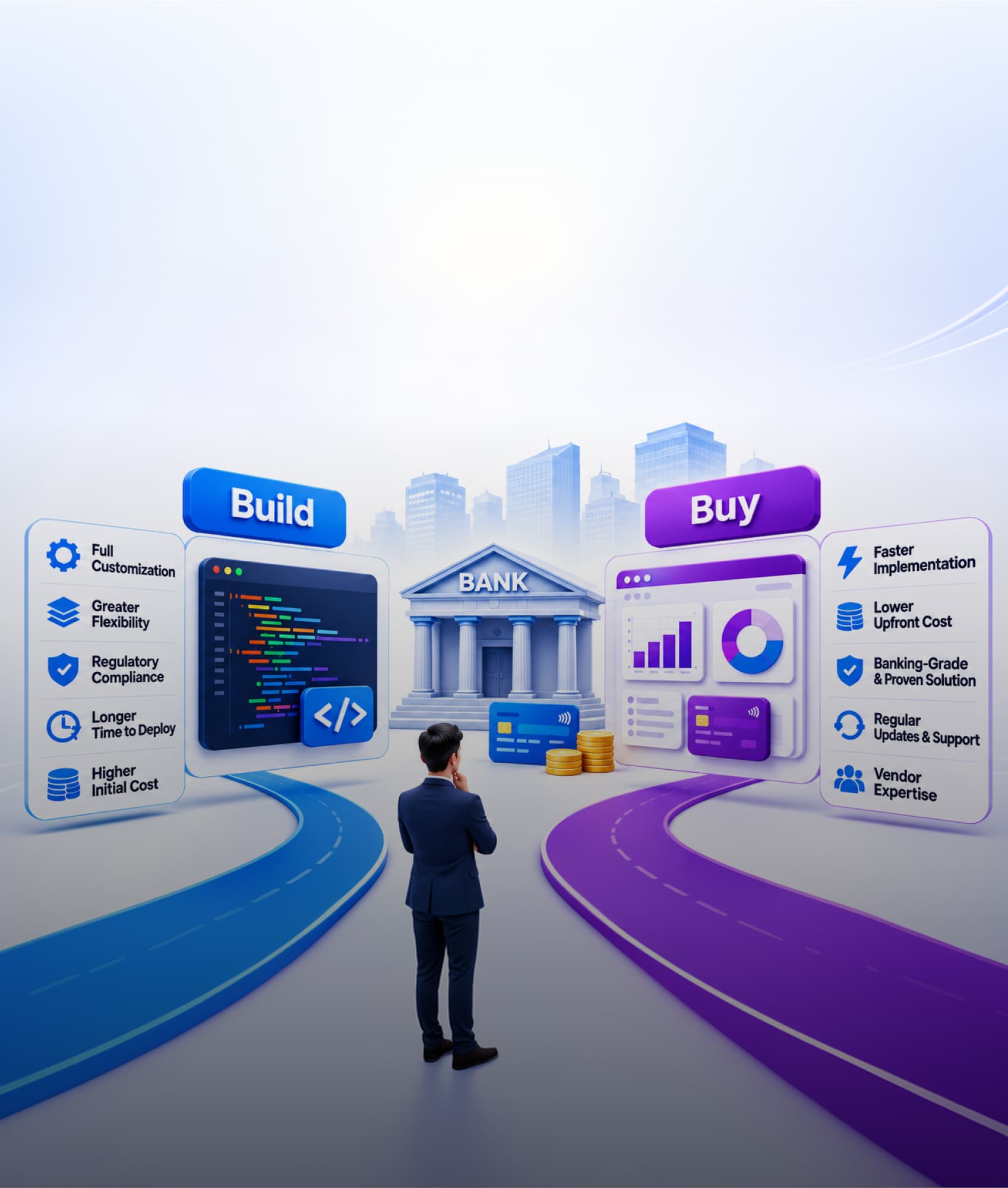
Managed vs. Custom Intelligent Document Processing: How to Choose
Choose a managed IDP platform when… | Consider a custom or hybrid build when… |
|---|---|
Document types are common, and the platform covers most required extraction. | Your documents, rules, or workflows are highly specialized or strategically differentiating. |
Time-to-pilot and managed model operations matter more than deep control. | You need fine-grained control over model choice, orchestration, data flow, or deployment. |
The vendor’s workflow, security, and integration model fits existing operations. | Your team can sustainably own evaluation, monitoring, upgrades, security, and support. |
Commercial terms and portability are acceptable. | The business case justifies the ongoing engineering and operational burden. |
A hybrid approach is often worth testing: use a managed model for extraction, while keeping business rules, validation, event handling, and system-of-record writes in components your organization controls. Select architecture based on operating capability, not trend.
Ready to Improve Your Document Processing?
Questions to Ask an Intelligent Document Processing Provider Before Signing
What exact document types, languages, file formats, and edge cases were tested?
Can you share field-level evaluation results and examples of failure cases from our test set?
How do confidence scores work, and can we configure mandatory review for critical fields?
Which features are native, which require custom development, and which depend on third-party services?
What data is retained, where is it processed, and is it used to train or improve models?
How are model, schema, prompt, and rules changes tested, approved, versioned, and rolled back?
What happens when extraction succeeds, but downstream write-back fails?
What are the service limits, rate limits, availability commitments, support response times, and escalation routes?
How is the price calculated as volumes, pages, models, users, and exception rates change?
Can we export our documents, results, schemas, annotations, rules, and audit records if we leave?
Who owns ongoing model tuning, monitoring, incident response, and business-rule maintenance?
What measurable acceptance criteria must the pilot meet before production approval?
Intelligent Document Processing: Key Takeaways for Vendor Selection
Define the business objective: Start with a specific workflow, establish a baseline, and set measurable success criteria before evaluating vendors.
Validate extraction accuracy: Test the solution using representative documents and assess field-level accuracy, errors, and exception handling.
Evaluate end-to-end workflows: Review the complete process, including document ingestion, validation, human review, system integration, monitoring, and recovery.
Prioritize security and governance: Confirm that security controls, data governance, retention policies, and data portability meet your requirements.
Compare total cost of ownership: Calculate the cost per successfully processed transaction, including manual review, rework, integration, and ongoing maintenance.
Use a structured selection process: Apply a transparent scorecard, document supporting evidence, and establish an exit strategy to reduce vendor dependency.
Conclusion: Choosing Intelligent Document Processing for Reliable Business Outcomes
Choosing the right Intelligent Document Processing (IDP) company comes down to how well it handles your documents, fits your existing systems, and meets your security and operational requirements. Vendor reputation and features can help narrow your options, but testing the solution with real documents, clear acceptance criteria, and a transparent cost model is essential to determine whether it will perform reliably in everyday business operations.
If you need support assessing requirements, designing integrations, building workflow components, or developing a tailored document-processing solution, contact us today to discuss your project. Zignuts can help you explore an approach that aligns with your business needs, existing systems, and operational goals.

Hard Trivedi
Business Enthusiast | Exploring ideas, understanding business challenges, and turning insights into practical solutions that create meaningful value and growth.