

Building an AI SaaS product in 2027 is not simply a matter of adding an LLM feature to a subscription application. Enterprise buyers will expect reliable automation, governed data, measurable productivity gains, and deployment models that satisfy security, compliance, and integration requirements. The right approach combines product strategy, AI engineering, SaaS architecture, and disciplined cloud operations from the first roadmap decision.
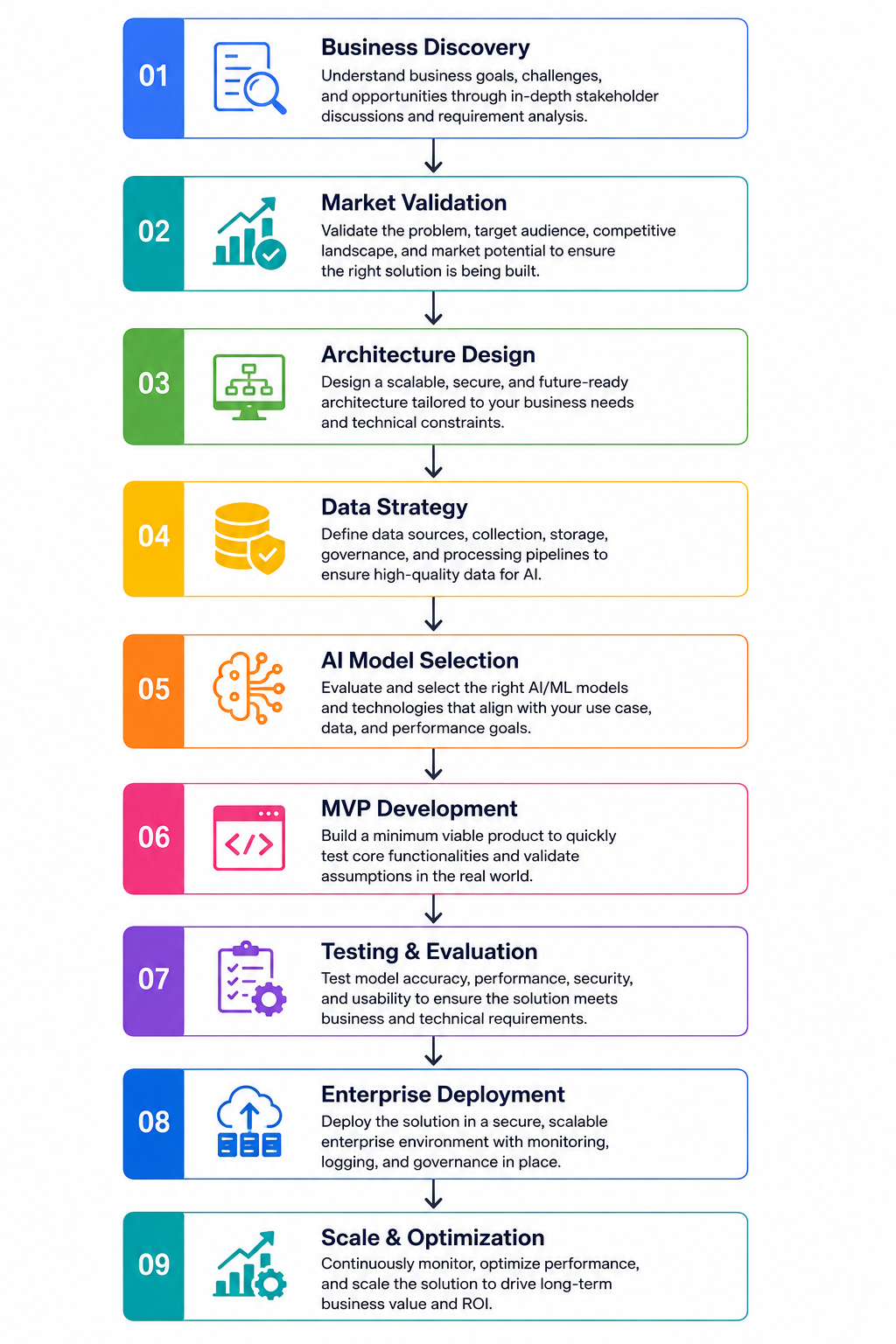
AI SaaS Development Lifecycle
Ready to Turn Your AI SaaS Idea Into a Scalable Product?

What an AI SaaS product must solve in 2027
The strongest AI SaaS products focus on high-value workflows where intelligence improves speed, accuracy, personalization, or decision quality. At the core of successful AI Product Development is defining the business outcome before selecting models or cloud services, whether that means reducing support resolution time, automating document review, forecasting demand, improving compliance checks, or accelerating internal operations. This clarity prevents expensive experimentation and helps product teams build features that enterprise customers are willing to fund.
Start with a commercially validated use case
AI SaaS development should begin with customer discovery, not model selection. Interview decision-makers, users, security teams, and operations leaders to understand budget ownership, current tools, data availability, risk tolerance, and buying triggers. A product that automates a painful, recurring, and measurable workflow has stronger commercial intent than a generic AI assistant.
Define the target user, economic buyer, and administrator persona.
Quantify the cost of the current manual process or legacy platform.
Confirm whether customers need prediction, generation, classification, search, automation, or agentic workflows.
Identify integration requirements such as CRM, ERP, data warehouses, ticketing systems, and identity providers.
Validate compliance needs, including SOC 2, GDPR, HIPAA, ISO 27001, audit trails, and data residency.
Design the SaaS architecture before training or integrating models
A scalable AI SaaS product needs a robust multi-tenant architecture, secure data boundaries, resilient APIs, and observability across both software and model behavior. Common architecture layers include the web or mobile interface, application services, AI orchestration, vector storage, relational databases, event queues, analytics, billing, identity, and cloud infrastructure. For enterprise accounts, tenant isolation and role-based access control should be treated as core architecture, not later enhancements.
Key architecture decisions
Multi-tenancy: Choose shared, isolated, or hybrid tenancy based on customer size, compliance, and cost model.
Model strategy: Use commercial LLM APIs, open-source models, fine-tuned models, or a hybrid approach depending on latency, cost, privacy, and control.
Data layer: Separate transactional data, unstructured content, embeddings, logs, analytics, and customer-specific knowledge bases.
AI orchestration: Build workflows for retrieval, prompting, tool use, validation, fallback handling, and human approval.
Integration layer: Use secure APIs, webhooks, event-driven services, and connectors to reduce onboarding friction.
Ready to Turn Your AI SaaS Idea Into a Scalable Product?
Build a data foundation that supports AI quality
In 2027, AI SaaS differentiation will depend heavily on data quality, domain context, and governance. Many products fail because the model is technically capable, but the available data is incomplete, inconsistent, or inaccessible. Build data ingestion pipelines that handle structured records, documents, conversations, images, and third-party systems. Include normalization, deduplication, access permissions, metadata tagging, and retention policies from the beginning.
For knowledge-intensive products, retrieval-augmented generation can help deliver grounded responses without training a custom model for every customer. However, RAG requires careful document chunking, embedding strategy, ranking, permissions, and evaluation. Enterprise users will not accept confident answers that ignore access rules or cite outdated information.
Select AI models with business constraints in mind
The best model is not always the largest or newest. CTOs and product leaders should compare models based on accuracy, latency, explainability, operating cost, regional availability, vendor dependency, and ability to support domain-specific tasks. For some workflows, a smaller fine-tuned model, rules engine, or traditional machine learning pipeline may outperform a general-purpose LLM on cost and reliability.
Use LLMs for language understanding, summarization, reasoning support, and content generation.
Use classical machine learning for forecasting, scoring, anomaly detection, and pattern recognition where structured data dominates.
Use computer vision models for inspection, healthcare imaging, retail shelf analytics, manufacturing quality, and logistics workflows.
Use agentic systems cautiously for multi-step task execution, especially where approvals, payments, compliance, or customer communication are involved.
Model Type
Best For
Cost
Speed
Privacy
Open Source LLM
Enterprise
Low
Medium
High
Fine-tuned Model
Industry AI
Medium
High
High
Classical ML
Prediction
Very Low
Very High
High
Plan for security, privacy, and governance from day one
Enterprise AI SaaS buyers will ask how data is processed, whether prompts are stored, how models are monitored, who can access outputs, and whether customer data is used for training. Security architecture should include encryption, tenant-aware authorization, audit logs, secrets management, secure model gateways, prompt injection defenses, rate limiting, and incident response processes. AI governance should cover evaluation, bias testing, human review, output traceability, and model change management.
Compliance readiness also affects sales velocity. Products targeting finance, healthcare, insurance, legal, or government ecosystems should build evidence collection into engineering workflows. Automated tests, infrastructure policies, access reviews, and documented controls make future SOC 2 or ISO certification faster and less disruptive.
Define the MVP without underbuilding the platform
An AI SaaS MVP should prove the core workflow, customer value, and willingness to pay while still respecting security and scalability fundamentals. Avoid building every admin feature, analytics dashboard, or model optimization in the first release. Instead, create a focused product that performs one valuable job reliably for a defined ICP.
A practical MVP scope
Core workflow with clear input, AI processing, review, and output stages.
Authentication, tenant setup, user roles, and basic administration.
Data ingestion or integration with one or two priority systems.
AI evaluation metrics such as accuracy, hallucination rate, task completion rate, or time saved.
Human-in-the-loop review for high-risk outputs.
Usage tracking, billing readiness, logging, and customer feedback capture.
Enterprise Readiness Checklist you can follow.
Production Readiness Checklist | Status |
|---|---|
Commercially validated use case | ✓ |
Multi-tenant architecture | ✓ |
Secure authentication & RBAC | ✓ |
AI model evaluation | ✓ |
Human-in-the-loop review | ✓ |
Monitoring & observability | ✓ |
Cost tracking | ✓ |
Compliance readiness | ✓ |
This approach helps founders and enterprises launch faster while avoiding a prototype that must be rebuilt entirely after validation. The MVP should be production-minded, even if its feature set is intentionally narrow.
Ready to Turn Your AI SaaS Idea Into a Scalable Product?
Engineer for scalability, cost control, and reliability
AI SaaS products introduce variable compute costs that can quickly erode margins. Every model call, embedding update, vector search, file processing job, and agent task should be measured. Product teams need cost-aware architecture with caching, request batching, asynchronous processing, model routing, token budgeting, and usage-based pricing logic. Cloud infrastructure should support autoscaling without allowing unpredictable AI workloads to create unbounded spend.
Reliability also requires fallback strategies. If a model provider has latency issues, the application should degrade gracefully. If confidence is low, the system should request clarification or route to a human. If retrieval results are weak, the product should avoid fabricating answers. These behaviors build trust with enterprise customers.
Create an enterprise-ready product experience
Enterprise AI adoption depends on trust and usability. Administrators need account controls, permissions, data sources, policy settings, usage visibility, and audit history. End users need transparent outputs, cited sources, editable results, and clear next actions. Buyers need dashboards that connect AI usage to business metrics such as hours saved, faster response times, reduced errors, improved conversion, or lower operational costs.
Pricing should align with value and infrastructure cost. Common models include per-seat pricing, usage-based pricing, workflow volume pricing, tiered enterprise plans, and hybrid models. For AI SaaS, pure per-seat pricing may be risky if heavy users generate high model costs. A balanced pricing strategy protects gross margin while remaining predictable for customers.
Choose the right technology stack
The technology stack should reflect team capability, performance requirements, and long-term maintainability. Popular choices include React or Next.js for web applications, Node.js, Python, or Java for backend services, PostgreSQL for transactional data, Redis for caching, Kafka or cloud queues for events, vector databases for semantic retrieval, and AWS, Azure, or Google Cloud for infrastructure. Mobile AI SaaS extensions may use Flutter, React Native, Swift, or Kotlin depending on device requirements.
For AI development, teams may use model APIs, open-source model hosting, orchestration frameworks, evaluation tools, MLOps pipelines, and observability platforms. The priority is not trend adoption but building a stack that is secure, testable, scalable, and easy to operate.
Implementation roadmap for AI SaaS development
Discovery: Validate ICP, workflow, integrations, business case, and data constraints.
Architecture: Define tenancy, data flows, model strategy, APIs, cloud infrastructure, and security controls.
Prototype: Test model performance, retrieval quality, prompts, user experience, and feasibility with real data.
MVP engineering: Build the production foundation, core workflow, admin features, observability, and deployment pipelines.
Evaluation: Measure output quality, latency, cost, user adoption, and business impact.
Scale: Add integrations, analytics, automation, enterprise controls, compliance readiness, and internationalization.
Ready to Turn Your AI SaaS Idea Into a Scalable Product?
When to work with an AI SaaS development partner
External engineering support becomes valuable when the product requires AI architecture, cloud scalability, complex integrations, regulated data, or rapid MVP execution. A strong development partner should help with product discovery, technical feasibility, AI model selection, SaaS platform architecture, DevOps, security, testing, and post-launch optimization. For enterprises modernizing legacy platforms, the right partner can also integrate AI into existing workflows without disrupting core operations.
Final takeaway
To build an AI SaaS product in 2027, start with a commercially validated workflow, architect for enterprise trust, use AI where it creates measurable advantage, and engineer the platform for scale from the beginning. The winners will not be the products with the most AI features; they will be the platforms that turn reliable intelligence into business outcomes customers can measure.

Deep Mistry
Digital Marketing Enthusiast | Diving into the world of trends, tools, and strategies, sharing discoveries that help create impactful online experiences.