

A hospital can have an EHR, a telehealth platform, a laboratory system, a PACS, a patient app, and a dozen specialist tools, yet still struggle to answer a basic question: What is happening with this patient right now? The problem is rarely a lack of software. It is the seams between systems.
Enterprise healthcare software is therefore an integration and trust problem as much as a product-development problem. The winning platforms do not simply add more screens or features. They establish a reliable data model, enforce security and access controls, fit real clinical workflows, exchange information through standards, and create an architecture that can survive regulatory change and growing transaction volumes.
THE PRACTICAL TEST: If a proposed healthcare platform cannot clearly explain where patient data comes from, who can access it, how it is exchanged, how consent is enforced, how changes are audited, and what happens when an external system is unavailable, the architecture is not ready for enterprise deployment.
Healthcare Software Development: Patient-Centered Architecture
A useful healthcare platform usually sits at the intersection of clinical workflows, operational workflows, patient engagement, data exchange, analytics, and governance. Each layer creates different engineering constraints.
Clinical workflows: encounters, orders, observations, medications, diagnoses, care plans, and clinical documentation.
Operational workflows: scheduling, registration, billing, claims, staffing, referrals, inventory, and facility operations.
Patient-facing experiences: portals, mobile apps, telemedicine, reminders, remote monitoring, and secure messaging.
Data exchange: EHR/EMR integrations, laboratories, imaging, pharmacies, payers, public-health systems and third-party applications.
Intelligence: dashboards, predictive models, clinical decision support, workflow automation and AI assistants.
Governance: identity, consent, auditability, retention, data residency, security and regulatory controls.
Ready to Build More Scalable Healthcare Software?

Healthcare Software Development: Start with Workflow Mapping
One of the most expensive mistakes in healthcare software is beginning with a technology decision instead of a workflow decision. A team selects microservices, a cloud provider, or an AI model before it has mapped the real journey through registration, care delivery, documentation, review, and follow-up.
A better discovery sequence is:
Identify the primary clinical or operational outcome the product must improve.
Map the actors: patient, clinician, nurse, administrator, pharmacist, lab technician, payer, caregiver, and external systems.
Document the current workflow, including manual workarounds and exception paths.
Identify every system that creates, consumes, or modifies healthcare data.
Define the minimum data needed at each workflow step.
Translate the workflow into capabilities, APIs, events, permissions, and audit requirements.
Only then choose the architecture and implementation approach.
FHIR in Healthcare Software Development: Integration Requirements and Limitations
FHIR, or Fast Healthcare Interoperability Resources, provides a standard way to represent and exchange healthcare information. HL7's current published FHIR specification is R5, although enterprise environments may still need to support R4 or R4B depending on the systems they integrate with. HL7 FHIR R5 documentation. The important engineering point is that adopting FHIR does not automatically make two systems interoperable. Profiles, implementation guides, terminology, authentication, authorization, versioning, and validation still have to be designed.
Healthcare Software Development: Enterprise Integration Architecture
For a large healthcare environment, a common pattern is to keep source systems authoritative while placing an integration layer between them and new applications.
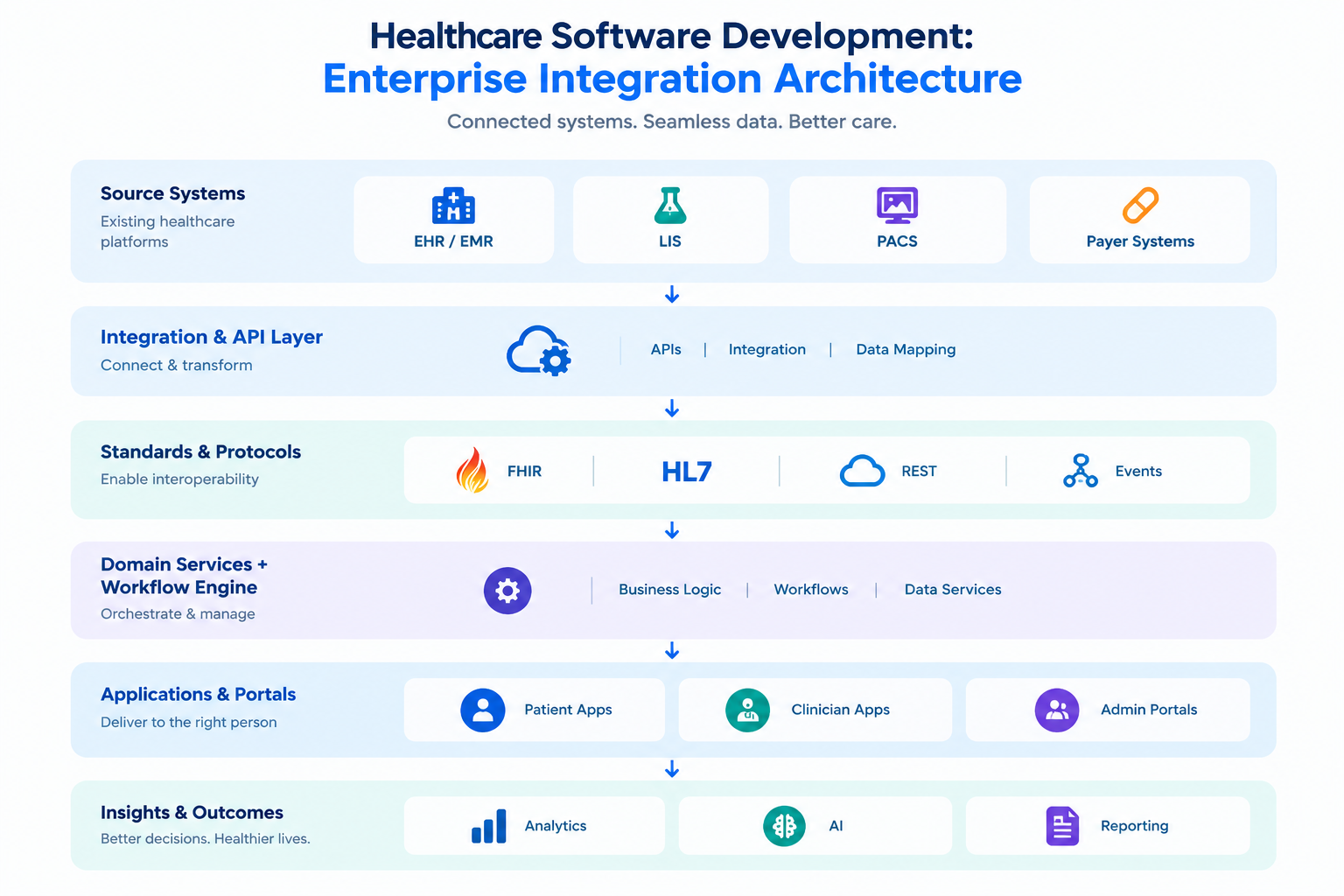
This approach reduces direct point-to-point dependencies. It also creates a place to normalize data, apply authorization, manage retries, validate messages, and observe integration health.
Ready to Build More Scalable Healthcare Software?
HL7, FHIR and Legacy Interfaces in Healthcare Software Development
Technology | Best fit | Enterprise consideration | Typical role |
|---|---|---|---|
FHIR | Modern APIs and application exchange | Design profiles and terminology carefully | Patient, clinical and population APIs |
HL7 v2 | Existing hospital and departmental systems | Common in mature healthcare environments | Orders, results, admissions and messages |
C-CDA | Document-based clinical exchange | Useful where document workflows remain important | Clinical summaries and transitions |
REST/events | Internal domain services and workflow | Use healthcare standards where healthcare data crosses boundaries | Business workflows, notifications and orchestration |
Healthcare Software Development Security: Protecting the Data Path
Healthcare applications cannot treat security as a checklist added before launch. In the United States, the HIPAA Security Rule establishes requirements for administrative, physical, and technical safeguards protecting electronic protected health information. HHS HIPAA Security Rule. Other jurisdictions introduce their own privacy, cybersecurity, consent, and data-residency requirements. The architecture should therefore start from the jurisdictions and data flows that the product will actually support.
Healthcare Software Security Architecture and Access Controls
Identity: SSO, MFA, OAuth 2.0/OIDC, service identities, and strong session management.
Authorization: RBAC for broad roles plus ABAC or policy-based controls for context-sensitive access.
Least privilege: Services and users should receive only the permissions needed for their workflow.
Encryption: Protect data in transit and at rest, with managed keys and controlled key rotation.
Auditability: Record who accessed or changed sensitive data, what action occurred, when it occurred, and the relevant system context.
Segmentation: Separate public-facing workloads, integration services, data stores, and administrative systems.
Secrets management: Keep credentials, API keys, and certificates out of source code and general configuration.
Resilience: Design backups, recovery objectives, failover, and degraded-mode workflows before production incidents occur.
Consent and Authorization in Healthcare Software Development
A healthcare application may need to answer questions that ordinary business software rarely encounters: Can this clinician see this patient's record? Can this application access the data the patient authorized? Has consent expired? Was access revoked? Should a caregiver see the same information as the patient? Can an emergency override normal restrictions, and how is that override audited?
These are not merely infrastructure questions. They affect user experience, API behavior, database design, and audit records. Authorization decisions should therefore be represented explicitly in the domain model and tested as business rules.
Ready to Build More Scalable Healthcare Software?
Healthcare Software Development: Patient Experience and Usability
Patients do not experience FHIR, queues, or database schemas. They experience appointment delays, confusing forms, duplicate data entry, video-call failures, unreadable results, and repeated requests for information. Enterprise software should measure those moments.
Reduce repeated data entry by reusing verified patient information.
Design for mobile-first access when the target population depends on phones.
Support accessible interfaces and clear clinical language.
Make appointment, prescription, result, and referral states obvious.
Build resilient communication for poor network conditions and interrupted sessions.
Use secure messaging rather than exposing sensitive information through ordinary notifications.
Telehealth Software Development: Beyond Video Infrastructure
A production telehealth platform typically needs scheduling, patient identity, clinician availability, consent, secure video, clinical documentation, prescriptions, notifications, payment or insurance workflows, follow-up, and integration with the patient's record. A video call that works perfectly in a demo can still fail as a clinical product if the encounter cannot be linked to the correct patient, documented properly, or carried into downstream workflows.
AI in Healthcare Software Development: Architecture and Regulatory Considerations
AI is increasingly being introduced into clinical documentation, imaging, triage, patient engagement, operational forecasting, and decision support. The FDA maintains an AI-enabled medical device list, and the list shows continued authorization activity across radiology, cardiovascular, neurology, and other clinical areas in 2025 and 2026. FDA AI-enabled medical device list. That does not mean every healthcare AI feature is a medical device, but it does mean product teams should determine the intended use and regulatory implications early.
Clinical AI in Healthcare Software Development: Governance and Safety Controls
Define intended use and prohibited use before model selection.
Keep deterministic business rules separate from probabilistic model output.
Log model version, prompt or input context, output, confidence or uncertainty indicators, and downstream action where appropriate.
Create human-review paths for high-risk decisions.
Monitor drift, false positives, false negatives, and subgroup performance.
Protect sensitive data used in training, retrieval, evaluation, and inference.
Make model changes traceable through controlled release processes.
For certified health IT in the United States, ONC's HTI-1 rule introduced transparency requirements around AI and predictive algorithms and updated interoperability standards, including USCDI v3 and newer FHIR/SMART-related requirements. ONC HTI-1 Final Rule: Enterprise teams should therefore treat algorithm governance and interoperability as connected architecture concerns rather than separate compliance projects.
Ready to Build More Scalable Healthcare Software?
Healthcare AI Architecture: From Clinical Data to Auditable Decisions
Clinical Data
↓
Validation
↓
Normalization
↓
Retrieval / Features
↓
Model
↓
Policy Rules
↓
Human Review
↓
Clinical Action
↓
Audit
Healthcare Software Development Cloud Architecture: Choosing the Right Operating Model
Healthcare organizations often debate cloud versus on-premises as if one is universally safer. The better question is which operating model gives the organization sufficient security, resilience, observability, performance, and control for its data and regulatory requirements.
Approach | Where it works well | Watch-outs |
|---|---|---|
Public cloud | Elastic workloads, managed services, analytics and rapid product delivery | Data residency, service configuration, IAM complexity and vendor dependencies |
Private cloud / on-prem | Legacy integration, strict control requirements and existing infrastructure | Capacity planning, patching, disaster recovery and operational cost |
Hybrid | Large enterprises with legacy systems plus modern digital products | Integration complexity and duplicated operational responsibilities |
Healthcare Software Development: Resilience and Failure Handling
External EHR API is unavailable.
A lab result arrives twice.
A message arrives out of order.
A patient loses connectivity during a telehealth session.
A downstream service responds slowly.
A third-party token expires.
A model provider is unavailable.
A clinician submits the same action twice.
A batch job partially completes.
A release introduces an incorrect data transformation.
Healthcare systems benefit from familiar distributed-systems techniques: idempotency keys, retries with backoff and jitter, dead-letter queues, circuit breakers, transactional outboxes, reconciliation jobs, immutable audit events and explicit workflow states.
Ready to Build More Scalable Healthcare Software?
Healthcare Software Development Testing: Clinical and Technical Validation
A green unit-test suite does not prove that a healthcare workflow is safe. Test plans should combine functional, integration, security, performance, and clinical workflow validation.
Interoperability tests: validate FHIR resources, profiles, terminology, and mappings.
Workflow tests: cover normal and exception paths with real user roles.
Security tests: authorization bypass, token misuse, privilege escalation, and sensitive-data leakage.
Resilience tests: dependency failure, duplicate messages, timeouts, and recovery.
Performance tests: peak appointment traffic, concurrent clinicians, bulk imports, and reporting workloads.
AI evaluation: accuracy, hallucination rate, safety boundaries, bias indicators and human override behavior.
Audit tests: verify that sensitive actions generate the required records.
Healthcare Software Development: Build vs. Buy by Capability
Enterprise teams rarely need to build everything. The smarter decision is to identify where differentiation matters and where mature infrastructure already exists.
Capability | Usually buy/integrate | Usually build/customize | Why |
|---|---|---|---|
Identity and SSO | Yes | Sometimes | Security-critical and mature ecosystem |
Video infrastructure | Often | Workflow layer | Commodity transport; workflow is differentiating |
EHR interoperability | Use standards/connectors | Mapping and domain logic | Source systems vary by customer |
Clinical workflow | No | Yes | Core product differentiation |
AI foundation model | Often | Orchestrate/evaluate | Model capability changes quickly |
Audit and policy | Platform services | Domain rules | Enterprise controls need customization |
Healthcare Software Development Roadmap: From Discovery to Scale
A realistic healthcare program should not attempt to solve every integration, compliance, and AI requirement in the first release. A staged roadmap is safer and easier to validate.
Phase 1 - Discovery and architecture: Map users, workflows, systems, data classes, regulatory scope, integration dependencies, and measurable outcomes.
Phase 2 - Foundation: Implement identity, tenant model, audit logging, core data model, API standards, observability, environments, and deployment controls.
Phase 3 - Core workflow: Deliver the highest-value clinical or operational workflow with real integration paths and exception handling.
Phase 4 - Interoperability: Expand EHR, laboratory, imaging, payer, pharmacy, and third-party integrations using appropriate standards and adapters.
Phase 5 - Intelligence: Add analytics and AI only after data quality, governance, evaluation, and human-review workflows are established.
Phase 6 - Scale and optimize: Tune performance, automate reconciliation, improve reliability, expand reporting, and establish continuous compliance controls.
Ready to Build More Scalable Healthcare Software?
Enterprise Healthcare Software Development Checklist
Business outcomes and clinical workflows are clearly defined.
Patient and organizational roles are mapped.
Source-of-truth systems are identified.
FHIR/HL7/C-CDA requirements are understood for each integration.
Terminology and data mapping are defined.
Identity, authorization, consent, and audit requirements are explicit.
Regulatory scope is documented by geography and product function.
Failure, retry, reconciliation, and recovery behavior is defined.
Security and privacy are tested continuously.
AI intended use and governance are defined before deployment.
Clinical users participate in workflow validation.
Observability covers technical, integration, and business signals.
The release process supports traceability and rollback.
Healthcare Software Development: Building a Trusted Enterprise Platform
The strongest enterprise healthcare products are not necessarily the ones with the longest feature lists. They are the ones clinicians can trust, patients can use, administrators can operate, and engineering teams can evolve without breaking the underlying data chain.
That means starting with workflows, treating interoperability as a first-class architecture concern, making security and authorization part of the product model, and introducing AI through controlled evaluation rather than attaching a model to an existing application and calling it intelligent.
If the platform can reliably move the right information to the right person at the right time, preserve the context around that information, and prove what happened afterward, it has the foundation required for enterprise healthcare software. Contact us today to discuss your healthcare software requirements and explore a practical path toward building a secure, interoperable, and scalable enterprise platform.

Deep Gondaliya
Business Analyst | Turning business challenges into clear insights, practical solutions, and meaningful improvements that help teams move forward.