Choosing a healthcare software development company is not the same as choosing a general software vendor. Healthcare products can handle sensitive patient information, complex workflows, regulated processes, clinical data, medical devices, and integrations with systems that organizations depend on every day.
That makes the selection decision bigger than price, technology stack, or a polished portfolio. The right partner should understand the healthcare problem, identify hidden risks, build securely, integrate with the existing ecosystem, and remain accountable after launch.
How to Start Evaluating a Healthcare Software Development Company
Before comparing vendors, define what the product is expected to accomplish. A patient portal, telemedicine platform, clinical decision-support product, healthcare marketplace, and hospital operations system can have very different requirements.
Start by clarifying:
Who will use the product: patients, physicians, nurses, administrators, insurers, pharmacists, or other stakeholders?
What healthcare or business problem does it solve?
What type of information will it process?
Which existing systems, devices, or third-party services must it integrate with?
Which countries or healthcare markets will it operate in?
Could the software influence clinical decisions or patient care?
This discovery work gives you a consistent basis for comparing development companies. It also prevents vendors from proposing technology before they understand the problem.
Healthcare Expertise to Look for in a Development Company
Healthcare experience should go beyond having a healthcare logo on a portfolio page. A capable partner should understand the workflows, constraints, terminology, integrations, security expectations, and user roles that make healthcare software different.
During vendor discussions, ask how the team has handled:
EHR and EMR integrations
FHIR and HL7-based data exchange
Patient consent and access control
Clinical and administrative workflows
Telemedicine and secure communication
Healthcare analytics and reporting
Audit trails and sensitive data
Healthcare-specific UX and accessibility
AI or medical-device-related requirements, when applicable
More importantly, observe the questions the vendor asks you. A healthcare-aware team will usually want to understand users, workflows, data, integrations, security, compliance, edge cases, and operational constraints before recommending an implementation.
Ready to Build the Right Healthcare Software?

Security and Compliance in Healthcare Software Development
Security should be designed into healthcare software from the beginning. It should not be treated as a final testing activity before production.
Ask potential partners how they handle:
Identity and access management
Role-based and least-privilege access
Multi-factor authentication
Encryption in transit and at rest
API authentication and secrets management
Audit logging
Vulnerability and dependency management
Security testing and penetration testing
Backups and disaster recovery
Incident detection and response
For U.S.-focused products, HIPAA may be an important consideration. Other markets can introduce additional privacy, security, medical-device, or data-residency requirements. Your development partner should help translate those requirements into practical engineering controls rather than simply promising that the product will be "compliant."
A USEFUL INTERVIEW QUESTION
Ask: “If an unauthorized user accessed patient data six months after launch, how would we investigate what happened?” The answer can reveal how mature the company's logging, monitoring, access control, and incident-response practices really are.
EHR, FHIR, and HL7 Expertise to Evaluate
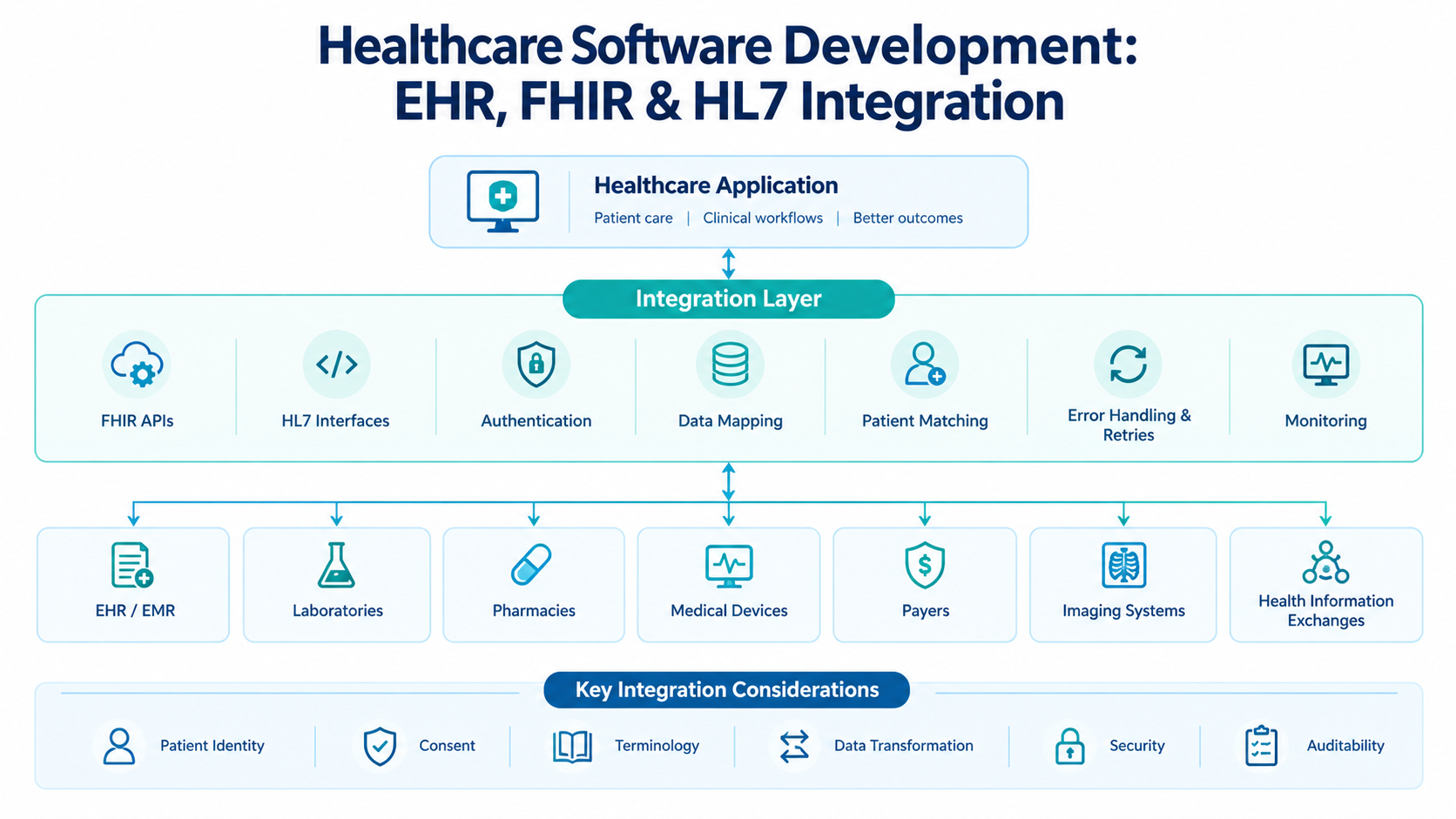
Healthcare applications rarely operate in isolation. Your product may need to exchange information with EHRs, laboratories, pharmacies, payers, medical devices, identity providers, or other healthcare platforms.
A development partner should understand FHIR and HL7, but standards knowledge alone is not enough. The team should also understand patient matching, terminology, consent, data provenance, transformation, error handling, retries, and integration monitoring.
Ask vendors to explain how they would design the integration layer for your specific ecosystem. A good answer should address both the happy path and what happens when an external healthcare system is unavailable or returns unexpected data.
AI Governance for Healthcare Software Development
Adding an AI model to healthcare software introduces another layer of risk. The important question is not simply which model the vendor recommends. It is how the model will be controlled, evaluated, monitored, and used within the workflow.
Ask:
What happens when the model is uncertain or produces an unexpected result?
Can a clinician or authorized user review and override an AI recommendation?
How are prompts, model versions, outputs, and important decisions tracked?
How is patient data protected during model processing?
How are model updates tested before deployment?
What fallback exists if the AI service becomes unavailable?
If the product could fall within medical-device software or clinical decision-support requirements, discuss the regulatory implications during discovery rather than after development.
Ready to Build the Right Healthcare Software?
Evaluating Architecture and Scalability Capabilities
You do not need the most fashionable architecture. You need an architecture that fits your product's current complexity while leaving room for sensible growth.
Ask the engineering team to explain its reasoning around:
Monolith versus services
Cloud architecture and managed services
Transactional versus analytical workloads
API and integration boundaries
Scalability and performance
Availability and disaster recovery
Observability and production monitoring
The strongest teams explain trade-offs. They can tell you what they would build now, what they would deliberately postpone, and which architectural decisions could become expensive to change later.
Healthcare Software Development Company Case Studies
Portfolio screenshots are useful for seeing design quality, but case studies provide much stronger evidence of engineering maturity. Look for projects that involve problems similar to yours.
Case Study Signal | What It Tells You |
|---|---|
Comparable healthcare workflow | The team understands the user's operational problem. |
EHR/EMR or FHIR/HL7 integration | The team has worked with healthcare interoperability. |
Sensitive patient data | The team has experience designing around security and privacy. |
Telemedicine or device integration | The team can handle real-time or hardware-related complexity. |
Healthcare AI | The team understands AI beyond generic chatbot development. |
Measured outcome | The vendor can connect engineering work to business or product results. |
Ask for the problem, the constraints, the architecture, the team's role, major challenges, and the outcome, not just screenshots.
Healthcare UX and Clinical Workflow Expertise
Healthcare users often work under time pressure. A physician may review information between appointments, a nurse may manage several patients, and a patient may use the application from home on a mobile device.
The development partner should demonstrate how it validates workflows before and during development.
User and stakeholder interviews
Workflow mapping
Role-specific interface design
Usability testing
Accessibility considerations
Error prevention and recovery
Feedback from clinicians or healthcare operations teams
A technically correct application can still fail if it adds unnecessary steps or disrupts established workflows. In healthcare, usability is closely connected to adoption and operational effectiveness.
Ready to Build the Right Healthcare Software?
Post-Launch Support and Maintenance for Healthcare Software
Healthcare software is a living product. Security patches, new integrations, regulatory changes, device support, performance improvements, reporting requirements, and AI updates can continue for years.
Before signing, clarify:
Who owns the source code and intellectual property?
Who manages production infrastructure?
What support and incident-response model is available?
How quickly are critical security issues addressed?
What monitoring and alerting are included?
How are future enhancements estimated and delivered?
What documentation and knowledge transfer will you receive?
WATCH OUT
A vendor that can deliver an MVP but cannot explain how it will support, secure, monitor, and evolve that MVP may create more long-term risk than value.
How to Evaluate a Healthcare Software Development Company
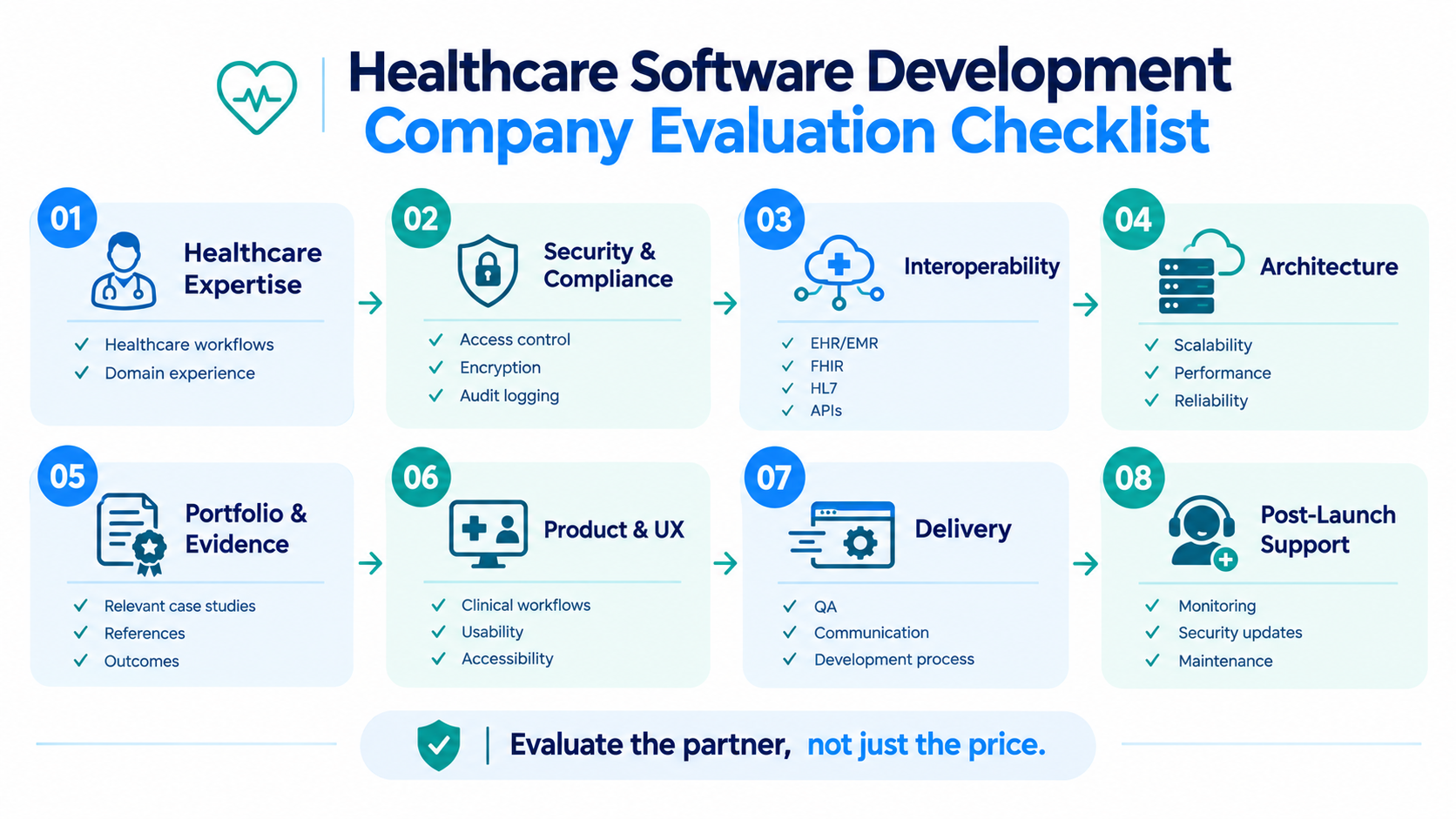
Once you have shortlisted vendors, use a weighted scorecard. This keeps the final decision from being dominated by the lowest price or the strongest sales presentation.
Evaluation Area | Suggested Weight |
|---|---|
Healthcare domain expertise | 20% |
Security and compliance | 20% |
Interoperability and integrations | 15% |
Architecture and scalability | 15% |
Relevant portfolio and references | 10% |
Product and UX capability | 10% |
Delivery methodology and communication | 5% |
Post-launch support | 5% |
These weights are a starting point, not a rule. A medical-device platform may place more weight on regulatory and cybersecurity capabilities, while a patient engagement platform may place greater emphasis on UX and interoperability.
Ready to Build the Right Healthcare Software?
Healthcare Software Development Company Selection Checklist
Relevant healthcare project experience
Healthcare workflow understanding
FHIR/HL7 and integration capability
Clear security and compliance approach
Relevant case studies and references
Strong product and UX process
Practical architecture recommendations
Defined QA and release process
Clear ownership and documentation terms
Credible post-launch support
15 Questions to Ask a Healthcare Software Development Company
Which healthcare products have you built that are comparable to ours?
What healthcare regulations and standards have your teams worked with?
How would you approach our EHR/EMR and third-party integrations?
Which interoperability standards would you recommend and why?
How will patient data be protected throughout the system?
What security testing is included before production?
How will audit logging and access control work?
How do you approach AI validation if our product uses AI?
Who owns the source code and intellectual property?
What happens when we need changes after launch?
Can we speak with relevant previous clients?
What does your development and QA process look like?
How do you handle production incidents?
What documentation and handover materials will we receive?
Can the architecture support our expected growth?
Ready to Build the Right Healthcare Software?
How to Choose the Right Healthcare Software Development Company
Do not choose the vendor that gives you the fastest "yes." Choose the team that demonstrates the clearest understanding of the problem and the risks.
A strong final evaluation should consider four things together: the quality of the proposed solution, the evidence behind the vendor's claims, the people who will actually deliver the project, and the commercial model.
If two vendors appear similar on paper, give greater weight to the team that identifies risks early, asks better questions, explains trade-offs clearly, and shows how it will remain accountable after launch.
THE DECISION FRAMEWORK
Problem ↓ Healthcare Expertise ↓ Security ↓ Interoperability ↓ Architecture ↓ UX ↓ Evidence ↓ Support ↓ Commercials |
Conclusion
Choosing the right healthcare software development company requires looking beyond development cost or technical skills. The right partner should understand your healthcare workflows, security and compliance requirements, EHR/EMR integrations, interoperability, AI needs, user experience, and long-term product goals.
Before making a decision, review the company's healthcare experience, case studies, architecture approach, development process, security practices, and post-launch support. A strong development partner should also be transparent about risks, costs, timelines, and the technical decisions that can affect your product in the future.
If you're planning to build, modernize, or integrate healthcare software, contact us today to discuss your requirements and explore a secure, scalable solution designed around your healthcare workflows and business goals.

Deep Gondaliya
Business Analyst | Turning business challenges into clear insights, practical solutions, and meaningful improvements that help teams move forward.