

Healthcare software carries a risk and compliance profile that most enterprise software simply does not. A bug in a project management tool causes inconvenience. A bug in a medication dosing calculator, a patient record system, or a clinical workflow tool can cause direct harm to a patient. A compliance gap in how patient data is handled can also trigger regulatory penalties and loss of trust that are far more costly than a delayed feature launch.
This creates a different engineering discipline than most software projects require. Compliance, data security, interoperability, and clinical safety are not review steps that happen after a feature is built. They are architecture inputs that need to shape decisions from the very first design conversation.
This checklist is written for CTOs, VPs of Engineering, and product leaders at healthcare organizations and health-tech companies scoping a new software build, whether that is a patient-facing application, a clinician-facing tool, or backend infrastructure connecting to existing healthcare systems.
Where specific implementation guidance is given, it reflects established regulatory requirements and industry best practice, not a claimed track record on a specific past project, unless otherwise noted.
Healthcare Software Development: Regulatory and Compliance Requirements
Regulatory compliance in healthcare software is not a single checkbox. It is a set of ongoing architectural and operational requirements that vary by what data the system handles and where its users are located.
HIPAA compliance applies to systems in the United States that create, receive, maintain, or transmit protected health information. Healthcare software should therefore address several technical safeguards from the beginning:
Access controls that limit data visibility to authorized users.
Audit controls that record access to patient data.
Integrity controls that help prevent unauthorized alteration of records.
Transmission security that protects data in transit.
HIPAA compliance is not achieved through a single feature. It depends on a combination of architectural decisions, operational processes, documented policies, access controls, monitoring, and security practices.
HITECH Act requirements extend HIPAA with breach notification obligations. Healthcare software therefore needs a defined process for detecting, assessing, and reporting a data breach within the required timeframe.
GDPR applies when the system handles data from patients in the European Union. It introduces requirements around consent, data access and deletion rights, and data transfers outside the EU.
Other requirements, including state-specific health data privacy laws and industry-specific standards, may apply depending on the jurisdiction and healthcare use case.
The practical architectural implication across these frameworks is that healthcare systems should provide:
Granular and auditable data access.
Encryption for data at rest and in transit.
Documented security and incident response processes.
Clearly defined ownership of compliance responsibilities.
Testable controls that can be validated before production launch.
Ready to Build More Secure Healthcare Software?

Healthcare Software Development Security and Privacy Checklist
Beyond specific regulatory requirements, several technical security practices should be treated as baseline requirements for healthcare software.
Encryption Requirements for Healthcare Software
Encryption should protect protected health information at rest and in transit. This includes databases, backups, cached information, temporary storage, and other locations where sensitive healthcare data may exist.
Role-Based Access Control for Healthcare Software
Role-based access control should be enforced consistently across the data layer, application interfaces, and integration points. Users should only access the patient records and data fields required for their responsibilities.
Clinician access should reflect clinical responsibilities.
Administrative access should be limited to required operational data.
Billing access should be restricted to relevant financial information.
Integration accounts should have narrowly defined permissions.
Audit Logging and Patient Data Access
Audit logging should record who accessed patient data, what information was accessed, when it was accessed, and where the access originated. Logs should be protected against unauthorized modification and retained according to applicable requirements.
Data Minimization in Healthcare Software
Data minimization means collecting and retaining only the patient data genuinely required for the system's purpose. This reduces unnecessary exposure and should be considered during data modeling rather than after the system is built.
Healthcare Software Breach Response Readiness
A documented and tested incident response plan should exist before launch. The process should define detection, assessment, notification, containment, and remediation responsibilities.
Secure Authentication and MFA for Healthcare Software
Secure authentication should be implemented for users accessing sensitive patient data. Multi-factor authentication and appropriate session management should be considered baseline controls rather than optional security hardening.
Healthcare Software Development Interoperability Requirements
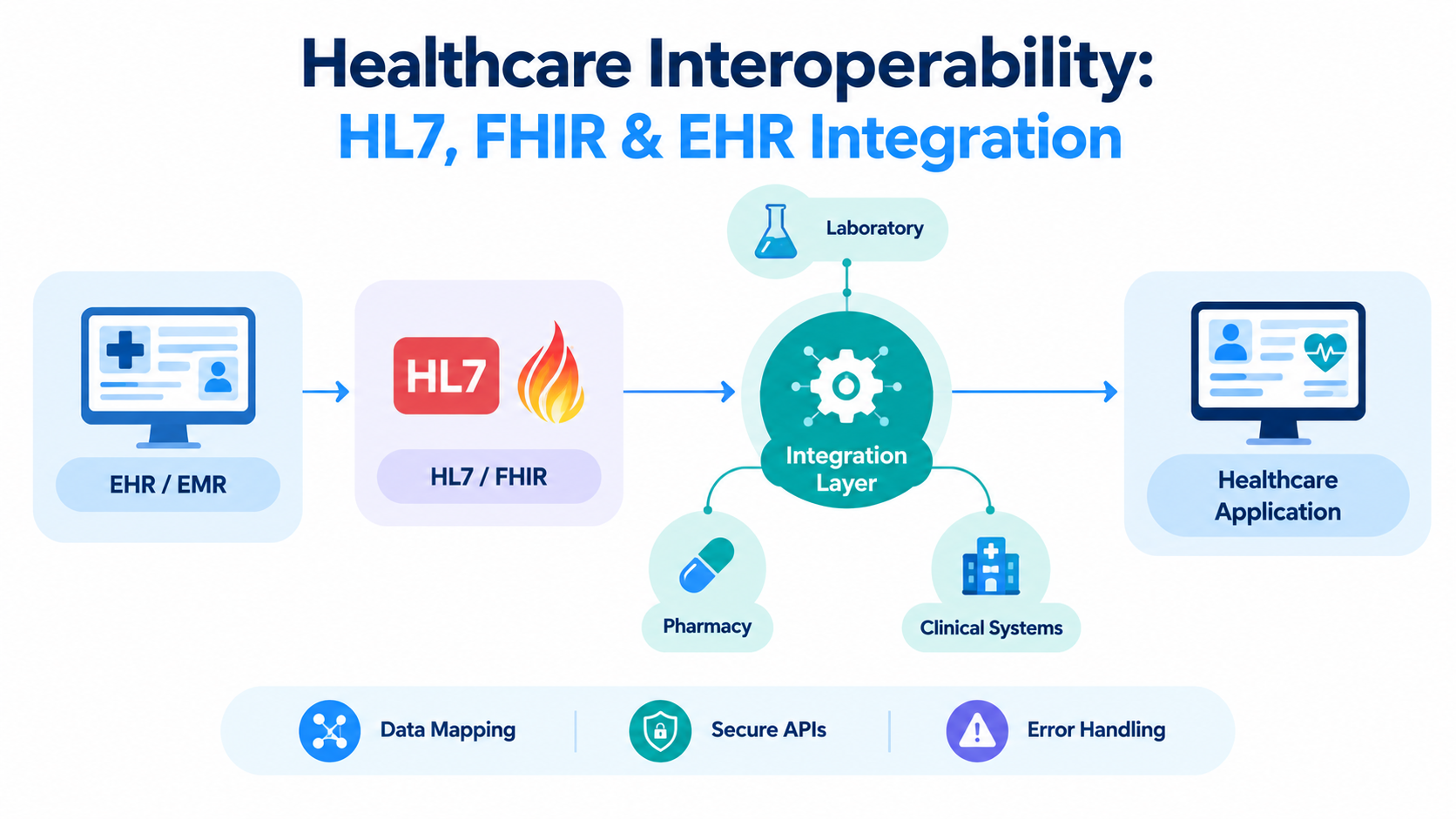
Healthcare software rarely operates in isolation. It commonly exchanges information with electronic health records, laboratory systems, pharmacy systems, and other healthcare infrastructure.
Interoperability should therefore be treated as a first-class architecture concern rather than a later integration task.
HL7 Integration Requirements for Healthcare Software
HL7 is a long-established messaging standard for exchanging clinical information between healthcare systems. Familiarity with HL7 message formats remains important when integrating with existing healthcare IT environments.
FHIR Integration and API Requirements
FHIR provides a more modern approach to healthcare data exchange using RESTful APIs and standardized resources. It is increasingly relevant for new healthcare software integrations.
EHR and EMR Integration for Healthcare Software
EHR and EMR integration should be scoped early because the specific healthcare system and available API capabilities can significantly affect architecture, implementation effort, and delivery timelines.
Interoperability planning should cover:
Required clinical data resources.
API availability and limitations.
HL7 message requirements.
FHIR resources and API capabilities.
Authentication and authorization.
Data mapping and transformation.
Error handling and retry mechanisms.
Data provenance and auditability.
Designing interoperability from the beginning helps avoid costly rework when the application needs to connect to the wider healthcare data ecosystem.
Ready to Build More Secure Healthcare Software?
Healthcare Software Development Architecture Checklist
Healthcare software also requires architecture decisions that address reliability, scalability, availability, and controlled environments.
Scalability Planning for Healthcare Software
Scalability planning should account for realistic healthcare-specific peak load scenarios instead of relying only on average daily usage.
Public health events.
Appointment scheduling peaks.
High-volume patient communication.
Large clinical data imports.
Peak reporting and analytics workloads.
Uptime and Reliability Requirements for Healthcare Software
Healthcare applications involved in active clinical care may require higher availability than general enterprise applications. Infrastructure redundancy and disaster recovery should therefore be considered during architecture planning.
Backup and Disaster Recovery for Healthcare Systems
Backup and disaster recovery planning should define appropriate recovery time objectives and recovery point objectives based on the criticality of the system.
Define recovery time objectives.
Define recovery point objectives.
Test backup restoration.
Validate disaster recovery procedures.
Document recovery responsibilities.
Development, Staging, and Production Environment Separation
Development, staging, and production environments should remain clearly separated. Real patient data should not be used in non-production environments without appropriate safeguards and authorization.
Healthcare Software UX and Accessibility Requirements
Healthcare software UX carries higher stakes than typical enterprise UX because usability failures in clinical environments can contribute to errors, while accessibility failures can prevent patients from accessing important services.
Clinician Workflow Design for Healthcare Applications
Clinician workflow design should reflect how healthcare professionals actually work. Direct observation and collaboration with clinical stakeholders can help identify practical workflow requirements that may not be visible to development teams.
Reducing Cognitive Load in Clinical Software
Clinical interfaces should minimize unnecessary steps and reduce the amount of information users must process for time-sensitive tasks.
Reduce unnecessary navigation.
Prioritize clinically relevant information.
Use consistent interaction patterns.
Make important actions easy to identify.
Reduce unnecessary data entry.
Accessibility Requirements for Healthcare Software
Patient-facing healthcare applications should consider ADA and WCAG accessibility requirements so that users with visual, auditory, motor, or cognitive disabilities can access the software.
Ready to Build More Secure Healthcare Software?
Healthcare Software Development Testing and Validation
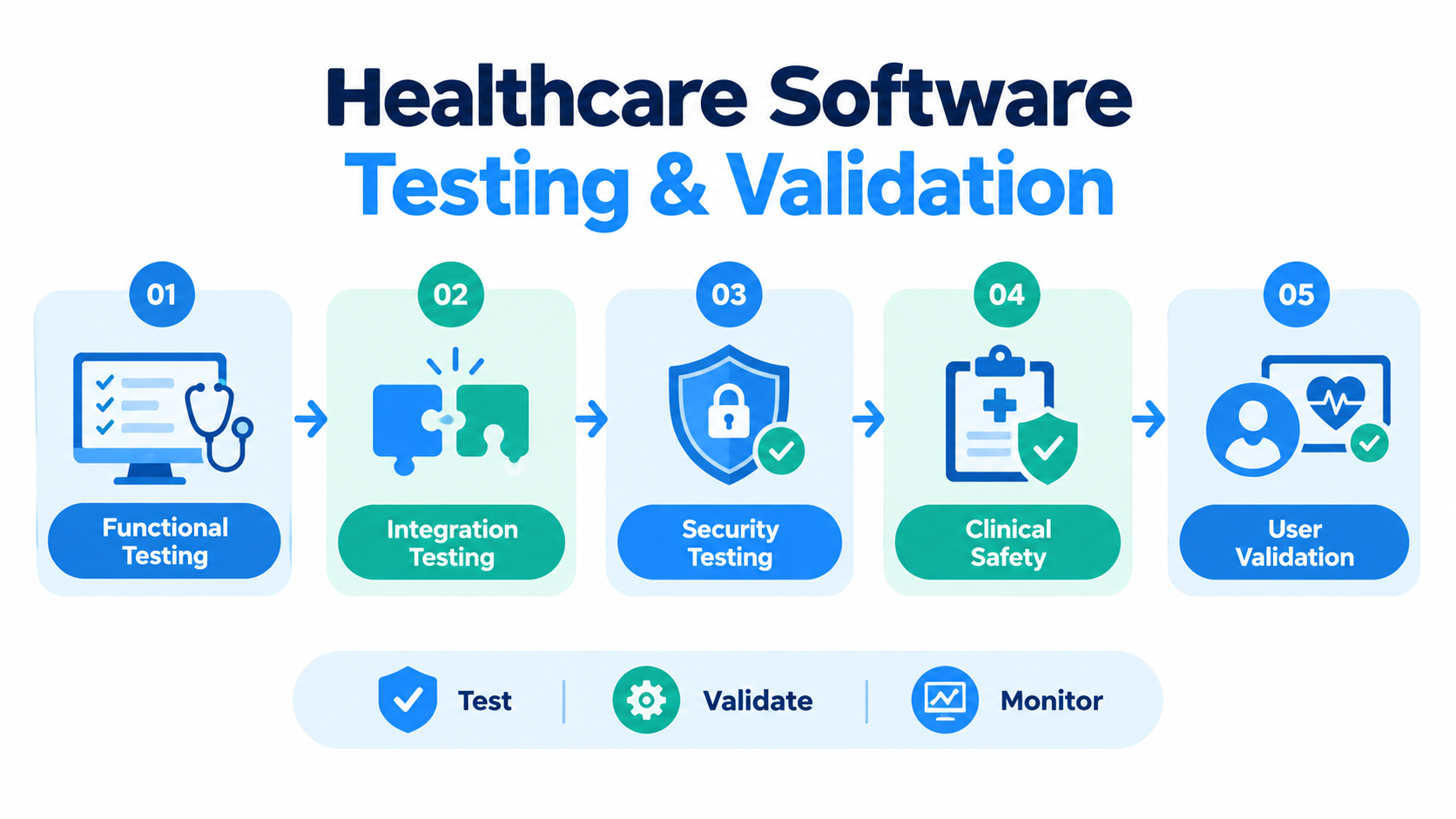
Healthcare software requires a rigorous testing and validation process because the consequences of an undetected defect can extend beyond normal business disruption.
Clinical Safety Testing for Healthcare Software
Clinical safety testing should validate how the software behaves across realistic clinical scenarios, including edge cases where incorrect behavior could create significant consequences.
Edge Case and Failure Mode Testing
Healthcare applications should specifically test unexpected data formats, ambiguous inputs, incomplete records, integration failures, and unusual workflow conditions.
Clinical Workflow Validation with Healthcare Users
Testing with clinical staff in realistic conditions can reveal usability and workflow issues that internal development testing may not identify.
Regression Testing for Healthcare Applications
Every update should be evaluated to ensure that existing healthcare workflows continue to operate correctly.
A healthcare testing strategy should therefore include:
Functional testing.
Integration testing.
Clinical safety testing.
Edge case testing.
Failure mode testing.
Security testing.
Regression testing.
User acceptance testing with clinical stakeholders.
Healthcare Software Third-Party Integrations and Vendor Risk
Healthcare software commonly integrates with external services and platforms. Every integration introduces technical, security, privacy, and compliance considerations.
Telehealth Integration Security and Compliance
Telehealth integrations should meet the same security and privacy expectations as the core healthcare application, including protection of video, audio, and related patient information.
Payment Processing and PCI DSS Requirements
Payment processing integrations may introduce PCI DSS requirements in addition to healthcare privacy requirements. These compliance areas should be evaluated together when payment and patient information are connected within the same workflow.
Lab and Pharmacy Integration Requirements
Lab and pharmacy integrations require attention to data formats, interoperability standards, workflow compatibility, and the compliance posture of the connected systems.
Healthcare Software Vendor Compliance Vetting
Third-party providers that handle patient information should be evaluated before they become part of the production architecture.
Review the vendor's compliance posture.
Understand how patient data is stored and processed.
Review security controls.
Confirm contractual requirements.
Determine whether a business associate agreement is required.
Review incident response responsibilities.
Ready to Build More Secure Healthcare Software?
Healthcare Software Development Post-Launch Requirements
Healthcare software compliance and safety obligations continue after launch. Production operations should therefore be treated as an ongoing responsibility.
Continuous Security and Performance Monitoring
Security, availability, system performance, and data access patterns should be monitored continuously, with defined thresholds and alerts for anomalies.
Incident Response and Breach Management
Incident response processes should be tested before an actual incident occurs. This allows teams to respond more quickly while supporting applicable breach notification requirements.
Ongoing Healthcare Software Compliance Audits
Internal or third-party compliance audits can help identify changes in risk as the software, infrastructure, data sources, and applicable requirements evolve.
Healthcare Software Maintenance and Change Management
Updates in a regulated environment require disciplined change management. Each change should be evaluated for potential security, compliance, and clinical safety implications.
Document production changes.
Validate important updates.
Maintain regression testing.
Review security implications.
Track compliance impact.
Maintain audit documentation.
How to Choose a Healthcare Software Development Partner
Healthcare projects require additional due diligence beyond general software development vendor evaluation.
Healthcare Regulatory and Compliance Experience
Verify whether the development partner understands the regulatory frameworks relevant to your project, such as HIPAA or equivalent requirements in the applicable jurisdiction.
HL7, FHIR, EHR, and EMR Interoperability Expertise
Confirm practical experience with HL7, FHIR, EHR, and EMR integrations rather than assuming that general API development experience automatically translates to healthcare interoperability.
Clinical Workflow and Usability Expertise
Ask how the team approaches requirements gathering, workflow analysis, usability validation, and clinical safety considerations.
Business Associate Agreement and Vendor Security Requirements
If the development partner will handle or access protected health information, determine whether a business associate agreement is required and verify the vendor's security and compliance posture.
Ready to Build More Secure Healthcare Software?
Complete Healthcare Software Development Checklist
Use the following checklist as a quick reference when scoping or reviewing a healthcare software project.
Regulatory compliance identified and documented for all applicable frameworks.
HIPAA, HITECH, and GDPR requirements evaluated where relevant.
Encryption at rest and in transit implemented for protected health information.
Role-based access control enforced across interfaces and integrations.
Audit logging implemented for patient data access.
Audit logs protected against unauthorized modification.
Data minimization principles applied during data modeling.
Documented and tested breach response plan established before launch.
Multi-factor authentication implemented for sensitive-data access.
Secure session management implemented.
HL7 or FHIR interoperability designed into the architecture where required.
EHR or EMR integration requirements scoped early.
Specific healthcare-system API capabilities evaluated.
Scalability planned around realistic healthcare peak demand.
Uptime and reliability requirements defined.
Infrastructure redundancy evaluated.
Backup and disaster recovery plan established.
Recovery time and recovery point objectives defined and tested.
Development, staging, and production environments separated.
Patient data usage in non-production environments controlled.
Clinician workflow design informed by clinical stakeholders.
Accessibility evaluated against applicable ADA and WCAG requirements.
Dedicated clinical safety testing completed.
Edge case and failure mode testing completed.
Clinical staff involved in validation before full rollout.
Third-party vendor compliance evaluated.
Business associate agreements reviewed where required.
Continuous security and availability monitoring implemented.
Incident response process tested.
Ongoing compliance audit process established.
Disciplined change management implemented for post-launch updates.
Key Takeaways for Healthcare Software Development
Healthcare software development requires compliance, security, interoperability, and clinical safety to be treated as architecture inputs rather than final review steps.
Design compliance from the beginning: Regulatory and security requirements should influence architecture and data modeling from the earliest project stages.
Build security into the architecture: Encryption, access control, audit logging, secure authentication, and incident response should be designed into the system.
Plan interoperability early: HL7, FHIR, EHR, EMR, laboratory, and pharmacy integration requirements should be identified before implementation begins.
Prioritize clinical safety: Healthcare testing should include clinical scenarios, edge cases, failure modes, and validation with appropriate clinical stakeholders.
Evaluate development partners carefully: Healthcare regulatory knowledge, interoperability expertise, clinical workflow understanding, and security practices should be part of vendor selection.
Conclusion
Healthcare software development requires compliance, security, interoperability, and clinical safety to be considered from the very beginning rather than treated as final-stage checklist items. When these requirements are built into the architecture from the start, organizations can reduce rework, strengthen data protection, support safer clinical workflows, and better manage regulatory risks.
Healthcare organizations and health-tech companies also need to consider how the software will operate after launch. Ongoing monitoring, security updates, compliance reviews, integration maintenance, and controlled changes help keep the system reliable as healthcare workflows, regulations, and technology requirements evolve. Zignuts helps healthcare organizations plan and build digital healthcare applications, AI-driven health solutions, integrations, and scalable software platforms. Contact us today to discuss your requirements, architecture, compliance considerations, and path to production.

Virang Kori
Business Analyst | Analyzing business needs, processes, and data to uncover insights, improve efficiency, and support smarter business decisions.