

How to Evaluate Healthcare Software Consulting Services
Healthcare software consulting is not general enterprise software consulting with a compliance checklist attached. It requires additional discipline around regulatory compliance, interoperability, patient data, clinical workflows, security, and patient-safety risk.
Healthcare organizations often work with complex technology environments that include EHR and EMR systems, laboratory platforms, pharmacy systems, billing applications, claims platforms, patient portals, analytics tools, and other clinical systems. A consulting partner must understand how these systems work together and how software decisions can affect both operational teams and patients. This may also include evaluating healthcare software development partners based on their ability to address healthcare-specific technical and operational requirements.
This guide helps CTOs, VPs of Engineering, product leaders, healthcare organizations, and digital health teams evaluate healthcare software consulting partners and understand the technical, regulatory, and operational factors that shape successful projects.
What Healthcare Software Consulting Services Cover
Healthcare software consulting scope and common engagement types
Healthcare-specific compliance and security requirements
Healthcare software development and validation practices
Build vs. buy vs. partner considerations
Healthcare consulting partner evaluation criteria
Common vendor red flags
Healthcare software cost drivers
Production risks and recommended controls
What Healthcare Software Consulting Services Include
Healthcare software consulting can cover the complete technology lifecycle, from early product strategy and system architecture to integration, modernization, security, deployment, and ongoing support.
The exact scope depends on the organization's existing technology environment, clinical workflows, compliance requirements, and product goals.
Key Areas of Healthcare Software Consulting Services
Custom Healthcare Application Development: Planning and building patient-facing, provider-facing, administrative, and operational applications.
EHR and EMR Integration: Connecting applications with existing clinical systems and exchanging healthcare data securely.
Legacy System Modernization: Updating outdated applications while reducing disruption to existing healthcare workflows.
Healthcare Interoperability: Designing integrations using standards such as HL7 and FHIR alongside system-specific APIs.
Compliance and Security Architecture: Building security and privacy controls into the application and infrastructure from the beginning.
Digital Health Product Strategy: Defining product requirements, technical architecture, workflows, integrations, and implementation priorities.
Healthcare Data Platforms: Designing systems that collect, process, organize, and securely exchange healthcare data.
AI-Assisted Healthcare Software: Supporting AI-enabled clinical or administrative workflows while considering security, validation, and regulatory requirements.
A strong consulting engagement should connect technical decisions with actual healthcare workflows rather than treating software development, compliance, and interoperability as separate activities.
Ready to Build a More Secure Healthcare Solution?

Why Healthcare Software Consulting Requires Specialized Expertise
Healthcare software differs structurally from general enterprise software because regulatory requirements, clinical workflow sensitivity, healthcare-specific interoperability standards, and patient-safety consequences can influence architecture, testing, release practices, and ongoing maintenance.
Key Differences in Healthcare Software Consulting
Regulatory requirements: Healthcare applications may handle protected health information and therefore require appropriate privacy and security controls.
Clinical workflow sensitivity: Software must fit the way clinicians, administrators, patients, and other healthcare users actually work.
Interoperability requirements: Healthcare systems frequently need to communicate with EHRs, EMRs, laboratories, pharmacies, billing platforms, and other systems.
Data sensitivity: Patient and clinical information requires careful access management, auditability, encryption, and secure transmission.
Patient-safety considerations: Defects can have consequences beyond ordinary operational or financial losses.
Long-term maintenance: Healthcare APIs, standards, regulations, workflows, and integrations can evolve after launch.
Because of these factors, healthcare software projects generally require more structured discovery, validation, testing, documentation, and release planning than a conventional business application.
Healthcare Software Consulting Services: Compliance and Security Requirements
Healthcare compliance should be considered during architecture and discovery rather than added after development. The appropriate controls depend on the type of software, the data being handled, the organizations involved, and the applicable regulatory requirements.
Key Healthcare Security Considerations
Access control: Define who can access specific categories of healthcare data and under which conditions.
Audit logging: Maintain records of relevant access and system activity to support accountability and incident response.
Encryption: Protect sensitive information at rest and during transmission.
Data integrity: Implement controls that help prevent unauthorized or improper modification of important healthcare information.
Administrative safeguards: Address policies, authorization, training, response processes, and organizational controls.
Business Associate Agreements: Determine whether a BAA is required when a service provider handles PHI on behalf of a covered entity or business associate.
Breach response: Establish processes for identifying, investigating, containing, and responding to potential security incidents.
Compliance should be evaluated based on the actual project context. A generic claim that an application is "HIPAA compliant" is not enough to demonstrate how security controls are implemented.
Ready to Build a More Secure Healthcare Solution?
Healthcare Software Consulting Services for HL7, FHIR, and EHR Integration
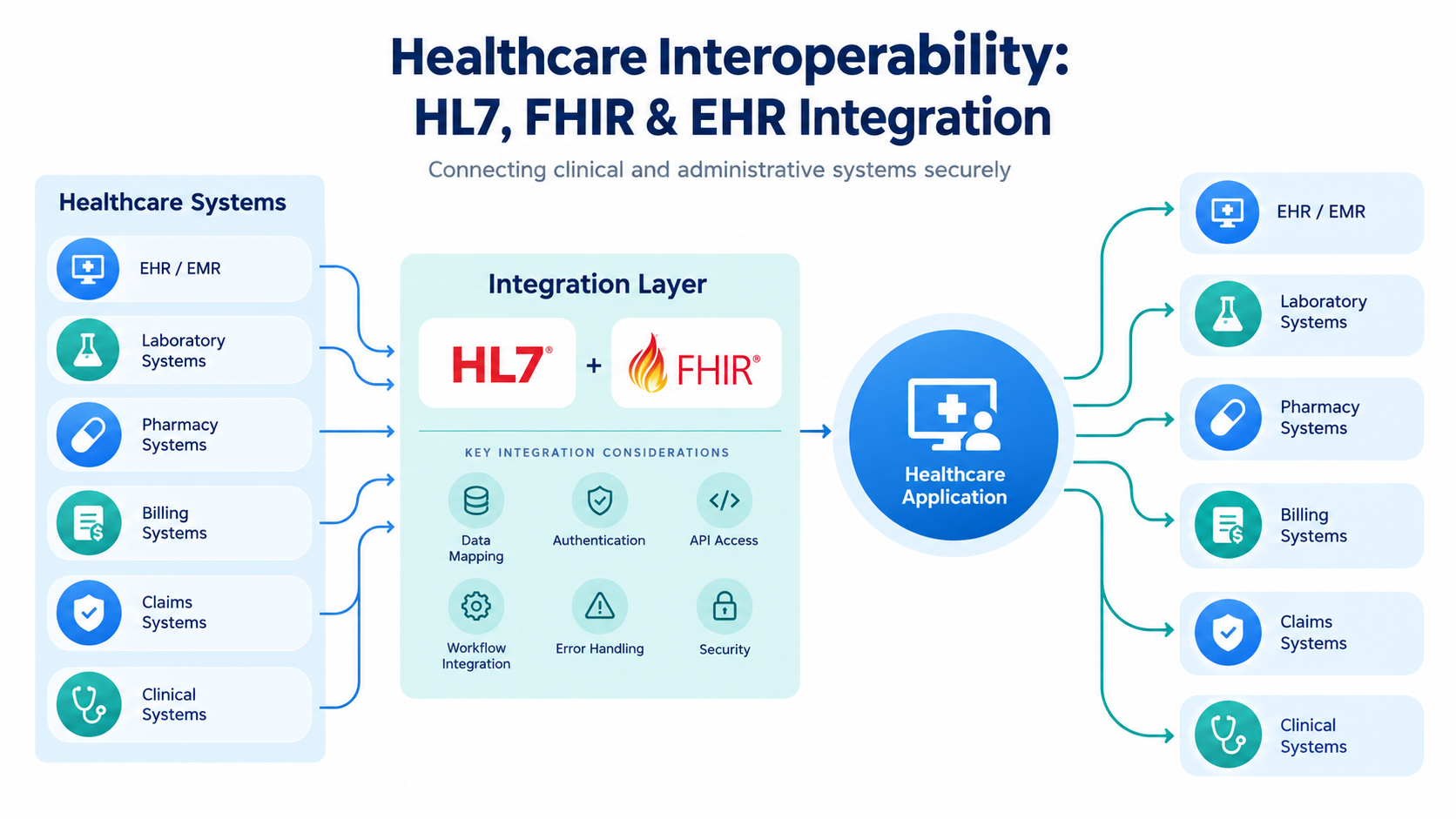
Interoperability is frequently one of the most technically demanding and underestimated components of healthcare software development. Healthcare applications rarely operate in isolation. They often need to exchange information with clinical, administrative, financial, and operational systems.
Common Healthcare Integration Requirements
HL7 v2: Frequently used for healthcare messaging across established clinical infrastructure.
FHIR: A resource-based interoperability standard commonly used for modern healthcare APIs and data exchange.
EHR and EMR APIs: Vendor-specific interfaces can have different capabilities, workflows, authentication requirements, and approval processes.
Laboratory systems: Applications may need to exchange orders, results, and other laboratory-related information.
Pharmacy systems: Medication and pharmacy workflows may require additional integration considerations.
Billing and claims systems: Financial and administrative workflows often introduce additional data-model and integration requirements.
Why Interoperability Discovery Matters in Healthcare Software
Integration complexity should be assessed before development commitments are finalized. A system may appear to have a straightforward API while still requiring significant work around data mapping, authentication, permissions, workflows, error handling, testing, and production approvals.
Early discovery should therefore identify the actual systems involved, available interfaces, expected data flows, data ownership, integration dependencies, and potential limitations before implementation begins.
Healthcare Software Consulting Services: Common Engagements
Healthcare software consulting can support a wide range of products and internal systems. The engagement model should reflect the organization's workflow, technical environment, regulatory requirements, and product maturity.
Patient-Facing Healthcare Software Solutions
Appointment and scheduling experiences
Patient communication workflows
Remote and digital care experiences
Provider-Facing Clinical Software Solutions
Clinical workflow applications
Provider dashboards
Clinical data interfaces
Decision-support workflows
Care coordination tools
Payer and Healthcare Administrative Systems
Claims-related systems
Administrative workflow applications
Healthcare data processing platforms
Reporting and analytics applications
Healthcare Data and Analytics Solutions
Healthcare data aggregation
Reporting platforms
Analytics dashboards
Data integration pipelines
Operational intelligence tools
AI-Assisted Healthcare Software Development
AI can support clinical and administrative use cases, but healthcare AI projects require additional attention to data handling, workflow validation, security, monitoring, and potential regulatory implications.
Ready to Build a More Secure Healthcare Solution?
Healthcare Software Development Lifecycle for Regulated Environments
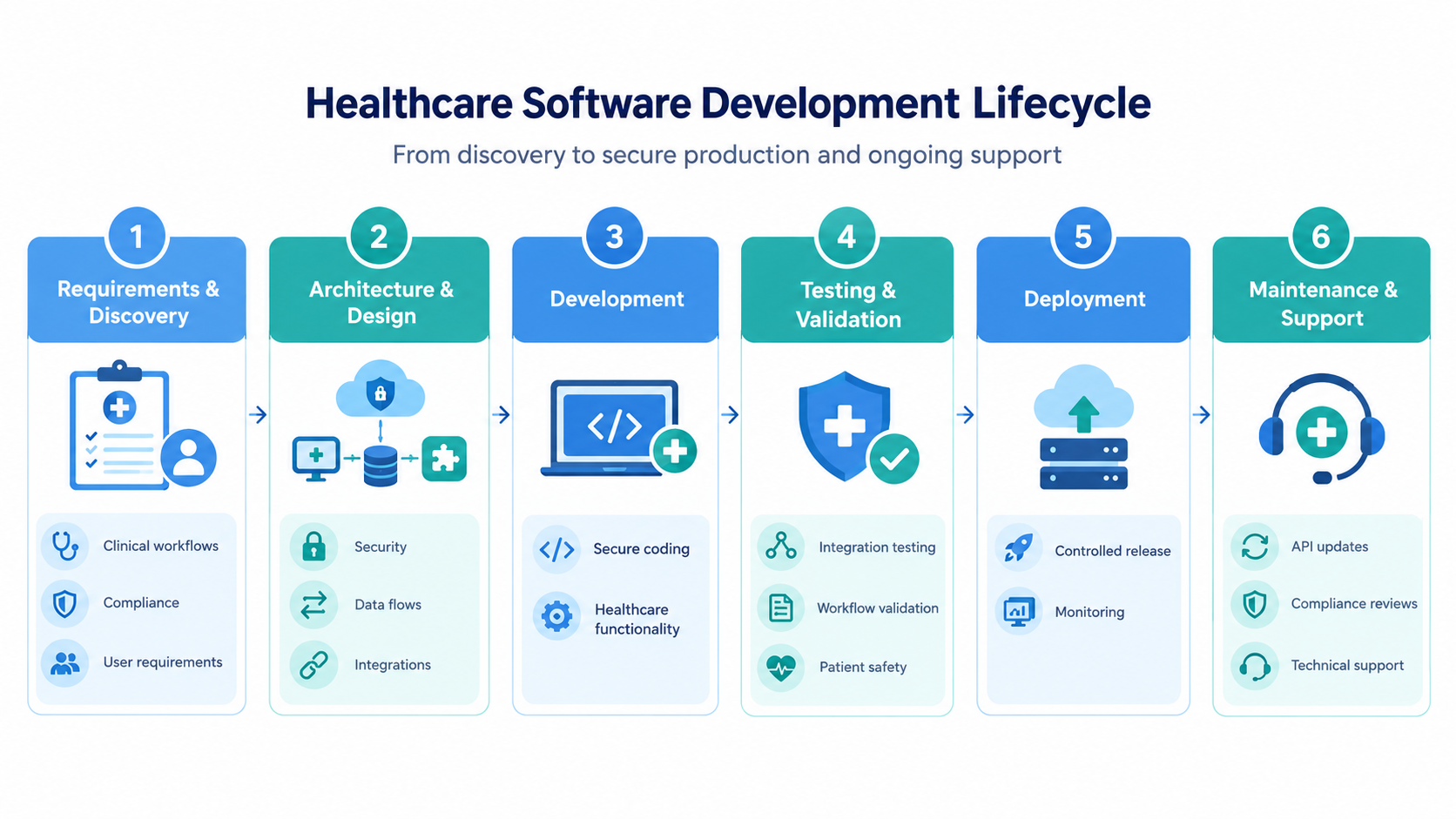
Healthcare development follows the familiar lifecycle of requirements, design, build, test, deploy, and maintain. However, regulatory requirements, validation, release controls, security, and patient-safety considerations can introduce additional rigor at every stage.
1. Healthcare Software Requirements and Discovery
Document business and clinical requirements.
Identify users and stakeholders.
Map relevant healthcare workflows.
Identify data types and sensitive information.
Document EHR, EMR, HL7, FHIR, and other integration requirements.
Identify applicable compliance and regulatory considerations.
2. Healthcare Software Architecture and Design
Define application and infrastructure architecture.
Design authentication and authorization controls.
Plan encryption and audit logging.
Define healthcare data flows.
Design integration and interoperability components.
3. Healthcare Software Development
Implement agreed workflows and functionality.
Apply secure development practices.
Build integrations according to documented interface requirements.
Maintain appropriate technical documentation.
4. Healthcare Software Testing and Validation
Functional testing
Integration testing
Security testing
Workflow validation
Data integrity testing
Performance and reliability testing
Additional validation where clinical or patient-safety risk warrants it
5. Healthcare Software Deployment
Use controlled deployment processes.
Validate production configurations.
Monitor critical integrations.
Prepare rollback and incident-response procedures.
6. Healthcare Software Maintenance and Support
Monitor system performance and security.
Maintain integrations as APIs and systems evolve.
Review changing compliance requirements.
Address defects and workflow changes.
Maintain documentation and operational processes.
Healthcare Software Consulting Services: Build vs. Buy vs. Partner
The right approach depends on workflow differentiation, available internal healthcare expertise, compliance needs, interoperability complexity, timeline, and long-term maintenance requirements.
Buying Healthcare Software
Buying an existing product can make sense when an established solution already supports the required workflow and integration requirements.
Evaluate the product's healthcare compliance capabilities.
Review its interoperability track record.
Understand available EHR and EMR integrations.
Review data ownership and security responsibilities.
Understand customization and ongoing support options.
Building Healthcare Software In-House
Building internally can provide greater control when an organization has strong healthcare-specific engineering and product expertise.
Requires dedicated engineering resources.
Requires healthcare domain knowledge.
Requires internal security and compliance ownership.
May require specialized interoperability expertise.
Creates long-term maintenance responsibilities.
Partnering for Healthcare Software Development
Partnering can be useful when an organization needs specialized healthcare engineering capabilities without building the entire capability internally.
Access to healthcare-specific engineering expertise
Interoperability and integration experience
Support for architecture and modernization
Additional development capacity
Ongoing technical and integration support
How to Choose Healthcare Software Consulting Services
Healthcare-specific experience should be evaluated directly rather than inferred from general software development experience. A partner should be able to explain how it approaches healthcare data, security, interoperability, workflows, testing, and post-launch support.
Key Criteria for Evaluating Healthcare Software Consulting Services
Healthcare architecture: Ask for specific examples of healthcare systems and security controls the team has implemented.
HIPAA experience: Understand how technical safeguards are designed and implemented.
BAA readiness: Determine whether the organization is prepared to work under a BAA when applicable.
HL7 and FHIR experience: Ask about production integrations rather than theoretical knowledge.
EHR and EMR experience: Confirm experience with the actual platforms relevant to the project.
Clinical workflow understanding: Determine how requirements are validated with clinicians and other healthcare stakeholders.
Security practices: Review access control, encryption, auditability, monitoring, and incident-response processes.
Testing practices: Understand how testing changes when software affects clinical workflows or patient safety.
Post-launch support: Confirm how the partner handles changing APIs, standards, regulations, and operational requirements.
Ready to Build a More Secure Healthcare Solution?
Red Flags When Choosing Healthcare Software Consulting Services
Healthcare software projects can become difficult to manage when a consulting partner underestimates compliance, interoperability, or clinical workflow requirements.
Common Healthcare Software Consulting Red Flags
Vague compliance claims: The provider simply says the application is "HIPAA compliant" without explaining the underlying safeguards.
Limited BAA awareness: The provider is unfamiliar with when a BAA may be required.
No production interoperability experience: The provider discusses general APIs but cannot demonstrate practical HL7 or FHIR experience.
EHR integration is treated as a simple API connection: This can indicate that system-specific complexity has not been properly assessed.
No clinical workflow validation: The team focuses only on technical functionality without involving relevant users.
Limited post-launch planning: The engagement ends at deployment without considering integration and compliance maintenance.
Insufficient testing detail: The provider cannot explain how testing and release controls will address healthcare-specific risks.
Healthcare Software Consulting Services Cost Factors
Healthcare software project costs vary significantly because the technical scope is only one part of the overall effort. Compliance architecture, interoperability, validation, regulatory considerations, and long-term maintenance can all influence project complexity.
Key Healthcare Software Project Cost Factors
Compliance architecture: Security and privacy controls need to be considered from the beginning.
Interoperability: EHR, EMR, HL7, FHIR, laboratory, pharmacy, billing, and claims integrations can require different levels of effort.
Legacy modernization: Older systems may require additional discovery, migration planning, testing, and continuity controls.
Validation and testing: Healthcare applications may require more extensive validation depending on workflow and patient-safety risk.
Regulatory pathway: Certain healthcare software products may need additional assessment for applicable regulatory requirements.
Ongoing maintenance: Healthcare systems require continued support as standards, APIs, security requirements, and regulations evolve.
Healthcare Software Consulting Services Matrix
Custom Healthcare Applications
Patient, provider, or administrative software focused on specific healthcare workflows. The primary complexity is aligning the application with both workflow and compliance requirements.
EHR / EMR Integration
Exchange data with existing clinical systems. Complexity can vary based on vendor APIs, implementation-specific requirements, authentication, data mapping, and workflow dependencies.
Legacy Modernization
Upgrade high-risk or outdated systems while maintaining continuity of clinical workflows and minimizing migration risk.
Interoperability
Support HL7, FHIR, laboratory, pharmacy, billing, and other healthcare integrations while managing fragmented data models and system landscapes.
Compliance & Security
Design HIPAA-driven architecture and controls covering access, auditability, encryption, governance, and data protection.
Digital Health Strategy
Define product direction, technical architecture, clinical fit, workflows, and potential regulatory considerations.
Healthcare Software Consulting vs. General Enterprise Software
Dimension | General Enterprise Software | Healthcare Software |
|---|---|---|
Regulation | Industry-dependent | HIPAA and potentially additional healthcare regulations |
Data | Business or customer data | Protected health information and sensitive clinical data |
Integration | General APIs and enterprise systems | HL7, FHIR, EHR/EMR, lab, pharmacy, billing |
Workflow impact | Productivity and operations | Clinical workflows, patient experience, and care delivery |
Defect consequences | Operational or financial | Potential privacy, regulatory, and patient-safety impact |
Release approach | Often rapid iteration | More rigorous validation and staged rollout where risk warrants |
Ready to Build a More Secure Healthcare Solution?
Healthcare Software Consulting Services: Compliance and Security
Healthcare security is broader than encryption alone. A well-designed system should consider technical controls, administrative safeguards, access management, auditability, and operational response.
Healthcare Software Access Control
Define appropriate user roles.
Restrict access to relevant healthcare information.
Review privileged access regularly.
Apply appropriate authentication mechanisms.
Healthcare Software Audit Controls
Record relevant access events.
Track important data changes.
Maintain logs that support investigation and accountability.
Define appropriate monitoring and retention practices.
Healthcare Data Integrity Controls
Protect healthcare data from unauthorized modification.
Validate important data exchanges.
Implement appropriate error handling.
Monitor critical data processing workflows.
Healthcare Data Transmission Security
Protect data exchanged between systems.
Use secure communication mechanisms.
Review third-party integration security.
Monitor sensitive data flows.
Healthcare Software Encryption
Encryption should be considered for sensitive data at rest and during transmission. The exact implementation should reflect the architecture, infrastructure, data flows, and applicable requirements.
Healthcare Administrative Safeguards
Policies and procedures
Workforce training
Authorization processes
Incident response
Risk management
Healthcare Software BAA Readiness
When applicable, organizations should determine whether a Business Associate Agreement is required before a service provider handles protected health information. Contractual responsibilities should be clarified during the engagement.
Healthcare Software Consulting for HL7, FHIR, and EHR Integration
HL7 v2 Integration
HL7 v2 remains widely used across established healthcare infrastructure. Integration work can involve message structures, data mapping, acknowledgements, error handling, and system-specific implementation requirements.
FHIR Integration
FHIR provides a resource-based approach to healthcare interoperability and is commonly used for modern API-driven healthcare integrations. Implementation still requires careful consideration of resources, workflows, authorization, data mapping, and system-specific behavior.
EHR and EMR API Integration
EHR and EMR integrations can vary significantly depending on the platform and implementation. Before development, teams should understand available APIs, authentication requirements, approval processes, supported workflows, and data-access limitations.
Clinical and Administrative System Integration
Healthcare applications may also need to integrate with laboratory, pharmacy, billing, claims, scheduling, and other clinical or administrative systems. Each integration can introduce its own data model, interface, security, and operational requirements.
Healthcare Software Consulting Services: Project Risk Assessment
Risk assessment should begin during discovery rather than after development. Identifying major risks early allows teams to plan architecture, testing, validation, and support requirements more effectively.
Healthcare Compliance Risk
Typical failure: Security and compliance controls are added after the core architecture has already been designed.
Recommended control: Capture regulatory, privacy, security, and data-handling requirements during discovery and architecture planning.
Healthcare Interoperability Risk
Typical failure: EHR or clinical system integration is treated as a routine API connection.
Recommended control: Conduct system-specific discovery before committing to detailed scope, timeline, and implementation assumptions.
Healthcare Clinical Workflow Risk
Typical failure: Software works technically but does not fit how healthcare users actually perform their work.
Recommended control: Validate workflows with relevant users and clinical stakeholders throughout the product lifecycle.
Healthcare Patient-Safety Risk
Typical failure: Defects or unexpected behavior affect clinical decisions, records, or care-related workflows.
Recommended control: Increase validation, testing, monitoring, and rollout controls according to the potential risk.
Healthcare Software Maintenance Risk
Typical failure: APIs, standards, or regulatory requirements change after launch, and the system is not prepared to adapt.
Recommended control: Plan continuous compliance reviews, integration maintenance, monitoring, and technical support.
Ready to Build a More Secure Healthcare Solution?
Healthcare Software Strategy: Build vs. Buy vs. Partner
When to Buy Healthcare Software
An existing product may be appropriate when it already supports the required healthcare workflow and integration needs.
Review healthcare compliance capabilities.
Assess interoperability support.
Check integration experience with relevant clinical systems.
Understand customization limitations.
Review support and maintenance commitments.
When to Build Healthcare Software In-House
In-house development can provide greater control when the organization has strong healthcare-specific engineering capabilities.
Requires specialized healthcare engineering resources.
Requires internal ownership of compliance and security.
Requires ongoing interoperability expertise.
Creates long-term maintenance responsibilities.
When to Partner for Healthcare Software Development
A specialized technology partner can provide additional expertise when a project requires custom functionality, complex integrations, modernization, or healthcare-specific engineering knowledge.
Validate healthcare domain experience.
Review HL7, FHIR, and EHR integration capabilities.
Assess security and compliance practices.
Understand the partner's testing and release approach.
Confirm post-launch support capabilities.
Healthcare Software Consulting Services Vendor Evaluation Checklist
Use the following checklist during vendor discovery and technical evaluation:
Demonstrated HIPAA-related architecture experience with specific technical safeguards.
Willingness and operational readiness to sign a Business Associate Agreement when applicable.
Practical HL7 v2 and FHIR experience relevant to the project.
Experience with the specific EHR or clinical systems involved.
Clinical workflow validation for clinician-facing products.
Security practices mapped to healthcare data requirements.
Defined testing and release practices appropriate to clinical or patient-safety risk.
Experience handling healthcare data securely throughout development and production.
Defined approach to integration monitoring and error handling.
Post-launch support for evolving regulations, APIs, and interoperability standards.
Healthcare Software Consulting Services: Production Signals vs. Red Flags
Healthcare Compliance: Positive Signals vs. Red Flags
Positive signal: The consulting partner explains specific safeguards, access controls, audit design, and security practices.
Red flag: The partner makes a generic claim that systems are simply "HIPAA compliant" without explaining the implementation.
BAA Readiness: Positive Signals vs. Red Flags
Positive signal: The partner understands BAA requirements and treats them as a standard consideration when applicable.
Red flag: The partner is unfamiliar with BAA requirements or treats them as an unexpected contractual issue.
Healthcare Interoperability: Positive Signals vs. Red Flags
Positive signal: The partner can explain relevant standards and systems with practical implementation details.
Red flag: The partner only claims general API experience without healthcare interoperability examples.
Healthcare Software Project Scoping: Positive Signals vs. Red Flags
Positive signal: The partner identifies EHR integration, data mapping, and system-specific requirements as discovery risks.
Red flag: The partner prices a complex healthcare integration as if it were a routine API connection.
Healthcare Clinical UX: Positive Signals vs. Red Flags
Positive signal: The development process includes workflow validation with relevant healthcare users.
Red flag: Clinical workflows are treated as ordinary enterprise user experience without domain validation.
Healthcare Software Support: Positive Signals vs. Red Flags
Positive signal: The partner plans for changing APIs, interoperability standards, security requirements, and compliance needs.
Red flag: The engagement treats product launch as the end of the project without a maintenance strategy.
Ready to Build a More Secure Healthcare Solution?
Healthcare Software Consulting Services Cost Driver Framework
Healthcare software budgets should account for both development effort and the additional work required to operate a secure, integrated, and maintainable healthcare system.
Healthcare Compliance Architecture Costs
Security and privacy controls need to be designed into the architecture rather than treated as an afterthought.
Access control design
Audit logging
Encryption
Security monitoring
Administrative safeguards
Healthcare Interoperability Costs
Healthcare system interfaces vary significantly in maturity and implementation. Budget planning should account for discovery, mapping, testing, error handling, and integration-specific requirements.
EHR and EMR integration
HL7 and FHIR interfaces
Laboratory systems
Pharmacy systems
Billing and claims systems
Healthcare Regulatory and Compliance Costs
Some healthcare software may require additional assessment depending on its intended function and applicable regulatory criteria. Regulatory considerations should be identified early because they can affect documentation, validation, timeline, and cost.
Healthcare Software Validation and Testing Costs
Healthcare software may require additional testing and documentation when clinical workflows or patient-safety risks are involved.
Functional validation
Integration testing
Security testing
Workflow validation
Performance testing
Staged deployment validation
Healthcare Software Maintenance Costs
Healthcare technology does not remain static after launch. Regulations, APIs, interoperability standards, security requirements, and workflows can evolve.
Integration maintenance
Security updates
Compliance reviews
API changes
Performance monitoring
Technical support
Key Takeaways for Healthcare Software Consulting Services
Healthcare software consulting is a distinct discipline shaped by compliance, clinical workflows, interoperability, security, and patient-safety considerations.
HIPAA-related architecture and security controls should be considered from the beginning of the project.
HL7, FHIR, and EHR-specific integration experience are important technical evaluation criteria.
Interoperability is often one of the most complex and least predictable components of healthcare software projects.
Clinical workflow validation helps ensure that technically functional software also works for its intended users.
Vendor selection should verify specific healthcare experience rather than relying only on general software development capability.
Healthcare software budgets should include ongoing compliance, security, integration, and maintenance requirements.
Production readiness requires planning for changes after launch, not just successful initial deployment.
Choosing the Right Healthcare Software Consulting Services
Healthcare software consulting succeeds or fails on decisions made before development begins. Compliance architecture needs to be considered from the start, interoperability complexity should be assessed against the actual clinical systems involved, and workflows should be validated with the people who will use the software.
The right consulting approach treats compliance, security, integration, workflow validation, testing, and maintenance as first-class engineering concerns rather than post-build checklists.
For healthcare organizations evaluating a new digital product, modernizing an existing platform, or integrating multiple clinical systems, a structured discovery and evaluation process can help identify technical risks early and create a clearer path toward production. Contact us today to discuss your healthcare software requirements and plan a secure, scalable approach.

Virang Kori
Business Analyst | Analyzing business needs, processes, and data to uncover insights, improve efficiency, and support smarter business decisions.