

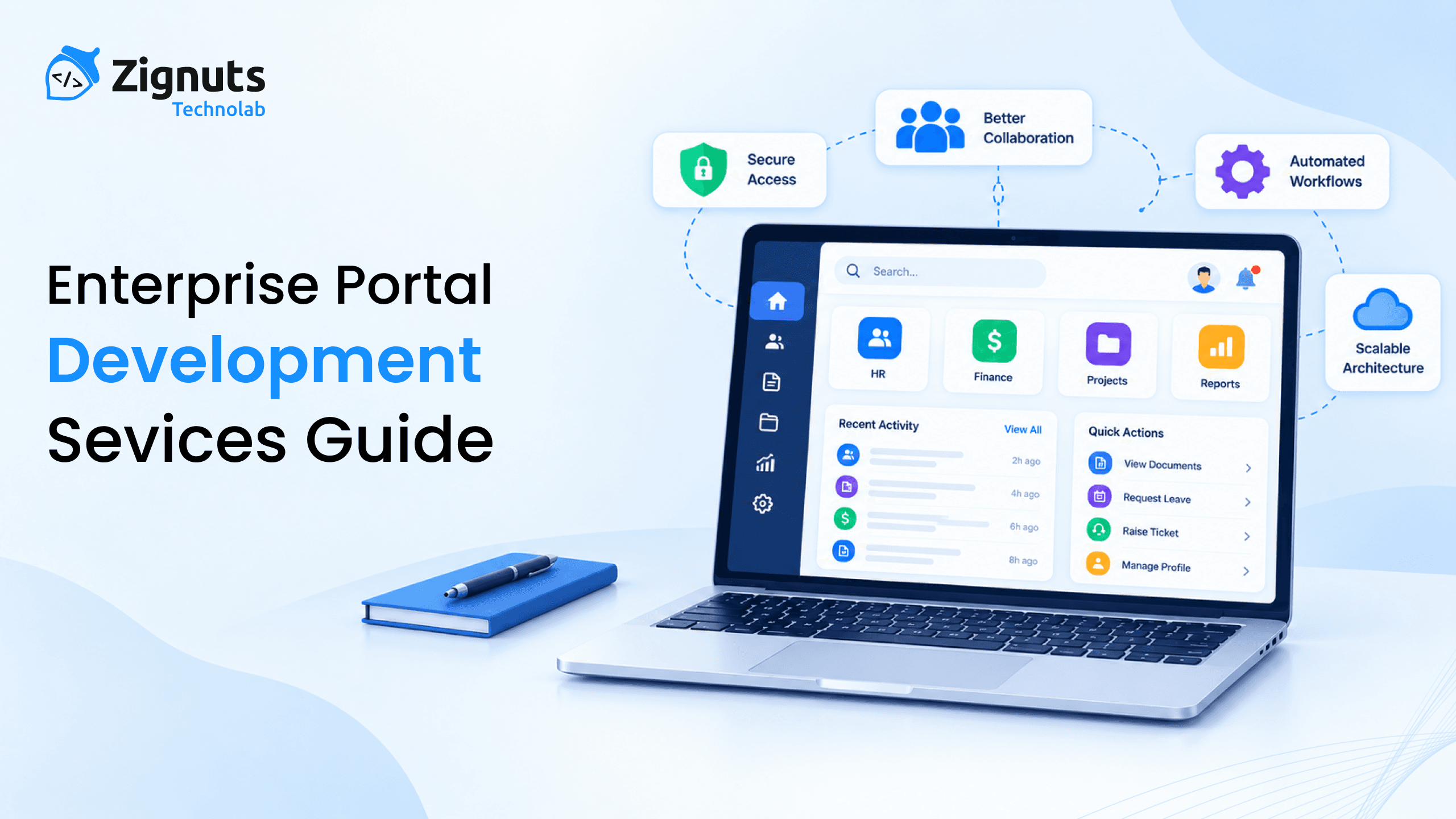
In the digital operating environment of 2026, enterprise portals have evolved from static document intranets into high-throughput digital operating cockpits.
Modern enterprise portals unify complex customer self-service journeys, multi-vendor B2B supply chain operations, internal employee workflows, and executive business intelligence into seamless, high-performance web and mobile experiences.
Building an effective Enterprise Portal Development strategy requires balancing distributed frontend architectures, legacy ERP and CRM interoperability, zero-trust security, and long-term total cost of ownership.
A well-engineered portal should be built on open, scalable cloud foundations that support flexibility, integration, and sustainable growth without unnecessary platform dependencies.
This comprehensive guide explores the core service capabilities, software architectures, security frameworks, delivery methodologies, and vendor evaluation criteria required to build an enterprise-grade portal.
It also covers practical engineering considerations drawn from experience with multi-tenant trading platforms, property management hubs, and financial systems.
Enterprise Portal Development Services: 4 Core Portal Types
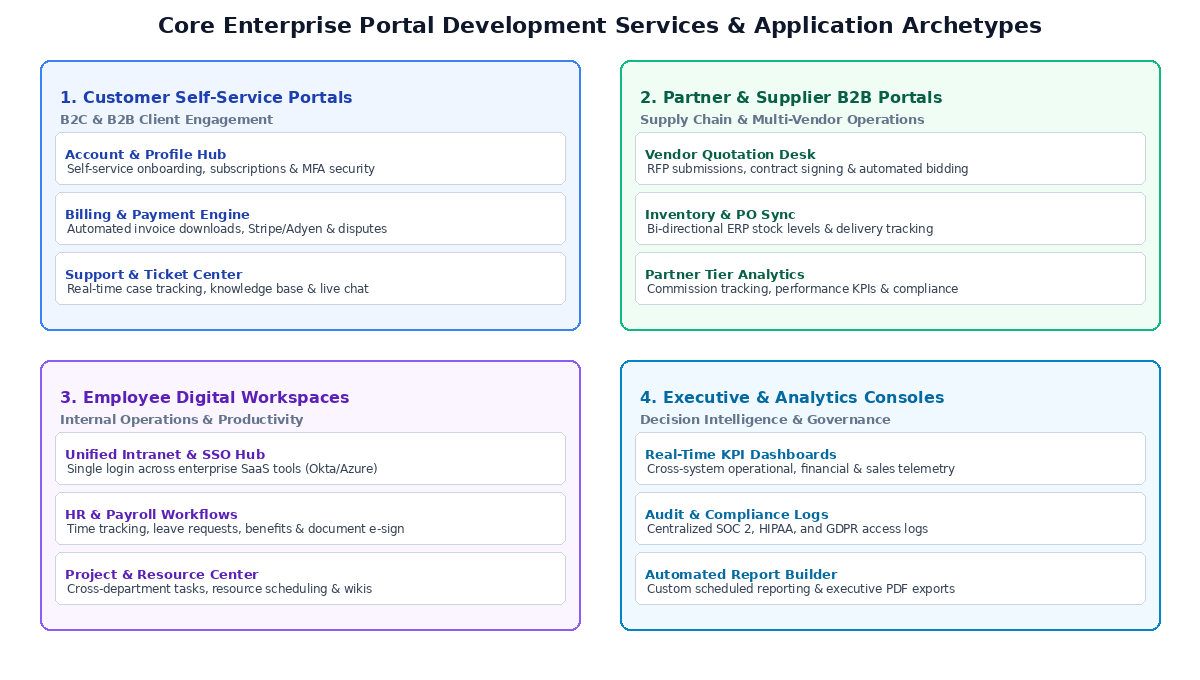
Enterprise portal development services encompass four primary solution archetypes, each tailored to distinct operational workflows, security boundaries, and user personas:
Customer Self-Service Portals: Client-facing hubs empowering users with digital onboarding, automated billing and invoice downloads, self-service dispute management, and direct support ticketing.
Partner & Supplier B2B Portals: Supply chain cockpits facilitating automated quotation desks, RFP bidding, real-time purchase order synchronization, catalog indexing, and tiered partner commission tracking.
Employee Digital Workspaces: Unified internal intranets aggregating enterprise SaaS tools under federated Single Sign-On (SSO), HR/payroll workflows, project scheduling, and document collaboration.
Executive & Analytics Consoles: Decision intelligence portals providing real-time KPI telemetry, automated executive PDF reporting, and centralized SOC 2/HIPAA compliance audit logs.
Ready to Build a More Scalable Enterprise Portal?

Core Capabilities of Enterprise Portal Development Services
Building an enterprise-grade portal requires deep full-stack engineering expertise across five foundational technical capabilities:
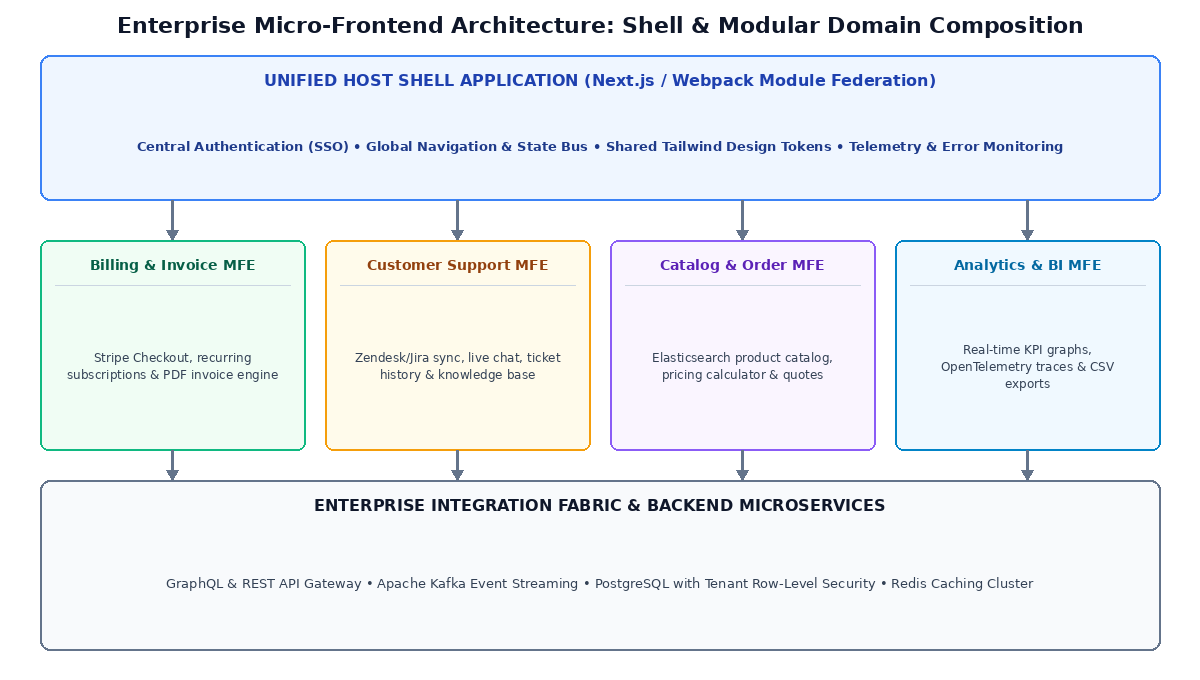
1. Micro-Frontend Architecture for Enterprise Portals
Traditional monolithic web portals create organizational bottlenecks where multiple engineering squads (e.g., billing, support, inventory) must deploy code simultaneously. Specialized portal engineering services implement modular micro-frontends (utilizing Next.js and Webpack Module Federation). A lightweight host shell manages global authentication, routing, and shared design tokens, while domain squads build and deploy their respective micro-apps independently to production with zero release conflicts.
2. Enterprise Integration and Real-Time Data Streaming
Enterprise portals must interface seamlessly with core ERPs (SAP, Oracle, NetSuite), CRMs (Salesforce, HubSpot), billing engines, and transactional databases. Engineering teams deploy an asynchronous event streaming fabric (using Apache Kafka, AWS EventBridge, or Redis Streams). This decouples high-traffic frontend read/write requests from legacy database locks, ensuring sub-second UI response times even during peak enterprise transaction volumes.
3. Zero-Trust SSO, Identity and Multi-Tenancy
Security is paramount when exposing enterprise data to external partners and customers. Comprehensive portal services embed federated Single Sign-On (SSO via SAML 2.0, OAuth2, and OIDC) with enterprise identity providers (Okta, Microsoft Entra ID / Azure AD). Multi-tenant architectures enforce strict Role-Based Access Control (RBAC) and database Row-Level Security (RLS) to guarantee complete data isolation between customer accounts.
4. AI-Powered Search and Automated Document Ingestion
Modern portal services integrate artificial intelligence to eliminate manual operational friction. By deploying optical character recognition (OCR) and semantic vector search pipelines, portals can automatically extract structured data from PDF purchase orders, summarize long contracts, and provide instant natural-language search across multi-system knowledge repositories.
5. Portal Observability and Core Web Vitals Optimization
Enterprise portals require rigorous performance engineering. Implementing Server-Side Rendering (SSR) and Incremental Static Regeneration (ISR) with Next.js ensures sub-second page loads and perfect Google Core Web Vitals. Centralized OpenTelemetry instrumentation tracks end-to-end API latency, error rates, and user session telemetry in real time.
Enterprise Portal Development Services vs. Proprietary DXP Platforms
When planning an enterprise portal initiative, technology leaders frequently weigh custom software engineering against proprietary Digital Experience Platforms (DXP suites like Adobe Experience Manager, Liferay, or Sitecore) and SaaS builders (Salesforce Experience Cloud, Microsoft Power Pages).
While low-code builders offer rapid initial prototyping, custom headless portal engineering delivers significantly lower 3-year total cost of ownership (TCO), complete UI customization, and 100% intellectual property ownership without recurring runtime platform taxes.
Enterprise Portal Development Approaches Comparison
Evaluation Parameter | Custom Headless Portal Engineering (Next.js + Microservices) | Monolithic Enterprise DXP (Adobe AEM / Liferay) | Low-Code SaaS Portal (Salesforce / Power Pages) |
|---|---|---|---|
Frontend UI/UX Flexibility | 100% Custom: Bespoke design systems, accessible Tailwind tokens, and sub-second Core Web Vitals. | Constrained: Dependent on DXP page builder components and heavy Java/HTML runtime templates. | Rigid: Bound to vendor layout templates; high friction for complex non-standard UI flows. |
Legacy ERP/CRM Integration | Unrestricted: Native connectors for REST, GraphQL, Kafka, SOAP, gRPC, and custom database webhooks. | Moderate: Requires specialized DXP integration modules and vendor marketplace adapters. | Constrained: Seamless for vendor ecosystem; expensive and complex for external multi-cloud backends. |
Licensing & Platform Taxes | $0 Licensing: Open cloud infrastructure; zero recurring per-user or per-login software penalties. | High: Annual six-figure enterprise platform licenses ($80K - $180K+/year) plus version upgrade fees. | Escalating: High monthly per-seat or per-login subscription tiers that penalize user growth. |
Intellectual Property & Control | 100% Owned: Full ownership of custom source code, Terraform IaC scripts, and API schemas. | Vendor-Bound: Customizations locked into proprietary DXP framework and developer runbooks. | Zero Ownership: Hosted entirely in vendor cloud; no code portability upon contract termination. |
Ready to Build a More Scalable Enterprise Portal?
Enterprise Portal Security and Federated SSO Architecture
Enterprise portals must enforce strict security perimeters to protect sensitive corporate, financial, and customer data. Our engineering services implement a 5-step federated identity and authorization architecture:
User Access Interception: Unauthenticated requests to web or mobile portal endpoints are intercepted at the API gateway layer.
Federated IdP Authentication: The user is redirected to the enterprise Identity Provider (Okta, Azure AD, Ping) to authenticate via SAML 2.0 or OpenID Connect (OIDC) with mandatory multi-factor authentication (MFA).
Signed JWT Issuance: Upon successful verification, the IdP issues a cryptographically signed JSON Web Token (JWT) containing user identity, tenant profile ID, and role claims.
Gateway Validation & Rate Limiting: The API gateway verifies the cryptographic signature, applies DDoS rate-limiting rules, and injects user context into downstream request headers.
Tenant-Scoped Data Isolation: Microservices execute queries against PostgreSQL using Row-Level Security (RLS) policies, ensuring tenant data is mathematically isolated at the database engine level.
Enterprise Portal Development Services Delivery Lifecycle
Successful portal engagements follow a disciplined, 4-stage agile delivery lifecycle designed to minimize capital risk and deliver working software to production early.
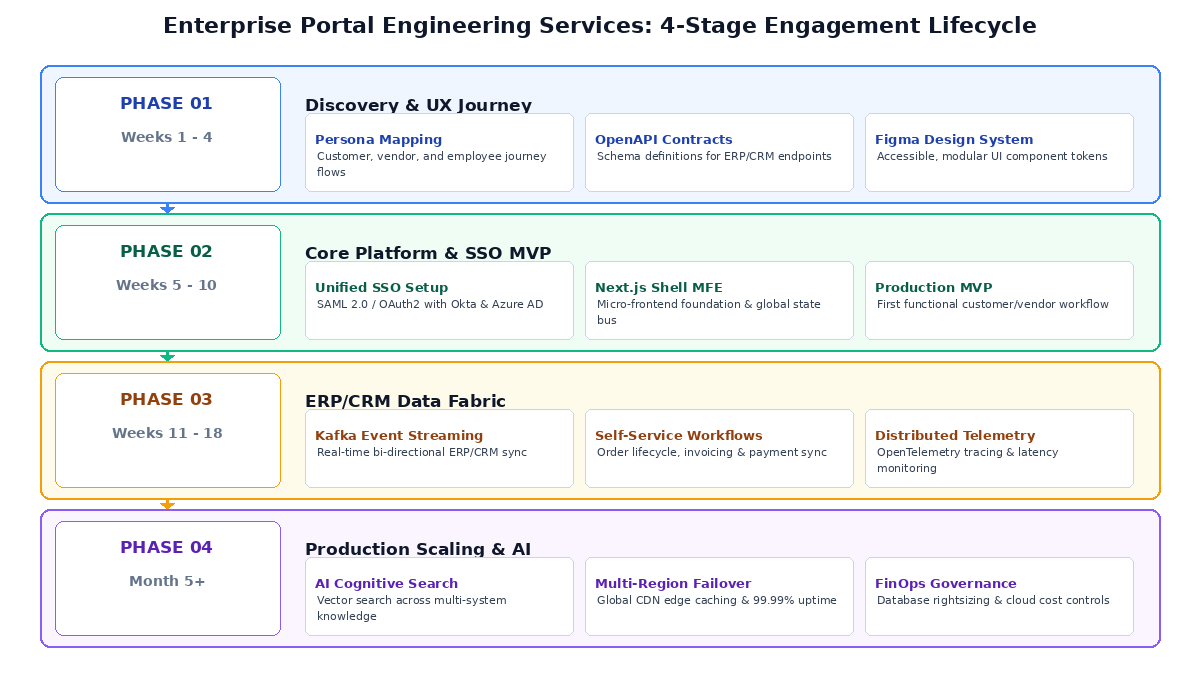
4-Stage Enterprise Portal Development Lifecycle
Delivery Phase | Duration | Key Engineering Deliverables | Outcome & Milestone Review |
|---|---|---|---|
Phase 1: Discovery & UX Architecture | Weeks 1 - 4 | Persona journey mapping, OpenAPI contract specifications, threat modeling, and accessible Figma design systems. | Approved architectural blueprint, interactive prototype, and validated security requirements. |
Phase 2: Core Platform & SSO MVP | Weeks 5 - 10 | Next.js micro-frontend host shell, federated SSO integration (Okta/Azure AD), and first functional user workflow. | Production MVP deployment to live staging with automated CI/CD canary testing pipelines. |
Phase 3: ERP/CRM Integration Fabric | Weeks 11 - 18 | Apache Kafka event bus, bi-directional ERP/CRM connectors, self-service transactions, and OpenTelemetry logging. | End-to-end data synchronization under live traffic conditions with sub-second response times. |
Phase 4: Scaling, AI & FinOps | Month 5+ | Semantic vector search, automated OCR document parsing, global CDN edge caching, and FinOps cost guardrails. | Enterprise-wide general availability launch with 99.99% multi-region high availability. |
Ready to Build a More Scalable Enterprise Portal?
Enterprise Portal Development Technology Stack
A resilient enterprise portal requires a modern, modular technology stack spanning frontend experience, integration middleware, and cloud infrastructure:
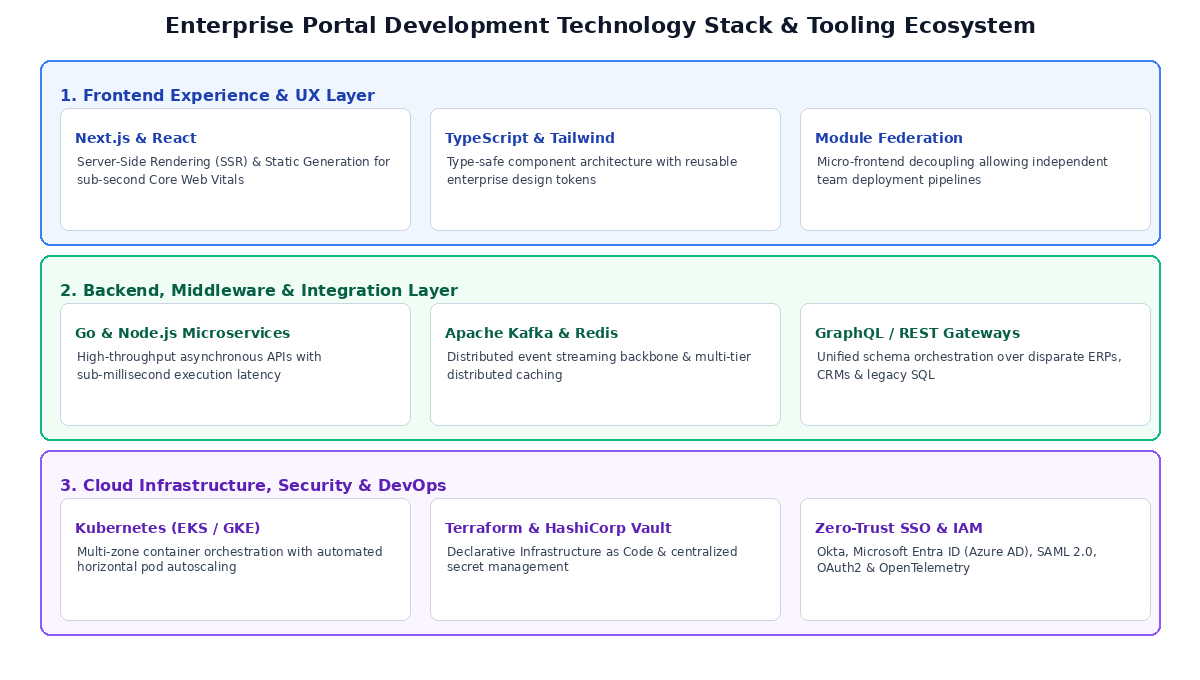
Frontend Experience Layer: Next.js, React 19, TypeScript, Tailwind CSS, Webpack Module Federation, TanStack Query, and Cypress for end-to-end test automation.
Backend & Middleware Layer: Go, Node.js (Fastify/Express), Python (FastAPI), GraphQL API Gateway, Apache Kafka, and Redis Cluster for distributed multi-tier caching.
Cloud & Security Layer: Kubernetes (EKS/GKE), Docker, Terraform Infrastructure as Code, HashiCorp Vault, Okta SAML 2.0 / OAuth2, and OpenTelemetry for distributed tracing.
Enterprise Portal Development Services Case Studies and Implementation Lessons
Our enterprise portal development experience spans several complex operational use cases, including B2B marketplaces, property management, AI workflow automation, supply chain visibility, and financial operations. These projects highlight how enterprise portals can connect users, workflows, data, and business systems within a unified digital environment.
Multi-Tenant B2B Portal and Directory Architecture: We developed scalable B2B trading platforms with tenant-scoped PostgreSQL schemas, dynamic fee calculation engines, and fast catalog search to support complex multi-tenant operations.
Property Management and Multi-Audience Self-Service Portal: We modernized real estate operations with dedicated portals for tenants, landlords, and property managers, supporting lease management, payment processing, and digital document workflows.
Enterprise AI Workflow Automation and Portal Orchestration: We helped automate multi-step business workflows across connected systems by decoupling business processes from monolithic databases and supporting durable workflow execution.
Multi-System Supply Chain and Vendor Visibility Portal: We integrated legacy ERP systems, warehouse management databases, and real-time tracking data into unified web consoles to improve supply chain visibility and reduce manual data entry.
Financial Modernization and Automated Billing Portals: We supported financial operations with secure digital architectures, automated invoice validation, and self-service billing workflows designed to improve accuracy while supporting compliance requirements.
Ready to Build a More Scalable Enterprise Portal?
Key Takeaways for Enterprise Portal Development Services
Adopt Micro-Frontends to Eliminate Deployment Bottlenecks: Modular micro-frontends allow independent product squads to ship features to customers, vendors, and staff daily without merge conflicts.
Insist on 100% Code and IP Ownership: Custom headless engineering eliminates recurring six-figure DXP licensing fees and gives your enterprise permanent control over its technology assets.
Decouple Frontends via an Asynchronous Message Bus: Protect the portal user experience from legacy backend latency by deploying Apache Kafka and Redis caching layers.
Embed Zero-Trust Identity (SSO/IAM) from Day One: Enforce SAML 2.0/OAuth2 federation and database Row-Level Security to prevent cross-tenant data leaks and meet compliance standards.
Partner with Experienced Software Engineers: Building mission-critical enterprise portals requires proven expertise in distributed systems, micro-frontends, legacy API integration, and FinOps governance. Collaborating with an experienced engineering team mitigates architectural risk and accelerates time-to-market.
Conclusion
Enterprise portal development services require more than a modern frontend. They demand a secure, scalable architecture that connects users, business workflows, legacy systems, data, and emerging AI capabilities within a unified platform. Micro-frontends, real-time integration, federated SSO, multi-tenant security, observability, and cloud cost governance provide the foundation for reliable enterprise portals.
Whether you are building a customer self-service portal, partner and supplier workspace, employee digital platform, or executive analytics portal, a phased engineering approach can reduce implementation risk while supporting long-term scalability and maintainability.
If you are planning an enterprise portal modernization or building a new portal from the ground up, contact us today to discuss your requirements and explore the right enterprise portal development approach for your business.

Swati Bais
Business Enthusiast | Curious about how businesses evolve, connecting ideas with insights to discover opportunities and shape better ways of working.