


Enterprise AI Agent Development Services: Executive Summary
Enterprise AI agents are moving from experimentation toward workflow execution. Recent industry research shows that organizations are increasingly experimenting with AI agents, while many have not yet reached enterprise-wide AI adoption and scaling. Industry research also indicates that most organizations expect to customize agents around their specific business requirements.
The opportunity is therefore significant, but the buying decision is less about selecting the most impressive model and more about building a controlled system that can safely act on enterprise data and applications.
For buyers, the strongest AI agent development strategy starts with a measurable business workflow, defines the level of autonomy that is acceptable, connects the agent to approved tools and data, and establishes security and evaluation controls before production rollout. The right development partner should be able to deliver AI Agent Development Services covering product discovery, workflow design, model orchestration, integrations, testing, observability, and post-launch optimization as one delivery lifecycle.
What Are Enterprise AI Agents and How Do They Work?
An enterprise AI agent is a software system that can interpret a goal, reason over available context, choose actions, use approved tools, and complete one or more steps in a business workflow. Unlike a conventional chatbot, an agent can interact with systems such as CRM, ERP, ticketing, knowledge bases, databases, APIs, and internal applications.
The distinction matters commercially. A chatbot may answer a customer question, while an agent can retrieve the customer's account, check eligibility, create a service ticket, update a record, request approval, and report the result. The business value comes from connecting intelligence to execution.
Why Enterprises Invest in AI Agent Development Services
The strongest use cases are usually workflows with high volumes of repetitive decisions, multiple systems, structured business rules, and measurable service-level outcomes. Examples include IT service management, customer operations, sales research, finance operations, procurement, claims processing, employee support, compliance workflows, and internal knowledge operations.
Industry research shows that organizations are increasingly experimenting with agents, but enterprise-wide scaling remains difficult. That gap is important for buyers: an agent that performs well in a demonstration is not necessarily ready for production. Production readiness depends on integration reliability, permissions, data quality, evaluation, observability, human oversight, and governance.
Ready to Build a More Scalable AI Agent Solution?

Where Enterprise AI Agents Create Business Value
A useful business case should connect the agent to a specific operational metric. For example, a customer-service agent can be evaluated through average handling time, first-contact resolution, escalation rate, and customer satisfaction. An internal finance agent can be evaluated through processing time, exception rates, analyst workload, and close-cycle efficiency.
The best candidates generally have a clear baseline and a definable outcome. Buyers should avoid starting with a vague objective such as "add an AI agent to our business." Instead, define the workflow, the bottleneck, the decision rights, the systems involved, and the economic value of improving the process.
Choosing the Right Level of AI Agent Autonomy
Maturity | Operating model | Risk level | Typical fit |
|---|---|---|---|
Assistive | Agent recommends or drafts; human performs the action | Low | Research, drafting, knowledge support |
Supervised execution | Agent executes approved steps with human checkpoints | Medium | Customer operations, IT workflows, finance review |
Bounded autonomy | Agent executes defined actions automatically within policy limits | Higher | High-volume, rules-driven workflows |
Not every enterprise workflow should be fully autonomous. A practical maturity model moves from assistive agents to supervised execution and then to bounded autonomy. For low-risk activities, an agent may be allowed to complete actions automatically. For high-impact activities, it should prepare a recommendation and require human approval.
A good implementation therefore defines an action policy for every tool the agent can access. Read-only access, write access, financial transactions, customer communication, data deletion, and policy-sensitive decisions should not receive the same permission level.
Enterprise AI Agent Architecture: Key Components to Include
Layer | Key capabilities | Business purpose |
|---|---|---|
Identity & access | Authentication, authorization, agent identity, least privilege | Controls who or what can act |
Agent orchestration | Planning, state, tool selection, retries, workflow control | Coordinates execution |
Model gateway | Model routing, policy, cost and latency controls | Avoids unnecessary model lock-in |
Knowledge / RAG | Approved documents, retrieval, metadata, permissions, freshness | Grounds agent decisions |
Tools & integrations | APIs, enterprise applications, databases, workflow systems | Lets the agent act |
Policy engine | Action rules, approval gates, risk thresholds | Constrains high-impact actions |
Observability | Traces, logs, metrics, evaluation and alerts | Makes production behavior measurable |
Human review | Escalation and exception workflows | Keeps people in control where required |
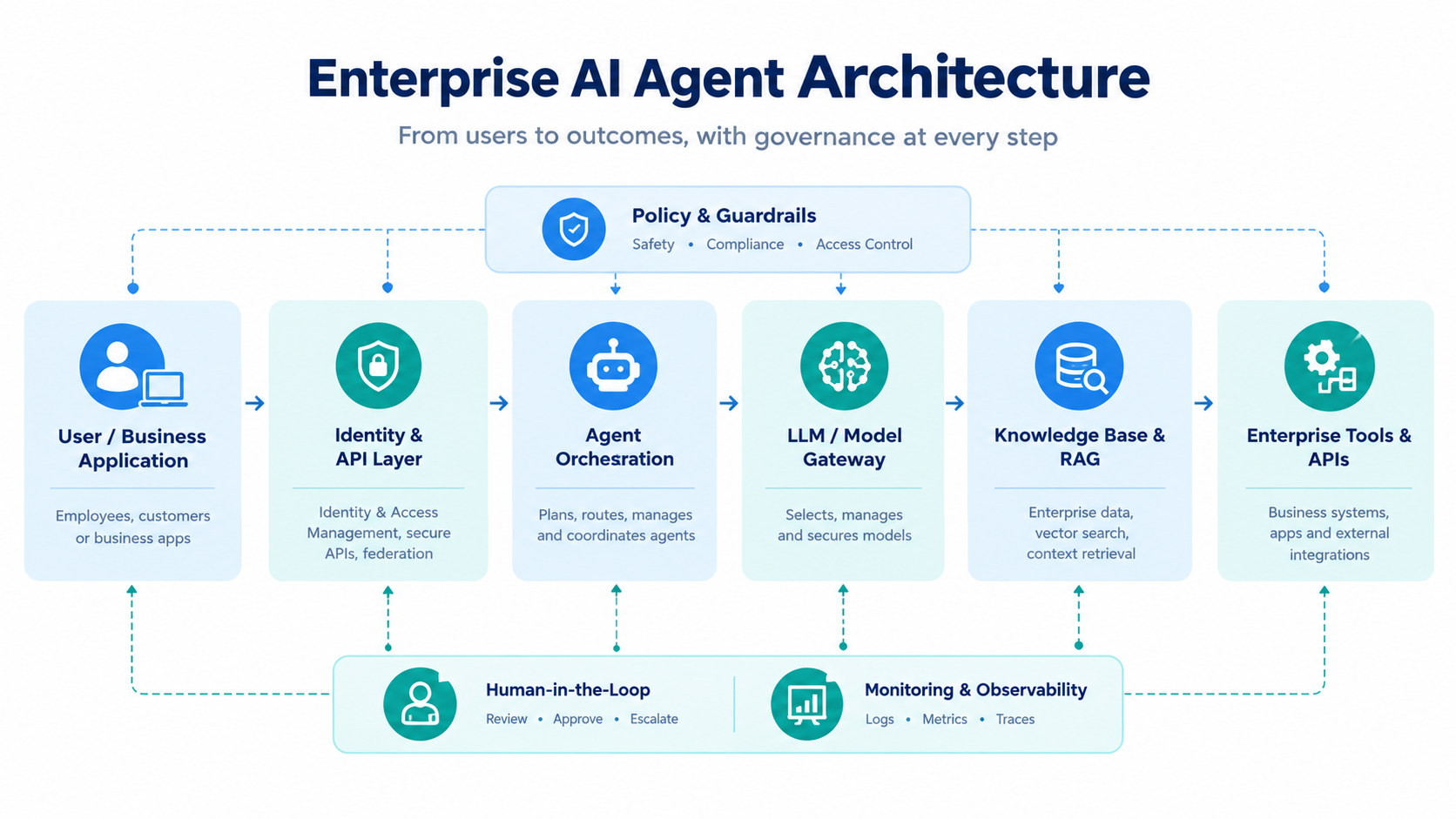
A production architecture normally contains several cooperating layers. The user or business application sends a request through an identity and API layer. An agent orchestration layer interprets the goal, manages state, selects tools, and controls workflow execution. A model gateway can route requests across approved models based on capability, latency, cost, or data requirements.
The agent then connects to enterprise data and tools through controlled interfaces. These may include RAG pipelines, databases, vector stores, CRM and ERP APIs, workflow engines, document repositories, event streams, and internal services. Policy enforcement should sit between the agent and sensitive actions so that business rules do not depend solely on model behavior.
Observability is equally important. Production systems should capture useful traces such as tool calls, latency, model usage, failures, policy decisions, and evaluation results without exposing unnecessary sensitive data. A human-review queue should be available for exceptions and actions that exceed predefined risk thresholds.
Ready to Build a More Scalable AI Agent Solution?
Core Components of Enterprise AI Agent Development
Model strategy: Decide whether the solution should use one model, several models, or a model gateway. Evaluate reasoning quality, tool use, context handling, latency, cost, data controls, and portability rather than choosing a model solely because it performs well in public benchmarks.
Agent orchestration: The orchestration layer should manage planning, state, retries, tool selection, structured outputs, and failure handling. For complex workflows, multi-agent designs can be useful, but they should not be introduced simply because the architecture looks sophisticated.
Knowledge and retrieval: Enterprise agents need grounded access to approved information. Retrieval pipelines should address document ingestion, chunking, metadata, permissions, freshness, source attribution, and access control. A vector database alone does not solve enterprise knowledge management.
Tool integration: Tools should have explicit schemas, authentication, authorization, input validation, rate limits, and audit trails. Existing systems may include ERP platforms, CRM platforms, IT service management systems, productivity suites, custom APIs, databases, and legacy applications.
Enterprise AI Agent Security, Privacy, and Governance
Control area | Controls to evaluate | Buyer question |
|---|---|---|
Identity | Unique agent identity, SSO, RBAC, least privilege | Who is the agent and what can it access? |
Data | Classification, encryption, residency, retention, access controls | What information can it see and store? |
Actions | Tool permissions, approvals, policy enforcement | What can it change or execute? |
Runtime | Monitoring, anomaly detection, rate limits, rollback | What happens when behavior deviates? |
Audit | Traceability, logs, evidence, versioning | Can the organization explain what happened? |
Enterprise agents can increase the impact of security failures because they can act on systems rather than only generate text. Buyers should therefore evaluate identity, least-privilege access, secrets management, encryption, data classification, prompt injection defenses, tool authorization, logging, retention, and incident response.
Governance should cover the full lifecycle: use-case approval, model and prompt changes, evaluation thresholds, deployment controls, monitoring, rollback, and retirement. Established AI risk-management frameworks can provide useful references for organizations designing controls across the AI lifecycle.
For organizations operating in the European Union, regulatory planning is also becoming a concrete delivery requirement. The EU AI Act's implementation is staged, with the majority of rules and enforcement for applicable provisions beginning on 2 August 2026 and additional high-risk provisions scheduled for later dates. Buyers should assess how their use case is classified and what obligations apply rather than assuming that every AI agent is regulated in the same way.
How to Evaluate an Enterprise AI Agent Development Company
Evaluation area | Questions to ask | Why it matters |
|---|---|---|
Business discovery | Can the partner map the workflow and define measurable outcomes? | Prevents technology-first projects |
AI engineering | Can it design orchestration, RAG, model routing, and tool use? | Determines technical feasibility |
Enterprise integration | Can it integrate identity, APIs, CRM, ERP, and legacy systems? | Determines production readiness |
Security & governance | Can it enforce permissions, auditability, and policy controls? | Reduces enterprise risk |
Evaluation | Does it test task success, safety, tool reliability, and failure paths? | Provides evidence before scale |
Delivery & support | Can it own production hardening and post-launch optimization? | Reduces handoff risk |
Start with the partner's ability to understand the workflow, not the number of AI models listed on its website. A strong partner should be able to translate an operational problem into an agent specification, define the agent's responsibilities, identify systems and data dependencies, and establish measurable acceptance criteria.
Technical capability should cover agent orchestration, RAG, model integration, APIs, cloud architecture, security, observability, evaluation, and enterprise application integration. Ask the vendor to explain what happens when the model is uncertain, a tool fails, retrieved information conflicts, an API times out, or a user attempts an unauthorized action.
Delivery capability matters just as much. Ask who owns discovery, architecture, development, testing, security review, deployment, monitoring, and post-production optimization. A partner that can support only the prototype phase may leave the enterprise with the hardest part of the project still unresolved.
Ready to Build a More Scalable AI Agent Solution?
Enterprise AI Agents: Build, Buy, or Hybrid Approach
Approach | Best fit | Main consideration |
|---|---|---|
Buy | Standardized workflow; mature packaged capability | Faster deployment; less customization |
Build | Differentiated workflow, proprietary data, or unique controls | Maximum control and fit; higher engineering effort |
Hybrid | Custom orchestration around established models/platforms | Balances speed, control, and differentiation |
Buying an off-the-shelf agent can make sense when the workflow is standardized, and the required integrations are already supported. Custom development becomes more attractive when the workflow is differentiated, the data is proprietary, the process spans several systems, or the organization requires specific security and governance controls.
A hybrid approach is often practical. Enterprises can use established foundation models and agent frameworks while custom-building the orchestration, business rules, integrations, retrieval layer, user experience, and governance controls that differentiate the solution.
Enterprise AI Agent Development Lifecycle
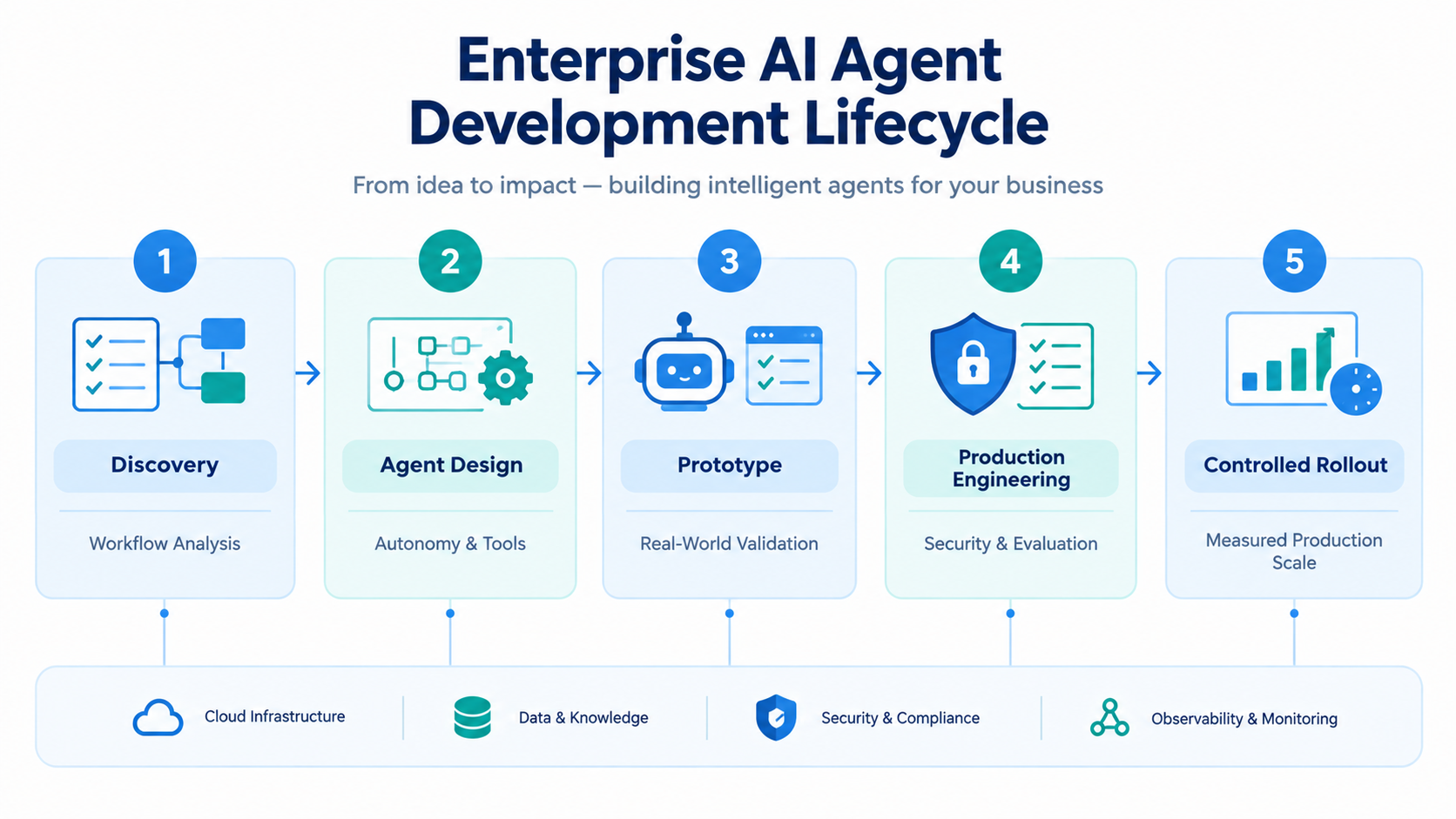
Phase 1, discovery: Map the current workflow, identify bottlenecks, define the target outcome, assess data and integrations, and classify risks.
Phase 2, agent design: Define the agent's goal, tools, memory or state requirements, knowledge sources, approval points, failure states, and autonomy boundaries.
Phase 3, prototype: Validate the highest-value workflow with representative data and real integration constraints. The prototype should test the actual workflow, not only a conversational interface.
Phase 4, production engineering: Implement authentication, authorization, monitoring, evaluation, auditability, error handling, deployment controls, and operational support.
Phase 5, controlled rollout: Begin with a limited user or workflow scope, measure performance against the baseline, review exceptions, and expand autonomy only when evidence supports it.
Enterprise AI Agent Development Cost
There is no reliable single price for enterprise AI agent development because the cost is driven by workflow complexity rather than the model alone. A narrow internal agent with a few read-only integrations is materially different from a regulated, multi-system agent that can execute transactions.
The major cost drivers are discovery and process redesign, model and inference usage, agent orchestration, enterprise integrations, data preparation and retrieval, security engineering, evaluation, cloud infrastructure, user experience, monitoring, and ongoing maintenance. Buyers should request a phased estimate that separates prototype, production hardening, deployment, and recurring operating costs.
Ready to Build a More Scalable AI Agent Solution?
Enterprise AI Agent KPIs and Performance Metrics
Metric group | Examples | Decision question |
|---|---|---|
Business | Cycle time, cost per transaction, resolution rate, conversion, backlog | Did the workflow improve? |
Task quality | Task completion, grounded-answer rate, escalation rate | Did the agent complete the right work? |
Reliability | Tool-call success, error rate, latency | Does it operate consistently? |
Safety | Unauthorized actions, policy violations, human overrides | Does it stay within its authority? |
Economics | Cost per successful task, model usage, infrastructure cost | Is the solution economically viable? |
Define business KPIs first, followed by agent quality metrics. Business KPIs may include cycle time, cost per transaction, resolution rate, conversion, revenue contribution, backlog, or employee productivity. Agent metrics can include task completion rate, tool-call success rate, grounded-answer rate, escalation rate, latency, error rate, and cost per successful task.
For high-risk workflows, include safety metrics such as unauthorized-action rate, policy-violation rate, human override rate, and evaluation failure rate. A production agent should be judged by successful and safe completion of business tasks, not by conversational fluency alone.
Enterprise AI Agent Development Services Buyer Checklist
Is the use case tied to a measurable business outcome?
Can the partner integrate with our existing enterprise systems and identity model?
How are tool permissions and high-impact actions controlled?
How does the solution handle uncertainty, failed tools, conflicting data, and escalation?
What evaluation framework will be used before and after production?
How are prompts, models, tools, and workflows versioned and governed?
What security, privacy, residency, and compliance requirements apply to our geography?
Can the architecture support multiple models without creating unnecessary vendor lock-in?
What will we pay for implementation, infrastructure, model usage, monitoring, and ongoing support?
Who owns the solution after launch, and what operating model will support it?
Common Enterprise AI Agent Development Mistakes
The most common mistake is starting with the technology instead of the workflow. Other recurring problems include granting agents excessive permissions, relying on ungoverned enterprise data, testing only happy paths, skipping evaluation until after launch, and treating a successful demo as proof of production readiness.
Another mistake is building a multi-agent system when a single bounded agent would solve the problem. Complexity should be justified by business requirements. The architecture should be as simple as possible while still meeting the required workflow, security, and scale objectives.
Choosing Enterprise AI Agent Development Services
Enterprise AI agent development should be evaluated as a business transformation initiative, not as a standalone chatbot project. The right partner will combine business analysis, AI engineering, enterprise integration, security, governance, and production operations.
For organizations evaluating AI agent development services, the strongest starting point is a high-value workflow with a measurable baseline, controlled autonomy, and a clear path from prototype to production. This approach reduces the risk of building an impressive demonstration that cannot operate reliably inside the enterprise.
Our AI agent development services can help enterprises assess use cases, design agent workflows, integrate enterprise systems, and build production-ready AI solutions with the security and governance controls expected by modern technology organizations. Contact us today to discuss your AI agent requirements and explore a practical path from strategy to production.

Deep Gondaliya
Business Analyst | Turning business challenges into clear insights, practical solutions, and meaningful improvements that help teams move forward.