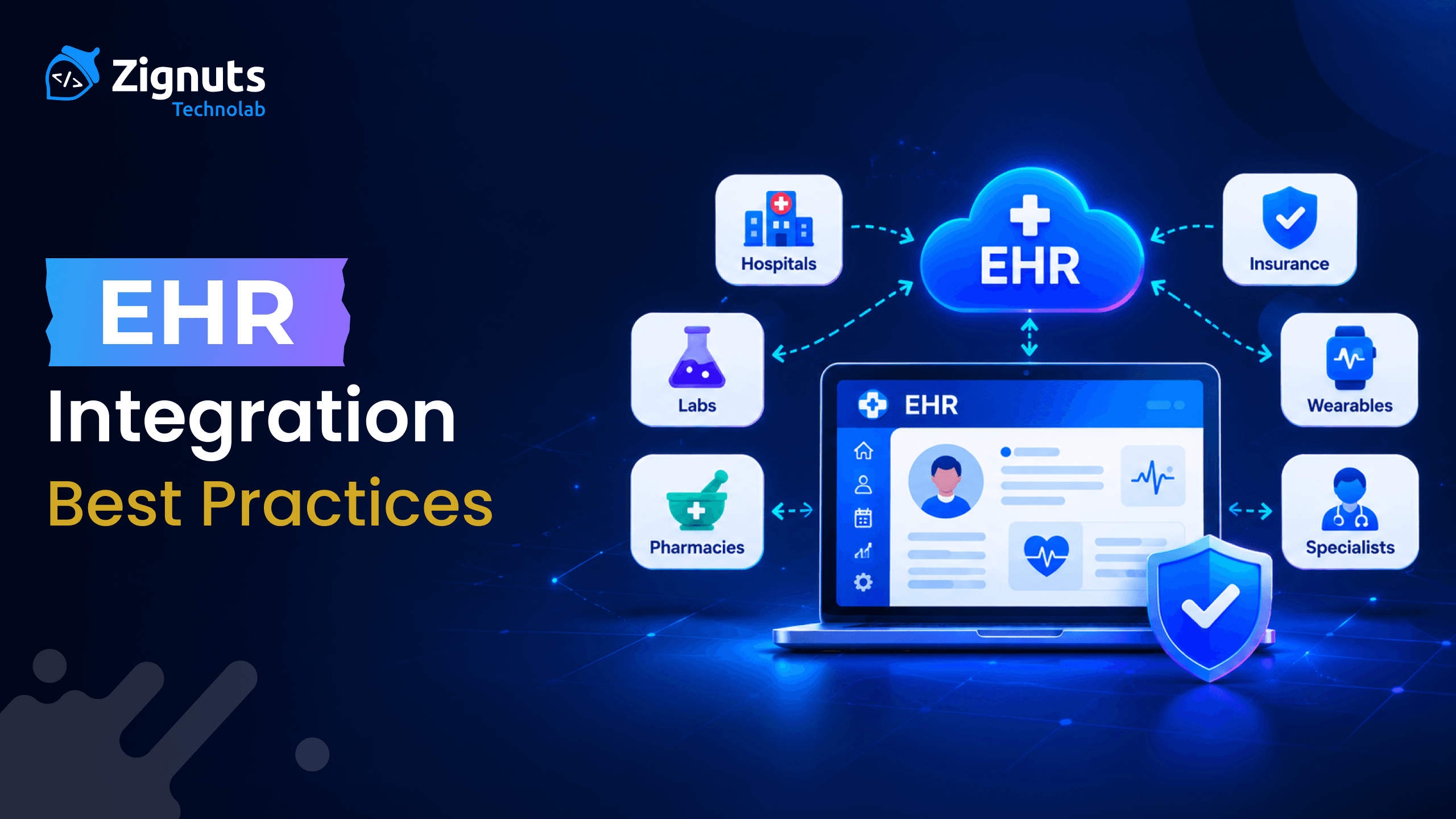
In 2026, healthcare organizations face growing pressure to modernize clinical technology while meeting strict interoperability and compliance requirements, including the 21st Century Cures Act, ONC HTI-1 requirements, and CMS-9115-F rules. EHR systems such as Epic Systems, Oracle Health (Cerner), MEDITECH, Athenahealth, and eClinicalWorks hold critical patient information, but integrating them with patient portals, RPM, CDS, and AI-powered diagnostics presents architectural, semantic, and regulatory challenges.
A reliable EHR integration strategy requires bi-directional HL7 v2 and FHIR R4 data pipelines, secure SMART on FHIR OAuth2 authorization, immutable HIPAA audit logging, and safeguards against clinical data truncation or loss.
Strong EHR Software Development practices help ensure integrations support clinical workflows, data accuracy, security, and long-term interoperability.
This guide covers technical best practices, integration architectures, security considerations, and regulatory requirements for resilient EHR integrations.
Drawing on our experience developing HIPAA-compliant healthcare applications, clinical staffing platforms, and medical data pipelines, we outline practical approaches to maintaining clinical data accuracy, reliable performance, and regulatory compliance.
EHR Integration: 4 Core Healthcare Integration Archetypes
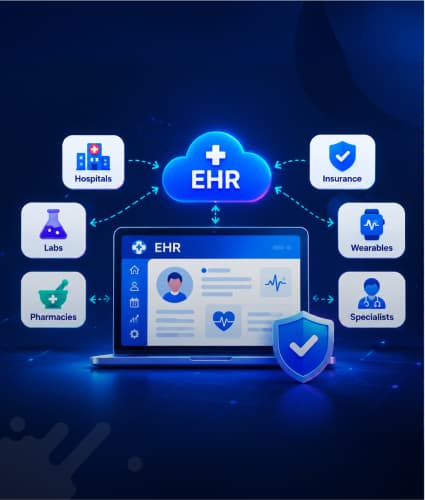
EHR integration initiatives span four distinct clinical integration patterns across the healthcare ecosystem:
Inpatient Enterprise EHR Systems: Connecting acute hospital EHRs (Epic, Cerner, MEDITECH) via HL7 v2.x MLLP feeds (ADT, ORU, MDM) and C-CDA XML document exchange.
Ambulatory & Telehealth EHRs: Integrating outpatient clinics (Athenahealth, eClinicalWorks, NextGen) utilizing standardized FHIR R4 RESTful APIs and NCPDP e-prescribing endpoints.
Diagnostic, LIS & Imaging Systems: Interfacing with Laboratory Information Systems (LIS) and Picture Archiving and Communication Systems (PACS) via HL7 ORM orders and DICOM C-STORE image exchange.
Patient RPM & Digital Health Apps: Connecting remote patient monitoring devices, mobile health apps, and digital therapeutics via SMART on FHIR patient-mediated OAuth2 scopes.
Ready to Build a More Scalable EHR Integration?

EHR Integration Best Practices for Enterprise Healthcare Systems
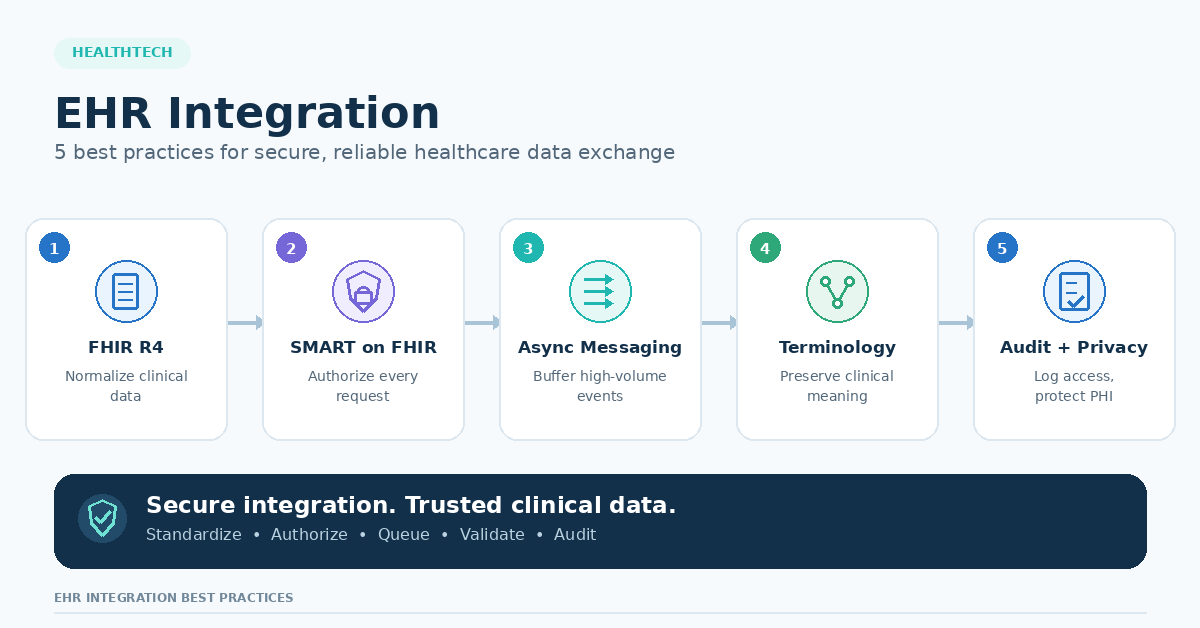
Engineering a resilient healthcare integration platform requires adherence to five foundational architectural best practices:
1. HL7 FHIR R4 for EHR Integration and Data Normalization
While legacy hospital backends communicate in delimited HL7 v2 pipe messages (e.g., ADT^A08 patient updates), modern clinical applications should never couple directly to raw HL7 v2 syntax. Leading healthcare architectures deploy an intermediate translation layer that converts inbound HL7 segments into standardized HL7 FHIR R4 JSON resources (such as Patient, Encounter, Observation, Condition, and MedicationRequest). This decouples downstream mobile and web portals from vendor-specific EHR dialect variations.
2. SMART on FHIR Authorization for Secure EHR Integration
Modern clinical integrations must avoid broad, unconstrained database credentials. Implementing the SMART on FHIR protocol (anchored to OAuth2 and OpenID Connect) enforces granular, context-aware authorization scopes (such as patient/*.read or user/Observation.write). This guarantees that third-party applications, clinicians, and patients access strictly authorized subsets of Protected Health Information (PHI).
3. Asynchronous Messaging for High-Throughput EHR Integration
Hospital EHR endpoints frequently generate sudden bursts of clinical messages during shift handoffs and morning rounds. Direct synchronous HTTP posting to downstream applications risks packet loss and database table locks. Engineering best practice mandates deploying an asynchronous message broker (such as Apache Kafka or AWS SQS) behind Minimal Lower Layer Protocol (MLLP) TCP listeners. This buffers inbound HL7 streams, guarantees message ordering, and ensures zero data loss during downstream maintenance windows.
4. Clinical Terminology Mapping for EHR Integration
Clinical data is only valuable if its semantic meaning is preserved across systems. Different EHR vendors frequently use proprietary local lab codes or disparate medication naming conventions. A robust integration pipeline incorporates automated ConceptMap terminology services to normalize local codes into standard clinical vocabularies: LOINC for laboratory observations, RxNorm for medications, SNOMED CT for clinical findings, and ICD-10-CM for diagnoses.
5. ATNA Audit Logging and PHI De-Identification for EHR Integration
HIPAA Security Rule § 164.312(b) mandates that healthcare systems record and examine activity in information systems containing PHI. Integration engines must implement the IHE Audit Trail and Node Authentication (ATNA) standard, writing tamper-proof audit records for every clinical read, write, update, and query event. When streaming clinical data to analytical or AI training pipelines, automated de-identification routines must scrub the 18 HIPAA Safe Harbor identifiers.
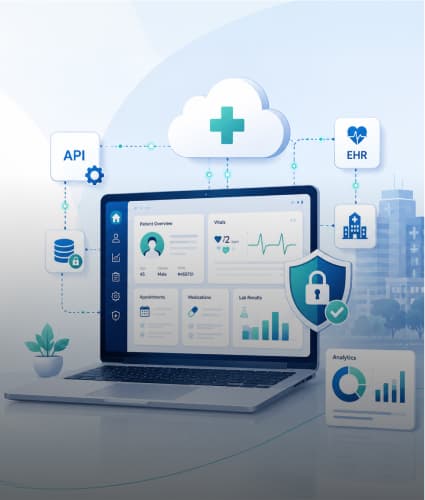
End-to-End Clinical Interoperability Architecture: HL7 to FHIR R4
End-to-End Clinical Interoperability Architecture: Inbound EHR Protocols, FHIR Orchestration Gateway, and Consuming Healthcare Applications
EHR Integration Architectural Strategies: Custom, Interface Engine, and Direct API
Healthcare organizations evaluating integration approaches typically choose between three primary architectural strategies: Custom FHIR Microservices Gateways, Commercial Healthcare Integration Engines (e.g., Mirth Connect, Redox, Rhapsody), and Direct Point-to-Point EHR APIs.
While commercial interface engines provide rapid out-of-the-box connectors for standard clinical workflows, custom FHIR microservices gateways deliver superior scalability, zero recurring per-connection software taxes, and 100% intellectual property ownership for proprietary digital health platforms.
Remove from SEO Heading Structure
Evaluation Parameter | Custom FHIR Microservices Gateway (Zignuts Architecture) | Commercial Healthcare Interface Engine (Mirth / Rhapsody) | Direct EHR Vendor APIs (Epic on FHIR / Athena) |
|---|---|---|---|
Multi-EHR Interoperability | High: Normalizes disparate EHR dialects into unified FHIR R4 repositories. | High: Pre-built transformation channels for HL7, C-CDA, and DICOM. | Low: Each EHR vendor requires a separate custom integration codebase. |
Execution Latency & Throughput | Sub-Second: Asynchronous Kafka event bus & Redis caching on Kubernetes. | Moderate: Dependent on JVM thread pooling and interface engine server sizing. | Variable: Subject to strict vendor API rate limits and throttling rules. |
Licensing & Platform Taxes | $0 Licensing: Open cloud infrastructure; zero recurring per-facility or per-message fees. | High: Annual six-figure enterprise licensing ($50K - $150K+/year) plus connection fees. | Tiered: EHR vendors charge annual developer program fees and app marketplace cuts. |
IP Ownership & Customization | 100% Owned: Full ownership of custom transformation scripts and schemas. | Vendor-Bound: Configurations tied to proprietary engine scripting runtimes. | Constrained: Restricted to vendor-approved API capabilities and data fields. |
Ready to Build a More Scalable EHR Integration?
5-Stage EHR Integration and Clinical Deployment Lifecycle
Deploying a production clinical integration into a live hospital or outpatient environment requires a structured, 5-stage engineering lifecycle designed to eliminate clinical risk and guarantee regulatory compliance:
Delivery Stage | Duration | Key Engineering Deliverables | Clinical Milestone & Acceptance Criteria |
|---|---|---|---|
Stage 1: Workflow & Schema Mapping | Weeks 1 - 4 | Clinical workflow audit, HL7 segment-to-FHIR ConceptMap specifications, and threat modeling. | Signed-off interface specification document (ISD) and clinical data dictionary. |
Stage 2: SMART Auth & Sandbox Test | Weeks 5 - 8 | EHR developer sandbox connectivity, SMART on FHIR OAuth2 setup, and synthetic patient data generation. | Successful automated token exchange and simulated patient record queries in sandbox. |
Stage 3: Message Pipeline & Validation | Weeks 9 - 14 | MLLP TCP listener deployment, HL7 parser engineering, and automated schema reconciliation rules. | Zero data truncation across 10,000+ synthetic HL7/FHIR test transactions. |
Stage 4: HIPAA Audit & Pen Testing | Weeks 15 - 18 | End-to-end TLS 1.3/AES-256 validation, third-party penetration testing, and BAA contract execution. | Clean SOC 2 Type II / HIPAA audit report and approved hospital IT security sign-off. |
Stage 5: Clinical Go-Live & Telemetry | Month 5+ | Staged production canary rollout, real-time ATNA audit logging, and 24/7 clinical latency monitoring. | 100% production traffic routing with <200ms API response times and zero clinical disruption. |
EHR Integration Security and HIPAA Compliance Architecture
Protecting electronic Protected Health Information (ePHI) requires a comprehensive defense-in-depth security architecture spanning transport, identity, and storage layers:
Perimeter & Transport Security: Strict enforcement of TLS 1.3 encryption for all HTTP/REST endpoints and VPN/IPsec tunnels with Mutual TLS (mTLS) for MLLP TCP connections between hospital network boundaries and cloud gateways.
Identity, Access & BAA Governance: Implementing SMART on FHIR OAuth2 with mandatory multi-factor authentication (MFA) and granular scopes. Business Associate Agreements (BAAs) must be executed across all cloud infrastructure and database providers.
Storage Cryptography & Immutable Audit Logs: AES-256 encryption at rest with automated key rotation via AWS KMS or HashiCorp Vault. Immutable ATNA audit logs record timestamp, user ID, patient ID, and action type for every PHI interaction.
Ready to Build a More Scalable EHR Integration?
EHR Integration Case Studies and Healthcare Engineering Lessons
Our healthcare software experience includes projects involving clinical applications, healthcare workforce platforms, AI-powered health solutions, and data-driven systems. These projects have helped us address practical challenges around interoperability, security, real-time data processing, and regulatory requirements.
Digital Healthcare & Patient Engagement Platform: We developed a cross-system healthcare platform with HIPAA-compliant architecture and automated HL7 message validation. The solution supported appointment scheduling, vitals tracking, and secure doctor-patient communication while maintaining clinical data accuracy.
SaaS-Based Clinical Staffing & Credentialing Solution: We modernized healthcare workforce operations by integrating credential verification databases, license validation, and shift scheduling workflows. The solution helped reduce clinical onboarding turnaround by 75%.
AI-Powered Health & Diagnostic Applications: We developed intelligent healthcare applications using structured FHIR resource schemas to support real-time vital sign monitoring, anomaly detection, and clinical decision support.
Fitness Tracker & Remote Patient Monitoring App: We built continuous Bluetooth and IoT data ingestion pipelines with real-time cloud synchronization, enabling biometric data to move efficiently between connected devices and healthcare applications.
Financial Compliance & Healthcare Record Governance: We implemented solutions using immutable audit trails, role-based access control, and automated validation to support secure, compliant processing of sensitive records and high-volume transactions.
Key EHR Integration Best Practices and Takeaways
Adopt FHIR R4 as Your Canonical Data Model: Decouple custom applications from proprietary EHR dialects by establishing a standardized FHIR JSON repository as your central clinical layer.
Mandate SMART on FHIR for Authorization: Eliminate insecure static database credentials by enforcing OAuth2/OIDC token verification with context-scoped clinical permissions.
Buffer Inbound Feeds via Message Queues: Protect clinical applications from unexpected hospital network volume spikes by deploying Apache Kafka or Redis Streams behind MLLP listeners.
Invest in Automated Terminology Mapping: Ensure clinical accuracy by implementing ConceptMap translation services for LOINC, SNOMED CT, RxNorm, and ICD-10 standards early.
Partner with Experienced Healthcare Software Engineers: Navigating EHR interoperability, HIPAA compliance, and FHIR standards requires specialized engineering depth. Collaborating with an experienced healthcare software development team mitigates clinical risk and accelerates time-to-market.
Conclusion
Effective EHR integration requires more than connecting systems through APIs. A reliable approach combines FHIR R4-based data normalization, HL7 integration, SMART on FHIR authorization, asynchronous messaging, clinical terminology mapping, and comprehensive HIPAA security controls to keep healthcare data accurate, secure, and accessible across systems.
By following these EHR integration best practices, healthcare organizations can build integration architectures that support patient-facing applications, clinical workflows, remote monitoring, analytics, and AI initiatives while maintaining interoperability and regulatory requirements.
If you are planning to modernize an existing EHR integration, connect multiple healthcare systems, or build a new HIPAA-compliant healthcare application, contact us today to discuss your requirements and explore an integration approach aligned with your clinical and technical needs.

Swati Bais
Business Enthusiast | Curious about how businesses evolve, connecting ideas with insights to discover opportunities and shape better ways of working.