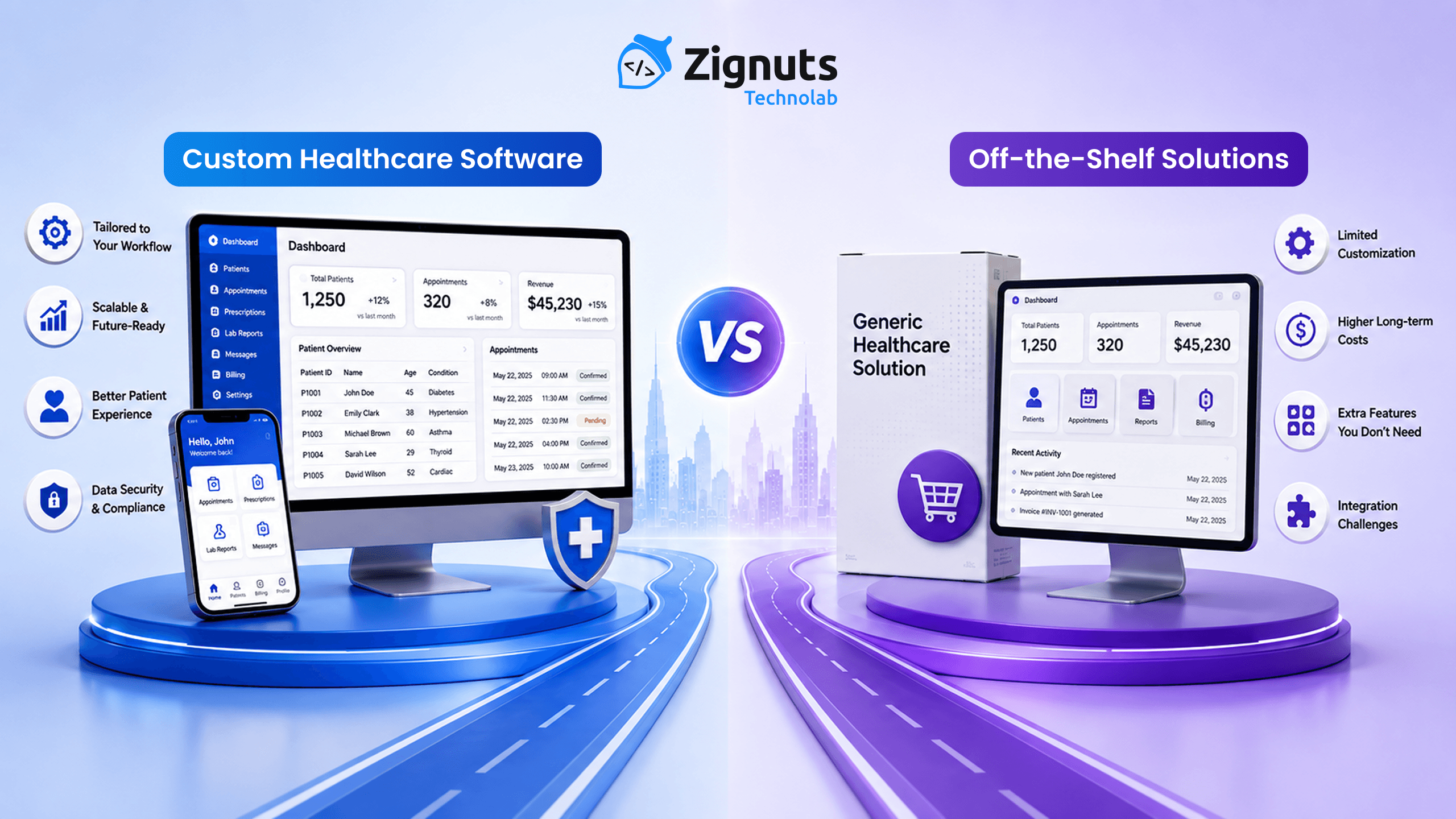
Custom Healthcare Software vs. Off-the-Shelf: Executive Summary
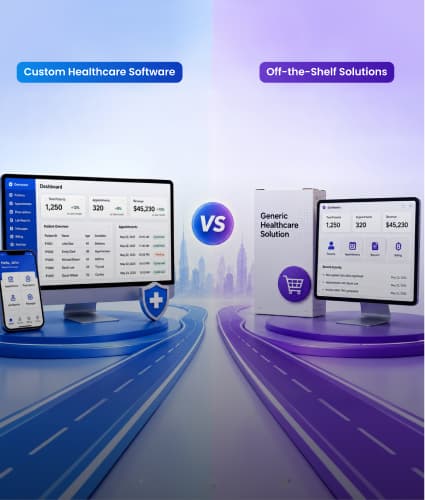
Evaluating custom healthcare software vs. off-the-shelf solutions in 2026 requires looking beyond initial licensing and considering clinical workflow, flexibility, data ownership, interoperability, and long-term scalability.
While commercial off-the-shelf healthcare platforms can provide faster deployment for standard workflows, their rigid structures may limit customization for organizations with specialized clinical requirements.
In contrast, custom healthcare software development enables tailored clinical workflows, greater control over intellectual property and data, and direct integration with healthcare standards such as FHIR R4.
For specialty clinics, digital health companies, and healthcare organizations with unique care delivery models, a custom approach can provide greater flexibility and control as their technology needs evolve
Custom Healthcare Software vs. Off-the-Shelf: The Healthcare Software Paradox
Healthcare delivery is becoming increasingly specialized. Digital therapeutics, decentralized clinical trials, AI-assisted oncology, and pediatric behavioral health all require technology that can support different care models and clinical workflows. As these needs evolve, health systems, specialty provider groups, and digital health companies face an important decision: should they buy off-the-shelf software or invest in custom healthcare software development?
Off-the-shelf platforms can provide faster deployment and established features, but they are generally built for broad use cases. In specialized healthcare environments, this can create a one-size-fits-all challenge where teams have to adapt their workflows to the software rather than the software adapting to their workflows.
Common challenges include:
Limited workflow flexibility: Standardized templates may not support specialized clinical processes.
Unused features: Organizations may pay for functionality that does not match their actual requirements.
Customization limitations: Important clinical fields, automations, or workflow changes may depend on vendor updates.
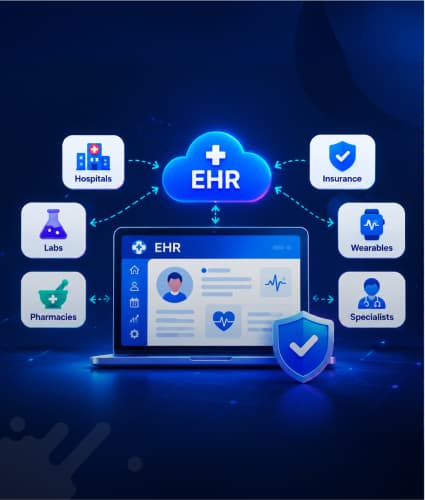
Interoperability challenges: Integrating EHRs, clinical systems, and external healthcare applications can become more complex.
Data and governance concerns: Healthcare organizations need greater control over how sensitive patient and clinical data is managed.
Custom healthcare software takes a different approach by designing the technology around specific clinical workflows, user requirements, data needs, and integration goals. This can give healthcare organizations greater control over their technology environment while making it easier to evolve as care models change.
The decision between custom and off-the-shelf software therefore goes beyond deployment speed. It should consider clinical workflow alignment, customization, data governance, interoperability, scalability, and long-term technology requirements.
Off-the-Shelf Healthcare Software: Hidden Per-Provider Costs
Off-the-shelf healthcare SaaS vendors market their products with deceptively low entry pricing.
However, once an organization scales, recurring fees escalate aggressively:
base provider subscriptions ($500 to $900/mo)
e-prescribing surcharges
patient portal licensing
SMS notification fees
metered FHIR API call charges
A growing 50-provider clinical network paying $1,060 per provider per month across all bundled add-ons spends over $3,180,000 across five years on software they will never own. A custom composable build breaks even in Month 18 and costs $1,150,000 over the same 5-year window, saving over $2,000,000.
Ready to Build the Right Healthcare Software Solution?

Custom Healthcare Software vs. Off-the-Shelf: 5-Year TCO and Break-Even Analysis
When modeling technology investments, executive leadership must compare initial software development capital expenditures (CapEx) against compounding recurring SaaS operational expenses (OpEx):
Cost Component | Off-the-Shelf EHR SaaS (50 Providers) | Custom Healthcare Platform (Zignuts Build) | Financial & Operational Impact |
|---|---|---|---|
Initial Setup & Development CapEx | $75,000 - $150,000 (Setup, onboarding, data conversion) | $180,000 - $350,000 (Complete bespoke build & FHIR sync) | Custom requires higher Year 1 CapEx but creates a balance-sheet software asset. |
Annual Base Licensing Fees | $300,000 - $540,000 / year ($500-$900/provider/mo) | $0 / year (Zero per-seat software licensing taxes) | Custom eliminates recurring per-seat penalties when hiring new clinicians. |
Add-On Modules (e-Rx, Telehealth, Portals) | $90,000 - $150,000 / year ($150-$250/provider/mo) | $0 / year (Included in core custom application architecture) | Off-the-shelf software monetizes every additional clinical workflow feature. |
Annual Cloud Hosting & Maintenance | $0 (Bundled into vendor SaaS subscription) | $42,000 - $78,000 / year (HIPAA-compliant AWS/GCP VPC) | Custom cloud infrastructure scales efficiently with active database throughput. |
5-Year Cumulative TCO Total | $3,180,000 - $4,200,000+ | $1,150,000 - $1,450,000 | Custom saves $2,030,000+ (64% savings) with financial break-even by Month 18. |
Enterprise IP & Valuation Multiple | 0% IP Ownership (Pure software rental expense) | 100% IP Ownership (Proprietary tech asset boosts M&A valuation) | Custom software adds millions in enterprise equity value for healthcare groups. |
Custom Healthcare Software vs. Off-the-Shelf: Composable Healthcare Architecture
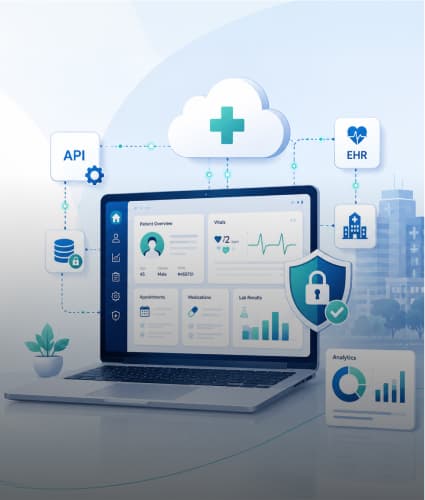
Modern digital health organizations do not have to choose between building an entire EHR from scratch and relying entirely on a rigid monolithic platform. A composable healthcare architecture provides another approach: keep established EHRs such as Epic, Oracle Cerner, or Athenahealth as the core system of record, while building specialized digital experiences and workflows around them.
This architecture separates the patient and provider experience from the underlying EHR, allowing organizations to build:
Patient mobile applications and clinical care portals
AI-powered triage and medical scribing
Custom clinical workflows and care pathways
Automated scheduling and provider engagement
FHIR R4-based integrations and data exchange
Private cloud infrastructure with healthcare security controls
The result is a more flexible architecture where existing EHR investments remain in place while custom applications, interoperability, and AI capabilities can evolve independently.
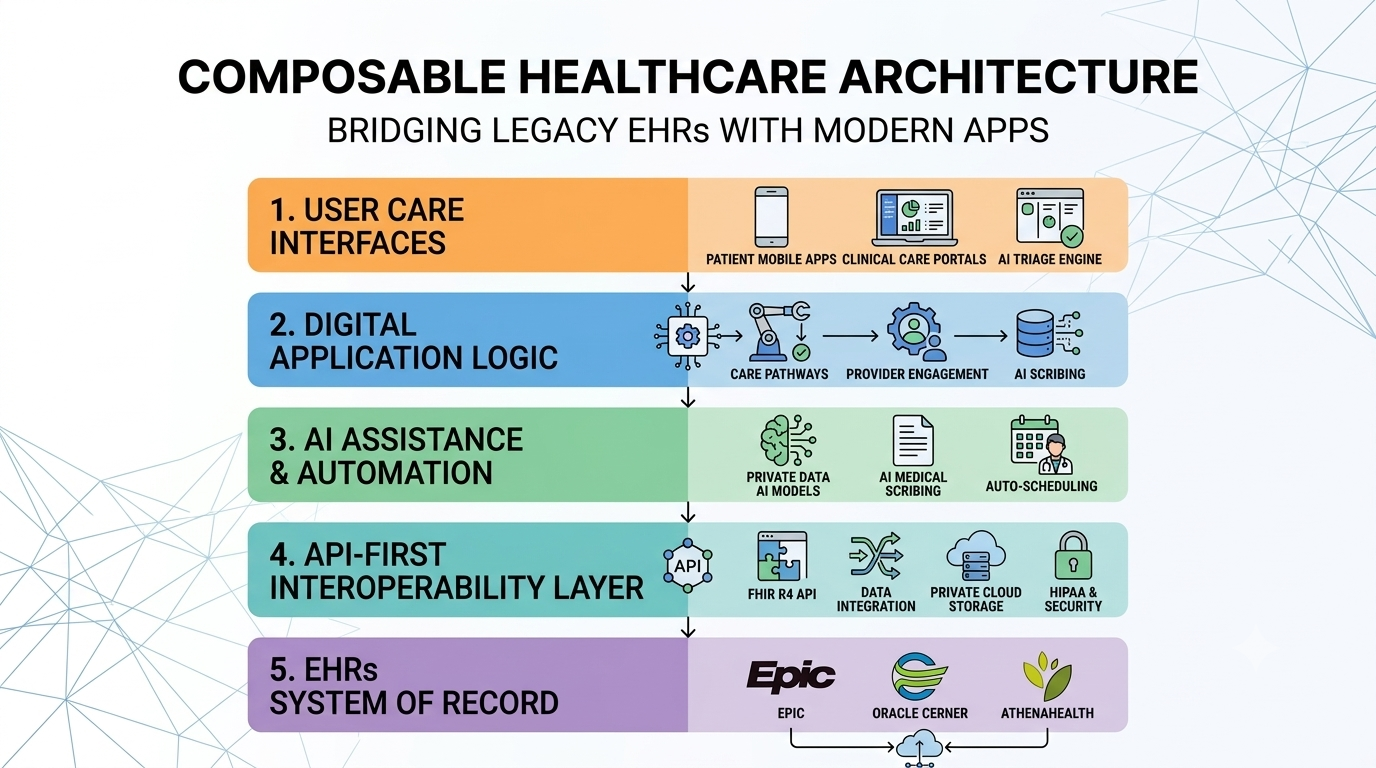
Composable Healthcare Architecture Blueprint - A layered architecture connecting legacy EHR systems with custom patient and clinical applications, AI-assisted workflows, FHIR R4 interoperability, and secure cloud infrastructure.
The Unused Feature Paradox in Off-the-Shelf Healthcare Software
Healthcare informatics benchmarks show that clinical staff utilize only 10% to 15% of the features available in standard commercial EHR software packages. However, healthcare organizations pay licensing, support, and maintenance fees on 100% of the bloated codebase. In addition, navigating through unused menus and complex billing validation trees increases clinician cognitive fatigue, driving an estimated $4.6 billion in annual physician turnover costs across the United States alone.
Ready to Build the Right Healthcare Software Solution?
Custom Healthcare Software vs. Off-the-Shelf: 7-Pillar Decision Matrix
To objectively determine whether custom software or an off-the-shelf platform fits your organization's clinical and strategic goals, evaluate your project across these seven foundational pillars:
Pillar Domain | Off-the-Shelf Healthcare Software (COTS) | Custom Healthcare Software Development | Optimal Strategic Decision Recommendation |
|---|---|---|---|
1. Clinical Workflow Fit | Rigid, pre-built templates designed for general medicine; clinical staff must adapt workflows to the software. | 100% tailored to specialized care pathways, custom SOAP notes, specialty diagnostics, and unique triage logic. | Choose Custom if your care pathway is a proprietary differentiator; choose COTS for generic primary care. |
2. Interoperability & FHIR | Vendor-controlled APIs with rate limits, complex approval processes, and high per-transaction data export fees. | Native bi-directional FHIR R4 and HL7 v2 integration; full control over real-time EHR, lab, and device sync. | Choose Custom for complex multi-EHR ecosystems, remote patient monitoring (RPM), and wearable telemetry. |
3. User Experience (UX) | Clunky, desktop-centric 1990s legacy interfaces that require extensive staff training and slow down consultations. | Modern, consumer-grade web and mobile interfaces (React Native, Flutter) designed for 1-click clinical charting. | Choose Custom if clinician retention, charting speed, or direct patient engagement is a core operational priority. |
4. Regulatory Compliance | Standard HIPAA compliance out of the box, but shared multi-tenant cloud models limit custom audit controls. | Full architectural control over zero-trust encryption, row-level RBAC, automated PHI de-identification, and BAA terms. | Choose Custom for regulated clinical AI, decentralized clinical trials, and proprietary telehealth models. |
5. AI & Ambient Scribing | Generic, vendor-gated AI add-ons charging $100-$300/provider/mo with zero customization to medical guidelines. | Deep integration with domain-specific LLMs, LangGraph agent workflows, and private RAG knowledge meshes. | Choose Custom to embed proprietary clinical guidelines, automated triage, and custom AI medical copilots. |
6. Scaling Economics | Linear cost increase: every new doctor, nurse, or clinic added triggers immediate software subscription increases. | Flat infrastructure cost: scaling from 50 to 500 providers incurs minimal additional AWS/GCP compute expenses. | Choose Custom for high-growth healthcare provider networks, M&A rollups, and digital health startups. |
7. Equity & Valuation | Zero equity value created; operational software spend is treated as pure operational overhead. | Creates a proprietary, defensible software asset that substantially increases enterprise valuation in M&A. | Choose Custom if building a scalable digital health brand or preparing for institutional growth capital. |
Custom Healthcare Software vs. Off-the-Shelf: 100-Point Build vs. Buy Scorecard
Apply this structured 100-point decision scorecard during internal architectural and procurement reviews to establish an objective decision baseline:
Evaluation Category | Weight | Score High for Custom Software If... | Score High for Off-the-Shelf If... |
|---|---|---|---|
1. Workflow Specialization | 25 Pts | Workflows require non-standard clinical fields, specialized therapy pathways, or custom triage algorithms. | Practice follows standard primary care workflows with standard ICD-10/CPT coding. |
2. Provider Scale & Growth | 20 Pts | Provider count exceeds 25 clinicians or is growing rapidly through clinic expansion and M&A. | Solo practitioner or small 1-5 provider clinic with limited upfront capital. |
3. Integration Complexity | 20 Pts | Requires real-time sync with custom medical devices, IoT telemetry, labs, and multiple hospital EHRs. | Only requires basic billing submission to a single clearinghouse with no custom hardware. |
4. Patient Engagement UX | 15 Pts | Branded patient mobile app, custom remote monitoring, and direct telehealth are core brand differentiators. | Standard web-based patient portal for basic PDF lab result downloads is sufficient. |
5. AI & Workflow Automation | 10 Pts | Planning to deploy proprietary clinical AI copilots, ambient scribing, or automated prior authorization. | No requirement for advanced AI automation or custom medical guideline retrieval. |
6. Data Sovereignty & IP | 10 Pts | Organization requires 100% ownership of clinical algorithms, source code, and dedicated VPC databases. | Happy to rent generic vendor software with zero proprietary software valuation. |
Custom Healthcare Software vs. Off-the-Shelf: 6 Red Flags to Watch For
Whether vetting commercial SaaS vendors or custom software development partners, watch out for these six critical red flags:
Healthcare Software Red Flag | What the Vendor Claims | The Clinical & Financial Risk |
|---|---|---|
1. Hidden API & Data Export Fees | 'We offer open API integration with any external system.' | Vendor charges $10,000+ setup fees per EHR endpoint and meters daily FHIR query volumes. |
2. Restrictive BAA Terms | 'Our cloud is secure, so a standard terms-of-service agreement is fine.' | Refusing to execute a comprehensive HIPAA Business Associate Agreement (BAA) exposes you to federal fines. |
3. The 'Big Bang' EHR Migration | 'We will replace all your clinical and billing systems in a single weekend cutover.' | Extremely high probability of lost patient records, billing interruptions, and clinical chaos. |
4. Brittle Third-Party Plug-In Sprawl | 'Just install 10 different marketplace plug-ins to get the features you need.' | Fragmented patient experiences, frequent software breaks during updates, and escalating add-on costs. |
5. Lack of Certified FHIR R4 Depth | 'We handle healthcare data via custom webhooks and REST endpoints.' | Fails 21st Century Cures Act interoperability mandates, preventing seamless hospital data exchange. |
6. Zero Source Code Ownership | 'You do not need code ownership; our hosted cloud will support you forever.' | Permanent vendor lock-in, unconstrained price increases, and zero balance-sheet software asset creation. |
Ready to Build the Right Healthcare Software Solution?
Custom Healthcare Software: Real-World Case Studies
Our healthcare software development experience spans digital health applications, clinical workflow automation, wellness platforms, and healthcare compliance solutions. These projects demonstrate how we apply secure architecture, healthcare interoperability, AI, and workflow automation to solve practical business and operational challenges.
Custom Healthcare Software Case Study: AI Health App Development
A digital health provider needed an intelligent clinical triage assistant capable of securely querying patient records while meeting HIPAA, GDPR, and clinical data governance requirements.
Our Approach: We developed end-to-end encrypted data exchange pipelines, real-time PII de-identification filters, FHIR and HL7 interoperability interfaces, role-based access controls, and immutable audit logging.
Business Impact: The solution established regulatory and security controls from the outset, helping reduce the risk of costly post-deployment security and compliance changes.
Custom Healthcare Software Case Study: Personal Trainer Application
A health and wellness business needed a custom platform for remote lifestyle and biometric tracking, with real-time wearable data synchronization and without the recurring costs associated with per-user SaaS platforms.
Our Approach: We developed an intuitive mobile application with real-time biometric telemetry ingestion, personalized routine management, and secure cloud synchronization.
Business Impact: The platform achieved a 94% patient engagement retention rate while giving clinicians and trainers unified, real-time visibility into user progress.
Custom Healthcare Software Case Study: AI Workflow Automation Platform
A multi-clinic specialty group was dealing with fragmented scheduling tools, repetitive patient data entry, and appointment cancellations that created additional administrative workload.
Our Approach: We designed an intelligent workflow automation platform combining NLP-based intent routing, automated appointment reminders, EHR webhook integrations, and resilient state management.
Business Impact: The solution reduced administrative scheduling workload by 60% and automated clinical reminder workflows across thousands of monthly patient visits.
Custom Healthcare Software Case Study: AI Contract Review Platform
A healthcare compliance department was managing hundreds of vendor agreements and Business Associate Agreements (BAAs), making manual contract review time-consuming and difficult to scale.
Our Approach: We built a domain-specific legal intelligence solution using compliance-focused embeddings, contextual citation graphs, and hallucination-verification guardrails.
Business Impact: The solution reduced agreement audit turnaround time by 75% while helping identify potential compliance risks across vendor contracts.
Custom Healthcare Software vs. Off-the-Shelf: 5 Steps to Choose
Conduct a Clinical Workflow Audit: Map out your core patient and clinical pathways. Determine what percentage of your daily charting is standard versus proprietary care delivery.
Calculate Your 5-Year Per-Provider TCO: Total all base subscriptions, add-on module fees, e-prescribing costs, and data export fees for off-the-shelf software, and compare it against custom build CapEx.
Adopt a Composable Architecture: Keep your core regulated EHR for backend legal and billing compliance, while building custom frontend mobile portals and clinician charting apps via FHIR R4.
Mandate a Paid 3-Week Discovery & Architecture Sprint: Partner with an experienced healthcare software engineering firm to deliver a Technical Architecture Document (TAD), FHIR schema map, and working proof-of-concept.
Secure 100% Code and Data Sovereignty: Ensure all custom software repositories, cloud infrastructure scripts, and encrypted databases reside within your organization's private HIPAA-compliant VPC.
Conclusion
Choosing between custom healthcare software and off-the-shelf solutions depends on how well the technology aligns with your clinical workflows, integration needs, patient experience, and long-term goals. Off-the-shelf platforms can support standardized operations, while custom software provides greater flexibility for specialized workflows, interoperability, AI capabilities, and data ownership.
A composable healthcare architecture can keep existing EHRs as the system of record while extending them with custom applications, FHIR-based integrations, AI-powered workflows, and secure cloud infrastructure. Looking to build or modernize your healthcare software? Contact us today to discuss your requirements and explore the right approach for your organization.

Mukund Patil
Business Enthusiast | Exploring ideas, trends, and opportunities, turning curiosity into meaningful insights and discovering smarter ways to make an impact.