


What Are Custom AI Development Services?
Custom AI development involves designing, developing, integrating, and maintaining AI-powered software around an organization’s specific business needs. Unlike generic AI applications with limited customization, Custom AI development services can be tailored to existing business processes, proprietary data, domain-specific terminology, software systems, APIs, security requirements, and user experiences. Depending on the business goal, these solutions may combine machine learning, generative AI, natural language processing, computer vision, predictive analytics, recommendation systems, or AI agents. Importantly, custom AI does not always mean building a model from scratch. In many enterprise projects, the most practical approach is to combine existing foundation models with proprietary data, retrieval systems, business logic, integrations, evaluation frameworks, and security controls.
Ready to Build a Custom AI Solution?

Why Enterprises Choose Custom AI Development Services Over Generic Tools
The decision usually comes down to control, integration, differentiation, and business fit.
An off-the-shelf AI application can be effective when the problem is common, and the required workflow is straightforward. Custom development becomes more attractive when AI needs to operate within an organization’s existing technology ecosystem.
For example, a generic document assistant may summarize contracts. A custom enterprise system could retrieve contracts from multiple repositories, identify relevant clauses, compare them against company policies, flag exceptions, route high-risk cases to legal teams, and record the outcome in a contract management platform.
That difference is where much of the enterprise value comes from.
Ready to Build a Custom AI Solution?
Where Custom AI Development Services Create Enterprise Value
Custom AI can create measurable value across automation, prediction, knowledge management, and workflow orchestration. The right approach depends on the business problem, data, and level of automation required.
AI application | Typical enterprise value | Example use cases |
|---|---|---|
Intelligent automation | Reduce manual effort and processing time | Invoice processing, claims review, support triage |
Predictive AI | Improve forecasting and decision quality | Fraud detection, churn prediction, demand forecasting |
Generative AI | Improve access to enterprise knowledge | Knowledge assistants, research, document analysis |
AI agents | Automate multi-step workflows | Case handling, API-based actions, exception routing |
Custom AI should not be introduced simply because a process can be automated. The strongest business cases connect AI capabilities to measurable operational or financial outcomes.
1. Intelligent Process Automation with Custom AI Development
AI can automate processes that previously required employees to review, classify, summarize, route, or interpret information. Examples include invoice processing, claims review, document classification, customer support triage, compliance reviews, and internal knowledge management.
The objective is not always to remove human involvement. In many enterprise environments, the better model is human-in-the-loop automation, where AI handles routine work and employees focus on exceptions.
2. Predictive Decision-Making in Custom AI Development
Machine learning can identify patterns in historical data and help organizations anticipate future outcomes. Potential applications include demand forecasting, fraud detection, customer churn prediction, predictive maintenance, credit risk assessment, inventory optimization, and sales forecasting.
The value comes from improving the timing and quality of decisions, not simply producing a prediction.
3. Generative AI and Enterprise Knowledge
Generative AI can provide natural-language interfaces to internal knowledge, documents, policies, and operational information.
A Retrieval-Augmented Generation architecture can connect a language model to approved enterprise information so that responses are grounded in relevant business content rather than relying solely on the model's pretrained knowledge. This can support internal assistants, research tools, customer service systems, technical support, knowledge management, and employee productivity.
4. AI Agents and Workflow Orchestration
More advanced implementations allow AI systems to perform multi-step tasks.
An enterprise AI agent might receive a request, retrieve relevant information, determine which systems need to be accessed, execute approved actions through APIs, validate the result, escalate exceptions to a human, and record the completed workflow.
Agentic systems require stronger controls than simple chatbots because they can potentially take actions rather than only generate information.
Ready to Build a Custom AI Solution?
Custom AI Development Architecture: Key Layers & Components
A custom AI architecture connects enterprise data, AI models, business rules, integrations, and monitoring into a controlled system. Each layer has a specific role in making the solution scalable, secure, and aligned with business workflows.
Layer | Primary responsibility |
|---|---|
Business applications | User-facing workflows and enterprise applications |
Identity and access | Authentication, authorization, and permissions |
Data layer | Structured and unstructured enterprise information |
Retrieval/feature layer | Relevant context, search, vectors, and features |
Model layer | Foundation, ML, vision, speech, or specialized models |
Orchestration | Prompts, routing, tools, context, and workflows |
Business rules | Deterministic controls and policy enforcement |
Integrations | ERP, CRM, HRMS, APIs, data platforms, and other systems |
Monitoring | Quality, cost, latency, security, and human review |
A production-grade enterprise AI system usually contains more than an AI model.
Ready to Build a Custom AI Solution?
A typical architecture can include:
1. Business Layer |
Each layer solves a different problem. The model provides intelligence, but the surrounding architecture determines whether that intelligence can be used safely and reliably in a business environment.
Key Components of Custom AI Development Architecture
A custom AI system depends on several interconnected architecture components. Each layer supports a specific function, from managing enterprise data and AI models to enforcing business rules, integrations, and governance.
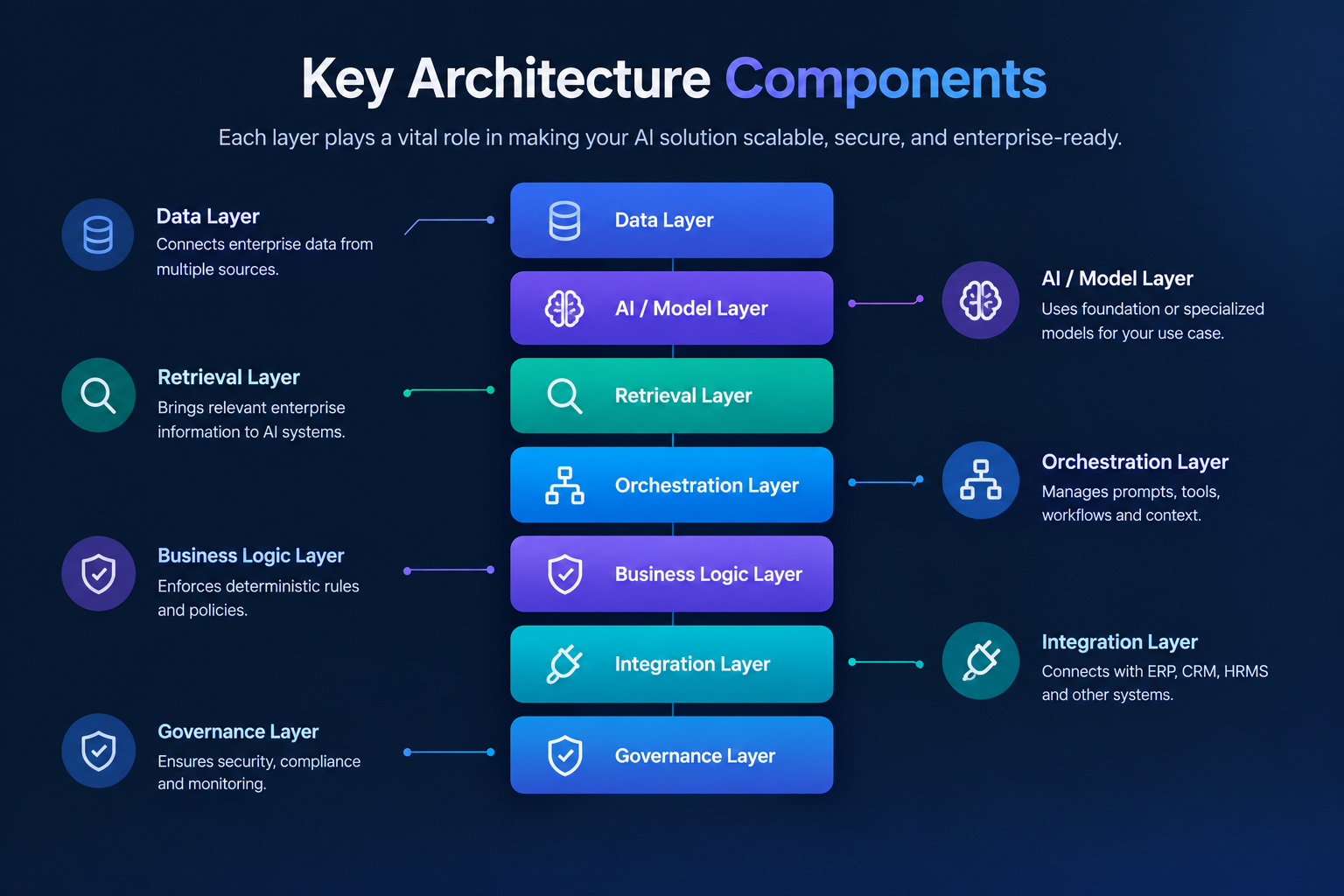
Data Layer
Connects structured and unstructured information from databases, documents, SaaS applications, data warehouses, and event streams.
AI or Model Layer
Uses foundation models, machine learning models, computer vision models, speech models, or specialized models based on the use case.
Retrieval Layer
Makes relevant enterprise information available to AI systems through search, vector databases, knowledge graphs, or hybrid retrieval.
Orchestration Layer
Controls prompts, model routing, tool usage, workflows, context, and multi-step reasoning.
Business Logic Layer
Applies deterministic rules and policies that should not be delegated entirely to probabilistic AI.
Integration Layer
Connects the AI solution with ERP, CRM, HRMS, payment platforms, ticketing systems, data platforms, and internal APIs.
Governance Layer
Handles access control, auditability, data protection, model evaluation, monitoring, and policy enforcement.
Ready to Build a Custom AI Solution?
How Custom AI Development Services Work
A successful enterprise implementation usually follows a phased approach rather than moving directly from idea to production.
1. Identify the Business Case for Custom AI Development
Start with the workflow, not the model.
Define the problem, current process, users, data sources, operational cost, decision points, and measurable outcome.
Useful metrics may include processing time, error rate, cost per transaction, conversion rate, customer retention, revenue per employee, or time-to-resolution.
2. Assess Data Readiness for Custom AI Development
AI performance depends heavily on data quality and availability.
An assessment should examine data sources and ownership, data quality, data volume, data labeling requirements, access permissions, sensitive information, data lineage, historical coverage, and real-time versus batch requirements.
Poor data quality cannot be solved simply by selecting a more powerful model.
3. Select the Right AI Approach for Custom AI Development
Approach | Best suited for | Key consideration |
Foundation model | General language and reasoning | Fastest starting point when general capability is sufficient |
RAG | Proprietary or frequently changing knowledge | Requires strong retrieval and data access controls |
Fine-tuning | Specialized behavior or domain patterns | Needs suitable training data and evaluation |
Traditional ML | Structured prediction problems | Often preferable for well-defined predictive tasks |
AI + deterministic rules | High-control business decisions | Keeps critical policies predictable and auditable |
Use an existing foundation model when general language or reasoning capabilities are sufficient.
Use RAG when the AI needs access to frequently changing or proprietary enterprise knowledge.
Fine-tune a model when specialized behavior or domain patterns justify additional training.
Use traditional machine learning when structured prediction problems are more appropriate than generative AI.
Combine deterministic rules with AI when business decisions require predictable controls.
Model selection should follow the business requirements rather than the other way around.
Ready to Build a Custom AI Solution?
4. Build and Integrate the Custom AI Solution
The development phase connects the AI capabilities to real enterprise workflows.
This can include API development, data pipelines, prompt and model orchestration, frontend applications, authentication, monitoring, databases, vector search, enterprise integrations, and human review workflows.
Legacy environments deserve particular attention. Large enterprises may need to integrate AI with older ERP systems, mainframes, data warehouses, or proprietary applications that were never designed for AI workloads.
5. Evaluate the Custom AI Solution Before Production
A demo that produces impressive responses is not enough for enterprise deployment.
Evaluation should test accuracy, relevance, hallucination rate, latency, cost per interaction, security, bias and harmful outputs, failure scenarios, permission boundaries, and model consistency.
Evaluation datasets should reflect real business scenarios, including difficult and exceptional cases.
6. Deploy, Monitor, and Improve the Custom AI Solution
AI systems require continuous monitoring because data, models, user behavior, and business requirements change over time.
Production monitoring can track model quality, response latency, token consumption, failures, user feedback, security events, and business outcomes.
Custom AI Development Services Cost: Key Factors
The cost of a custom AI solution depends on its scope, technical complexity, data requirements, integrations, security needs, and ongoing operational demands.
Cost driver | What increases complexity |
|---|---|
Integrations | More enterprise systems, APIs, and legacy platforms |
Data engineering | More sources, cleaning, labeling, and transformation |
Model usage | Higher traffic, larger models, or real-time inference |
Security | Sensitive data, strict access control, auditing, and governance |
Application scope | More workflows, users, interfaces, and business functions |
Operations | Monitoring, evaluation, maintenance, and continuous optimization |
There is no single price for custom AI development because project complexity varies significantly.
A simple AI assistant connected to a limited knowledge base may require considerably less investment than an enterprise AI platform integrating multiple systems, models, data pipelines, and governance controls.
Major cost drivers include the number and complexity of integrations, data engineering requirements, model usage and inference costs, fine-tuning or model training, application development, security requirements, infrastructure, evaluation and testing, user volume, real-time processing requirements, and ongoing monitoring and maintenance.
A practical approach is to begin with a narrowly defined use case, validate business value through a pilot, and then expand the architecture once the business case is proven.
Custom AI Development Services: Build, Buy, or Hybrid?
Choosing the right AI development approach depends on the organization’s business needs, technical complexity, existing infrastructure, and level of customization required.
Approach | Choose it when | Main advantage |
|---|---|---|
Buy | The workflow is standardized, and an existing product fits | Faster deployment with less custom development |
Build | The workflow is strategic or highly specialized | Greater control and differentiation |
Hybrid | Existing AI can provide the foundation, but workflows need customization | Balance between speed and business control |
The decision should be based on business differentiation and technical complexity.
Buy when the problem is standardized and an existing product meets security, integration, and workflow requirements.
Build when the process is strategically important, highly specialized, or dependent on proprietary data and workflows.
Choose a hybrid approach when existing AI models and infrastructure can provide the foundation while custom development supplies the enterprise-specific intelligence, integrations, controls, and user experience.
For many organizations, hybrid architecture provides the best balance between development speed and business control.
How to Choose a Custom AI Development Services Partner
Technical capability is only one part of the decision.
Business understanding: Can the partner translate operational problems into measurable AI use cases?
AI engineering: Do they understand model selection, RAG, fine-tuning, agents, evaluation, and production deployment?
Integration capability: Can they work with APIs, enterprise platforms, databases, cloud infrastructure, and legacy systems?
Security: Can they design appropriate access controls, data protection, monitoring, and governance?
Delivery approach: Do they provide a clear path from discovery and proof of concept to production?
Long-term support: Can they monitor, optimize, and evolve the AI system after launch?
A strong partner should be able to explain not only what technology they recommend, but why that architecture makes sense for the organization's business and risk profile.
Ready to Build a Custom AI Solution?
Enterprise Custom AI Development Services Checklist
Before approving an AI initiative, decision-makers should be able to answer:
What business problem are we solving?
Which metric will improve if the solution works?
What data will the AI use?
Who owns and governs that data?
Which model or AI approach is appropriate?
Which enterprise systems must be integrated?
What decisions can AI make independently?
Where is human approval required?
How will accuracy be evaluated?
How will sensitive data be protected?
What will the solution cost at production scale?
How will model and business performance be monitored?
What happens when the AI fails?
If these questions cannot be answered, the organization may not yet be ready for production deployment.
Custom AI Development Services: Key Takeaways
Custom AI development is about more than building a smarter chatbot or proprietary model. The real value comes from embedding AI into business workflows to improve decisions, automate repetitive work, and unlock valuable enterprise knowledge.
Successful implementations combine AI models with quality data, secure architecture, business rules, integrations, evaluation, and human oversight. Starting with a focused use case and expanding gradually can help reduce risk and build lasting business value.
The key question is not, “Which AI model should we use?” but “Which business process can AI make meaningfully better?” Contact us today to explore the right custom AI solution for your business.

Deep Gondaliya
Business Analyst | Turning business challenges into clear insights, practical solutions, and meaningful improvements that help teams move forward.