


How to Evaluate a Custom AI Development Company
Choosing a custom AI development company is not the same as selecting a conventional software vendor. The partner you choose can influence how your AI solution is designed, integrated, secured, evaluated, deployed, and maintained long after the first proof of concept.
A strong Custom AI Development partner should be able to connect business objectives with practical AI architecture. That means understanding the problem before recommending a model, working with your existing data and systems, planning for security and governance, and defining how success will be measured in production.
This guide provides a practical framework for comparing custom AI development companies without relying on marketing claims, impressive demos, or generic technology checklists.
Start With the Business Problem, Not the AI Technology
The first question should not be, "Which AI model will you use?" It should be, "What business outcome are we trying to improve?" A capable AI development company should help define the problem, establish measurable outcomes, and determine whether AI is actually the right solution.
Before speaking with vendors, define:
The process or business decision you want to improve.
The users who will interact with the solution.
The data required to support the workflow.
The current cost, delay, error rate, or manual effort.
The business KPI that should improve after implementation.
Ready to Build a More Scalable AI Solution?

How to Evaluate a Custom AI Development Company's AI Expertise
A custom AI partner should not force every requirement into generative AI. Depending on the problem, the right architecture may involve machine learning, predictive analytics, computer vision, NLP, RAG, AI agents, recommendation systems, or a combination of approaches.
AI Capability | What to Evaluate | Typical Business Application |
|---|---|---|
Generative AI / LLMs | Prompting, model selection, RAG, orchestration, evaluation | Knowledge assistants, content workflows, enterprise copilots |
Machine Learning | Feature engineering, training, validation, deployment | Prediction, classification, risk scoring, forecasting |
Computer Vision | Image processing, model accuracy, inference performance | Inspection, document processing, visual analysis |
NLP | Extraction, classification, entity recognition, language handling | Document intelligence, search, text analytics |
AI Agents | Tool use, workflow control, guardrails, human review | Multi-step automation and operational workflows |
Custom AI Development Company: What to Check in the Technical Architecture
A polished AI demo proves that something can work. It does not prove that it can operate reliably inside an enterprise. Ask the vendor to explain the architecture behind the proposed solution and how each component will behave in production.
Key areas to review include:
Data ingestion, processing, storage, and retrieval.
Model selection and model-routing strategy.
RAG and vector-search architecture where relevant.
API and enterprise application integration.
Cloud infrastructure across AWS, Azure, or GCP.
Scalability, latency, observability, and failure handling.
Human-in-the-loop controls for high-impact decisions.
Custom AI Development Company: Security and AI Governance
AI systems can process sensitive business information, customer data, documents, and operational records. Security therefore needs to be part of vendor selection from the beginning rather than added after development.
Area | Questions for the AI Development Company |
|---|---|
Data protection | How is data encrypted, stored, accessed, and retained? |
Privacy | How are PII and other sensitive data identified and handled? |
Model security | How are prompts, model inputs, outputs, and third-party model providers controlled? |
Governance | What logging, auditability, evaluation, and approval mechanisms are provided? |
Compliance | Which relevant requirements can the architecture support, such as GDPR, CCPA/CPRA, SOC 2, or ISO 27001 controls? |
Data residency | Where will data and model workloads be processed and stored? |
Ready to Build a More Scalable AI Solution?
Custom AI Development Company: Enterprise Integration Capabilities
Custom AI rarely operates as a standalone application. It usually needs to work with existing CRMs, ERPs, databases, document repositories, identity systems, APIs, and business applications. A vendor that can build an AI model but cannot integrate it into your workflow may create another isolated tool.
Ask for a clear integration architecture showing data flows, authentication, APIs, event handling, error management, and ownership boundaries.
Custom AI Development Company: MLOps and AI Operations
Production AI requires continuous evaluation. Model quality can change as data, user behavior, prompts, business rules, or third-party model versions change.
Production Capability | Why It Matters |
|---|---|
Model and prompt versioning | Allows controlled releases and rollback. |
Evaluation framework | Measures response quality and task-specific performance. |
Monitoring | Identifies latency, errors, drift, and reliability issues. |
Cost monitoring | Controls inference and infrastructure spending. |
Retraining/optimization | Supports improvement as new data becomes available. |
Incident management | Provides a structured response when AI behavior fails. |
How a Custom AI Development Company Measures AI Performance and Business Value
Avoid accepting broad claims such as "high accuracy" or "major efficiency gains." The evaluation criteria should be tied to your specific workflow.
Business Goal | Possible KPI |
|---|---|
Reduce manual work | Automation rate or human intervention rate |
Improve speed | Processing time or response time |
Improve decision quality | Task-specific accuracy, precision, recall, or review outcomes |
Control operating cost | Cost per transaction or workflow |
Improve customer experience | Resolution time, conversion, retention, or satisfaction |
Accelerate delivery | Time-to-market for targeted workflows |
The important point is not to use every metric. Select the smallest set of KPIs that clearly connect AI performance to business value.
Ready to Build a More Scalable AI Solution?
Custom AI Development Company: POC, MVP, and Production Approach
A proof of concept should answer a business or technical uncertainty. It should not become an open-ended experiment with no production path.
Stage | What the Vendor Should Prove |
|---|---|
Discovery | Business problem, users, data, constraints, KPIs, and feasibility |
POC | Critical technical assumptions and measurable feasibility |
MVP | Usable workflow, core integrations, evaluation, and security foundations |
Production | Scalability, monitoring, governance, support, and operational readiness |
Optimization | Continuous improvement based on production evidence |
How to Evaluate the Team Behind a Custom AI Development Company
The company logo on a proposal tells you little about the people who will actually build and operate the solution. Ask who will be assigned to the project and how the team will collaborate with your product, engineering, security, and business stakeholders.
Depending on the scope, the team may need:
AI/ML engineers
Data engineers
Software engineers
Cloud architects
Business analysts or product specialists
QA and AI evaluation specialists
DevOps/MLOps specialists
Custom AI Development Company Evaluation Scorecard
A weighted scorecard reduces the risk of choosing a provider because of presentation quality or the lowest initial quote.
Evaluation Area | Suggested Focus |
|---|---|
Business understanding | Ability to translate the problem into measurable outcomes |
AI expertise | Relevant models, frameworks, and use cases |
Architecture | Scalability, maintainability, and integration design |
Security & governance | Privacy, access control, auditability, and compliance readiness |
Integration | APIs, enterprise platforms, data sources, and identity |
MLOps | Deployment, monitoring, evaluation, and optimization |
Team | Relevant technical and product expertise |
Commercial model | Transparent scope, assumptions, pricing, and ownership |
Post-launch support | Maintenance, monitoring, improvements, and incident response |
IP & data ownership | Clear contractual ownership of code, data, models, and deliverables |
Ready to Build a More Scalable AI Solution?
Red Flags When Choosing a Custom AI Development Company
Guaranteed AI accuracy, ROI, or business outcomes without understanding your data and workflow.
A model-first proposal that does not clearly define the business problem.
No production architecture beyond the demo or POC.
Unclear answers about data security, privacy, or third-party model providers.
No evaluation or monitoring strategy.
Portfolio examples focused mainly on prototypes with little evidence of production thinking.
Very low estimates that exclude integration, testing, governance, or post-launch support.
Unclear ownership of source code, data, prompts, models, or other project assets.
Questions to Ask a Custom AI Development Company Before Hiring
How would you approach our use case, and why?
Which parts of the workflow should use AI and which should not?
What data would you need before development begins?
Which model or architecture would you recommend, and what alternatives did you consider?
How will you evaluate the AI system before and after launch?
How will our data be protected?
How will the solution integrate with our existing systems?
What happens when the AI produces an incorrect or uncertain result?
Who owns the source code, data, prompts, models, and other deliverables?
What support and optimization are included after production deployment?
How to Choose the Right Custom AI Development Company
The strongest partner is not necessarily the company with the largest AI portfolio or the lowest proposal. The better choice is the company that can connect your business objectives to a secure, maintainable, measurable production system.
Decision Criterion | Weighting Guidance |
|---|---|
Business and domain understanding | High |
Technical architecture | High |
AI expertise | High |
Security and governance | High |
Integration capability | High |
Delivery methodology | Medium-High |
Team quality | Medium-High |
Commercial value | Medium |
Long-term support | Medium |
Ready to Build a More Scalable AI Solution?
Choosing a Custom AI Development Company for Production AI
Choosing a custom AI development company is ultimately a risk and capability decision. The right partner should understand your business problem, select technology based on the use case, design for enterprise integration, protect your data, measure AI performance, and provide a credible path from experimentation to production.
Instead of asking which company can build an impressive AI demo, ask which company can help your organization build an AI capability that remains useful, measurable, secure, and maintainable as the business evolves.
Conclusion
Choosing a custom AI development company requires more than comparing AI capabilities, technology stacks, or impressive proof-of-concept demos. The right partner should understand your business problem, recommend the right AI approach, design for secure enterprise integration, and establish clear processes for evaluation, governance, deployment, and ongoing operations.
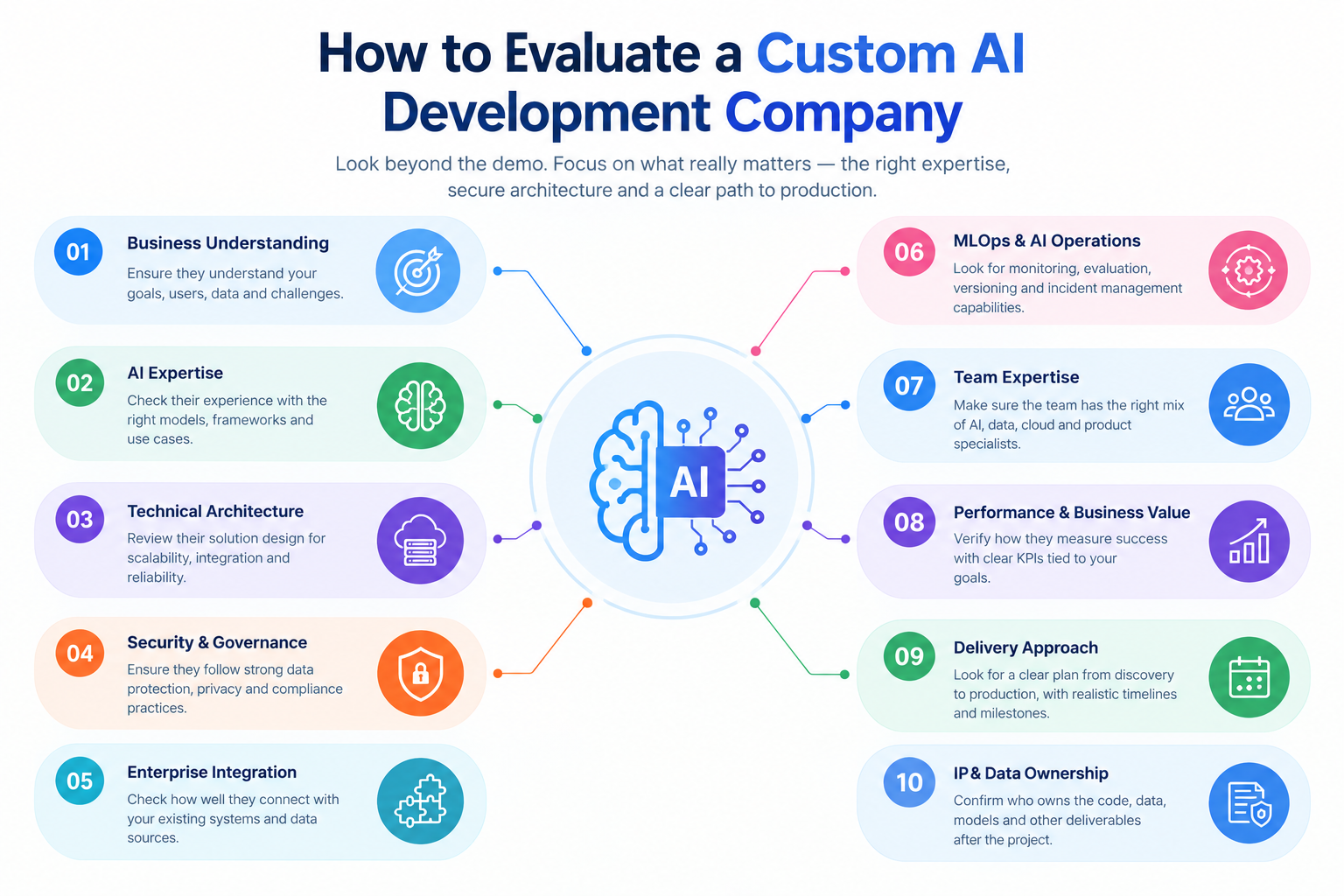
Before making a decision, evaluate the company's technical architecture, AI expertise, security practices, MLOps capabilities, team experience, delivery approach, ownership terms, and post-launch support. A structured evaluation can help reduce implementation risks and ensure your AI solution is built to remain secure, measurable, scalable, and maintainable as your business evolves.
If you are evaluating a custom AI development partner or planning an AI solution for your business, contact us today to discuss your requirements and explore a practical approach to building and deploying production-ready AI.

Deep Gondaliya
Business Analyst | Turning business challenges into clear insights, practical solutions, and meaningful improvements that help teams move forward.