

Custom AI Copilot Development Cost: What to Expect
"Just add a chatbot" is the most common way an AI copilot project gets under-scoped at the budgeting stage, and it is also one of the fastest ways for a project to exceed its original estimate once real engineering work begins. A chatbot answering questions from a knowledge base and a copilot embedded inside a CRM, drafting outreach based on the specific account a rep is viewing, may share the same underlying language model, but they require very different levels of engineering. AI Copilot Development Services can help address the additional integration, context, action, and product requirements involved in building a custom copilot.
The price difference between the two is not the model. It is everything wrapped around the model: the work required to make the system aware of exactly what the user is doing right now, the work required to let it take a bounded action safely, and the work required to place it inside an existing product without breaking the user's workflow or the organization's access controls.
These are the cost centers that a generic "AI development cost" estimate consistently misses, because they are specific to copilots and do not show up in a standalone chatbot or RAG-only cost model.
This guide breaks down what actually drives the cost of building a custom enterprise AI copilot in 2026, why that cost structure differs meaningfully from a general LLM or chatbot project, and how to build a realistic budget before committing to a scope, a vendor, or an internal build plan.
Where this guide gives cost figures or bands, they reflect general market patterns observed across the industry, not a claimed cost history from a specific delivered project.
Custom AI Copilot Development Cost: Key Cost Components
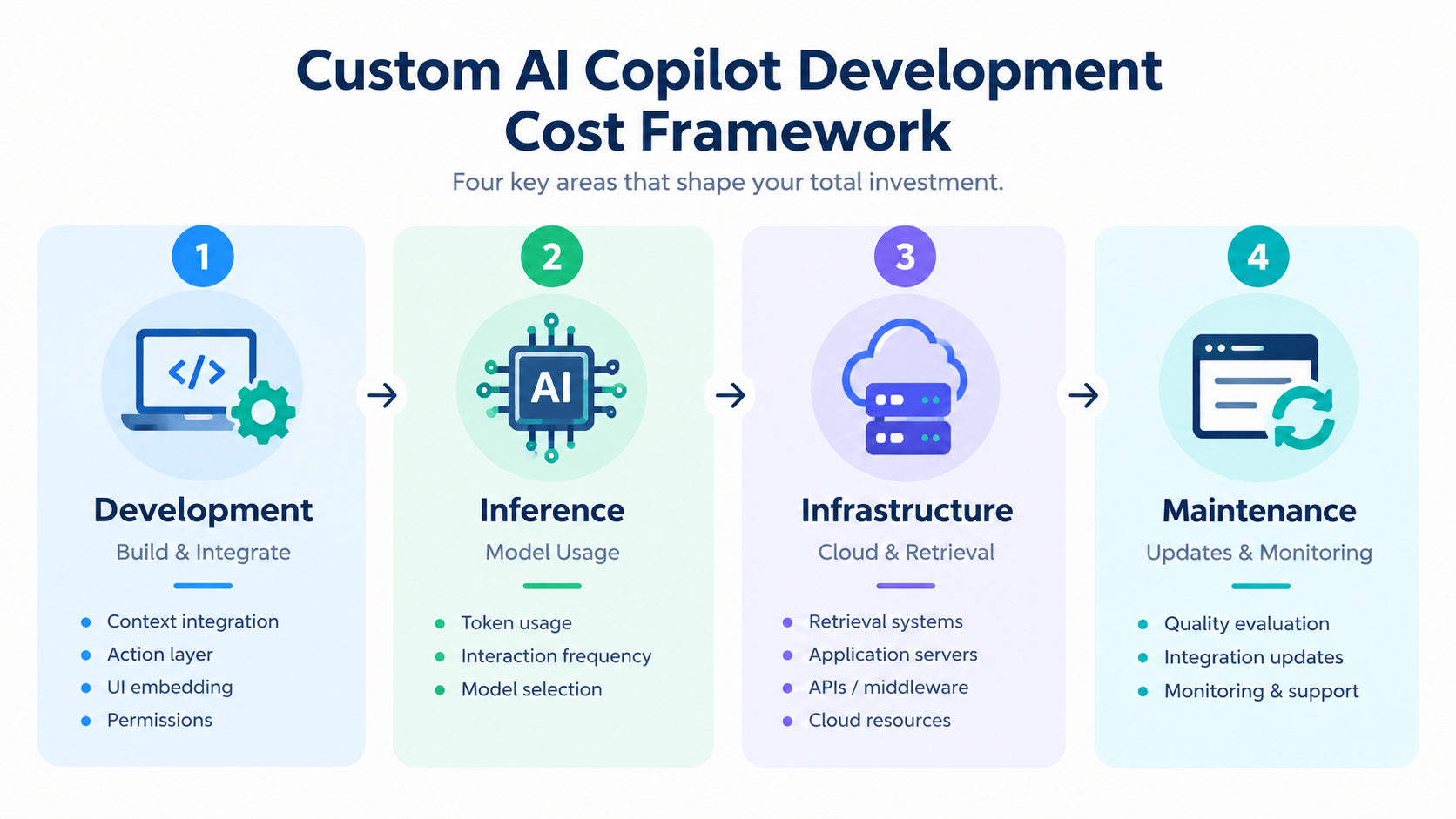
Custom AI copilot development involves more than the initial cost of building the AI functionality. Like broader enterprise LLM projects, the overall cost can be divided into four ongoing categories, with each category carrying a different level of importance depending on the copilot's scope, integrations, and usage.
Development Cost: This is the one-time engineering investment required to design, build, and integrate the copilot. It includes context integration, action layer development, UI embedding, and permission enforcement. For a copilot, development typically carries more relative weight than it does for a standalone RAG chatbot because much of the complexity comes from integrating the copilot into the product and its workflows.
Inference Cost: This is the ongoing, usage-based cost of running the underlying AI model. Copilots tend to generate more frequent, shorter interactions than standalone chat tools because they can be used continuously throughout a user's working session rather than only for occasional, longer conversations. As a result, inference costs should be estimated based on realistic usage patterns, even when overall token consumption is comparable.
Infrastructure Cost: This covers the retrieval pipeline, application servers, middleware required to receive real-time context from the host product, and other cloud resources that support the copilot. Because copilots often need low-latency access to live application state, infrastructure decisions can be more sensitive to response-time requirements than those for a typical RAG system handling asynchronous queries.
Maintenance Cost: This includes evaluating whether the copilot's suggestions and actions remain accurate and useful, updating context integrations as the host product's data model or UI changes, and monitoring adoption and correction rates over time. Maintenance is easy to underestimate during initial planning, but it becomes increasingly important as the copilot remains connected to a continuously evolving product.
This structure makes Custom AI Copilot Development different from simply estimating the cost of an AI model or chatbot. The final budget needs to account for the engineering, infrastructure, usage, and ongoing maintenance required to keep the copilot reliable within its real operating environment.
Ready to Build a Custom AI Copilot?

Why Custom AI Copilot Development Costs More Than a Chatbot
Cost Driver | Chatbot | Enterprise Copilot |
|---|---|---|
Context | Mostly static knowledge retrieval | Real-time awareness of records, pages, projects, or documents |
Permissions | Often shared knowledge access | User-, role-, and tenant-aware retrieval and actions |
UX | Standalone chat interface | Embedded sidebar, inline suggestions, or command experience |
Actions | Usually answers questions | Drafts, data entry, workflow triggers, and multi-step assistance |
A chatbot and a copilot can use the same underlying model at a similar price point per token, so when a copilot project costs meaningfully more to build, the difference is almost always concentrated in three areas that a chatbot does not need to solve.
Context integration is the largest of these. A chatbot typically retrieves from a static or periodically updated knowledge base. A copilot needs to know, in real time, what record, page, project, or document the user currently has open, without the user needing to state it.
Permission-aware responses add cost that a general-purpose chatbot answering from a shared knowledge base does not carry. A copilot embedded in a multi-user, often multi-tenant product needs its retrieval and its available actions to respect exactly what the specific logged-in user is authorized to see and do.
UX embedding work is the third driver, and it is frequently underestimated because it looks like ordinary frontend work rather than AI engineering. Deciding whether the copilot appears as a persistent sidebar, an inline suggestion, or a command-triggered panel is real, non-trivial engineering effort.
Action Layer: A Major Custom AI Copilot Development Cost Driver
Drafting-only actions, where the copilot generates a suggested reply, summary, or document section that the user reviews and decides whether to use, are generally the least expensive action type to build.
Data Entry & Form Filling: These actions cost more because they require confirmation steps, field-level validation, and handling for incorrect or ambiguous inferred values.
Workflow-Triggering Actions: Actions such as initiating an approval, sending a notification, or creating a linked record in another system add integration costs and require careful confirmation logic and error handling.
Multi-Step Task Actions: These are the most complex to build well because they require state management, recovery paths, and deliberate decisions about how much of the process can proceed without additional human confirmation.
This progression shows why the action layer should be clearly defined when estimating Custom AI Copilot Development costs. As a copilot moves from generating content to performing data updates and multi-step tasks, the engineering, integration, validation, and governance requirements increase accordingly.
UX and Integration Costs in Custom AI Copilot Development
UX Pattern | Relative Effort | Key Consideration |
|---|---|---|
Command-based | Lower | Simple invocation with less persistent context |
Sidebar | Medium to High | Maintains session context and synchronizes with navigation |
Inline | High | Requires careful placement and workflow-aware frontend behavior |
Sidebar copilots generally cost more to build well than command-based copilots because they maintain context across a session and synchronize as the user navigates.
Inline copilots often require the most careful frontend engineering because suggestions appearing in the wrong place or at the wrong moment can disrupt the user's workflow.
Command-based copilots are generally the least expensive UX pattern to build and integrate, though they trade off some of the invisible assistance quality of sidebar and inline experiences.
Latency engineering deserves its own line in a copilot cost estimate. Interactive workflows may require additional investment in caching, streaming responses, and retrieval optimization.
Ready to Build a Custom AI Copilot?
Security and Permission Costs in Custom AI Copilot Development
Engineering Area | Why It Adds Cost | Core Requirement |
|---|---|---|
Permission enforcement | Identity and role must flow through retrieval and actions | Check authorization at every relevant call |
Tenant isolation | Cross-tenant leakage must be prevented and tested | Explicit isolation testing |
Audit logging | Retrievals, suggestions, and actions need traceability | Logging designed into architecture |
Compliance | Regulated use cases may require additional controls | Data handling, encryption, access control, documentation |
Security and permission work for a copilot is core engineering effort that should be priced into the build from the start.
Permission enforcement at the copilot's retrieval and action layer requires explicit work to pass and check user identity and role at every retrieval and action call.
Tenant isolation requires deliberate testing to verify that one tenant's data cannot surface in another tenant's copilot session.
Audit logging of what the copilot retrieved, suggested, and acted on should be designed into the architecture from the beginning.
Compliance-specific requirements can add cost for regulated industries because they may require additional data handling, encryption, access control, and documentation.
Inference and Infrastructure Costs in Custom AI Copilot Development
Cost Component | Copilot-Specific Impact |
|---|---|
Inference | Higher interaction frequency across a working session |
Retrieval | Low-latency queries required for interactive use |
Context middleware | Additional APIs/services for live application state |
Self-hosting | Economics depend on sustained usage and infrastructure needs |
A copilot invoked continuously throughout a working session generates a higher frequency of shorter interactions than a standalone chat tool. Costs should therefore be modeled against realistic per-user and per-session usage patterns.
Retrieval infrastructure must support low-latency queries at the frequency the copilot is invoked. Real-time context middleware or APIs are an additional infrastructure category specific to copilots.
Self-hosting follows the same cost-crossover logic as other enterprise LLM systems and should be modeled explicitly against sustained usage volume.
Ongoing Maintenance Costs for Custom AI Copilots
Maintenance Area | Typical Trigger |
|---|---|
Quality evaluation | Suggestions or actions drift in usefulness or accuracy |
Feedback loops | Users accept, ignore, or correct outputs |
Integration updates | Host product data model, UI, or workflow changes |
Monitoring | Usage, latency, errors, and action outcomes need review |
Maintenance is shaped by the fact that copilots are embedded into products that continue to change.
Organizations need a defined process for evaluating suggestion and action quality over time, often using representative test sets and periodic scoring.
Feedback loop tooling should capture where users accepted, ignored, or corrected suggestions.
When the host application's data model, UI, or workflow changes, the copilot's context integration and action layer may need corresponding updates.
Ready to Build a Custom AI Copilot?
Custom AI Copilot Development Cost by Project Scope
Copilot Scope | Context & Actions | Relative Complexity |
|---|---|---|
Internal knowledge copilot | Internal documentation; limited real-time state; minimal actions | Lower |
CRM sales copilot | Current account/opportunity; drafting, summaries, data entry | Medium |
Multi-action product copilot | Deep product embedding; real-time state; permission-aware actions and workflows | High |
A simple internal knowledge copilot, grounded in internal documentation with limited real-time application state and no meaningful action layer, sits near the lower end of the complexity spectrum.
A CRM-embedded sales copilot, aware of the current account or opportunity and capable of drafting outreach, summarizing history, and performing data-entry actions, sits in the middle of the range.
A multi-action product copilot, deeply embedded into a proprietary or customer-facing product with real-time state, permission-aware retrieval, and workflow-triggering actions, represents the highest complexity.
Custom AI Copilot Development Cost: Build vs. Buy vs. Partner
Approach | Cost Profile | Best Fit |
|---|---|---|
Buy | Lowest initial implementation cost | Built-in copilot already covers the use case |
Build in-house | Higher internal engineering investment | Proprietary integration is essential, and expertise exists |
Partner | External delivery cost with lower rework risk | Deep integration is needed, but specialized experience is limited |
Buying an existing vendor's built-in copilot is typically the lowest-cost path when it adequately covers the use case, but customization is limited.
Building in-house makes sense when proprietary integration is essential, and the organization already has engineering capability in context integration, action-layer design, and permission-aware architecture.
Partnering can reduce the risk of costly rework when an organization needs deep integration but lacks prior experience with copilot-specific engineering challenges.
How to Budget for Custom AI Copilot Development
Budget Area | Planning Question |
|---|---|
Action scope | What is the target level: drafting, data entry, workflow triggering, or multi-step? |
Context integration | How complex is the host product architecture and live state? |
Security | What permission, tenant, audit, and compliance controls are required? |
Usage | What does realistic continuous session usage look like? |
Maintenance | How quickly will the host product evolve after launch? |
Start by scoping the action layer honestly. Drafting-only, data entry, workflow-triggering, and multi-step actions represent distinct levels of effort.
Price context integration against the actual host product architecture rather than a generic assumption of simply connecting to data.
Include security and permission engineering as a first-class line item.
Model inference and infrastructure against realistic, continuous usage patterns.
Budget maintenance against the pace of change in the host product.
Ready to Build a Custom AI Copilot?
Custom AI Copilot Development Cost Framework
The cost of Custom AI Copilot Development can be understood across four core categories. Each category contributes differently to the overall investment and should be considered when planning the project budget.
1. Development Cost
Development covers the engineering required to connect the copilot with the host product and make it useful within real workflows. This includes context integration, action-layer development, UI embedding, permission enforcement, and the application logic required to support the copilot's intended functionality.
2. Inference Cost
Inference costs come from model usage during copilot interactions. Because copilots can be used repeatedly throughout a working session, budgeting should account for realistic interaction frequency, session length, model selection, and usage patterns rather than estimating usage from occasional chatbot queries.
3. Infrastructure Cost
Infrastructure covers the technical components required to operate the copilot reliably. This can include retrieval systems, context middleware, APIs, application services, real-time application state, and cloud resources. Infrastructure requirements will vary depending on the copilot's integration depth and expected usage.
4. Maintenance Cost
Maintenance covers the ongoing work required to keep the copilot reliable as the surrounding product changes. This includes quality evaluation, feedback loops, integration updates, monitoring, troubleshooting, and ongoing support. The maintenance budget should reflect how frequently the host product, workflows, data models, and integrations are expected to evolve.
Action Layer Scope and Custom AI Copilot Development Cost
The action layer is a key factor in Custom AI Copilot Development Cost because the level of autonomy and control required increases the engineering effort, validation needs, and potential operational risk.
Action Tier | Relative Complexity |
|---|---|
Drafting & summarization | Lower - human review naturally limits downstream risk. |
Data entry & form filling | Medium - requires confirmation, validation, and ambiguity handling. |
Workflow triggering | Higher - requires integrations, error handling, and stronger controls. |
Multi-step actions | Highest - requires state management, recovery paths, and deliberate approval design. |
Ready to Build a Custom AI Copilot?
Custom AI Copilot Development Cost: Key Takeaways
Custom AI Copilot Development Cost Goes Beyond the AI Model: The overall cost is influenced by context integration, permission-aware architecture, UX embedding, and action-layer engineering.
The Action Layer Is a Major Cost Driver: Drafting, data entry, workflow triggering, and multi-step actions require different levels of engineering, validation, and control.
Security and Permissions Are Core Engineering Requirements: Identity, authorization, tenant isolation, audit logging, and compliance should be included in the initial project scope.
Usage Patterns Affect Inference and Infrastructure Costs: Budgeting should account for continuous, session-based usage, retrieval requirements, model interactions, and supporting infrastructure.
Maintenance Depends on Product Evolution: Ongoing costs are influenced by changes to the host product, integrations, workflows, data models, monitoring requirements, and release cadence.
Conclusion
Custom AI copilot development cost in 2026 depends on far more than the underlying AI model. Context integration, action-layer complexity, UX design, security and permissions, infrastructure, usage patterns, and ongoing maintenance all contribute to the overall investment. Defining these requirements early helps organizations create a more realistic budget and avoid underestimating the engineering work required for a production-ready copilot.
A well-planned copilot should align its capabilities with specific business workflows while maintaining appropriate security, reliability, and user control. Whether you are evaluating an existing copilot, planning a custom implementation, or determining the right development approach, contact us today to discuss your requirements and explore a practical path for your AI copilot project.

Virang Kori
Business Analyst | Analyzing business needs, processes, and data to uncover insights, improve efficiency, and support smarter business decisions.