

AI business process automation is no longer limited to chatbots or isolated productivity tools. For enterprises, SaaS companies, and scaling startups, the real value comes from AI Workflow Automation that redesigns repetitive, decision-heavy processes so teams can move faster, reduce operational risk, and focus on higher-value work. The best candidates are processes with clear inputs, measurable outcomes, high volume, and costly delays.
Leaders should approach automation as an engineering and operating model decision, not a software shortcut. AI performs best when connected to clean data, governed workflows, secure integrations, and human review points. The following 15 processes are practical starting points for organizations that want measurable efficiency gains without compromising control.
How to Prioritize AI Automation Opportunities
Before automating, evaluate each workflow against business impact, data readiness, integration complexity, and risk. A process may look simple on paper but become fragile if it depends on inconsistent documents, undocumented approvals, or disconnected legacy systems.
Volume: High-frequency tasks deliver faster return on investment.
Decision logic: Rules, patterns, and historical outcomes make AI recommendations more reliable.
Data quality: Structured, accessible data improves accuracy and reduces manual correction.
Compliance exposure: Regulated workflows need audit trails, permissions, and human oversight.
Integration needs: Automation should fit into CRM, ERP, HRIS, finance, support, cloud, and data platforms.
15 Business Processes You Should Automate with AI Today
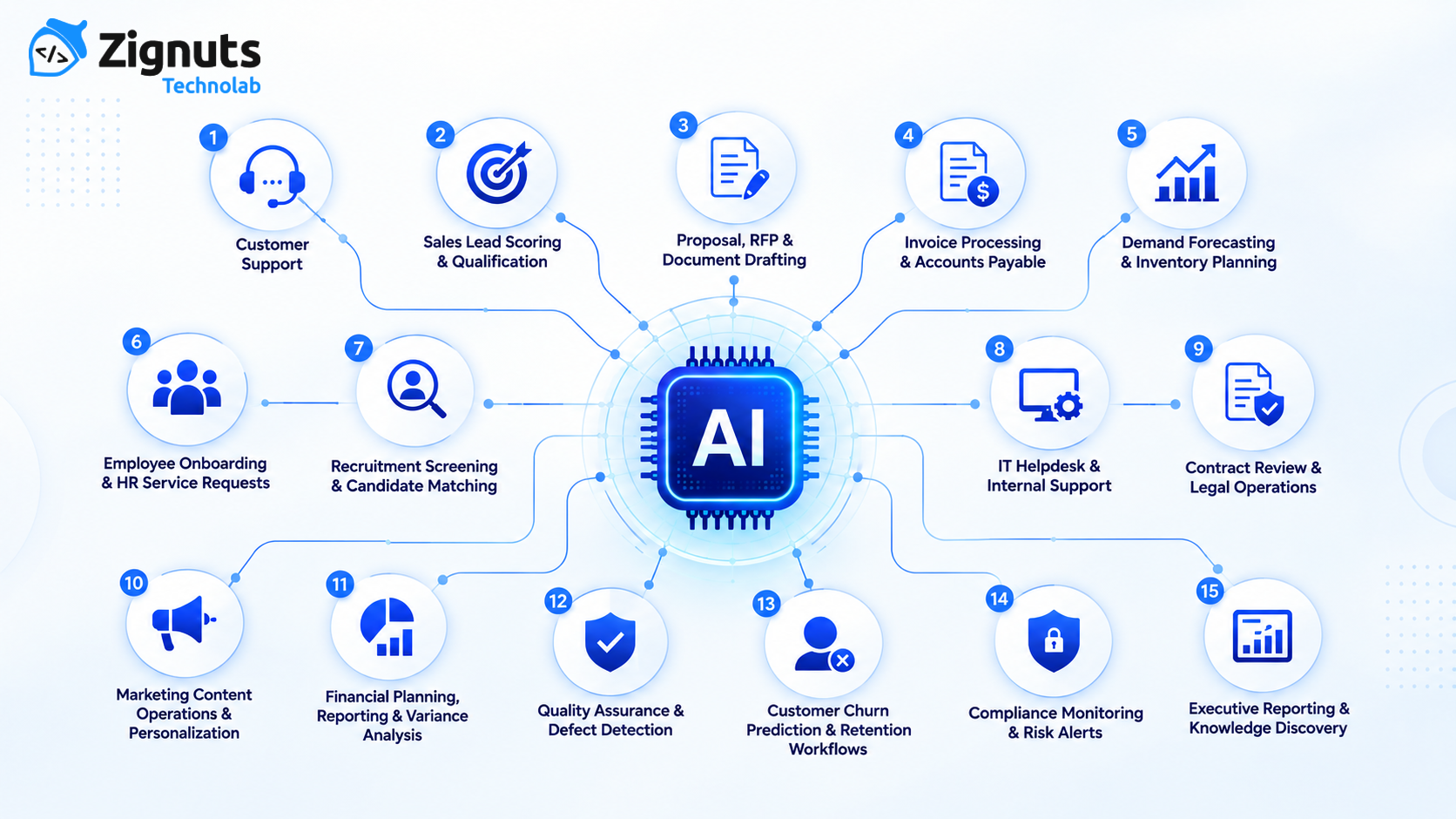
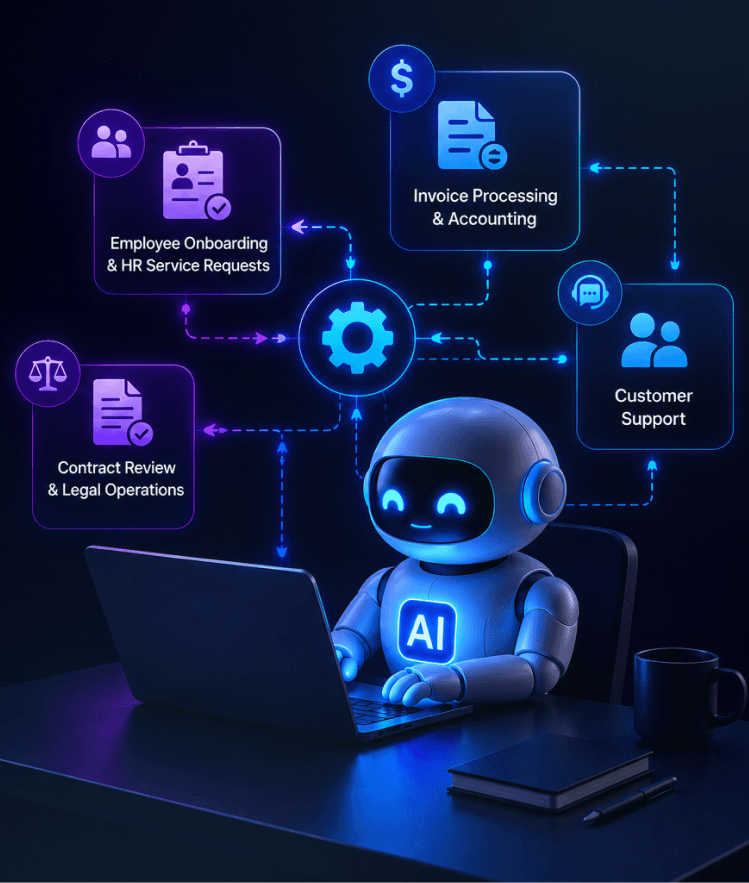
1. Customer Support Triage and Resolution
AI can classify tickets, identify intent, suggest responses, route issues, summarize conversations, and escalate complex cases. For enterprise support teams, this reduces first response time while preserving human ownership for sensitive accounts, SLA breaches, and technical defects.
2. Sales Lead Scoring and Qualification
AI models can evaluate firmographic data, website behavior, product usage, CRM history, and engagement signals to prioritize leads. This helps sales teams focus on accounts with stronger buying intent and gives leadership better visibility into pipeline quality.
3. Proposal, RFP, and Document Drafting
Enterprise buyers often require detailed proposals, security responses, implementation plans, and compliance documentation. AI can generate first drafts from approved knowledge bases, past proposals, case studies, pricing logic, and technical capability libraries, reducing turnaround time while keeping final review with subject matter experts.
Ready to Automate Your Business Processes with AI?

4. Invoice Processing and Accounts Payable
Finance teams can automate invoice extraction, purchase order matching, duplicate detection, approval routing, and exception handling. When integrated with ERP and accounting systems, AI reduces manual entry, improves payment accuracy, and supports stronger financial controls.
5. Demand Forecasting and Inventory Planning
AI can analyze sales history, seasonality, supplier performance, market signals, and external events to improve forecasting accuracy. For manufacturing, retail, logistics, and distribution businesses, this helps reduce stockouts, overstocking, and reactive procurement decisions.
6. Employee Onboarding and HR Service Requests
HR teams can automate document collection, policy guidance, access requests, onboarding checklists, training recommendations, and common employee queries. The business impact is stronger when AI connects with HRIS, identity management, payroll, learning systems, and internal knowledge bases.
7. Recruitment Screening and Candidate Matching
AI can assist with job description refinement, resume parsing, skills matching, interview scheduling, and candidate communication. To avoid bias and compliance issues, enterprises should use transparent criteria, human review, and continuous monitoring rather than fully autonomous hiring decisions.
8. IT Helpdesk and Internal Support
AI-powered IT automation can resolve password resets, software access requests, device troubleshooting, knowledge search, incident classification, and ticket routing. When linked with service management tools, identity providers, and endpoint systems, it lowers operational load and improves employee productivity.
9. Contract Review and Legal Operations
AI can identify risky clauses, compare contracts against standard terms, summarize obligations, flag renewal dates, and support compliance review. Legal teams benefit most when automation is configured around approved playbooks, escalation rules, confidentiality controls, and document management integrations.
10. Marketing Content Operations and Personalization
AI can accelerate campaign research, audience segmentation, content briefs, email variations, landing page optimization, and performance analysis. The strongest use cases combine automation with brand governance, analytics, CRM data, and clear approval workflows.
Ready to Automate Your Business Processes with AI?
11. Financial Planning, Reporting, and Variance Analysis
AI can detect anomalies, explain budget variances, generate management summaries, and support scenario planning. Finance leaders gain faster insight when models are connected to trusted data warehouses, ERP systems, and business intelligence platforms.
12. Quality Assurance and Defect Detection
In software, manufacturing, and operations, AI can detect patterns in defects, logs, test results, images, and process data. For product engineering teams, AI-assisted QA can improve test coverage, accelerate regression analysis, and identify failure patterns before they affect customers.
13. Customer Churn Prediction and Retention Workflows
AI can analyze product usage, support history, payment behavior, account health, sentiment, and engagement trends to predict churn risk. Automated retention workflows can alert customer success teams, recommend next-best actions, and personalize outreach for key accounts.
14. Compliance Monitoring and Risk Alerts
AI can continuously monitor transactions, access activity, policy exceptions, documentation gaps, and operational anomalies. This is especially valuable in fintech, healthcare, insurance, logistics, and enterprise SaaS, where auditability, governance, and security controls are essential.
15. Executive Reporting and Knowledge Discovery
Leadership teams spend significant time waiting for reports or searching across systems. AI can summarize performance metrics, answer operational questions, retrieve relevant documents, and create executive-ready insights from approved data sources. The goal is not replacing analysts but giving decision-makers faster access to reliable context.
Ready to Automate Your Business Processes with AI?
Architecture Considerations for Enterprise AI Automation
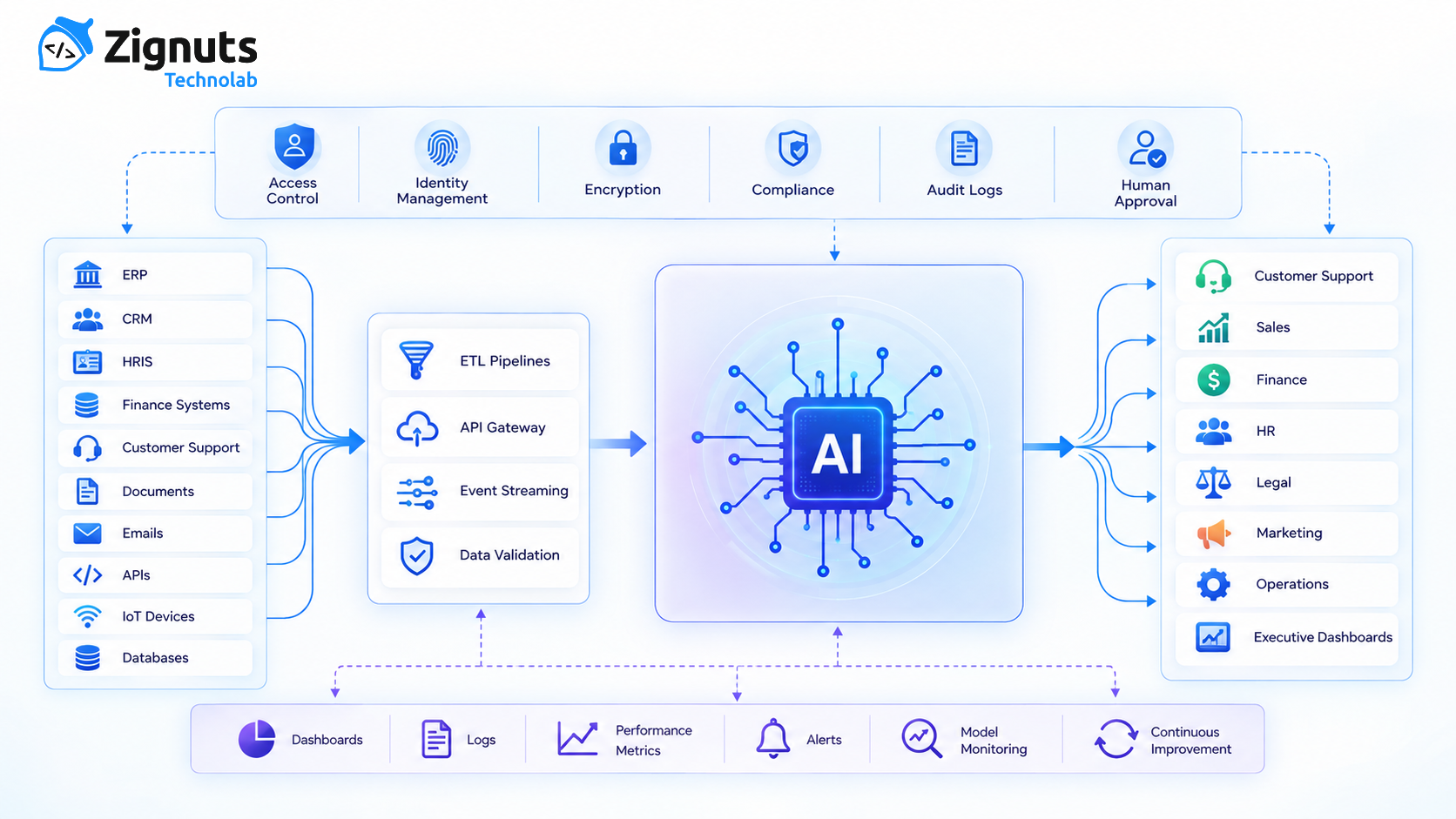
Effective automation requires more than choosing an AI tool. Enterprises need a secure architecture that connects applications, data, workflows, and monitoring. Common building blocks include API integrations, workflow orchestration, vector search, role-based access control, observability, analytics, human approval queues, and cloud-native deployment.
Many organizations begin with a focused proof of concept, then expand into a governed platform. For example, a company may start by automating support triage, then reuse the same knowledge retrieval, user permissions, and audit logging patterns for sales enablement, HR service delivery, and IT operations.
Build, Buy, or Customize?
Off-the-shelf AI tools are useful for standardized tasks, but enterprise workflows often require custom software development when data is sensitive, processes are unique, systems are fragmented, or compliance requirements are strict. A custom AI automation solution can align with existing business logic, integrate with legacy platforms, and scale across departments without creating tool sprawl.
Buy when the process is common, low-risk, and well supported by mature platforms.
Customize when workflows require proprietary rules, integrations, or security models.
Build when automation becomes a strategic capability or product differentiator.
Implementation Roadmap
A practical roadmap starts with discovery and process mapping. Identify bottlenecks, manual handoffs, decision points, and measurable outcomes such as cycle time, cost per transaction, error rate, SLA performance, or revenue conversion. Next, assess data sources, integration requirements, privacy obligations, and user roles.
Then pilot one high-value workflow with limited scope. Measure before-and-after performance, collect user feedback, tune the model or workflow rules, and define governance. Once the solution proves value, scale through reusable components, shared APIs, monitoring dashboards, and standardized security patterns.
Common Mistakes to Avoid
Automating a broken process without simplifying it first.
Using AI without reliable data ownership and access controls.
Removing human review from high-risk decisions too early.
Ignoring change management, training, and adoption metrics.
Creating disconnected automations that increase maintenance complexity.
Ready to Automate Your Business Processes with AI?
When to Involve an Engineering Partner
AI automation becomes a strategic engineering initiative when it touches core systems, customer data, regulated workflows, or revenue operations. An experienced software engineering partner can help design the architecture, select the right AI models and cloud services, integrate with enterprise systems, implement security controls, and create maintainable workflows that evolve with the business.
For enterprises and product companies, the opportunity is not simply to automate tasks. It is to build intelligent operations that improve speed, accuracy, customer experience, and decision quality across the organization.

Deep Mistry
Digital Marketing Enthusiast | Diving into the world of trends, tools, and strategies, sharing discoveries that help create impactful online experiences.