

Evaluating an AI Workflow Automation Company for Enterprise Use
Selecting an enterprise AI workflow automation partner in 2026 is no longer a standard vendor procurement exercise. In earlier phases of enterprise technology adoption, technology leaders evaluated software engineering partners based on basic staff augmentation capacity, hourly rate structures, or standard robotic process automation (RPA) portfolios. However, integrating non-deterministic artificial intelligence models into mission-critical, end-to-end business workflows and systems of record introduces fundamentally different operational risks.
A typical procurement failure occurs when enterprise leadership selects a firm that excels at surface-level API wrapping or rapid proof-of-concept (PoC) scripts, but lacks deep workflow orchestration and platform engineering capability. These surface-level implementations fail when exposed to real-world production demands: multi-step agentic workflows trigger unbounded latency spikes, unsecured prompts expose sensitive corporate data to public model endpoints, and brittle context retrieval pipelines generate high hallucination rates across complex business schemas.
Partnering with the wrong vendor results in severe architectural debt, extended delivery delays, and exposed corporate liability. To build scalable, production-ready AI workflow automations, technology executives must evaluate potential partners through a structured, platform-first selection methodology, prioritizing decoupled gateway architectures, continuous security guardrails, advanced RAG engineering, stateful agent orchestration, and robust LLMOps discipline.
5 Key Criteria for Evaluating an AI Workflow Automation Company
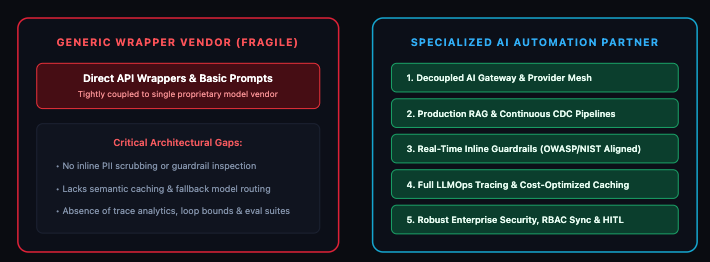
Selecting a qualified enterprise AI workflow automation partner requires looking beyond surface-level slide decks. Technology leaders should audit prospective firms across five non-negotiable technical domains:
1. AI Gateway and Architectural Decoupling Expertise
A competent automation partner constructs provider-agnostic platform foundations. If a vendor proposes hardcoding automated business logic directly into a single foundation model provider's proprietary SDK, they create severe vendor lock-in.
Evaluate whether the firm designs centralized AI Gateways that handle token rate-limiting, team-based cost allocation, dynamic fallback routing during provider outages, and semantic caching to curb unnecessary token consumption across automated workflows.
2. RAG and Context Engineering for AI Workflows
Automated enterprise workflows rely on dependable domain data. Naive RAG setups fail in complex operational environments. Qualified partners treat document and data retrieval as a rigorous data engineering discipline.
Assess the vendor's ability to build real-time Change Data Capture (CDC) pipelines, dynamic document chunking strategies, and hybrid search indexers that combine dense vector embeddings with sparse keyword search (BM25). This ensures high accuracy when automated pipelines ingest technical terminology, internal SKU numbers, and regulatory data.
3. Agentic Workflow Orchestration and Human-in-the-Loop Controls
Moving from static, linear automations to autonomous workflow agents requires robust state management. Your partner must demonstrate experience building stateful execution chains with explicit autonomy thresholds and boundary conditions.
Inquire about their usage of open standards like Model Context Protocol (MCP), structured JSON output validation, and asynchronous human-in-the-loop triggers that pause execution for human verification before high-risk system writes occur, such as executing ERP modifications or financial disbursements.
4. AI Workflow Security, Guardrails, and Governance
Security in automated workflows cannot be an afterthought or a manual checkpoint. A qualified partner implements automated inline guardrail engines that inspect both ingress prompts and egress tool calls.
The vendor must demonstrate clear frameworks for scrubbing personally identifiable information (PII), neutralizing prompt injection attacks, enforcing enterprise Role-Based Access Control (RBAC) boundaries during context retrieval, and maintaining audit trails aligned with applicable NIST AI RMF and ISO 42001 governance requirements.
5. LLMOps, Observability, and AI Workflow Evaluation
Non-deterministic models powering multi-step automations require continuous, real-time monitoring. Standard application performance monitoring (APM) tools cannot evaluate output hallucinations, drift, or multi-step execution loops.
Your partner should deploy specialized LLMOps tracing infrastructure that logs input context, dynamic tool execution, intermediate execution steps, and completion tokens. Furthermore, they should establish automated CI/CD evaluation suites to stress-test workflow prompt revisions against golden datasets before any automated release enters production.
Ready to Automate Your Business Workflows?

AI Workflow Automation Company vs. Traditional IT and RPA Firms
Capability Criteria | Traditional Software / RPA Firm | Specialized AI Workflow Automation Partner |
|---|---|---|
Integration & Orchestration | Point-to-point API scripts or rigid rule-based RPA bots hardcoded in application logic. | Decoupled platform architecture utilizing an Enterprise AI Gateway, dynamic model mesh, and stateful agent frameworks. |
Data Ingestion & Context | Static document parsing, basic keyword matching, and naive vector similarity search. | Continuous CDC pipelines, hybrid vector-keyword retrieval (BM25), dynamic chunking, and contextual compression. |
Security & Compliance | Relies on manual developer discipline and static external policy documentation. | Automated inline guardrails, PII redaction, prompt injection defense, and fine-grained RBAC filtering. |
Cost Management | Unmonitored API calls leading to unbounded loops, runaway token spend, and billing spikes. | Built-in semantic caching, dynamic model routing (SLM vs. LLM based on task complexity), and department token quotas. |
LLMOps & Monitoring | Basic application logging, including HTTP response codes and simple runtime crash tracking. | Full workflow execution tracing, prompt version registries, and automated CI/CD regression evaluation suites. |
Agentic Capability | Brittle single-prompt scripts prone to recursive failures and non-deterministic deadlocks. | Stateful multi-agent orchestrations with explicit autonomy thresholds, rollback capabilities, and human-in-the-loop review. |
Technical Questions to Ask an AI Workflow Automation Company
1. AI Gateway and Infrastructure Architecture Questions
"How do you decouple automated business workflows from underlying foundation model providers to prevent vendor lock-in?"
"What mechanism does your orchestration layer use to handle model rate limits, latency spikes, or sudden third-party API outages during an active multi-step process?"
2. RAG and Context Management Questions
"How does your RAG architecture address the 'lost in the middle' phenomenon when dynamic workflows require context from extensive corporate documentation?"
"How do you enforce enterprise RBAC boundaries within retrieval pipelines so automated agents cannot access or surface restricted data to unauthorized users?"
3. AI Workflow Security and Autonomous Safety Questions
"Where does your inline guardrail engine execute, and how does it scrub sensitive customer or employee PII before requests cross the security perimeter?"
"What specific guardrails protect agentic workflows against indirect prompt injection embedded inside processed emails, tickets, or documents?"
"Where and how are human-in-the-loop checkpoints enforced for irreversible operations like database mutations or transaction approvals?"
4. AI Workflow Cost Control and LLMOps Questions
"What caching strategies do you deploy at the gateway level to minimize redundant token spend across recurring scheduled automations?"
"How do you trace non-deterministic multi-step agent executions when debugging workflow bottlenecks or evaluating reasoning drift?"

Ready to Automate Your Business Workflows?
Why AI Workflow Automation POCs Fail in Production
Many software vendors build working AI automation demos in days using simple API wrappers and basic chaining frameworks. However, these prototypes rarely survive real-world operational loads.
In production, fixed system prompts fail with edge-case user inputs, hardcoded API connections crash under heavy concurrent loads, and basic vector setups retrieve noisy context that derails automated decision chains. Engineering leaders must evaluate potential partners based on their platform engineering and stateful orchestration expertise, not how fast they assemble a lightweight sandbox demonstration.
Enterprise AI Workflow Automation Engineering Services
Transitioning artificial intelligence automations from experimental pilots into high-availability enterprise production systems requires an engineering partner experienced in enterprise architecture, compliance, and platform reliability.
Zignuts engineers resilient, secure, and cost-effective AI workflow automation platforms across four core capabilities:
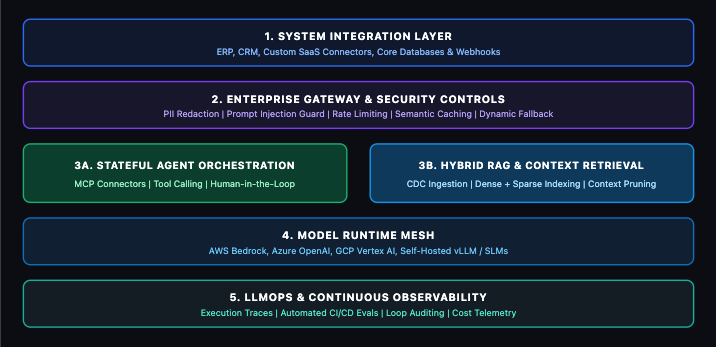
Enterprise AI Gateway & Orchestration Mesh: Resilient ingress control planes with provider-agnostic abstraction layers, dynamic rate-limiting, automated multi-provider fallback chains, semantic caching, and precise cost tracking per workflow.
Production RAG & Knowledge Pipeline Engineering: Real-time Change Data Capture (CDC) pipelines, dynamic document chunking, hybrid vector-keyword retrieval (BM25), and granular RBAC authorization filters.
Stateful Agentic Workflow Development: Resilient multi-agent execution frameworks built with Model Context Protocol (MCP), structured JSON validation, and deterministic human-in-the-loop review boundaries.
LLMOps, Security Guardrails & Compliance: Continuous telemetry tracing, automated regression evaluation suites, and inline security guardrails aligned with NIST AI RMF, OWASP Top 10 for LLMs, and ISO 42001 governance standards.
Conclusion
Choosing the right AI workflow automation company requires looking beyond a working PoC or a list of AI tools. Enterprise automation needs a strong foundation across AI gateway architecture, RAG and context engineering, agentic workflow orchestration, security guardrails, integrations, and LLMOps.
The right partner should be able to move beyond simple API-based automation and design workflows that are secure, observable, resilient, cost-controlled, and capable of handling real-world business conditions. They should also have clear processes for human oversight, failure handling, data access, and continuous evaluation as AI models and workflows evolve.
At Zignuts, we help businesses design and build production-ready AI workflow automation solutions that connect AI capabilities with real business processes and enterprise systems. From AI gateway architecture and RAG pipelines to agentic workflows, security guardrails, integrations, and LLMOps, our approach focuses on building automation that can operate reliably beyond the PoC stage.
Contact us today to discuss your AI workflow automation requirements, evaluate your current automation architecture, and plan a production-ready roadmap for your business.

Utkrishti Mishra
Business Analyst Intern | Exploring data, processes, and business strategies to turn insights into smarter decisions and impactful solutions.