

What Is AI Integration Cost for Enterprises?
The enterprise AI market in 2026 has shifted dramatically from speculative experimentation to strict balance-sheet accountability. During the initial wave of generative AI adoption, organisations routinely overspent on unthrottled API tokens, redundant infrastructure, and custom point-to-point wrappers. Today, technology leadership faces a clear financial objective: establishing predictable Total Cost of Ownership (TCO) while scaling artificial intelligence across core systems of record.
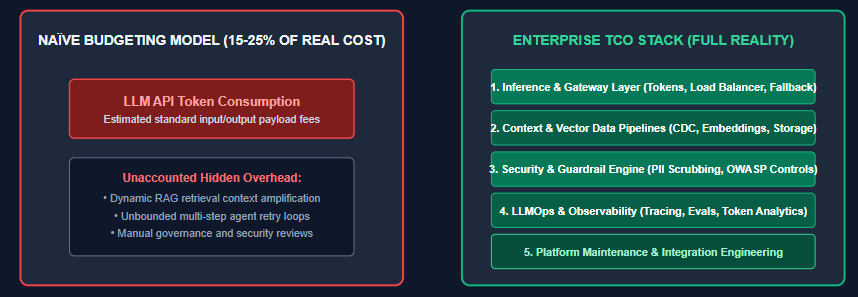
A typical enterprise budgeting mistake is calculating AI costs solely based on model provider pricing per million tokens. In production, base LLM inference costs represent only 15% to 25% of the total operating budget. The remaining expenditure is consumed by context ingestion pipelines, vector database hosting, security guardrail processing, LLMOps observability, and ongoing platform maintenance. AI Integration Services can help enterprises address these cost components through structured architecture, optimized infrastructure, and efficient AI workflows.
Without a structured cost architecture, enterprise AI deployments encounter aggressive financial friction. Token volume grows non-linearly as agentic workflows execute autonomous retry loops and dynamic RAG lookups. Cloud compute bills explode unexpectedly, and legacy infrastructure maintenance strains internal engineering budgets. Accurately forecasting and controlling AI integration costs requires analysing the entire technical stack, from initial architectural discovery to long-term operational maintenance.
Ready to Optimize Your AI Integration?

What Factors Affect AI Integration Cost?
Calculating enterprise AI integration investment requires breaking costs down into four major technical domains: Initial Engineering, Infrastructure & Compute, Data Pipeline Engineering, and Operational LLMOps.
1. AI Integration Development and Engineering Cost
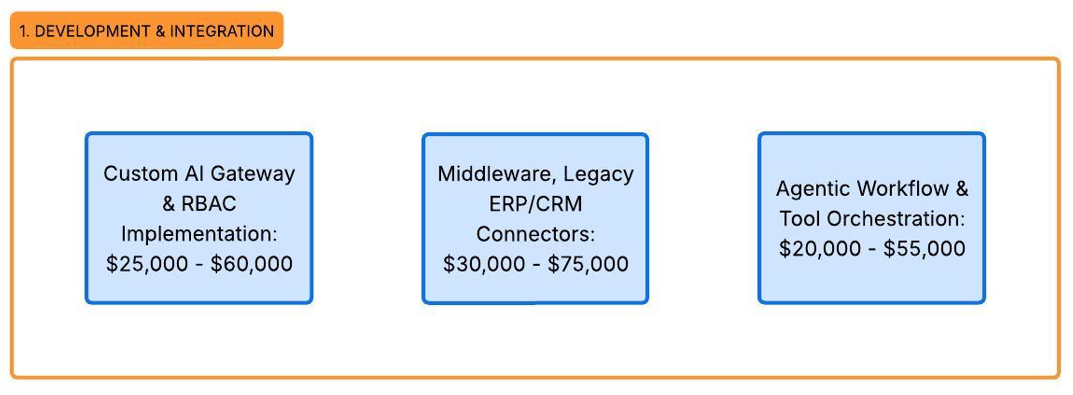
Building custom enterprise-grade connectors, security wrappers, and orchestration layers represents the primary upfront capital expenditure (CapEx). While simple point-to-point wrappers can be assembled quickly, enterprise implementations require decoupled architectures that abstract API dependencies.
Engineering costs cover constructing custom AI Gateways, writing RBAC synchronisation scripts, building event-driven microservices, and setting up resilience mechanisms like dynamic circuit breakers and automated fallbacks.
2. AI Data Integration and Knowledge Indexing Cost
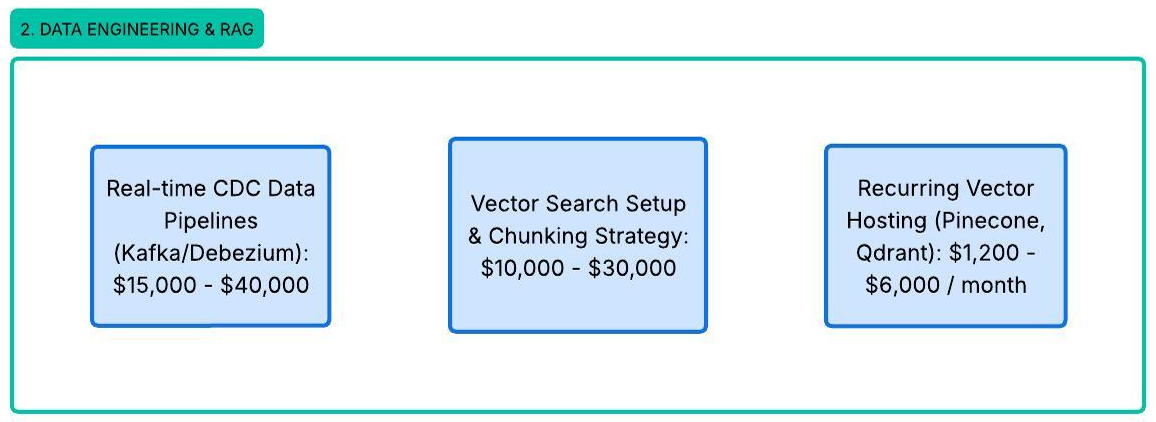
A model is ineffective without clean context. Preparing unstructured enterprise data for Retrieval-Augmented Generation (RAG) requires building robust ETL pipelines.
Costs include configuring real-time Change Data Capture (CDC) streaming, executing chunking strategies, generating initial vector embeddings, and licensing scalable vector database clusters. Higher data velocity and complex document schemas drive overall engineering and storage fees higher.
Ready to Optimize Your AI Integration?
3. AI Inference, Compute and Model Runtime Costs
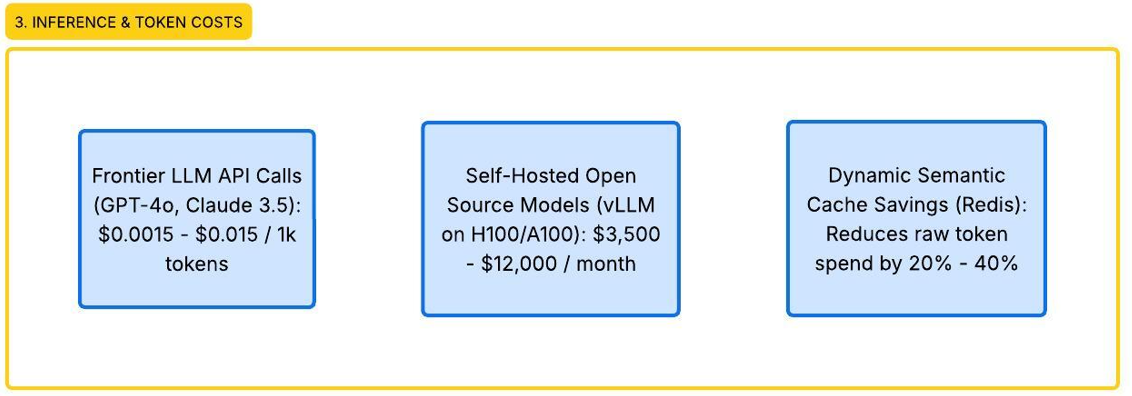
Inference pricing in 2026 varies significantly based on execution strategy:
Commercial Model APIs: Pay-as-you-go per million tokens (input vs. output). While optimal for low-to-medium variable workloads, high-volume transactional systems face steep scaling costs.
Self-Hosted Open-Source Models (vLLM/TGI): Deploying models like Llama 3 or Mistral on dedicated cloud GPUs (NVIDIA H100/A100 instances) introduces fixed monthly infrastructure overhead. This model shifts costs from variable API tokens to predictable compute capacity, becoming highly cost-effective at scale.
4. AI Integration Security, Governance and LLMOps Costs
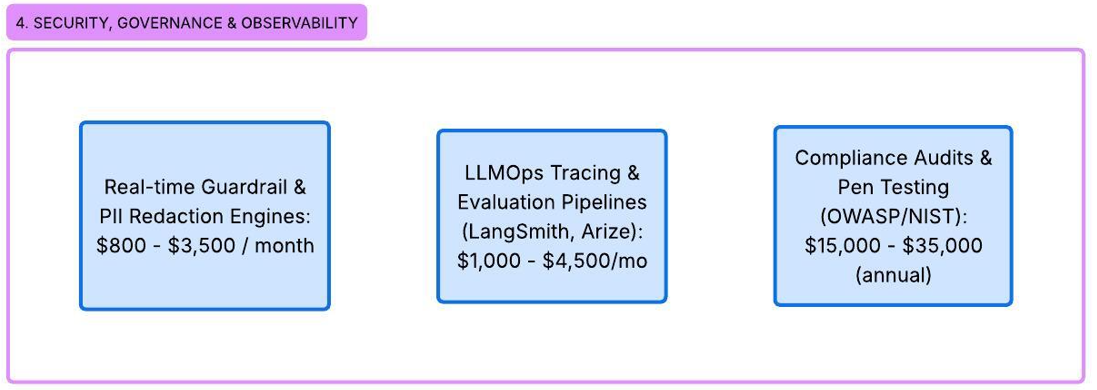
Operational expenditure (OpEx) includes inline security inspection and observational tracing. Processing prompts through real-time PII redaction engines, prompt injection filters, and trace analytics adds compute and licensing costs. However, these guardrails are critical to prevent catastrophic legal liabilities, compliance fines, and data leaks.
Ready to Optimize Your AI Integration?
In-House vs. Partnered AI Integration Cost
Enterprise leaders face a critical trade-off: building internal AI integration engineering capabilities from scratch or engaging a specialised engineering firm.
Cost & Execution Parameter | In-House Internal Development | Specialized AI Engineering Partner |
|---|---|---|
Upfront Initial Investment | $180,000 – $350,000+ (high initial CapEx due to hiring specialized AI/LLMOps talent). | $45,000 – $120,000 (predictable project-based or phased implementation pricing). |
Time-to-Production | 8 to 14 months (extended timeline for recruiting, upskilling, and architectural trials). | 2 to 4 months (uses pre-architected integration gateways and modular RAG patterns). |
Long-Term Operational Debt | High; internal teams often build custom point-to-point wrappers that require constant maintenance as model APIs evolve. | Low; implementations rely on decoupled, provider-agnostic gateway patterns designed for easy updates. |
LLMOps & Cost Optimization Maturity | Basic token logging; high risk of uncontrolled API spending due to missing caching mechanisms. | Advanced semantic caching, dynamic model routing, and token caps built directly into the platform gateway. |
Security & Compliance Preparedness | Requires manual implementation of custom PII scrubbers and guardrail frameworks. | Pre-built compliance architectures aligned with OWASP Top 10 for LLMs and NIST AI |
Ready to Optimize Your AI Integration?
AI Integration Cost by Project Type in 2026
Enterprise AI integration costs vary based on system scope, data complexity, and execution scale. Below are three representative integration cost tiers based on production deployments in 2026:
Tier 1: Departmental AI Integration Cost: RAG and Knowledge Assistant
Scope: Internal knowledge system serving 200 to 500 active users, integrated with Jira, Confluence, and SharePoint.
Initial Development Investment: $35,000 – $65,000
Monthly Infrastructure & Inference OpEx: $1,500 – $3,500 / month
Key Cost Factors: Commercial LLM API calls, managed cloud vector storage (Pinecone/Qdrant), basic semantic caching, and standardised security guardrails.
Tier 2: Enterprise AI Integration Cost: ERP and CRM Automation
Scope: Customer-facing agentic assistant integrated with Salesforce and custom SQL databases, supporting 10,000 daily active queries with real-time transactional writes.
Initial Development Investment: $70,000 – $140,000
Monthly Infrastructure & Inference OpEx: $5,000 – $12,000 / month
Key Cost Factors: High API token usage, real-time CDC data synchronisation, dedicated guardrail inspection microservices, fine-grained RBAC filters, and advanced LLMOps trace logging.
Tier 3: Enterprise Multi-Agent Integration Cost at Scale
Scope: Core operational workflow platform processing millions of unstructured documents annually with autonomous agent decision-making across legacy ERP systems.
Initial Development Investment: $150,000 – $300,000+
Monthly Infrastructure & Inference OpEx: $15,000 – $40,000 / month
Key Cost Factors: Self-hosted open-source models deployed on dedicated cloud GPU nodes (vLLM clusters), high-throughput hybrid vector/keyword indexers, multi-tenant AI Gateways, and automated continuous evaluation suites.
Ready to Optimize Your AI Integration?
How to Reduce AI Integration Cost
Engineering leaders can control production AI spending without sacrificing system performance or security by applying four key optimisation frameworks:
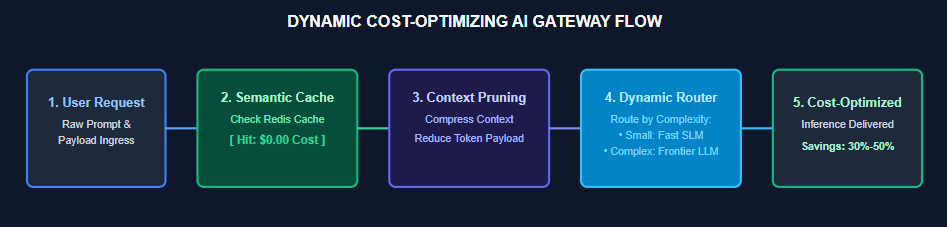
Implement Semantic Caching at the Gateway: Up to 35% of enterprise queries in corporate environments contain repetitive requests. Installing a semantic caching layer (such as Redis Enterprise or GPTCache) directly behind the gateway allows identical or semantically equivalent prompts to be served instantly from memory. This reduces token spend to zero for cached responses while delivering sub-10ms response times.
Adopt Dynamic Model Routing (SLM vs. LLM): Not every user prompt requires a high-cost frontier foundation model. Implementing intelligent intent-classification routing at the gateway level directs simple tasks, such as text classification, entity extraction, or concise summarisation, to smaller, localised models (SLMs) or quantised open-source instances. High-cost frontier models are reserved exclusively for complex reasoning and multi-step orchestration.
Context Window Compression & Hybrid Search: Passing oversized context windows to foundation models increases token costs exponentially. Using hybrid vector-keyword retrieval (BM25 paired with dense embeddings) combined with dynamic context compression algorithms ensures that only essential, highly relevant document passages are sent in the final prompt payload.
How to Optimize Enterprise AI Integration Cost
Optimising enterprise AI architecture for performance and cost efficiency requires deep software engineering expertise. Building custom gateway layers, context pruning pipelines, and LLMOps telemetry from scratch can consume internal engineering capacity and delay time-to-market.
As a dedicated software engineering partner, Zignuts helps enterprise technology leaders build, deploy, and scale cost-optimised AI platforms securely. Zignuts delivers measurable business value across four main service areas:
Cost-Optimized AI Gateway Engineering: Designing custom API gateways equipped with semantic caching, dynamic model routing, automated failover, and precise team-level cost tracking.
Production RAG & Data Pipeline Development: Building efficient context retrieval systems featuring real-time CDC synchronisation, hybrid vector search, dynamic context compression, and granular RBAC controls.
Agentic Orchestration with Circuit Breakers: Developing stateful agent frameworks with strict iteration thresholds, execution boundaries, and human-in-the-loop review triggers.
LLMOps, Telemetry & Security Infrastructure: Setting up tracing pipelines, token usage dashboards, and security guardrails aligned with OWASP Top 10 for LLMs and NIST AI RMF frameworks.
By leveraging pre-engineered integration blueprints and robust software practices, Zignuts enables enterprise teams to eliminate architectural debt and reduce long-term operational spend.
Ready to Optimize Your AI Integration?
AI Integration Cost: Key Takeaways and Next Steps
Managing enterprise AI integration costs in 2026 requires more than simply tracking token usage. A well-designed platform should combine structured AI gateways, semantic caching, dynamic model routing, and disciplined LLMOps practices to support scalable AI capabilities while keeping costs predictable.
If your team is evaluating enterprise AI integration costs, improving an existing RAG system, or planning a more cost-effective AI architecture, Zignuts can help you identify the right approach and implementation priorities. Contact us today to discuss your requirements and create a practical roadmap for your AI platform.

Utkrishti Mishra
Business Analyst Intern | Exploring data, processes, and business strategies to turn insights into smarter decisions and impactful solutions.