

How to Evaluate an AI Copilot Development Company
Evaluating a copilot development partner is narrower than evaluating a general LLM or chatbot vendor. A team can build a convincing demo and still lack the competencies required for deep integration with live application state, autonomous decisions, UX embedding, and production-ready permission controls. AI Copilot Development Services can help address these requirements through specialised integration, architecture, and production engineering capabilities.
This guide provides a practical framework for evaluating AI copilot development companies, including technical competencies, architecture questions, security practices, production signals, red flags, pricing models, and a structured enterprise checklist.
Technical Competencies to Evaluate in an AI Copilot Development Company
When evaluating an AI copilot development company, focus on capabilities that directly affect how the copilot works inside the host product.
Context integration experience: Ability to connect real-time application state, such as the record, page, or workflow currently open, using structured and low-latency state passing.
Action layer design judgment: Understanding the difference between drafting, data-entry, and workflow-triggering actions and selecting the right level of autonomy based on risk and reversibility.
UX embedding experience: Proven judgment about sidebar, inline, and command-based patterns, with adoption and workflow impact considered.
Permission-aware architecture: Explicit enforcement of what each user can retrieve or do at the copilot's own retrieval and action layers.
Integration and API experience: Ability to connect the copilot to existing technology stacks and external tools using scalable integration patterns.
AI Copilot Security and Compliance: What to Verify
Security evaluation should focus on permission enforcement, tenant isolation, audit logging, compliance requirements, and prompt injection or adversarial input risk for action-taking copilots.
Ask how permissions are enforced when the copilot retrieves information and performs actions. The architecture should prevent users from accessing information or triggering actions beyond their existing authorization.
For multi-tenant applications, ask how tenant isolation is implemented and tested. Also verify whether the system maintains sufficient audit visibility into retrieved context, suggestions, user confirmations, and completed actions.
Permission enforcement at retrieval and action layers
Explicit tenant isolation and isolation testing
Audit logging for suggestions, retrieved context, and actions
Encryption and appropriate data-handling controls
Protection against prompt injection and adversarial inputs
Bounded action execution for higher-risk workflows
Ready to Build a More Effective AI Copilot?

AI Copilot Development Company: Evaluating Production Experience
A convincing prototype does not necessarily demonstrate production readiness. Look for evidence that the development partner understands how an embedded copilot behaves after launch and how it evolves alongside the host product.
Defined evaluation frameworks for suggestion and action quality
Monitoring of adoption, acceptance, correction, and usefulness
Staged autonomy based on evidence and risk
Post-launch maintenance tied to host-product evolution
UX iteration based on feedback from real users
Monitoring that goes beyond uptime and latency
Production experience should also include a clear approach to changing application interfaces, data models, workflows, permissions, and action requirements after deployment.
AI Copilot Development Company Portfolio and Case Study Red Flags
Review case studies for technical and product-specific evidence rather than relying only on general AI claims.
Vague AI assistant claims without action-layer specifics
No explanation of how permissions were handled
No evidence of UX validation or user adoption
Technical delivery claims without measurable product context
Inability to explain important architecture decisions
Marketing language replacing technical implementation details
A credible case study should make it possible to understand what the copilot actually did, what systems it interacted with, what level of autonomy it received, and how its performance was evaluated.
AI Copilot Development Company Pricing Models
Pricing should be evaluated alongside the level of uncertainty in the project. A fixed-price proposal can work when the integration scope is already well understood, but it can create problems when host-product complexity has not been properly discovered.
For complex enterprise copilots, a phased approach can allow the team to understand application architecture, integration requirements, action scope, security requirements, and UX constraints before committing to the complete build.
Common pricing approaches include:
Fixed scope and fixed price: Suitable for narrow, well-defined requirements where integration complexity is already understood.
Phased discovery and build: Useful when host-product integration, action scope, or technical complexity requires further discovery.
Ongoing retainer: Appropriate when the copilot requires continuous maintenance, optimization, UX improvements, and updates as the host product evolves.
Ready to Build a More Effective AI Copilot?
AI Copilot Development Company Vendor Evaluation Checklist
Use specific and verifiable criteria instead of relying on general impressions from sales conversations.
Demonstrated context integration with real-time application state
Clear action-layer sequencing based on risk and evaluation results
Concrete permission enforcement at retrieval and action layers
UX embedding experience across appropriate interface patterns
Defined evaluation metrics for suggestion and action quality
Post-launch support aligned with host-product evolution
Willingness to discuss trade-offs, challenges, and lessons learned
Common Mistakes When Choosing an AI Copilot Development Company
Several selection mistakes can create unnecessary technical and commercial risk during an AI copilot project.
Selecting a partner based only on general AI or chatbot experience
Accepting a full fixed-price quote before sufficient discovery
Under-scoping the action layer
Ignoring permission requirements during early architecture discussions
Skipping adoption-focused reference calls
Evaluating the vendor only for the initial build
Failing to discuss post-launch maintenance and host-product changes
AI Copilot Development Company Competency Evaluation Matrix
The following matrix can be used as a quick reference when comparing potential AI copilot development partners.
Competency | What to Verify | Positive Signal |
|---|---|---|
Context integration | Real-time application state, not only static documents | Specific examples of record, page, or workflow context passing |
Action layer | Drafting, data-entry, and workflow-triggering tiers | Risk-based sequencing and staged autonomy |
UX embedding | Sidebar, inline, and command-based experience | Patterns selected based on product workflow and user testing |
Permissions | Retrieval and action-layer authorization | Explicit user and role enforcement |
Integration | APIs and external tools | Scalable integration approach without one-off code for every action |
Ready to Build a More Effective AI Copilot?
AI Copilot Development Company Architecture Interview Questions
Architecture interviews should focus on how the development team makes decisions rather than simply which technologies it uses.
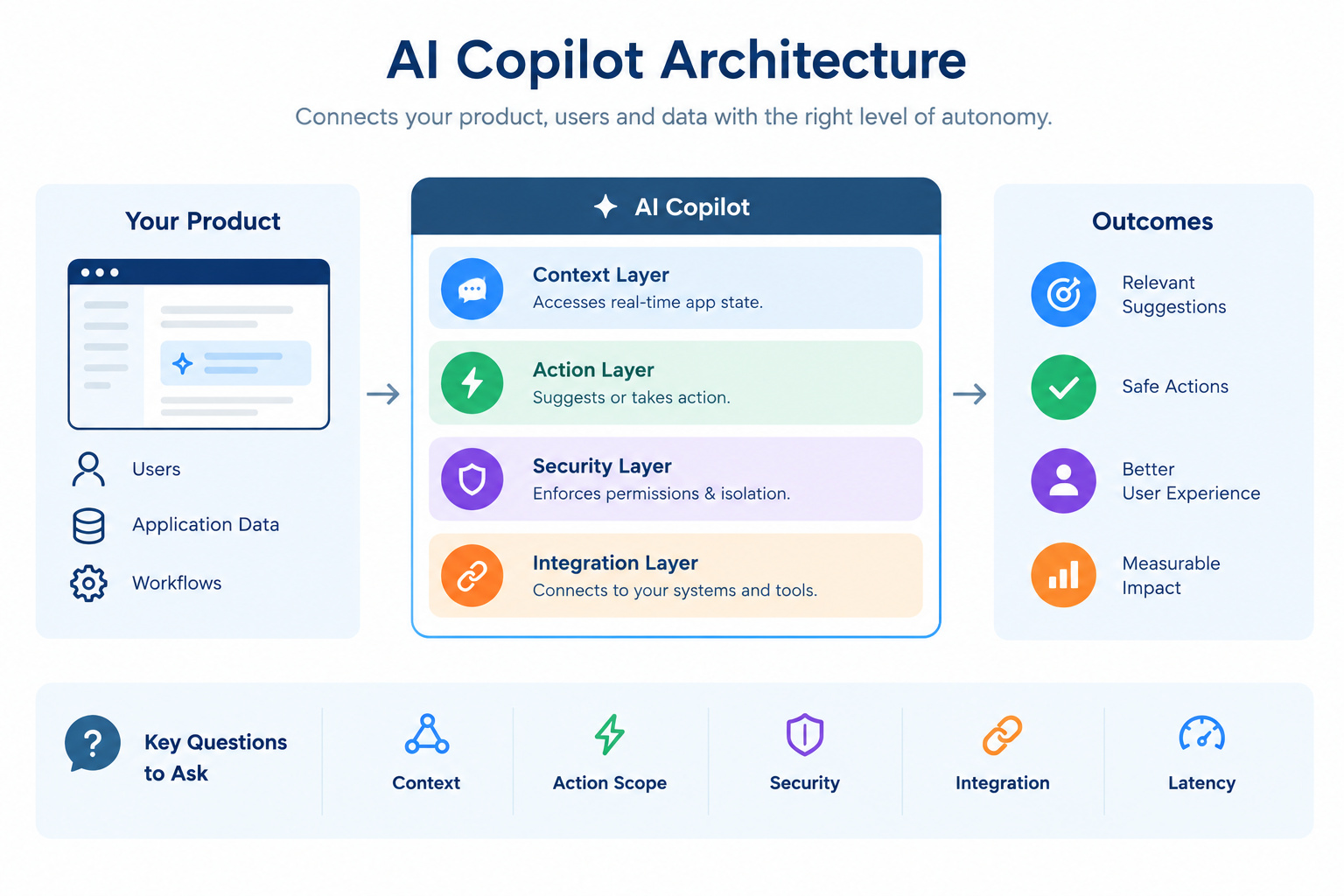
Context Requirements
Ask how the team determines what application context the copilot needs. A strong approach should begin with the host product's data model, user workflow, and task requirements instead of applying the same retrieval-plus-chat pattern to every use case.
Action Scope
Ask how the team decides whether an action should remain a suggestion, require confirmation, or become automated. Lower-risk actions should generally be evaluated before expanding the copilot into more consequential workflows.
Legacy Systems
Ask how the copilot will access application state when legacy systems do not expose clean modern APIs. Strong answers may involve instrumentation, middleware, integration layers, or other controlled methods of accessing difficult system state.
Scope Changes
Ask how new actions or workflows affect project scope. Adding new action tiers can introduce additional integration, testing, security, and evaluation requirements and should not automatically be treated as a minor feature addition.
Latency
Ask how interactive performance will be maintained. Relevant considerations may include caching, streaming, retrieval optimization, efficient context handling, and minimizing unnecessary processing during user interactions.
AI Copilot Security and Compliance Evaluation Matrix
Security discussions should cover both what the copilot can see and what it can do.
Permission enforcement: Verify that authorization is applied to both retrieved information and executable actions.
Tenant isolation: Ask how cross-tenant data leakage is prevented and tested.
Audit logging: Confirm that the system can provide visibility into retrieved context, suggestions, confirmations, and completed actions.
Compliance: Ask how access, encryption, auditing, and data handling requirements are reflected in the architecture.
Prompt injection: Understand how adversarial inputs are handled when the copilot can take actions.
AI Copilot Development Company Production Experience: Signals vs. Red Flags
Production readiness should be evaluated through measurable evidence rather than how convincing a demo appears.
Area | Production Signal | Risk Signal |
|---|---|---|
Evaluation | Tracks acceptance, correction, usefulness, or task-completion measurements | Relies mainly on whether the copilot appears helpful |
Monitoring | Measures adoption, correction rates, task impact, latency, and system health | Tracks only basic uptime and latency |
Autonomy | Uses staged rollout and evidence-based expansion of autonomous actions | Expands autonomy without sufficient evaluation or validation |
Maintenance | Accounts for host UI, data-model, workflow, and integration changes | Treats launch as the end of the engagement |
UX | Validates and refines the embedded experience with real users | Builds the original specification without meaningful user iteration |
Ready to Build a More Effective AI Copilot?
AI Copilot Development Company Portfolio and Case Study Review
When reviewing a portfolio, focus on whether the examples demonstrate actual copilot engineering depth.
Action layer: Look for specific drafting, data-entry, or workflow actions rather than generic AI assistant descriptions.
Permissions: Look for clear discussion of authorization in multi-user products.
Adoption: Look for UX validation and evidence of post-launch usage.
Technical depth: Ask whether the team can clearly explain the architecture and trade-offs behind the implementation.
AI Copilot Development Company Pricing Model Comparison
There are three common pricing approaches for copilot development.
Pricing Model | What It Means | When It Fits |
|---|---|---|
Fixed Scope and Fixed Price | Works when requirements and integration scope are clearly defined, but can create uncertainty when host-product complexity has not been fully discovered. | Narrow, well-defined copilot projects |
Phased Discovery and Build | Allows the team to identify host-product complexity, integration requirements, and implementation scope before the full build. | Complex enterprise copilot projects |
Ongoing Retainer | Accounts for continued maintenance, optimization, UX improvements, and changes as the host product evolves. | Post-launch support and continuous improvement |
AI Copilot Development Company Selection Checklist
Before selecting an AI copilot development company, validate the following areas through technical discussions, portfolio reviews, reference calls, and discovery work:
Real-time application context integration
Risk-based action-layer sequencing
Retrieval and action-layer permission enforcement
UX embedding experience
Suggestion and action quality evaluation
Post-launch product and technical support
Transparency around technical trade-offs and implementation challenges
Ready to Build a More Effective AI Copilot?
Key Takeaways for Choosing an AI Copilot Development Company
Evaluate copilot-specific competencies rather than general AI or chatbot experience alone.
Ask direct questions about context, action scope, legacy integration, permissions, and latency.
Scrutinize case studies for action-layer, security, and adoption evidence.
Favor a discovery phase before committing to full-scope pricing when host-product complexity is uncertain.
Evaluate post-launch maintenance as carefully as the initial build.
Conclusion
Choosing an AI copilot development company is closer to selecting a partner for deep product integration and autonomy judgment than selecting a general AI vendor. The strongest candidates can discuss live context integration, action-layer risk, UX embedding, permission-aware security, and post-launch adoption with concrete production experience.
A structured evaluation process can help enterprises identify the technical capabilities, security practices, delivery approach, and long-term support required for a production-ready copilot. Validating these areas before committing to a full build can help reduce implementation uncertainty and support a more informed partner-selection decision. Contact us today to discuss your AI copilot requirements and explore a practical approach for your project.

Virang Kori
Business Analyst | Analyzing business needs, processes, and data to uncover insights, improve efficiency, and support smarter business decisions.