

Custom AI is justified when a business problem is specific enough to model, valuable enough to measure, and difficult enough that generic tools create more manual work than they remove. The question is not whether a public model can produce an impressive answer. It is whether an AI capability can improve a controlled workflow without creating unacceptable security, compliance, or operational risk.
For a fintech lender processing 50,000 applications each month, a generic assistant may summarize files, but it cannot reliably apply credit policy, preserve an audit trail, and route exceptions to underwriters. For a manufacturer with 25 GMP production lines, a generic tool may identify a defect pattern, but it cannot become part of quality release without validated data, accountable review, and evidence retention. These distinctions reveal when custom AI becomes a business investment rather than an experiment.
Seven signs that generic AI has reached its limit
The strongest signal is repeated operational friction, not executive enthusiasm. The following signs indicate that a tailored system deserves formal discovery.
1. High-value decisions depend on fragmented internal data. Teams reconcile CRM records, policy documents, tickets, sensor readings, or clinical notes before acting. Retrieval, permissions, and data quality matter more than the model.
2. The same exceptions consume expert time every day. If skilled employees manually classify, verify, route, or draft a response hundreds of times weekly, workflow automation may create measurable capacity.
3. Generic outputs cannot meet your accuracy threshold. A payer handling prior authorization cannot accept plausible answers without member context, coding rules, and human escalation.
4. Governance is blocking deployment. Requirements for tenant isolation, retention, regional processing, PCI DSS, HIPAA, or audit evidence often require an architecture that public tools cannot provide.
5. Your advantage is encoded in process knowledge. Pricing policy, fraud review patterns, dispatch constraints, and shop floor procedures are valuable only when translated into controlled prompts, tools, and evaluation data.
6. Existing software must take action, not merely generate text. Creating a case, placing a hold, updating inventory, or triggering a review needs identity controls, idempotency, and rollback paths.
7. Pilot usage is growing without measurable outcomes. When 8 to 10 teams adopt disconnected tools, duplicated spend and inconsistent answers usually appear before enterprise value does.
Organizations commonly fail by treating these as model selection problems. They are operating model problems: who owns the data, approves an action, investigates an error, and funds ongoing evaluation. That ownership question leads directly to architecture.
Architect's Note: If an AI recommendation can change money, care, safety, or a customer commitment, design the human exception path before automating the happy path.
Is Custom AI the Right Next Step for Your Business?

Start with a workflow, then prove the economics
Many leaders begin with a use case catalog. A better starting point is one workflow with a known baseline: handling time, rework rate, exception volume, decision latency, and cost of error. A global payment processor handling 10 million daily transactions may find that reducing false positive review by 8 percent is worth more than an enterprise chatbot serving every employee. The counterintuitive point is that a narrow, well-governed workflow often creates the first credible AI return.
The VALUE screen for candidate selection
Dimension | Question | Evidence of readiness |
|---|---|---|
Value | What does one improved decision save? | Baseline cost and target metric exist |
Access | Can approved data be retrieved reliably? | Owners, permissions, and quality checks exist |
Limits | What must the system never decide alone? | Escalation rules and audit logging are defined |
Usage | Will people use it in their daily tool? | Workflow integration has an accountable owner |
Evaluation | How will quality be measured after launch? | Representative test set and review cadence exist |
Score each dimension from 1 to 5. A candidate below 18 out of 25 should remain in discovery; a candidate above 21 is usually suitable for a bounded pilot. This is high confidence guidance for regulated or high volume processes. A lower score can still be viable for internal knowledge work, where the cost of a wrong answer is limited.
Budget for the hidden work. A focused production pilot often requires 8 to 14 weeks and $150,000 to $400,000 once data preparation, identity integration, observability, security review, and change management are included. Over five years, maintenance can equal or exceed initial delivery because policies, source systems, and user behavior change. For every dollar assigned to model experimentation, plan comparable funding for data, evaluation, and workflow integration. The next decision is whether the surrounding platform can support that commitment.
Build an operating system around the model
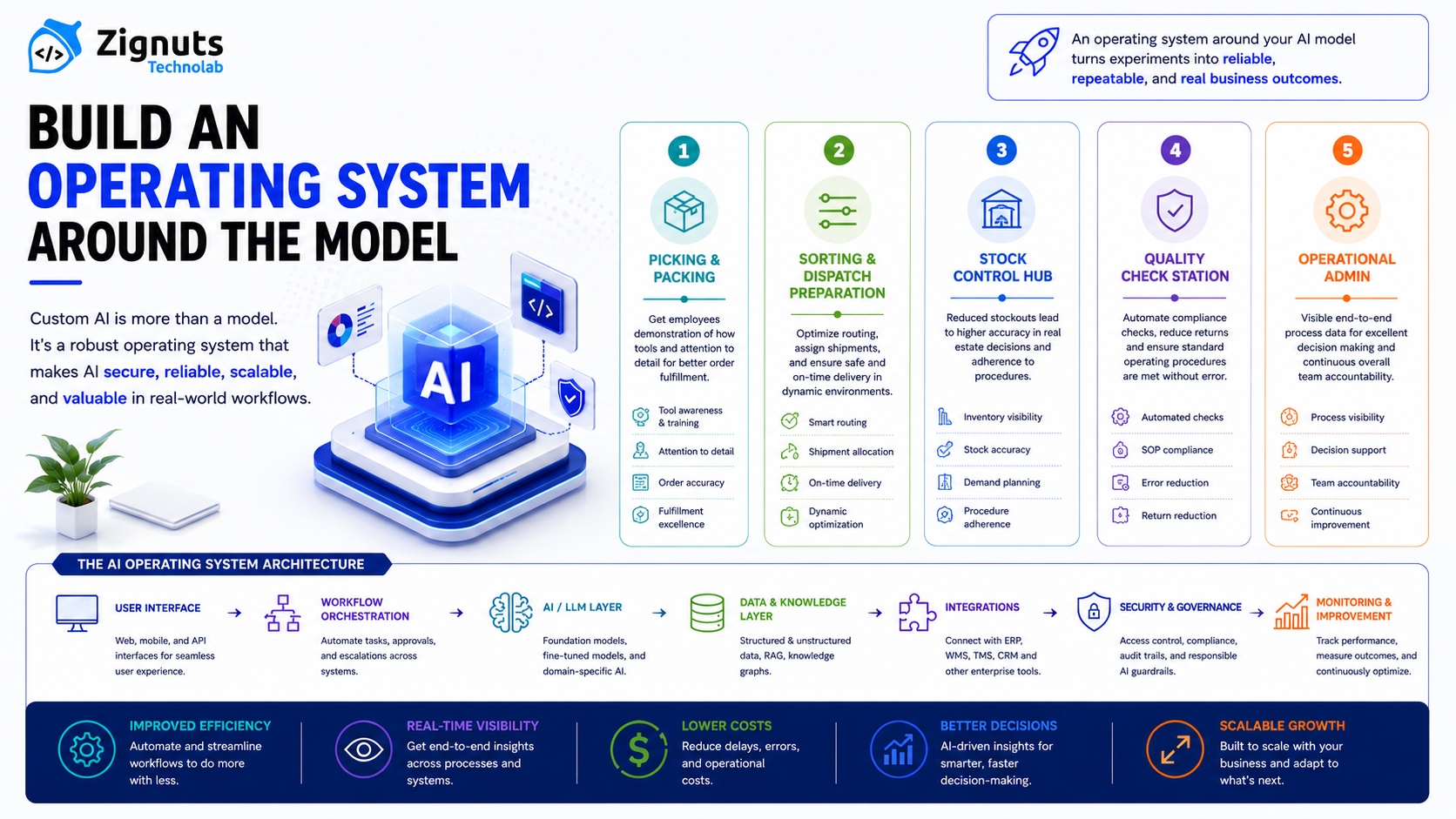
Custom AI should be treated as a governed application component, not a smart endpoint. In an HR platform supporting 25,000 employees, the hard problem is not drafting an answer about leave policy. It is ensuring that the answer uses the employee's jurisdiction, role, approved policy version, and access rights, while never exposing another worker's data. Security is not a feature. It is a property of the whole request path.
Critical architecture includes a permission-aware retrieval layer, a policy and tool orchestration layer, immutable event logging, evaluation datasets, and a human review queue. Keep deterministic rules outside the model whenever possible. For example, a lending platform should calculate affordability thresholds in a controlled service, then let AI explain missing documentation or prioritize a review. This improves auditability, although it increases integration effort.
Most teams fail six months after launch because they monitor uptime but not decision quality. Track grounded answer rate, override rate, unsafe action attempts, latency, cost per completed workflow, and drift by customer segment. Every action-capable endpoint needs usage monitoring before launch. A cold chain provider operating across 12 countries should also record which temperature source, route event, and policy version informed each exception recommendation.
Rule of Thumb: If a deployment cannot be rolled back in minutes and investigated in hours, it is not ready to automate a mission critical workflow.
This architecture may look heavier than a prompt prototype, but it reduces the expensive failure mode of rebuilding controls after users depend on the system. With control points defined, procurement can make a rational build or buy choice.
Build Enterprise-Grade Custom AI That Scales
Choose build, buy, or compose with clear boundaries
Buying is often the right answer for common capabilities such as transcription, document OCR, or baseline support search. Building is justified when the workflow embeds differentiated policy, requires unusual integration depth, or needs evidence that a vendor cannot expose. In practice, the best enterprise pattern is usually composition: buy the foundation, build the domain workflow, and retain ownership of prompts, evaluation sets, policies, and telemetry.
A B2B SaaS company with 5,000 enterprise customers should not train a custom model simply because competitors mention AI. It should first test whether tenant-aware retrieval and product analytics can reduce time to resolution by 20 percent while maintaining contractual data isolation. Conversely, a logistics network with 500 distribution centers may need custom optimization and exception handling because local carrier constraints and inventory commitments are its operating advantage.
Critical, high confidence: Require data processing terms, identity integration, audit export, regional controls, and documented incident response before vendor approval.
Important, high confidence: Keep a provider abstraction only where switching is realistic; excessive abstraction can slow delivery and hide provider-specific safeguards.
Optional, medium confidence: Fine-tune a model only after retrieval, workflow design, and evaluation show a persistent quality gap.
Future, medium confidence: Consider autonomous multi-step agents after human approval queues demonstrate stable exception rates.
The common procurement error is comparing license price while ignoring implementation and exit costs. A low-cost tool that requires custom identity work, manual audit extraction, and separate monitoring can be more expensive than a higher-priced platform. The approval plan below turns that observation into delivery discipline.
Ready to Turn Your AI Strategy Into Production?
Approve a phased program, not an AI promise
Before approval, ask: What business metric will improve? Which workflows are mission critical? Which integrations cannot fail? Who owns the platform after launch? What would trigger redesign in two years? What is the worst-case scenario and mitigation plan? How will success be measured at 3, 6, and 12 months?
Phase | Duration | Milestone | Success metric |
|---|---|---|---|
Discovery | 4 to 6 weeks | Workflow and risk design approved | Baseline metrics and owners confirmed |
Foundation | 8 to 12 weeks | Bounded pilot in one workflow | Quality target met on test set |
Integration | 8 to 16 weeks | Identity, source, and action paths live | All critical exceptions are traceable |
Scale | 8 to 12 weeks | Production rollout and review cadence | Adoption above 80 percent, agreed ROI |
Approve custom AI when it targets a measurable bottleneck, uses governed data, preserves human accountability, and has an owner beyond the pilot team. Defer it when the workflow is unstable or the underlying data is untrusted. The objective is not broader AI adoption. It is reliable operational improvement that survives audits, staffing changes, and the next system integration.
Conclusion
Custom AI is most valuable when it solves a measurable business problem that generic tools cannot reliably handle. The right decision is not simply whether your organization should “use AI,” but whether a specific workflow has enough value, reliable data, clear governance, and measurable outcomes to justify a tailored solution.
Start with one high-value workflow, establish its baseline, define the limits of automation, and prove the economics through a controlled pilot. From there, build the security, retrieval, orchestration, evaluation, and human-review capabilities needed for production.
The strongest enterprise AI programs are not built around the most advanced model. They are built around reliable workflows, governed data, accountable decisions, and measurable business results. When those foundations are in place, custom AI can move from experimentation to a dependable part of the organization’s operating model.