

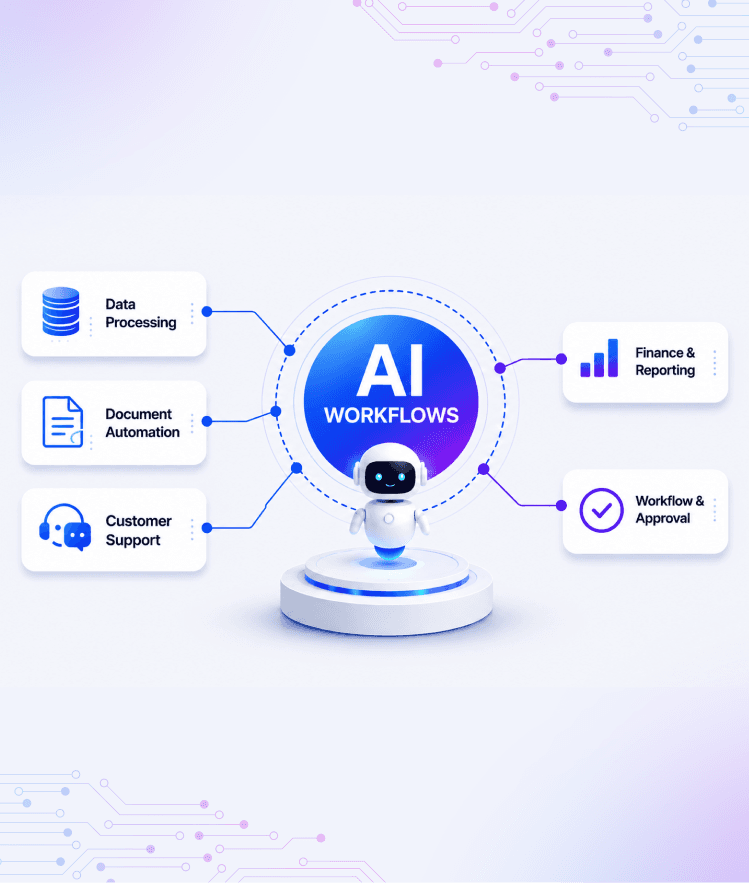
The strongest AI workflows do not simply ask an AI model to perform a task. They connect AI reasoning with business rules, enterprise data, APIs, human approvals, and existing software systems.
That distinction matters.
An AI model can understand an invoice, summarize a customer complaint, classify a sales lead, or identify a contract clause. But an enterprise workflow also needs to determine what happens next, whether the action is authorized, which system should be updated, and when a human needs to intervene.
Recent research reinforces why this workflow-level approach matters. McKinsey reported that organizations using generative AI were increasingly seeing revenue gains within individual business functions, with service operations, marketing and sales, and supply chain among the functions reporting meaningful increases.
AI creates value when it is connected to the right business workflow, not simply when a company adds an LLM to an existing process.
Executive Summary
Enterprise AI workflow automation is most valuable when a process contains repetitive work, large amounts of information, multiple systems, frequent decisions, or significant manual coordination.
The strongest opportunities typically include:
Workflow | AI Opportunity | Primary Business Value | Automation Potential |
|---|---|---|---|
Customer support | Classification, retrieval, response generation, routing | Faster resolution and lower support workload | High |
Sales qualification | Lead enrichment, scoring, routing | Faster response and better sales productivity | High |
Document processing | Extraction, classification, validation | Lower manual data-entry effort | High |
Accounts payable | Invoice processing, matching, exception handling | Finance efficiency and faster processing | High |
Accounts receivable | Payment follow-up, prioritization, analysis | Improved collections operations | High |
IT service management | Ticket classification, troubleshooting, routing | Faster IT resolution | High |
Contract review | Clause extraction, comparison, risk identification | Reduced review workload | Medium to High |
Employee onboarding | Coordination, document collection, assistance | Reduced administrative work | High |
Finance reporting | Data analysis, summaries, anomaly identification | Faster reporting cycles | Medium |
Supply chain operations | Exception analysis, communication, coordination | Better operational responsiveness | Medium to High |
The important point is that automation potential and business value are not the same thing.
A workflow that is easy to automate but rarely occurs may have less ROI than a moderately complex workflow executed thousands of times every month.
Turn AI Workflows Into Business Advantage

What Is an Enterprise AI Workflow?
An enterprise AI workflow is a business process in which AI is combined with software automation, business rules, enterprise data, APIs, and human decision-making to complete a sequence of tasks.
A simplified workflow looks like this:
Trigger → Data → AI Processing → Business Rules → Tool/API Action → Human Approval if Required → Outcome → Monitoring
For example:
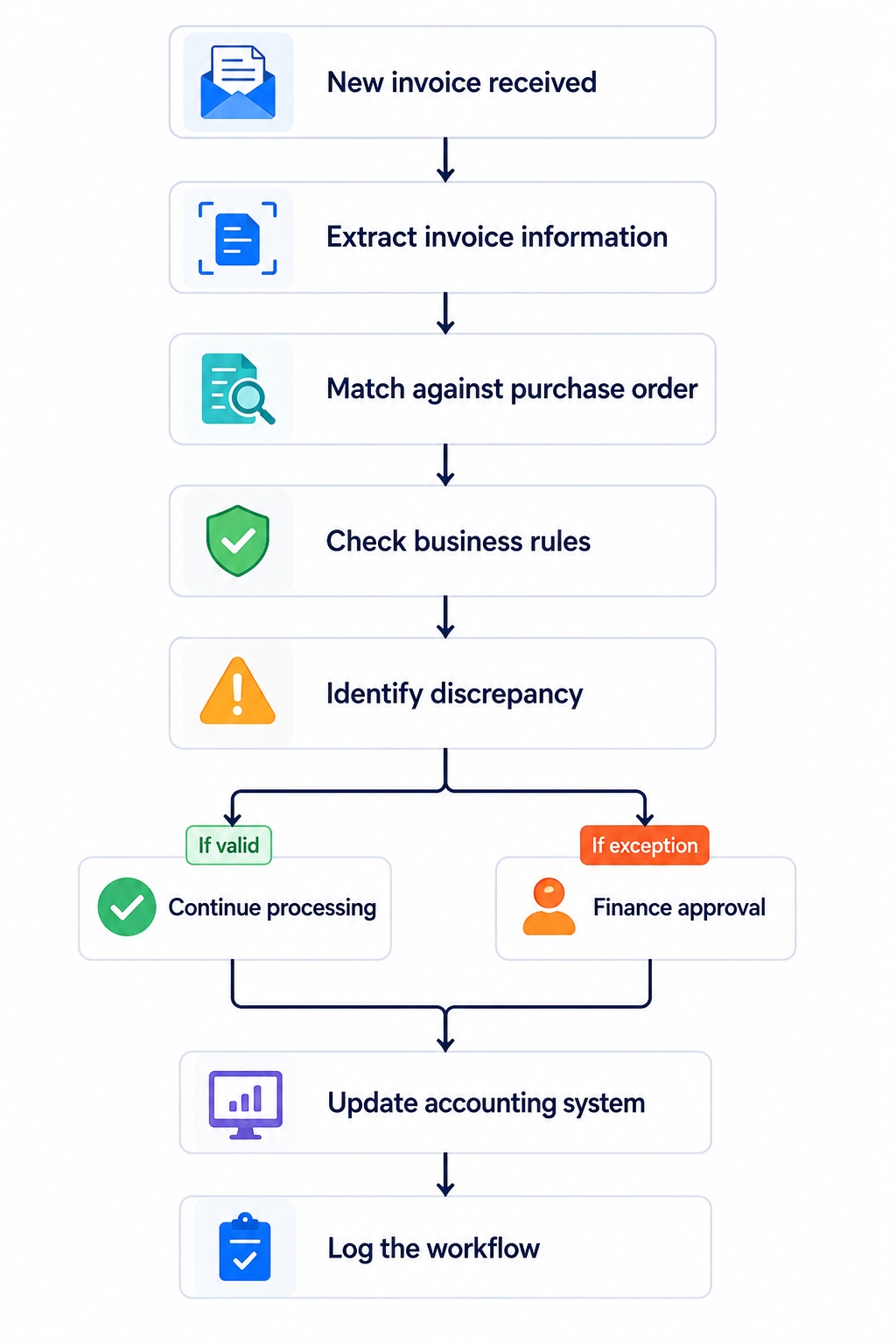
The AI component is only one part of the system.
The real engineering challenge is coordinating everything around it.
Why AI Workflow Automation Is Becoming a Priority
Traditional automation works extremely well when business processes follow deterministic rules.
For example:
If invoice amount is below $5,000, route it to Manager A.
But enterprise workflows frequently contain information that is difficult to process using fixed rules.
An invoice may contain an unusual description.
A customer may describe a technical problem using natural language.
A contract may contain a clause that differs from the standard agreement.
A sales lead may provide important information in a free-text form.
This is where AI adds another layer.
Traditional Automation | AI Workflow Automation |
|---|---|
Rule-driven | Rule + reasoning driven |
Structured inputs | Structured + unstructured inputs |
Fixed conditions | Context-aware processing |
Predictable workflows | Adaptive workflows |
Limited interpretation | Natural-language interpretation |
API automation | AI + API orchestration |
Deterministic decisions | AI-assisted decisions |
The strongest enterprise implementations combine both.
Use deterministic automation for what machines can decide reliably.
Use AI for the parts that require interpretation.
The ROI Reality of Enterprise AI Automation
AI ROI is often presented as if automation automatically produces financial returns.
The reality is more complicated.
IBM's research found that only 25% of AI initiatives were delivering expected ROI, while only 16% had scaled enterprise-wide.
Deloitte's 2025 AI ROI research found that organizations frequently need 2 to 4 years to achieve satisfactory ROI on a typical AI use case, compared with a much shorter expected payback period for conventional technology investments.
However, other research shows that measurable gains are already appearing in specific functions.
McKinsey's 2025 analysis found that among organizations regularly using gen AI in specific functions, 63% reported revenue increases in service operations, 66% in marketing and sales, and 67% in supply chain and inventory management.
IBM's research into highly automated IT organizations has also reported a 28% reduction in IT costs and 10% revenue growth tied directly to automation investments. These figures are benchmark findings, not guaranteed outcomes for an individual implementation.
Turn AI Workflows Into Business Advantage
What This Means for Enterprise Leaders
The right question is not:
"What percentage ROI will AI give us?"
The better question is:
"Which workflow has enough volume, cost, friction, and measurable outcomes to justify automation?"
Where Enterprise AI Creates ROI
AI workflow ROI generally comes from several sources.
ROI Driver | Example |
|---|---|
Labor efficiency | Employees spend less time on repetitive tasks |
Faster processing | Requests are completed faster |
Revenue growth | Sales teams process and qualify more opportunities |
Lower operational costs | Fewer manual processing steps |
Better customer experience | Faster and more consistent responses |
Reduced errors | Automated validation catches inconsistencies |
Faster decisions | Relevant information is assembled automatically |
Scalability | Business handles more volume without proportional headcount growth |
Employee productivity | Employees focus on higher-value work |
The strongest business cases often combine multiple benefits.
For example, an AI support workflow may reduce repetitive ticket handling while also improving response times and allowing support employees to focus on complex cases.
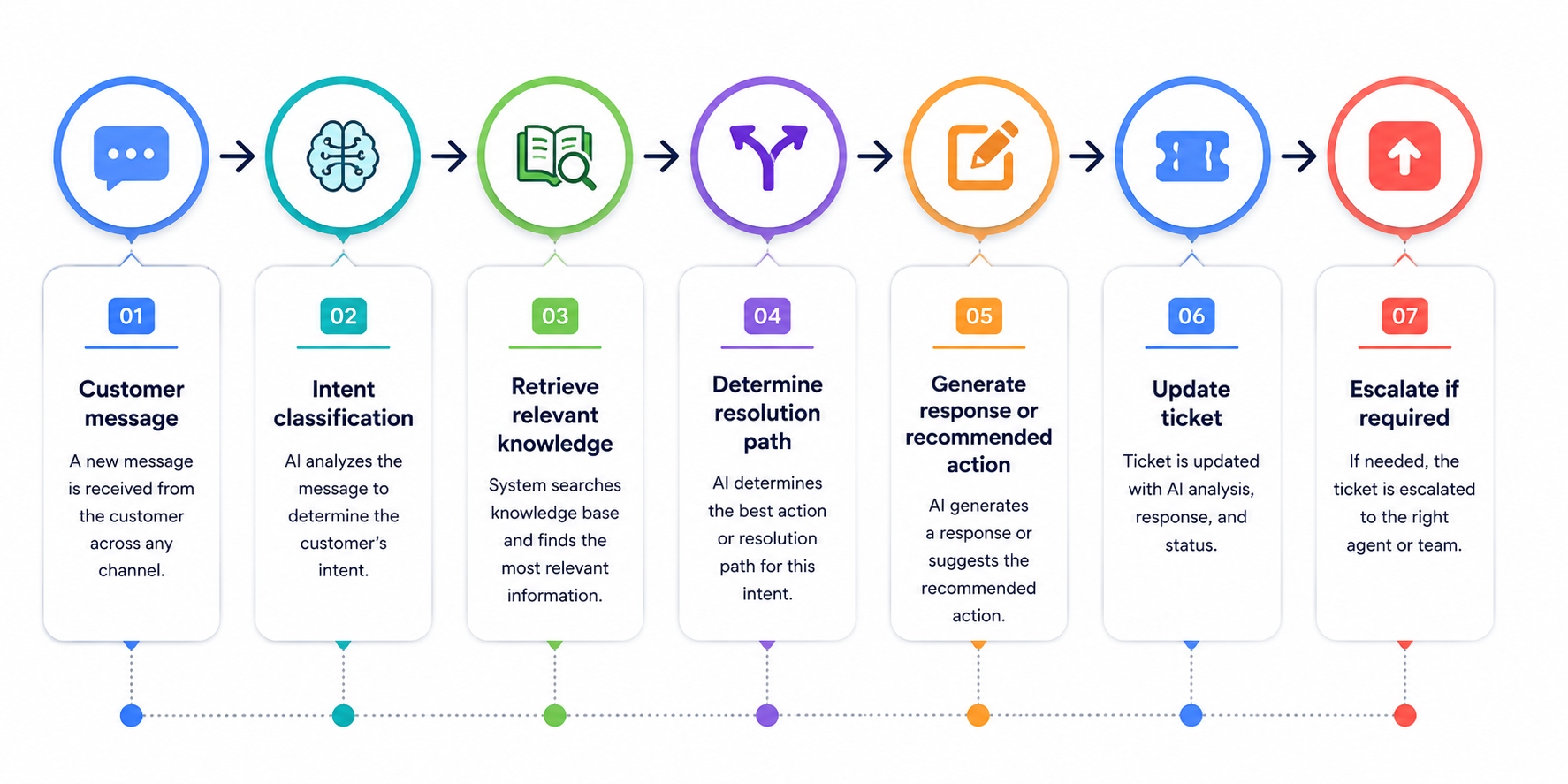
What AI Can Handle
Ticket classification
Intent detection
Knowledge retrieval
Response drafting
Conversation summaries
Sentiment analysis
Ticket routing
Suggested troubleshooting steps
Customer-history analysis
What Should Remain Controlled
Actions that modify customer accounts, issue refunds, change permissions, or create financial commitments should use explicit authorization and business rules.
Potential ROI
The primary ROI opportunity is not simply replacing support employees.
It is increasing the number of customer issues each employee can handle while reducing response time.
2. Sales Lead Qualification and Routing
Sales teams often spend significant time processing leads before a salesperson can have a meaningful conversation.
AI can automate the initial qualification layer.
Example Workflow
Website form submitted
↓
Company enrichment
↓
Industry classification
↓
Requirement analysis
↓
Intent scoring
↓
Lead qualification
↓
CRM update
↓
Sales representative routing
This can help sales teams focus their time on prospects that meet defined qualification criteria.
Manual Process | AI Workflow |
|---|---|
Employee reads every lead | AI analyzes initial information |
Manual company research | Automated enrichment |
Manual classification | AI classification |
Manual CRM updates | API-driven updates |
Manual routing | Rule-based + AI-assisted routing |
Delayed response | Near-real-time processing |
The business value can be measured using:
Lead response time
Qualified lead rate
Sales productivity
Conversion rate
Cost per qualified opportunity
Revenue per sales employee
3. Document Processing and Data Extraction
Enterprise organizations process enormous amounts of documents.
Examples include:
Invoices
Purchase orders
Contracts
Insurance forms
Financial reports
Compliance documents
Customer documents
A modern document workflow can go beyond OCR.
Workflow
Document uploaded
↓
OCR / document parsing
↓
Document classification
↓
AI extraction
↓
Validation
↓
Business-rule checks
↓
Exception detection
↓
Human review if required
↓
Enterprise system update
This approach allows enterprises to automate the repetitive parts while maintaining human control over uncertain cases.
4. Accounts Payable Automation
Accounts payable contains many repetitive operations that are well suited to automation.
A typical AI-enabled AP workflow can process:
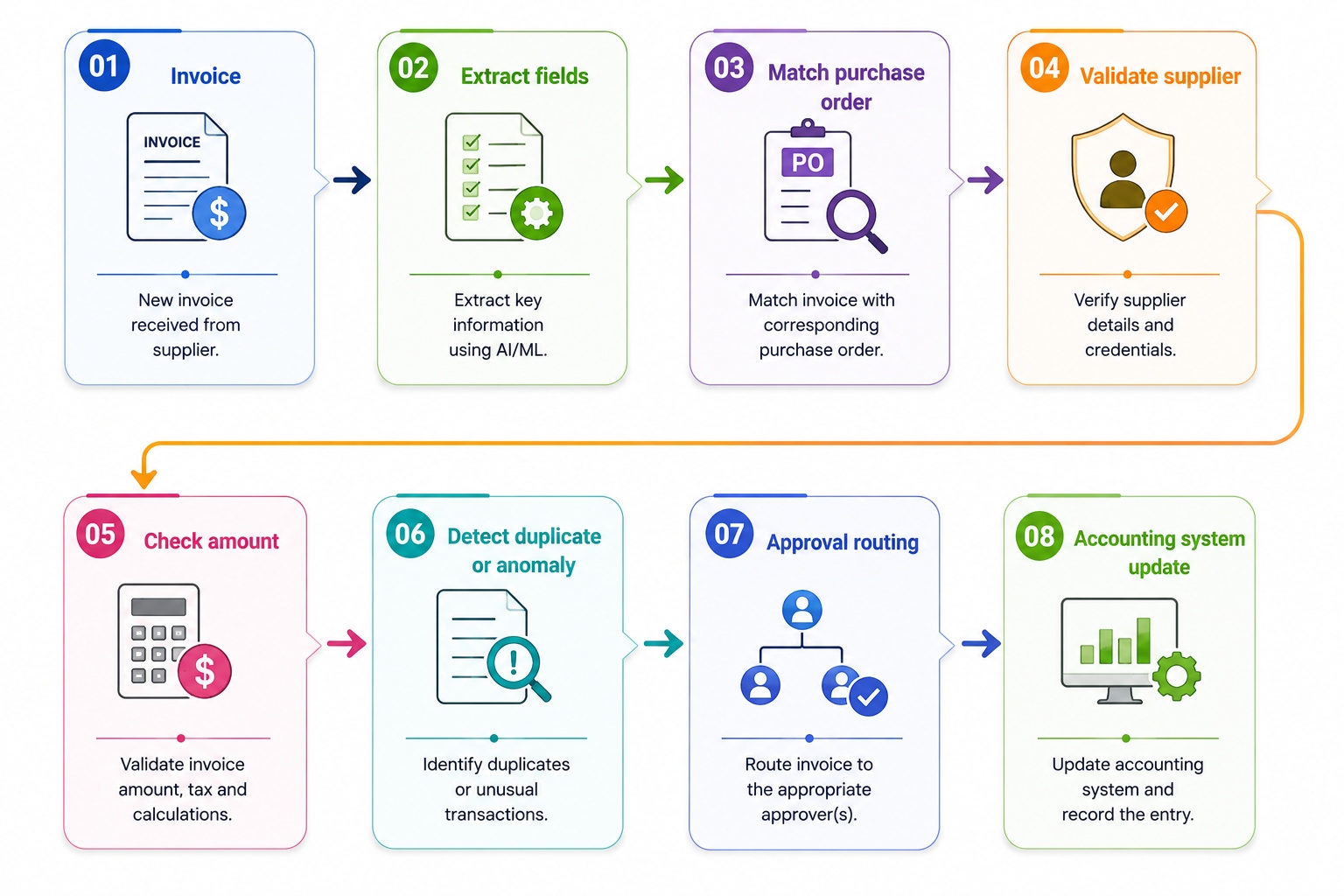
The workflow can automatically process straightforward invoices while routing exceptions to finance employees.
ROI Metrics
A finance team evaluating AP automation should measure:
Metric | Before Automation | Target After Automation |
|---|---|---|
Invoice processing time | Baseline | Lower |
Manual touches per invoice | Baseline | Lower |
Exception resolution time | Baseline | Lower |
Duplicate/error rate | Baseline | Lower |
Cost per invoice | Baseline | Lower |
Straight-through processing | Baseline | Higher |
The exact improvement should be established from the company's own baseline rather than using generic vendor promises.
Turn AI Workflows Into Business Advantage
5. Accounts Receivable Workflows
Accounts receivable can also benefit from AI-assisted workflow automation.
Possible workflows include:
Payment-status analysis
Invoice follow-up
Customer communication
Collections prioritization
Account analysis
Exception identification
Reconciliation support
Reporting
For example:
Outstanding invoice detected
↓
Analyze customer/account history
↓
Determine follow-up priority
↓
Generate communication
↓
Human approval if required
↓
Send communication
↓
Update CRM/ERP
↓
Schedule next action
Zignuts' case-study portfolio includes an accounts receivable automation and FinOps platform, making this a relevant area of demonstrated project experience.
6. Employee Onboarding
Employee onboarding frequently involves multiple departments and systems.
An AI workflow can coordinate:
New employee created
↓
HR data received
↓
Documents requested
↓
Accounts and access requests initiated
↓
Equipment workflow triggered
↓
Training assigned
↓
Employee questions answered
↓
Completion tracked
AI is particularly useful for internal questions because employees can ask questions in natural language rather than searching through multiple policy documents.
However, access to internal information should always respect identity and authorization controls.
7. IT Service Management
IT teams process large numbers of incidents and service requests.
AI can assist with:
Ticket classification
Priority recommendations
Duplicate detection
Troubleshooting
Knowledge retrieval
Incident summaries
Routing
Resolution documentation
Example
Employee reports login problem
↓
AI identifies issue type
↓
Search approved troubleshooting knowledge
↓
Recommend resolution
↓
Determine whether automated action is allowed
↓
Execute controlled action or escalate
↓
Document resolution
For high-risk infrastructure changes, the workflow should require authorized human approval.
IBM's research into AI-powered IT automation reports significant benefits from combining AI automation with IT operations, including improved efficiency and business value.
8. Contract Review and Compliance
Legal and compliance workflows are highly information-intensive.
AI can assist with:
Clause extraction
Contract comparison
Risk identification
Policy matching
Document summarization
Renewal tracking
Compliance review preparation
Contract Review Flow
Contract uploaded
↓
Document classification
↓
Clause extraction
↓
Compare against approved standards
↓
Identify deviations
↓
Risk categorization
↓
Generate review summary
↓
Legal review
The AI should prepare the analysis.
The authorized professional should make the final decision where legal or regulatory consequences are involved.
Zignuts' case-study portfolio also includes an AI contract review platform, supporting the relevance of this workflow category to its engineering experience.
9. Finance Reporting and Analysis
Finance teams frequently spend significant time collecting information before they can analyze it.
AI workflows can help automate:
Data collection
Report preparation
Variance summaries
Trend analysis
Anomaly identification
Management commentary
Report distribution
Example
Reporting period closes
↓
Retrieve approved datasets
↓
Validate data availability
↓
Compare periods
↓
Identify significant changes
↓
Generate analysis
↓
Finance review
↓
Publish report
The underlying ERP or financial database remains the source of truth.
AI should interpret validated data rather than becoming the authoritative financial system.
10. Supply Chain and Operations
Supply chain workflows contain multiple systems, suppliers, documents, and operational events.
AI can help with:
Shipment exception analysis
Supplier communication
Purchase order processing
Inventory-related analysis
Operational summaries
Document processing
Exception routing
For example:
Shipment exception
↓
Retrieve order information
↓
Analyze shipment status
↓
Identify likely cause
↓
Determine operational impact
↓
Notify responsible team
↓
Recommend next action
↓
Track resolution
Zignuts' case-study portfolio includes supply chain visibility, warehouse management, logistics, fleet management, and last-mile delivery solutions, making this another relevant area of engineering experience.
Turn AI Workflows Into Business Advantage
AI Workflow Architecture: What Happens Behind the Scenes?
A production enterprise workflow generally contains several layers.
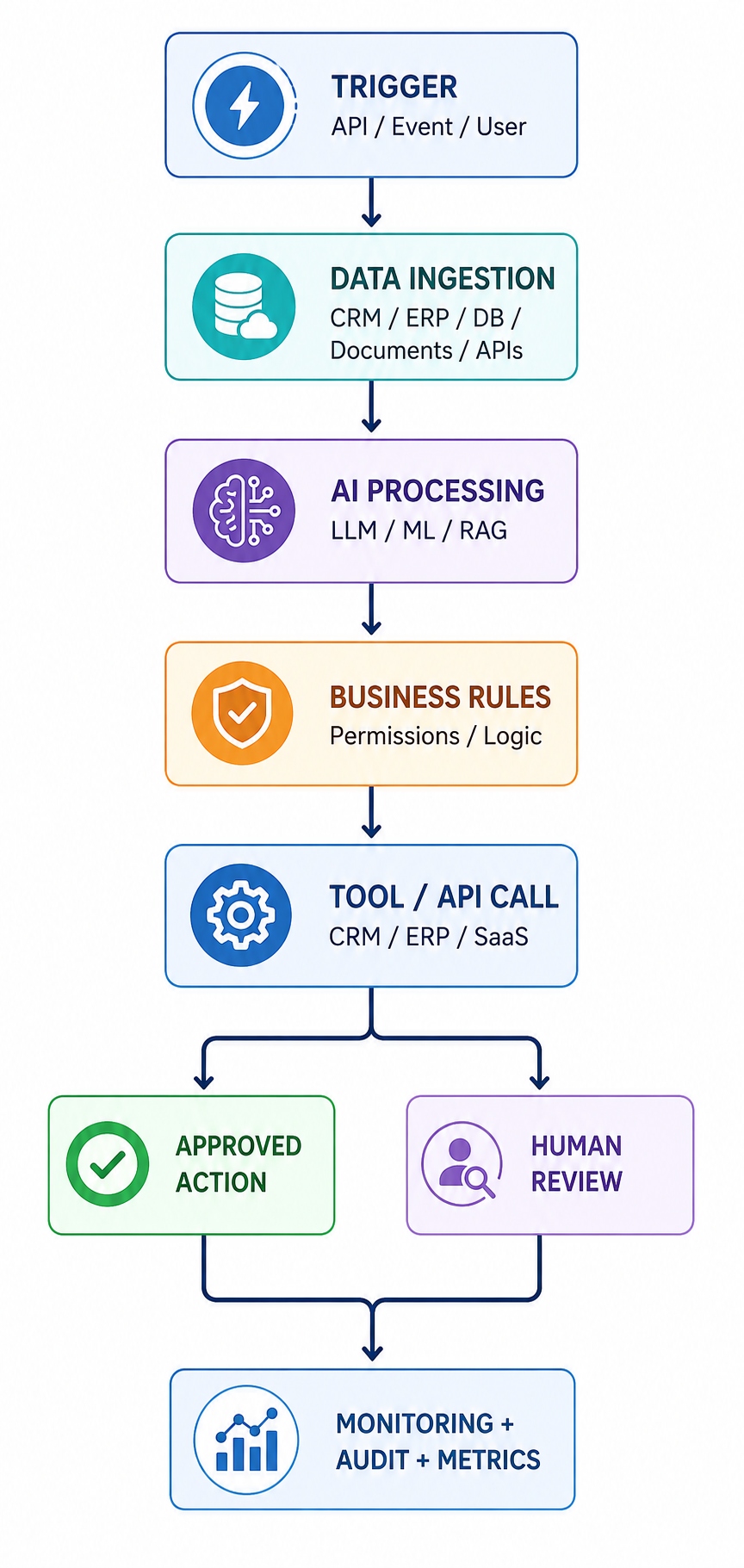
This architecture separates AI reasoning from actual system execution.
That separation is one of the most important principles for enterprise AI.
AI Agents vs Traditional Workflow Automation
Not every workflow requires an AI agent.
Requirement | Best Approach |
|---|---|
Fixed business rules | Traditional automation |
Structured data transformation | Traditional automation |
Classification | AI-assisted workflow |
Document interpretation | AI workflow |
Natural-language interaction | AI workflow |
Contextual decision support | AI workflow |
Multi-step tool selection | AI agent |
Dynamic task planning | AI agent |
High-risk irreversible action | AI + strict controls + human approval |
A simple rule is:
Use automation for predictable work.
Use AI for interpretation.
Use agents when controlled multi-step reasoning and tool selection are actually required.
Human-in-the-Loop: Where Enterprises Should Keep Humans
Enterprise automation should not aim for zero human involvement.
It should aim for the right human involvement.
A Practical Automation Model
Task Type | Recommended Handling |
|---|---|
Data extraction | Automated |
Classification | Automated with validation |
Summarization | Automated |
Low-risk routing | Automated |
Draft generation | Automated |
Routine system updates | Automated with permissions |
Financial approval | Human-controlled |
Legal decision | Human-controlled |
Production infrastructure changes | Human-controlled |
High-impact customer decisions | Human-controlled |
This approach allows companies to automate repetitive work while keeping accountability where it belongs.
How to Calculate the ROI of an AI Workflow
Before building an AI workflow, establish a baseline.
A simple model is:
Annual Current Cost = Workflow Volume × Current Cost per Transaction
Then estimate:
Annual Automation Benefit = Labor Savings + Error Reduction + Revenue Impact + Capacity Gain
And:
ROI = (Annual Benefit - Annual AI Automation Cost) ÷ Annual AI Automation Cost × 100
Example
Assume a company processes:
50,000 transactions per year
Current manual processing cost:
$8 per transaction
Annual process cost:
$400,000
Suppose an automation program reduces the effective processing cost by 40%.
Estimated annual savings:
$160,000
If the complete annual cost of the automation platform, infrastructure, maintenance, model usage, and support is $70,000:
Estimated net benefit = $90,000
Estimated ROI = 128.6%
This is only an illustrative calculation. A real business case should include implementation cost, integration work, maintenance, human review, model usage, infrastructure, and change-management costs.
The 6 Metrics Ctos Should Track
Do not measure an AI workflow only by how many tasks it completes.
Track business outcomes.
Metric | Why It Matters |
|---|---|
Cost per workflow | Measures operational efficiency |
Automation rate | Shows how much work is handled automatically |
Human escalation rate | Indicates where AI still requires intervention |
Processing time | Measures speed improvement |
Error/exception rate | Measures reliability |
Business outcome | Connects automation to revenue, cost, or productivity |
For more mature systems, also track:
Model cost per transaction
API failure rate
Workflow completion rate
Average latency
Token consumption
Accuracy
Retrieval quality
Human override rate
Customer satisfaction
Revenue influenced by workflow
Turn AI Workflows Into Business Advantage
How to Choose the First Workflow to Automate
Do not begin with the workflow that sounds most impressive.
Begin with the workflow where the business case is strongest.
Score each candidate from 1 to 5.
Evaluation Factor | Score 1 | Score 5 |
|---|---|---|
Volume | Rare | Very frequent |
Manual effort | Low | Very high |
Business impact | Low | Very high |
Data availability | Poor | Strong |
Integration readiness | Difficult | Ready |
Risk | Very high | Manageable |
Measurability | Unclear | Easy to measure |
The highest-scoring workflows should normally receive priority for discovery and proof of concept.
Common Enterprise AI Automation Mistakes
Automating a Broken Process
AI cannot compensate for an inefficient process design.
Fix the workflow first.
Giving AI Too Much Authority
An LLM should not automatically receive unrestricted access to production systems.
Use controlled tools, permissions, and approval boundaries.
Using an Llm for Deterministic Logic
If a simple rule can solve the problem reliably, use the rule.
There is no reason to introduce probabilistic reasoning where deterministic logic is sufficient.
Ignoring Exceptions
Every production workflow needs a failure path.
Ask:
What happens when the AI is uncertain?
What happens when the API fails?
What happens when the input is incomplete?
What happens when the result conflicts with business rules?
Measuring Only AI Accuracy
A technically accurate model can still produce a poor business outcome if the workflow around it is badly designed.
Measure the complete process.
Ignoring Operational Cost
AI cost includes more than model API calls.
Consider:
Infrastructure
APIs
Storage
Monitoring
Engineering maintenance
Human review
Security
Model evaluation
Integration maintenance
IBM's recent research also highlights technical debt as an important factor in AI ROI, finding that enterprises that fully account for technical debt in their AI business cases project up to 29% higher ROI.
What Does a Production-Ready Enterprise AI Workflow Need?
Before moving from prototype to production, evaluate the workflow across these areas:
Architecture
Clear workflow boundaries
Reliable integrations
Scalable execution
Appropriate model selection
Deterministic business rules
Security
Authorization
Data protection
Secrets management
Audit logging
Reliability
Retries
Timeouts
Fallbacks
Error handling
Human escalation
AI Quality
Prompt/version management
Model evaluation
Output validation
Retrieval quality
Hallucination controls
Operations
Monitoring
Logging
Cost tracking
Performance monitoring
Workflow analytics
Governance
Approval boundaries
Data policies
Access controls
Compliance requirements
Zignuts’ Experience With AI Workflow Automation
Enterprise AI workflow automation requires more than connecting an application to an LLM.
Zignuts has worked on an AI workflow automation platform that brought multiple LLMs and workflow capabilities into a unified environment. The company's case-study sitemap identifies the AI Workflow Automation Platform project alongside AI agent, contract review, accounts receivable automation, supply-chain, logistics, and other AI-enabled systems.
The AI workflow automation case study is particularly relevant to this topic because it demonstrates experience with workflow orchestration and AI infrastructure rather than treating AI as an isolated chatbot feature.
That distinction is important for enterprise buyers.
A production system must connect:
AI models + workflows + APIs + business logic + data + permissions + monitoring
into one reliable operating environment.
The Future of Enterprise AI Workflows
The next stage of enterprise AI is unlikely to be defined by companies having the largest number of AI models.
It will be defined by how effectively companies redesign work around AI.
IBM research indicates that enterprise AI agents are expected to deliver measurable ROI, while research across the market increasingly points toward workflow redesign and orchestration as the key to moving from AI pilots to scalable business value.
That means future enterprise architectures will increasingly combine:
Traditional software
AI models
RAG and enterprise knowledge
AI agents
Workflow orchestration
Business rules
Human approvals
Observability
The organizations that get this architecture right will be able to automate increasingly complex work without giving up control.
Turn AI Workflows Into Business Advantage
Key Takeaways
The best AI opportunity is usually a workflow, not an isolated AI feature.
Customer support, sales, finance, document processing, IT, legal, HR, and operations all contain strong automation opportunities.
Traditional automation and AI should work together.
AI is most valuable where interpretation and contextual reasoning are required.
AI agents should be introduced only when dynamic multi-step execution provides a genuine advantage.
High-risk actions should have explicit permissions and human approval.
ROI should be calculated using the organization's own workflow volume, cost, error rate, and business outcomes.
Enterprise AI requires security, observability, reliability, scalability, and governance from the beginning.
The goal is not maximum automation.
The goal is maximum business value with an acceptable level of operational risk.
Conclusion
Enterprise AI automation is no longer simply about asking an AI model to perform a task.
The real opportunity is to redesign the entire workflow around AI.
The strongest implementations combine AI reasoning with deterministic business logic, enterprise data, APIs, workflow orchestration, security controls, human approvals, and operational monitoring.
The ROI evidence also suggests a practical approach. Some organizations are already reporting meaningful productivity, revenue, and cost benefits from AI, while many others are struggling to move beyond pilots.
The difference is often not the AI model.
It is the workflow.
Companies should therefore start with one high-value process, establish a measurable baseline, identify what AI can safely handle, define human escalation points, integrate the required systems, and measure the business outcome.
That is the path from an AI experiment to a production enterprise workflow.
For organizations evaluating this transition, experienced AI engineering partners can help identify suitable automation opportunities, design the architecture, integrate AI with existing enterprise systems, and build the controls required for reliable production deployment.
Zignuts' AI workflow automation experience provides a relevant foundation for organizations looking to move from individual AI capabilities toward connected, production-grade business workflows.

Parth Trivedi
Co-founder and CTO of a global software agency, I lead innovative IT solutions across industries, focusing on scalable architectures and agile methodologies. Let’s connect to scale your digital initiatives!