

AI integration rarely fails because a model cannot generate an answer. It fails because the answer enters an operational workflow with unclear ownership, incomplete data, weak controls, or no measurable decision it is allowed to influence. For a CTO, the investment question is therefore not which model has the best benchmark score. It is whether the integration improves a business process without creating an audit, security, or reliability liability.
A global lender processing 50,000 loan applications each month may use AI to summarize documents, flag missing evidence, and route exceptions. If identity verification data arrives late or a human reviewer cannot see why an application was routed, the queue simply moves from operations to compliance. The cost of delay remains. The following mistakes explain why promising pilots do not become durable enterprise capabilities.
Starting with a model instead of a constrained workflow
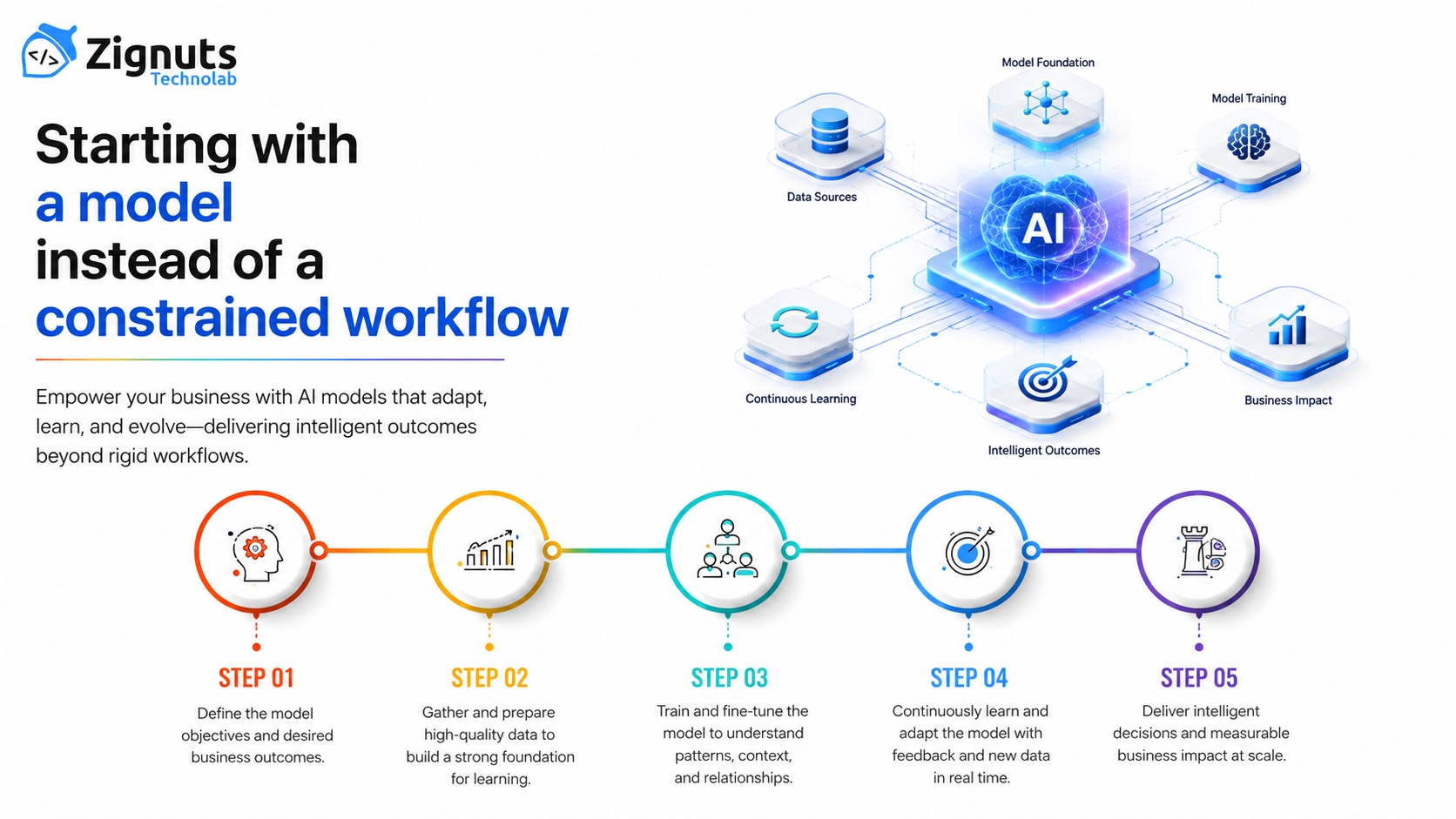
The most expensive AI mistake is selecting a model before defining the workflow decision it will support. Teams often begin with a broad mandate such as “automate customer service,” then discover that service agents need policy retrieval, account context, approval boundaries, and a way to correct a bad response. The model was never the complete solution.
For a financial services team, begin with one bounded workflow: classify inbound disputes, extract transaction references, and prepare a reviewer packet. Define the handoff point, the acceptable error rate, the source systems, and the reviewer who owns the final disposition. A higher automation percentage is not always better. In payment disputes, a 35% reduction in preparation time with complete evidence can be more valuable than 80% automation that increases false approvals.
Organizations commonly fail here because they measure demonstrations rather than operational outcomes. A pilot can look successful with 200 clean examples, while production includes scanned documents, duplicate customer records, multilingual correspondence, and policy exceptions. The hidden risk appears after six months, when teams cannot explain which workflow changes created value and which created rework.
Note: If a use case cannot name its human decision owner, source of truth, and rollback path, it is not ready for production integration.
Critical, high confidence: prioritize workflows with high volume, repeatable inputs, measurable cycle time, and a safe human escalation path. This foundation determines the data and governance decisions that follow.
Start Your AI Integration with the Right Strategy

Underestimating data provenance and integration reality
Most enterprises do not have an AI data problem. They have a provenance problem. A customer record may differ across CRM, core banking, fraud, and document systems; each can be valid for a different purpose. Connecting all of them to a model without defining precedence produces plausible but incorrect outputs.
Consider a digital bank with 2 million customers and 100,000 daily account activities. Its AI assistant may need account status, KYC status, transaction history, and product eligibility. It should not receive unrestricted database access. Use purpose-specific services that return only approved, current fields, log every retrieval, and enforce authorization before retrieval rather than after response generation. PCI DSS obligations, privacy commitments, retention rules, and audit requirements must shape this boundary.
The TRACE decision framework
Dimension | Question | Evidence of readiness |
|---|---|---|
Traceability | Can each output cite approved source records? | Request and retrieval logs retained |
Rights | Is access limited by role, purpose, and consent? | Policy enforcement before retrieval |
Accuracy | Are key fields reconciled and monitored? | Exception rate and freshness targets |
Control | Can unsafe actions be stopped quickly? | Kill switch and approval gates |
Evaluation | Does testing reflect real edge cases? | Versioned production test set |
TRACE is useful because it separates data access from model quality. Many teams focus on prompt refinement while stale product rules or ambiguous identity matching cause the actual failure. As a rule of thumb, every AI output that changes a customer, financial, or clinical record should be traceable to a source, a policy, and a responsible user.
Critical, high confidence: create a data contract for each use case, including field owner, freshness expectation, permitted use, retention, and failure behavior. This adds upfront work, but it prevents expensive remediation when a regulator or internal auditor asks how a decision was formed. Once provenance is controlled, teams can make a rational automation decision.
Automating decisions before designing exception handling
The conventional goal is straight-through processing. In practice, well-designed exceptions are what make automation trustworthy. A fraud triage system may correctly prioritize alerts, but it still needs queues for missing data, conflicting signals, suspected prompt injection, and cases that exceed a risk threshold. Silent failure is worse than a visible manual queue.
A payment processor handling 10 million daily transactions across 40 currencies needs deterministic controls around any AI-assisted workflow. Model outputs can recommend a review priority, summarize evidence, or draft an analyst narrative. They should not independently release funds, alter sanctions status, or close an AML case. Those actions require policy rules, dual control where appropriate, and immutable audit events.
Critical: define confidence and business risk thresholds separately. A confident output can still be unsafe.
Important: build reviewer screens that show source evidence, model version, and override reason.
Important: route low-quality inputs to a remediation queue instead of forcing a response.
Optional: use automation to suggest next actions after exception patterns stabilize.
The trade-off is clear: approval gates reduce automation speed, yet they preserve explainability and make scaling acceptable to risk teams. Companies fail by treating human review as a temporary pilot feature, then discovering that it needs staffing forecasts, service level targets, training, and quality assurance. Design it as a product capability from day one. That also creates the feedback needed for evaluation.
Build Secure AI Solutions with Enterprise-Grade Governance
Shipping a pilot without evaluation, security, or operating ownership
AI quality is not a launch metric. It is an operating discipline. Prompt changes, model releases, new product policies, and shifts in customer behavior can all change outcomes. A B2B SaaS platform serving 5,000 enterprise customers may see its support assistant degrade after a knowledge base restructure even when the model itself has not changed.
Build an evaluation set from real, de-identified cases: routine requests, adversarial inputs, stale documents, policy conflicts, and high-value exceptions. Track groundedness, task completion, escalation accuracy, latency, cost per completed task, and reviewer overrides. Review security quarterly, not just before launch. Access controls, secrets handling, vendor data processing terms, retention settings, and incident playbooks belong in the release process.
Rule of Thumb: If an AI workflow cannot be measured against a non AI baseline every month, its ROI claim is an assumption, not an operating fact.
The overlooked cost is not only inference. A mid-sized program can spend $150,000 to $400,000 annually on evaluation tooling, observability, security reviews, data preparation, and workflow support, before dedicated engineering staffing. Custom integrations often cost more than model usage because each upstream policy or schema change needs regression testing. Important, high confidence: assign a product owner, risk owner, data owner, and platform owner before production approval. Without this operating model, accountability fragments after the first incident.
Make the investment decision and sequence delivery
Do not fund an enterprise-wide assistant as a single transformation program. Fund a sequence of controlled workflow improvements, each with a baseline and a stop condition. Phased modernization is usually safer than replacing core systems, particularly where legacy transaction records and reconciliation processes remain authoritative.
Before approval, ask:
Which business metric should improve within 90 days?
Which workflow is mission-critical, and what is the manual fallback?
Which integrations cannot fail under any circumstances?
Who owns model behavior, data quality, and incident response after launch?
What evidence would force an architecture redesign in two years?
What is the worst-case customer or regulatory outcome, and how is it contained?
How will success be measured at 3, 6, and 12 months?
Phase | Duration | Milestone | Success metric |
|---|---|---|---|
Discovery | 4 to 6 weeks | Workflow and controls approved | Baseline and owners documented |
Foundation | 8 to 10 weeks | Secure retrieval and review queue | Traceable outputs in test |
Controlled release | 6 to 8 weeks | One production workflow | Cycle time reduced without higher error rate |
Scale | Quarterly | Additional workflows | Quality and cost targets sustained |
Critical: establish workflow boundaries, provenance, approval gates, and measurable baselines.
Important: invest in evaluation, observability, and named operational ownership.
Optional: expand to customer-facing automation after internal exception handling is proven.
Future: consider broader agent orchestration only when permissions, auditability, and recovery controls are mature. The strongest AI programs are not those that automate first. They are the ones who earn the right to automate more.
Ready to Integrate AI Without Costly Mistakes?
Conclusion
Successful AI integration is not about connecting a model to an existing system and expecting automation to follow. It requires a well-defined workflow, trusted data, clear decision boundaries, strong exception handling, and measurable accountability.
The right approach is to start with one controlled business process, establish a baseline, define what AI can and cannot decide, and build the necessary security, evaluation, and human-review controls before expanding. This turns AI integration from a technology experiment into a reliable operational capability.
The strongest AI programs do not automate everything from day one. They earn the right to automate more by proving that each workflow can deliver measurable value without compromising security, compliance, or reliability. When those foundations are in place, organizations can scale AI across processes with greater confidence and a clearer path to long-term ROI.