

Businesses make planning decisions every day.
How much should we produce?
How much inventory should we buy?
How much revenue can we expect next quarter?
How many sales opportunities are likely to close?
How much capacity will we need?
Which products are likely to see higher demand?
These questions are difficult because business conditions keep changing.
Historical data can explain what happened. Traditional reports can show what is happening now. But leaders also need to understand what is likely to happen next.
That is where AI forecasting models become valuable.
AI forecasting models combine historical data, real-time signals, statistical methods, machine learning, and business context to estimate future outcomes.
They can support sales forecasting, demand forecasting, inventory planning, revenue forecasting, workforce planning, supply chain planning, and financial decision-making.
At Zignuts, we build AI forecasting models around the business decision first. Our team combines data engineering, AI engineering, predictive analytics, enterprise software development, APIs, dashboards, and MLOps so forecasts can move from a spreadsheet or prototype into a production system.
Our forecasting practice covers time-series forecasting, inventory forecasting, revenue forecasting, supply chain forecasting, probabilistic forecasting, automated retraining, and explainable forecast dashboards.
This article explains how AI forecasting models work, how they improve sales and demand planning, which forecasting approaches businesses can use, and what it takes to build reliable forecasting systems for production.
What Are AI Forecasting Models and How Do AI Forecasting Models Work?
AI forecasting models use historical and current data to estimate future business outcomes.
The data can include:
Sales transactions
Orders
Inventory levels
Customer behavior
Promotions
Seasonality
Market signals
Pipeline activity
Product usage
Supplier lead times
Operational data
External events
The model learns patterns in that data.
It can then produce a forecast for a future period.
For example:
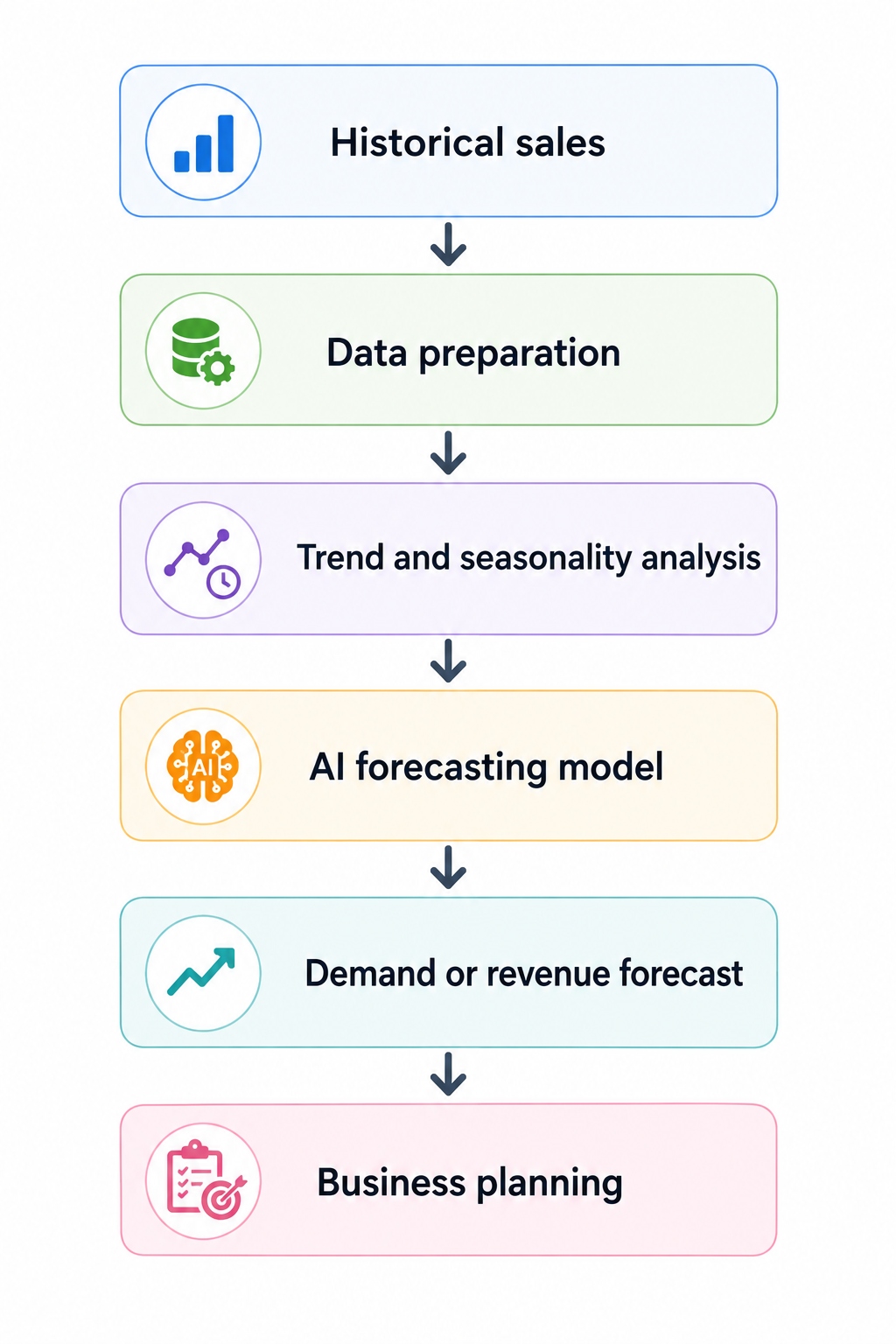
At Zignuts, we build forecasting systems that can generate hourly, daily, weekly, monthly, or custom forecasts. Our forecasting architecture can also support single-series, multi-series, and hierarchical forecasting for more complex enterprise structures.
The important point is that AI forecasting models should not operate as isolated predictions.
They should connect to the decisions that follow the forecast.
Why AI Forecasting Models Matter for Sales and Demand Planning
Traditional forecasting often depends on spreadsheets, historical averages, manual assumptions, and expert judgment.
These methods can still be useful.
The problem appears when the business becomes more complex.
A company may have thousands of products. Different regions may behave differently. Sales cycles may vary. Promotions can change demand. Pricing can influence conversion. Markets can shift quickly.
A single spreadsheet may no longer provide enough detail.
AI forecasting models can process larger volumes of data and identify patterns that are difficult to evaluate manually.
Our forecasting services are designed to move businesses from reactive reporting toward proactive planning. We use historical trends, seasonality, operational patterns, real-time data, and external signals to help teams improve planning accuracy and respond earlier to changes.
The objective is not to eliminate human judgment.
The objective is to give decision-makers better information before they commit resources.
Smarter Sales & Demand Forecasting with AI

AI Forecasting Models for Sales Forecasting
Sales forecasting is one of the most important applications of AI forecasting models.
Sales leaders need to estimate future revenue from a pipeline that is constantly changing.
Opportunities move. Deals stall. Conversion rates change. Sales cycles vary. New accounts enter the pipeline. Existing accounts expand or contract.
AI forecasting models can combine these signals to produce more structured sales projections.
At Zignuts, our sales forecasting approach can analyze historical revenue, pipeline movement, win rates, deal velocity, seasonality, account behavior, and other relevant business signals. We also design forecasting systems around sales, finance, and operations workflows so forecasts can support quota planning, cash-flow visibility, inventory decisions, and executive reporting.
AI Forecasting Models for Sales Pipeline Prediction
A sales forecasting model does not need to look only at closed revenue.
Pipeline data can provide an earlier signal.
Useful inputs can include:
Opportunity stage
Deal value
Historical win rate
Deal age
Sales velocity
Account history
Product category
Territory
Rep performance
Pipeline coverage
Seasonality
The model can then estimate expected revenue across the forecast period.
A useful sales forecast can also show uncertainty.
For example:
Expected revenue
Best-case outcome
Risk-adjusted outcome
Confidence range
Pipeline at risk
That gives leadership more context than a single revenue number.
Our sales forecasting methodology includes scenario planning, confidence intervals, model validation, and forecast explainability so revenue teams can understand not only the number but also the assumptions and risks behind it.
AI Forecasting Models for Revenue Forecasting
Revenue forecasting is broader than sales pipeline forecasting.
Revenue can be influenced by:
New sales
Renewals
Subscriptions
Upsells
Pricing
Seasonality
Product mix
Customer expansion
Market conditions
Our revenue forecasting solutions combine CRM, ERP, billing, finance, product, and operational data to create a connected forecast. We design systems that can support revenue planning, subscription growth, cash-flow visibility, demand forecasting, scenario modeling, and executive decision-making.
This becomes particularly useful when sales and finance teams are working from different data sources.
For example:
Sales uses CRM data. Finance uses ERP data. Billing uses payment data. Operations uses separate planning data.
Each team may produce a different forecast.
A connected AI forecasting model can bring those signals together.
That creates a shared forecasting view.
AI Forecasting Models for Demand Planning
Demand planning asks a different question:
How much demand is likely to occur?
This matters across retail, ecommerce, manufacturing, logistics, distribution, food and beverage, healthcare, agriculture, and other industries.
AI forecasting models can estimate demand across:
Products
Stores
Regions
Channels
Customer segments
Time periods
At Zignuts, we design demand forecasting solutions using historical sales, orders, inventory, pricing, promotions, seasonality, customer behavior, supplier lead times, and external signals where appropriate.
The forecast can then support:
Procurement
Production
Inventory allocation
Replenishment
Warehouse planning
Capacity planning
Distribution
The real value comes when demand forecasting is connected to execution.
Smarter Sales & Demand Forecasting with AI
AI Forecasting Models for Inventory Planning
Inventory is one of the clearest areas where forecast quality can affect financial performance.
Too little inventory can create stockouts and lost sales.
Too much inventory can increase carrying costs and create obsolete stock.
AI forecasting models can help estimate future demand and identify the inventory levels needed to support expected sales.
Our forecasting models can support inventory demand prediction, replenishment planning, warehouse allocation, stock-level optimization, and supply management.
The architecture can become more detailed as the business grows.
Instead of forecasting one total number, the system can forecast:
SKU level
Store level
Region level
Channel level
Customer level
Category level
This allows planning teams to work with more granular demand signals.
AI Forecasting Models for Supply Chain Planning
Demand does not exist in isolation.
A forecast can affect procurement. Procurement affects production. Production affects inventory. Inventory affects fulfillment. Fulfillment affects customer experience.
This creates a connected planning problem.
Our demand forecasting consulting approach considers sales, inventory, market, operational, and external signals to create forecasts that can support procurement, manufacturing, logistics, and finance. We also design integrations with ERP, SCM, WMS, CRM, BI, and planning platforms.
This means the forecasting system can become part of the supply chain rather than another reporting layer.
AI Forecasting Models for Promotions and Product Launches
Historical averages are often not enough when a business changes its behavior.
A promotion can increase demand. A price change can reduce or increase demand. A new product has little historical data. A new channel can alter the customer mix.
AI forecasting models can incorporate these factors when suitable data is available.
Our demand forecasting methodology can incorporate promotions, pricing, seasonality, external demand signals, and launch-related scenarios. We also support what-if simulations so teams can compare different planning assumptions before making commitments.
For example, a business could evaluate:
Expected demand without promotion
Expected demand with promotion
Expected demand under a larger discount
Expected demand under a constrained inventory scenario
This turns forecasting into a planning tool.
AI Forecasting Models for Sales and Demand Planning: From Data to Decision
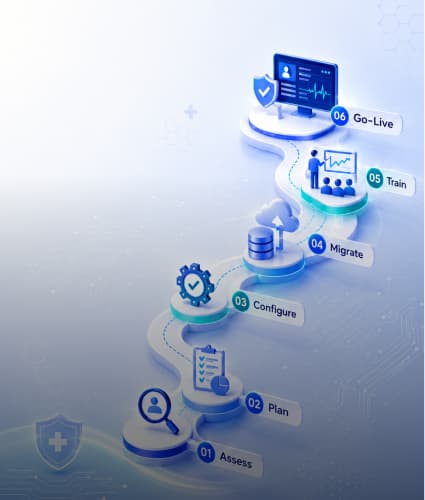
A production forecasting system usually follows a structured pipeline.
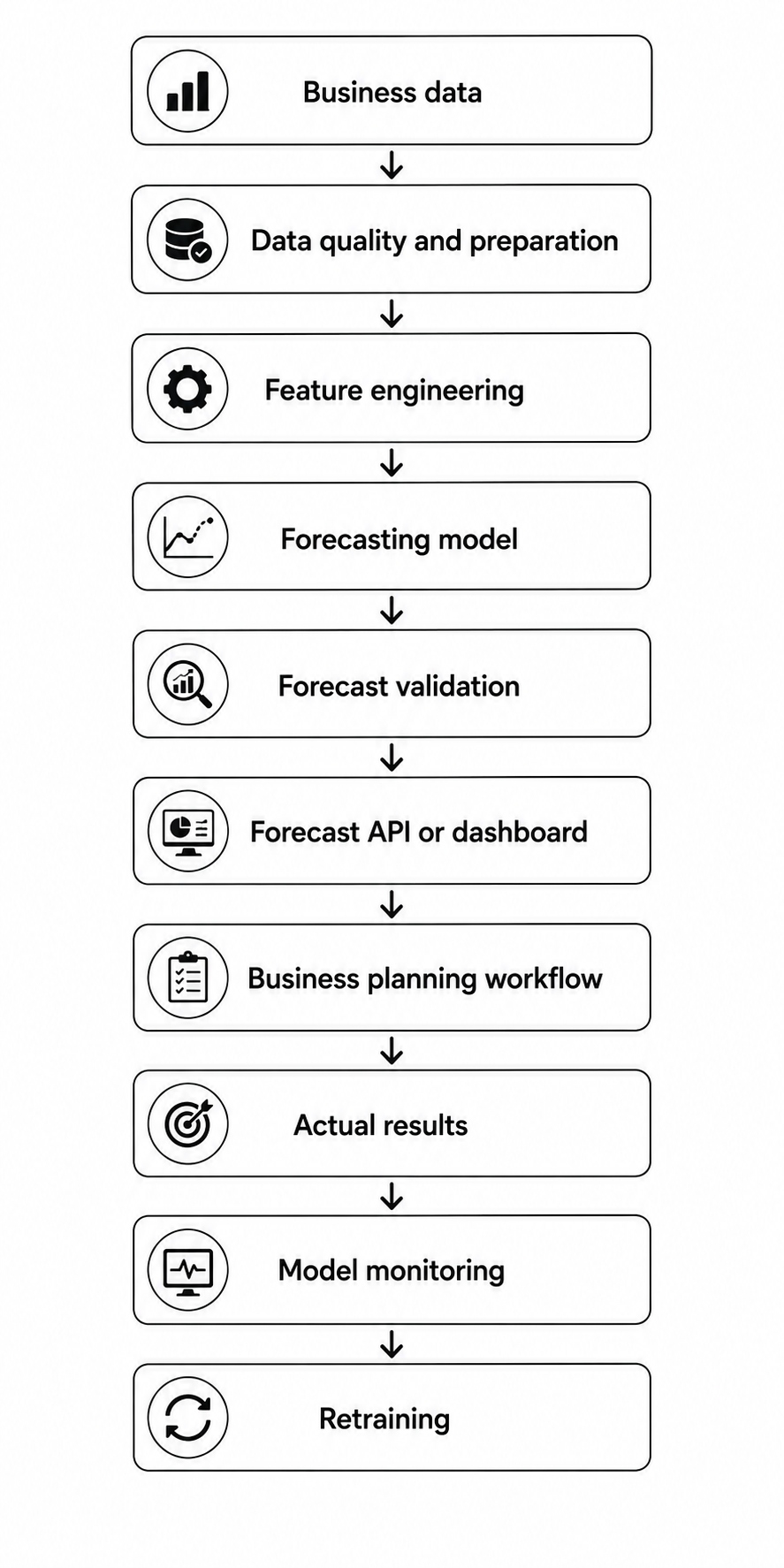
Actual results should be compared with predicted results.
That creates feedback.
The feedback can then improve future forecasts.
At Zignuts, we build automated pipelines, monitoring, model versioning, drift detection, retraining workflows, and forecast dashboards so forecasting systems can remain useful after deployment.
AI Forecasting Models for Time-Series Forecasting
Time-series forecasting is one of the foundations of modern forecasting.
A time series is data collected over time.
Examples include:
Daily sales
Weekly demand
Monthly revenue
Hourly traffic
Weekly orders
Monthly subscriptions
The model studies historical patterns and estimates future values.
Important components can include:
Trend
Seasonality
Autocorrelation
Events
Outliers
External variables
At Zignuts, we build machine learning-based time-series forecasting systems that can support multiple forecast horizons and different business granularities.
The choice of model depends on the structure of the data.
A simple statistical model may be enough for one stable series.
A larger organization may need machine learning, hierarchical forecasting, or hybrid models across multiple products and regions.
Smarter Sales & Demand Forecasting with AI
AI Forecasting Models for Machine Learning Forecasting
Machine learning forecasting models can incorporate many variables beyond historical values.
For example, demand may depend on:
Price
Promotion
Weather
Holiday periods
Customer behavior
Regional activity
Competitor changes
Supply constraints
The model can use these inputs to estimate the likely outcome.
At Zignuts, our forecasting teams select between statistical forecasting, machine learning, deep learning, hierarchical forecasting, causal models, and hybrid approaches based on the business problem rather than simply choosing the newest algorithm.
That distinction is important.
A more complex model is not automatically a better model.
The right model is the one that provides useful accuracy, acceptable latency, explainability, maintainability, and business value.
AI Forecasting Models for Probabilistic Forecasting
A single forecast number can create false confidence.
Suppose the system predicts:
Next month's demand = 100,000 units.
What if the realistic range is 85,000 to 120,000?
A planning team may need that uncertainty.
Probabilistic forecasting provides ranges instead of relying only on one point estimate.
At Zignuts, we build forecasting systems with prediction ranges, confidence bands, and uncertainty modeling so teams can plan around expected, best-case, and risk-case outcomes.
This can be especially useful for:
Inventory decisions
Financial planning
Capacity planning
Board planning
Scenario analysis
The forecast becomes more useful because the business can see risk, not just expectation.
AI Forecasting Models for Multi-Horizon Planning
Businesses rarely need only one forecast horizon.
Sales leaders may need a weekly forecast. Finance may need a monthly forecast. Operations may need a quarterly plan. Strategic leadership may need a multi-year outlook.
AI forecasting models can therefore support:
Short-term forecasts
Medium-term forecasts
Long-term forecasts
At Zignuts, our forecasting architecture supports hourly, daily, weekly, monthly, and custom intervals. We also support multi-horizon forecasting for enterprise use cases.
Different horizons can require different data and modeling assumptions.
Short-term forecasts may depend more heavily on recent behavior.
Long-term forecasts may depend more heavily on structural trends, seasonality, and external variables.
AI Forecasting Models for Hierarchical Forecasting
Large enterprises often have data organized into multiple levels.
For example:
Company ↓ Region ↓ Country ↓ Store ↓ Product |
A simple forecasting system might generate separate predictions at each level.
That can create inconsistencies.
For example:
The sum of regional forecasts may not match the company-level forecast.
Hierarchical forecasting helps address this problem.
At Zignuts, we support hierarchical and multi-series forecasting for complex enterprise structures where forecasts need to work across products, regions, stores, and channels.
This is especially useful for organizations that need one forecasting framework across multiple levels of planning.
AI Forecasting Models and External Signals
Historical sales data is useful.
But historical data does not always capture future changes.
External signals can provide additional information.
Depending on the industry, those signals can include:
Market trends
Holidays
Weather
Macroeconomic indicators
Competitor activity
Campaigns
Local events
At Zignuts, our demand forecasting approach supports external signal enrichment when those signals can improve the forecast. We evaluate market trends, holidays, weather, macroeconomic indicators, campaigns, competitor activity, local events, and other relevant factors based on the use case.
External data should not be added simply because it is available.
It should have a measurable relationship with the outcome being forecast.
AI Forecasting Models for What-If Scenario Planning
Forecasting should not always answer:
"What will probably happen?"
Business leaders may also ask:
"What if we change something?"
For example:
What if we increase price?
What if demand rises by 15%?
What if supply is delayed?
What if we increase hiring?
What if a major promotion performs better than expected?
What if sales conversion declines?
Scenario modeling can help answer these questions.
Our forecasting systems can include what-if simulations that help teams evaluate pricing changes, promotions, supply disruptions, hiring plans, budget shifts, and market scenarios before committing resources.
This can make forecasting more useful for strategic planning.
AI Forecasting Models for Real-Time and Batch Forecasting
Not every forecast needs to run every second.
Some forecasting workloads are naturally batch-oriented.
Examples include:
Monthly revenue forecasting
Weekly demand planning
Quarterly capacity planning
Other use cases may need near-real-time predictions.
Examples can include:
Live demand monitoring
Dynamic inventory updates
Real-time operational planning
Continuous anomaly detection
At Zignuts, we deploy both batch and real-time forecasting pipelines. These can use APIs, event streams, data warehouses, feature stores, containerized services, and cloud-native ML platforms depending on the use case.
The choice should be driven by the business decision.
Real-time infrastructure can increase complexity.
Batch processing can often be simpler and more economical where immediate prediction is unnecessary.
Smarter Sales & Demand Forecasting with AI
AI Forecasting Models and Forecast Accuracy
Forecast accuracy is essential.
But "accuracy" does not have a single universal definition.
Different businesses may use:
MAE
RMSE
MAPE
WAPE
sMAPE
Forecast bias
Service-level impact
Business-specific KPIs
At Zignuts, we evaluate forecasts using multiple statistical metrics as well as business-specific measures. We also compare actual results with predicted results and monitor forecast degradation after deployment.
The most important question is:
Does the forecast improve the business decision?
A model with slightly better statistical accuracy may not create more value if it is difficult to explain, expensive to operate, or disconnected from the planning workflow.
AI Forecasting Models for Forecast Bias
Forecast accuracy alone may not reveal systematic problems.
Imagine the forecast consistently underestimates demand.
The absolute error may look acceptable.
But repeated under-forecasting can still create:
Stockouts
Production shortages
Missed sales
Poor service levels
Forecast bias analysis can identify these patterns.
At Zignuts, our forecasting methodology includes accuracy and bias measurement so teams can understand whether the model is consistently overpredicting or underpredicting.
This is particularly important for inventory and capacity decisions.
AI Forecasting Models and Explainability
Business users need to trust a forecast.
A sales leader may ask:
Why is the forecast lower this month?
A supply planner may ask:
Why did the demand forecast increase?
A finance leader may ask:
Which assumptions changed?
Explainable forecasting can provide those answers.
Our forecasting solutions can provide forecast drivers, confidence ranges, actual-versus-predicted comparisons, and dashboards designed to help business teams understand why the prediction changed.
Explainability also improves adoption.
A forecast that cannot be understood may be ignored.
A forecast that provides context can become part of the decision process.
AI Forecasting Models and Data Quality
Forecasting quality depends heavily on data quality.
Before model development, we evaluate:
Missing data
Duplicates
Outliers
Data gaps
Incorrect timestamps
Inconsistent definitions
Historical changes
Data leakage
Feature quality
At Zignuts, our forecasting consulting process includes data readiness assessments across CRM, ERP, POS, ecommerce, warehouse, inventory, pricing, promotions, and operational datasets.
This stage is important.
A complex model cannot reliably compensate for unreliable source data.
Data preparation is therefore part of forecasting engineering.
AI Forecasting Models and MLOps
Forecasting systems change over time.
Customer behavior changes. Markets change. Products change. Pricing changes. Sales processes change. Supply chains change.
A model that performed well last year may not perform equally well after those changes.
This is called model drift.
At Zignuts, we design MLOps workflows for monitoring drift, comparing model versions, triggering retraining, and keeping production forecasts aligned with changing business conditions.
A production forecasting platform may therefore include:
Data monitoring
Model monitoring
Version control
Automated retraining
Forecast comparison
Drift detection
Alerting
Documentation
The objective is long-term reliability.
AI Forecasting Models Architecture for Enterprise Systems
A scalable forecasting architecture may include several layers.
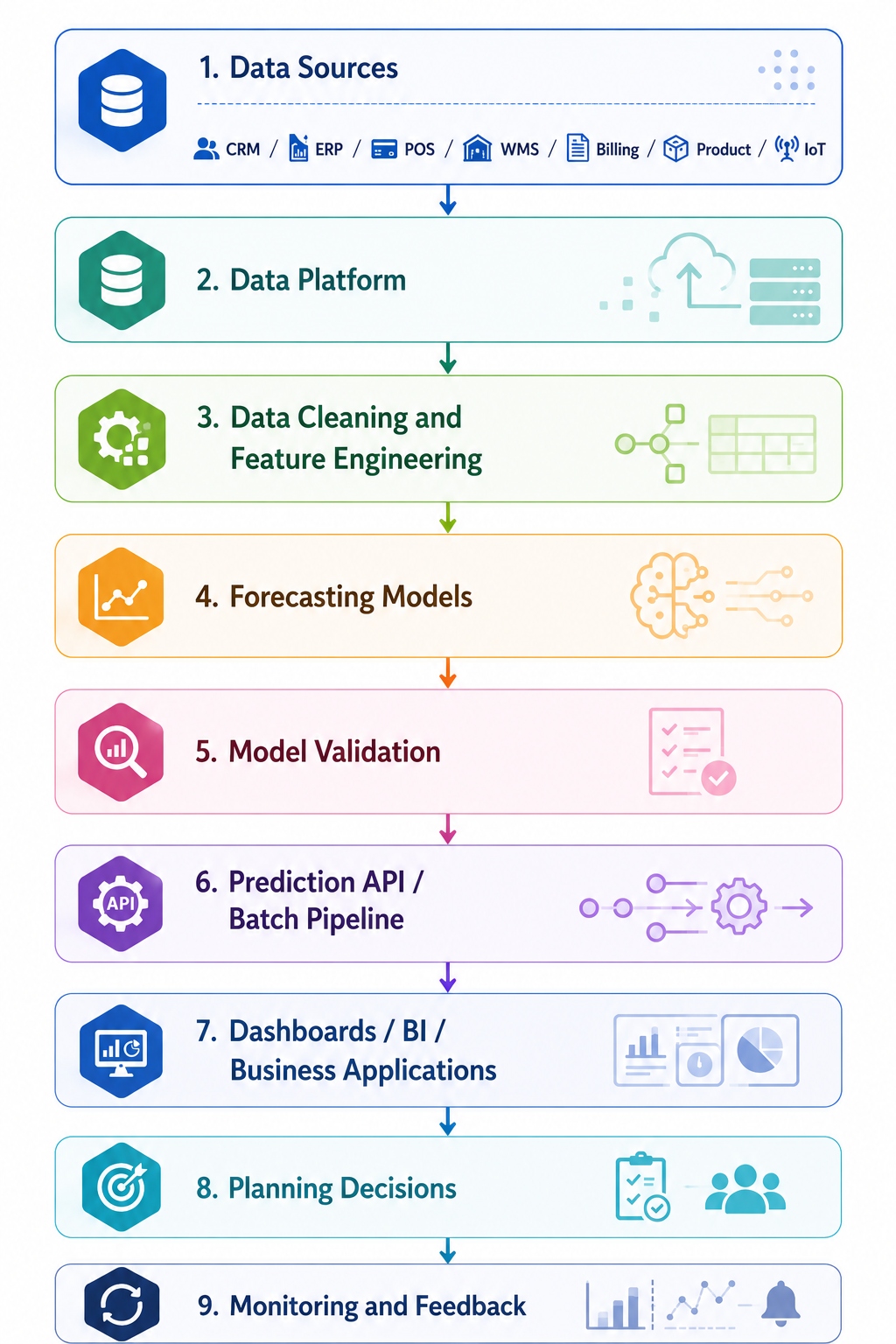
At Zignuts, our forecasting architecture can include secure APIs, data warehouses, dashboards, automated pipelines, cloud infrastructure, model monitoring, MLOps, and integrations with ERP, CRM, BI, WMS, SCM, and planning platforms.
Architecture should follow business scale.
A startup forecasting one product does not need the same infrastructure as a multinational business forecasting millions of product-location combinations.
AI Forecasting Models and Cloud Deployment
Enterprise forecasting systems can run across major cloud environments.
Our forecasting technology stack can include Python, pandas, NumPy, scikit-learn, statsmodels, Prophet, XGBoost, LightGBM, TensorFlow, PyTorch, MLflow, Airflow, FastAPI, Docker, Kubernetes, cloud data warehouses, relational databases, BI tools, AWS, Azure, and Google Cloud.
The exact stack depends on the existing enterprise environment.
For example:
A company already operating on Azure may benefit from Azure-native ML infrastructure.
A data platform built around BigQuery may favor Google Cloud components.
A business with an existing AWS MLOps platform may prefer SageMaker-centered deployment.
Technology should fit the architecture already used by the organization.
AI Forecasting Models vs Traditional Spreadsheet Forecasting
Spreadsheets are not automatically bad.
They can be useful for small businesses and early-stage planning.
The problem appears when forecasting becomes:
Large
Frequent
Multi-dimensional
Cross-functional
Real-time
Highly regulated
Dependent on multiple data sources
At that stage, a production forecasting platform can offer stronger controls.
Forecasting Capability | Spreadsheet Forecasting | AI Forecasting Models |
|---|---|---|
Data sources | Often manually collected | Automated multi-source pipelines |
Forecast updates | Manual or scheduled | Automated or real-time |
Scale | Limited by workbook complexity | Designed for larger datasets |
Seasonality | Often manually considered | Can be modeled directly |
External signals | Difficult to maintain | Can be integrated into pipelines |
Scenario planning | Manual formulas | Automated what-if modeling |
Uncertainty | Often limited | Confidence intervals and prediction ranges |
Version control | Can become difficult | Model and pipeline versioning |
Monitoring | Mostly manual | Automated model and data monitoring |
Integration | File-based | API, dashboard, ERP, CRM, BI |
Retraining | Manual | Automated or trigger-based |
Auditability | Depends on process | Governed pipeline and model history |
The right decision is not always to replace spreadsheets immediately.
For some organizations, the right starting point is to modernize one high-value forecasting workflow and then expand.
Our team supports this modernization path by assessing existing spreadsheets, BI forecasts, legacy scripts, or underperforming machine learning systems and moving suitable workloads toward automated, governed forecasting pipelines.
Smarter Sales & Demand Forecasting with AI
AI Forecasting Models for Enterprise Sales Planning
Sales forecasting becomes more valuable when it is shared across departments.
Sales needs quota visibility. Finance needs revenue visibility. Operations needs capacity visibility. Marketing needs demand visibility. Leadership needs a reliable business outlook.
Our sales forecasting consulting methodology connects sales, finance, marketing, and operations around a shared forecasting framework. We can integrate CRM, ERP, billing, marketing automation, data warehouses, and BI platforms so teams work from connected revenue data.
That reduces one of the most common forecasting problems:
Different teams using different numbers.
AI Forecasting Models for Revenue and Executive Planning
Executives often need a forecast that is easy to understand.
They may not need to inspect every feature.
They need to know:
What is the expected outcome?
What changed?
Why did it change?
What is the risk?
What happens under different scenarios?
Our revenue forecasting solutions include executive forecasting dashboards, forecast summaries, confidence levels, risk signals, and scenario planning so leaders can interpret forecasts without working directly inside the underlying model.
This is an important design principle.
The technology should disappear behind a usable business experience.
AI Forecasting Models for Workforce and Capacity Planning
Forecasting is not limited to products and revenue.
Businesses also need to forecast capacity.
That can include:
Staffing requirements
Customer support volume
Fleet utilization
Production capacity
Appointment demand
Infrastructure usage
At Zignuts, our forecasting practice includes workforce and capacity forecasting so organizations can align resources with expected demand.
For example, a support organization can estimate ticket volume and plan staffing accordingly.
A manufacturer can estimate production demand and align capacity.
A logistics business can estimate shipment volume and plan vehicles.
The principle remains the same:
Forecast expected demand before allocating resources.
AI Forecasting Models for Financial Planning
Finance teams use forecasting to understand the future.
Common areas include:
Revenue
Expenses
Working capital
Margins
Budget requirements
At Zignuts, we build financial forecasting systems that connect finance data with operational, sales, and market signals. Our financial forecasting approach supports revenue planning, cash-flow forecasting, demand prediction, expense forecasting, margin analysis, scenario modeling, and executive reporting.
This can help finance teams move from periodic spreadsheet updates toward more connected and repeatable forecasting workflows.
AI Forecasting Models and What Businesses Should Measure
A forecasting project should have clear success metrics.
Technical metrics can include:
Forecast error
Forecast bias
Latency
Pipeline reliability
Model drift
Business metrics can include:
Stockout reduction
Inventory reduction
Revenue visibility
Planning cycle time
Forecast adoption
Decision speed
Resource utilization
Cash-flow visibility
The correct KPI depends on the use case.
A demand forecasting model should be evaluated differently from a sales forecasting model.
A revenue forecast may prioritize financial accuracy and decision confidence.
An inventory model may need to emphasize service levels and stock availability.
We define forecasting success around the decision the model supports.
AI Forecasting Models: Common Implementation Mistakes
Mistake 1: Starting With the Algorithm
Do not start by asking which AI model should be used.
Start with the decision.
The algorithm comes later.
Mistake 2: Ignoring Data Readiness
More data does not automatically mean better forecasting.
Poorly structured data can create misleading patterns.
Mistake 3: Using One Forecast for Every Level
Products, regions, channels, and customers may behave differently.
Granularity should match the planning decision.
Mistake 4: Ignoring Uncertainty
A single point forecast can create false confidence.
Prediction ranges may provide more useful planning information.
Mistake 5: Building Without Integration
A forecast that only exists in a notebook or dashboard may not influence the business.
It should connect to the workflow.
Mistake 6: Ignoring Model Drift
A deployed model needs continuous monitoring.
Mistake 7: Measuring Accuracy Without Business Impact
Better statistical performance is useful only when it improves the underlying decision.
AI Forecasting Models Decision Framework for Business Leaders
Before investing in AI forecasting models, leaders should ask:
What decision are we trying to improve?
What data already exists?
How reliable is the data?
What forecast horizon is required?
What level of granularity is required?
Does the business need real-time or batch forecasting?
Which external signals matter?
How much uncertainty can the business tolerate?
What happens when the forecast is wrong?
Who owns the forecast?
How will model performance be monitored?
How will models be retrained?
Which systems need the forecast?
What business KPI will define success?
These questions create a clearer path from AI experimentation to production planning.
How We Build AI Forecasting Models at Zignuts
At Zignuts, our AI forecasting work follows a business-first engineering approach.
We begin by understanding how the organization forecasts today.
That may involve spreadsheets. It may involve CRM reports. It may involve ERP data. It may involve an existing BI dashboard. It may involve a legacy machine learning model.
From there, our team evaluates the data, forecasting maturity, business requirements, and technology environment.
Our typical approach includes:
Forecast strategy and business discovery
Data readiness assessment
Data and signal engineering
Baseline model development
Advanced model development where justified
Forecast validation
Architecture and integration
API and dashboard development
Deployment
Monitoring
MLOps
Continuous optimization
Our forecasting models can support demand, sales, revenue, inventory, supply chain, workforce, capacity, cash flow, risk, and operational planning.
We also support different delivery models.
A business can start with a focused forecasting assessment.
It can validate one use case through a proof of concept.
It can move into a production forecasting module.
Or it can build a dedicated long-term forecasting platform with our AI engineering team.
Smarter Sales & Demand Forecasting with AI
AI Forecasting Models for Sales and Demand Planning: Key Takeaways
AI forecasting models help businesses estimate future demand, sales, revenue, inventory requirements, capacity, and other operational outcomes.
Sales forecasting models can combine CRM pipeline activity, historical performance, win rates, deal velocity, seasonality, and account behavior to improve revenue planning.
Demand forecasting models can combine sales, inventory, pricing, promotions, seasonality, operational data, and external signals to improve procurement and planning.
Probabilistic forecasting helps teams understand uncertainty instead of relying only on one forecast number.
Scenario planning allows teams to compare expected, best-case, and risk-case outcomes.
Real-time and batch forecasting serve different operational needs.
Forecast accuracy should be measured with both statistical metrics and business KPIs.
MLOps is essential because forecasts can become less reliable as business conditions change.
The most effective forecasting systems are integrated into the tools and workflows where planning decisions actually happen.
The best AI forecasting model is not necessarily the most complex model.
It is the model that improves the business decision.
Conclusion: Why AI Forecasting Models Are Becoming Essential for Modern Planning
Sales and demand planning become difficult when businesses rely on fragmented data, manual spreadsheets, delayed reports, and assumptions that are not updated frequently enough.
AI forecasting models provide another approach.
They can analyze historical behavior.
They can incorporate current signals.
They can account for seasonality and trends.
They can model uncertainty.
They can support scenario planning.
They can connect predictions directly to business workflows.
But building a reliable forecasting system requires more than selecting a machine learning algorithm.
Data pipelines matter.
Feature engineering matters.
Model validation matters.
Integration matters.
Explainability matters.
Monitoring matters.
MLOps matters.
Most importantly, the forecast must improve a real business decision.
At Zignuts, we build AI forecasting models with that principle in mind. We combine AI engineering, data engineering, predictive analytics, enterprise software development, cloud architecture, APIs, dashboards, and MLOps to create forecasting systems that teams can use in production.
For sales teams, that can mean stronger revenue visibility.
For supply chain teams, it can mean better demand and inventory planning.
For finance teams, it can mean more reliable revenue and cash-flow forecasting.
For operations teams, it can mean better capacity planning.
The goal is not to predict the future perfectly.
The goal is to reduce uncertainty enough to make better decisions before the future arrives.

Deep Mistry
Digital Marketing Enthusiast | Diving into the world of trends, tools, and strategies, sharing discoveries that help create impactful online experiences.