


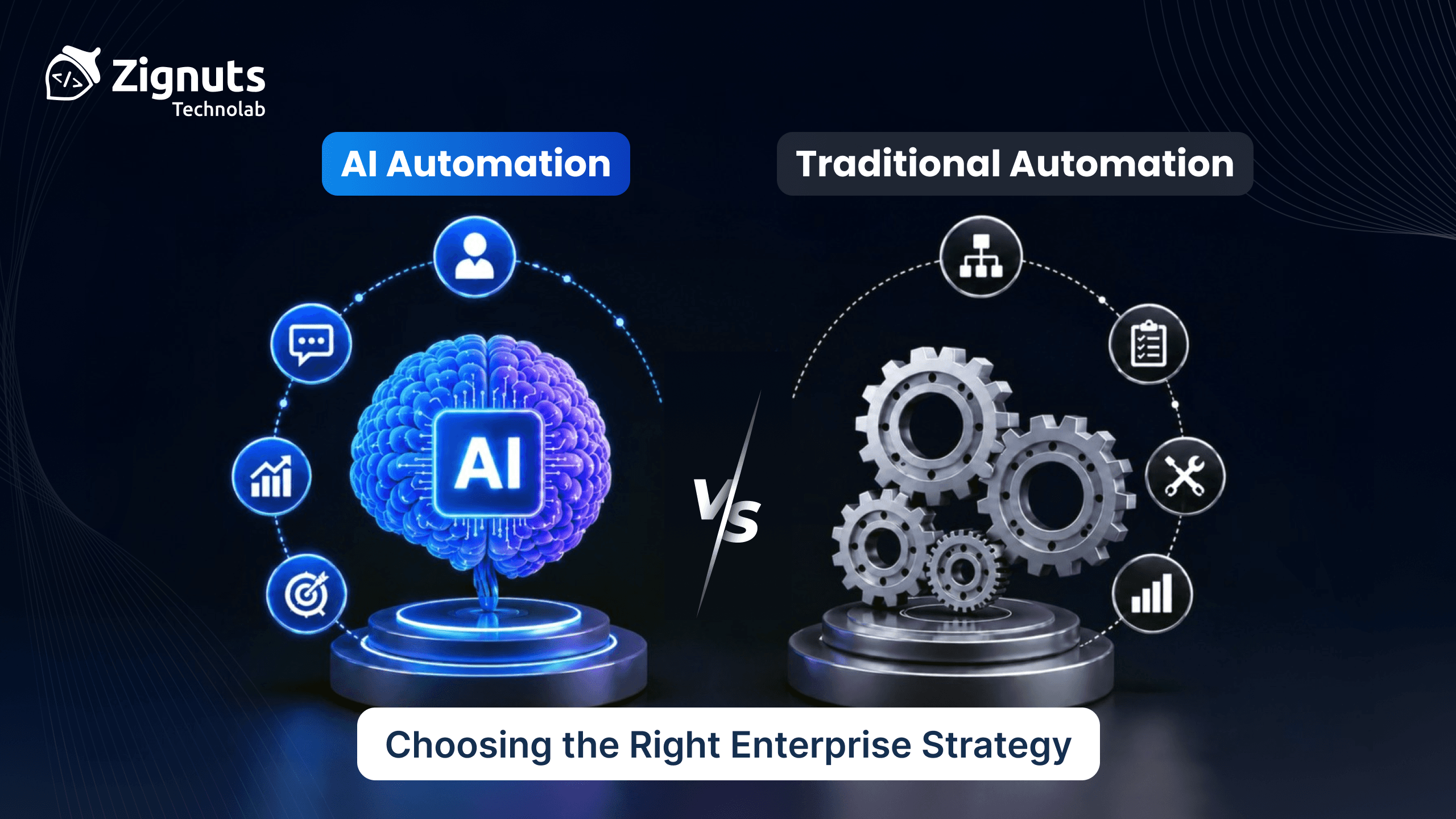
Choosing between AI automation and traditional automation is not a tooling decision. It is a decision about which business uncertainties the enterprise can safely delegate. In financial services, that distinction determines whether a payment exception is routed in seconds, whether an AML investigator receives credible evidence, and whether a customer onboarding decision remains explainable under audit.
Traditional automation follows defined rules through workflow engines, robotic process automation, integrations, and deterministic validations. AI automation interprets unstructured evidence, predicts outcomes, and recommends or executes actions within controlled boundaries. The strongest enterprise strategy is rarely an all-or-nothing choice. It is a deliberately governed portfolio of both.
Start with process certainty, not the appeal of AI
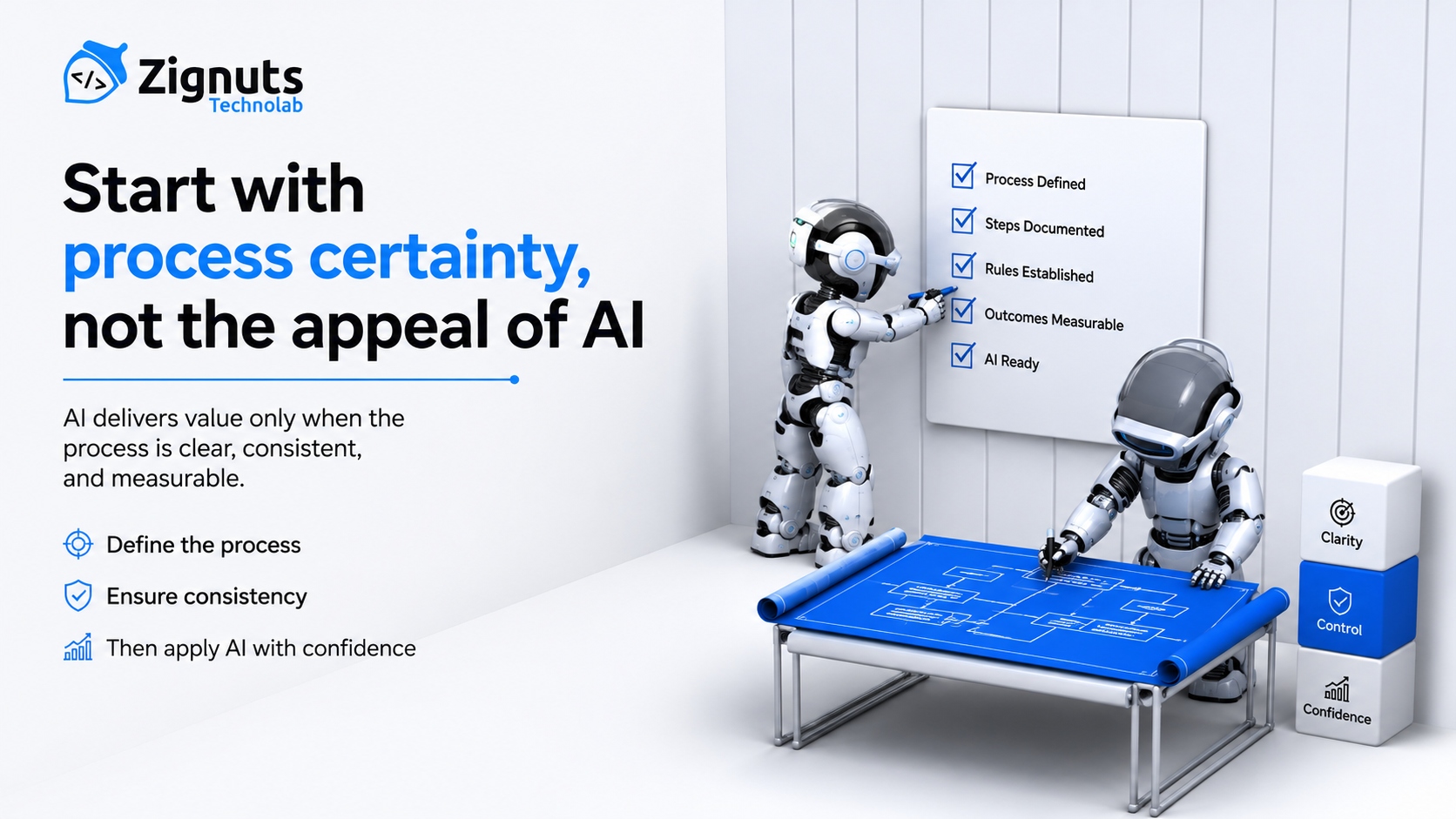
The conventional belief is that AI should replace every repetitive process. In practice, highly repeatable payment, reconciliation, and regulatory reporting steps usually produce faster returns with traditional automation. A rules engine can validate an account format, apply a transaction threshold, and create an immutable audit event with predictable behavior. Adding a model to that path may increase cost and make root cause analysis harder.
AI earns its place where meaning varies: reading a proof of address document, summarizing an investigator's case file, categorizing a free-text dispute, or identifying an unusual pattern across linked transactions. A digital bank with 2 million customers and 100,000 daily account activities should not use a language model to decide whether a known sanctions list match is exact. It can use one to prioritize ambiguous alerts for trained analysts.
Most programs fail because leaders classify work by how many people perform it rather than by how variable the inputs and acceptable outcomes are. The hidden cost emerges after launch, when exceptions have no accountable owner and staff quietly rebuild manual queues outside the platform. Begin with 30 days of process telemetry: volume, exception rate, cycle time, rework, data completeness, and customer impact. This evidence becomes the basis for the architecture choices that follow.
Note: Automate certainty with rules; use AI to manage ambiguity; keep a human accountable where an error can create customer harm, regulatory exposure, or irreversible financial loss.
Build Smarter AI Automation

Use the PACE framework to select the automation boundary
For regulated transaction workflows, PACE provides a practical decision test. Score each candidate from 1 to 5, then require a score of at least 16 before permitting AI to recommend an action. Fully autonomous actions need documented controls for all four dimensions and a risk owner sign-off. This is a high-confidence recommendation for payments, lending, and wealth platforms.
PACE: Performance, Auditability, Control, Exceptions
Dimension | Question for the architecture review | Preferred approach |
|---|---|---|
Performance | Can the workflow meet peak volume and latency targets? | Rules for real time authorization; AI for asynchronous triage |
Auditability | Can an auditor reconstruct input, decision, and override? | Versioned rules plus retained model evidence |
Control | Can policy changes be approved, tested, and rolled back? | Feature flags, approval gates, and segregation of duties |
Exceptions | Who resolves low confidence or conflicting outcomes? | Human queue with service level targets |
Consider a global payment processor handling 10 million daily transactions across 40 currencies. Authorization routing requires deterministic latency and idempotency, so traditional automation is critical. Merchant support classification can be AI-assisted because a confidence threshold and a reviewer queue contain the risk. The trade-off is clear: AI reduces handling time, but its benefit disappears if evidence capture, prompt changes, and model versions are not governed.
Every AI decision should emit the same minimum record: source references, model and prompt version, confidence, policy applied, action taken, reviewer identity when applicable, and final outcome. Organizations commonly skip this because the prototype works without it. Six months later, a disputed decision or regulator inquiry turns an inexpensive pilot into a costly forensic exercise. PACE therefore connects directly to the data and control model.
Design a layered architecture that can prove what happened
Security is not a feature. It is a property of the entire decision path. A resilient enterprise design separates systems of record from orchestration, decision services, and user experience. Core ledger, KYC, and customer identity data remain authoritative. An automation layer receives narrowly scoped events, applies rules or models, records evidence, then returns an action through an approved interface.
Many enterprises assume a single enterprise AI platform will simplify this design. It often creates a concentration risk: one permissive connector can expose personally identifiable information across teams. Instead, use purpose-specific access scopes, tokenization for sensitive fields, encrypted event storage, and role-based approval for production model changes. PCI DSS duties, GDPR data minimization obligations, and AML record retention requirements must shape data flow before model selection.
Critical: make all transaction commands idempotent and retain correlation identifiers across the workflow.
Critical: send low-confidence outcomes to an owned exception queue, not a generic support inbox.
Important: isolate model context from payment card data and unnecessary customer attributes.
Optional: add retrieval over approved policies for investigator assistance after access controls are proven.
A lending platform processing 50,000 applications monthly may use AI to extract income evidence, while deterministic policy services calculate affordability and adverse action reasons. That division protects explainability and speeds up document handling. The common failure is allowing extracted data to overwrite a source record without validation. Treat AI output as proposed data until a rule, reviewer, or verified source confirms it. Once the boundary is explicit, economics becomes the next decision.
Evaluate total cost through operational outcomes
License price is rarely the deciding cost. Integration remediation, test data, audit evidence, model monitoring, and exception handling usually exceed the initial prototype budget. A custom solution can deliver a better fit for a differentiated fraud workflow, but it also creates an ongoing responsibility for observability, security patches, evaluation datasets, and specialist staffing. A packaged platform accelerates deployment but may constrain policy logic or create usage costs that scale with document volume.
Cost category | Rules and workflow automation, annual | AI assisted automation, annual |
|---|---|---|
Platform and infrastructure | $80,000 to $250,000 | $120,000 to $400,000 |
Integration and change delivery | $100,000 to $350,000 | $180,000 to $600,000 |
Governance, security, and audit | $50,000 to $150,000 | $100,000 to $300,000 |
Operations and exception review | $100,000 to $300,000 | $80,000 to $350,000 |
These illustrative ranges fit a mid-sized regulated enterprise and exclude major core banking replacement. A useful business case compares cost per completed case, exception rate, time to decision, loss exposure, and compliance findings, not hours saved alone. For example, reducing a 12-minute KYC document review to four minutes matters only if false acceptance stays within the approved risk threshold.
Note: If a proposed automation cannot name its exception owner, evidence record, and rollback method, it is not ready for production funding.
Teams often promise savings before measuring the manual baseline, then cannot demonstrate ROI. Establish a control group for at least four weeks and review results monthly. A wealth platform serving 500,000 investors may discover that reducing false positive alerts by 15 percent creates more value than automating the highest volume queue. That insight should drive the rollout sequence, not vendor feature lists.
Run a phased program, then govern it as a product
Enterprise automation succeeds when operations, risk, compliance, and engineering share ownership. The first release should target one bounded workflow with measurable pain, such as document classification before KYC review or payment exception routing. Do not start by connecting 30 downstream systems. Stabilize two or three high-value interfaces, prove evidence capture, and expand only after operational acceptance.
Model drift is the risk traditional automation leaders often underestimate. New document templates, fraud patterns, policy updates, and customer behavior can degrade an apparently successful model without causing an obvious outage. Monitor confidence distributions, override rates, completion time, and outcome quality. Review material prompt, model, or policy changes through the same change advisory process used for transaction logic.
Before approval, ask these questions
Which business metric will improve, and what is its current baseline?
Which workflows are mission-critical, and which integrations cannot fail?
Who owns exceptions, model evaluation, and platform reliability after launch?
What customer, financial, or compliance harm can a wrong decision cause?
What would require redesign in two years: volume, regulation, product expansion, or vendor dependency?
How will success be measured at 3, 6, and 12 months?
Phase | Duration | Milestone | Success metric |
|---|---|---|---|
Discovery and controls | 4 to 6 weeks | Workflow and risk baseline approved | 100 percent accountable owners assigned |
Foundation | 8 to 10 weeks | Rules, evidence store, and queue live | Two critical workflows functional |
AI pilot | 6 to 8 weeks | Human-reviewed recommendations live | 20 percent cycle time reduction |
Scale and optimize | 8 to 12 weeks | Controlled production expansion | 99.9 percent availability and measured quality |
Ready to Transform Your Workflows?
Critical, high confidence: retain deterministic controls for irreversible transactions, create auditable exception handling, and instrument every decision.
Important, high confidence: establish shared governance and measure outcome quality against a baseline.
Optional, medium confidence: introduce autonomous AI actions only in low-harm workflows with proven controls.
Future, medium confidence: extend AI assistance to cross-case investigation after data access and retention policies mature.
The right strategy is not AI automation versus traditional automation. It is a controlled division of labor: rules protect certainty, AI accelerates judgment, and people govern consequences. That approach improves throughput without sacrificing the trust that regulated enterprises must earn every day.

Deep Mistry
Digital Marketing Enthusiast | Diving into the world of trends, tools, and strategies, sharing discoveries that help create impactful online experiences.