

EXECUTIVE SUMMARY
In 2026, enterprise RAG development can cost around $20,000 for a departmental proof of concept and $250,000+ for an enterprise GraphRAG platform. RAG Development Services typically include initial engineering for data pipelines, retrieval, security, and evaluation, plus monthly operating expenses of roughly $500 to $25,000+. Optimizing retrieval, chunking, semantic caching, and model routing can significantly reduce ongoing token and infrastructure costs.
RAG Development Cost: Where Enterprise Budgets Go
For technology and finance leaders planning AI budgets in 2026, RAG can deliver strong value by connecting Large Language Models with proprietary business data. But estimating the true RAG development cost can be challenging.
A quick prototype using a free vector database tier may cost very little, but a production RAG system requires data pipelines, retrieval, security, integrations, and ongoing evaluation.
As usage grows, operational costs can increase significantly. That is why enterprise RAG budgeting should consider both the initial development investment and recurring infrastructure and model costs.
Ready to Build a Scalable RAG Solution?

RAG Development Cost: 2026 Pricing Tiers by Project Complexity
Enterprise RAG development costs scale with data complexity, retrieval requirements, and compliance needs. The matrix below outlines realistic 2026 benchmarks across four enterprise complexity tiers:
Complexity Classification | Typical CapEx (Dev) | Timeline | Monthly OpEx | Core Scope & Architecture |
|---|---|---|---|---|
Tier 1: Departmental PoC | $20,000 - $45,000 | 3 - 5 weeks | $500 - $1,500/mo | Single data source, standard dense vector search, pgvector, experimental test harness |
Tier 2: Production Hybrid RAG (2026 Baseline) | $50,000 - $110,000 | 2 - 3 months | $2,000 - $6,000/mo | Multi-source ETL, multimodal OCR, hybrid BM25 + dense search, cross-encoder reranking, RBAC, RAGAS evaluation |
Tier 3: Corrective & Agentic RAG | $110,000 - $190,000 | 3 - 5 months | $5,000 - $14,000/mo | Multi-agent query decomposition, LLM retrieval grading, SQL/API fallback routing, fine-tuned embeddings, OpenTelemetry tracing |
Tier 4: Enterprise GraphRAG Platform | $190,000 - $350,000+ | 4 - 8 months | $12,000 - $35,000+/mo | Knowledge graph extraction, multi-hop synthesis, community summaries, private VPC GPU cluster, SOC 2/HIPAA compliance |
RAG Development Cost: Engineering Phase Breakdown
A structured RAG development process helps reduce rework, control costs, and keep delivery milestones predictable. The development lifecycle can be divided into six key phases:
Development Phase | Duration | Estimated CapEx | Key Focus |
|---|---|---|---|
Discovery & Corpus Audit | 1–2 weeks | $8K–$18K | Data profiling, security, architecture |
Ingestion & Parsing | 2–4 weeks | $15K–$35K | ETL, OCR, chunking, metadata |
Hybrid Retrieval & Reranking | 2–4 weeks | $18K–$45K | Vector search, BM25, reranking |
Security & Guardrails | 2–3 weeks | $12K–$30K | RBAC, PII protection, governance |
Evaluation & Benchmarking | 2–3 weeks | $10K–$28K | Testing, accuracy, regression |
Deployment & Integration | 1–3 weeks | $10K–$24K | CI/CD, cloud deployment, monitoring |
RAG Development Cost: Monthly OpEx, Token Economics & FinOps
RAG systems have ongoing costs that vary with usage, data volume, retrieval complexity, and model selection. The main cost areas include data processing, vector storage, retrieval and reranking, LLM generation, and monitoring.
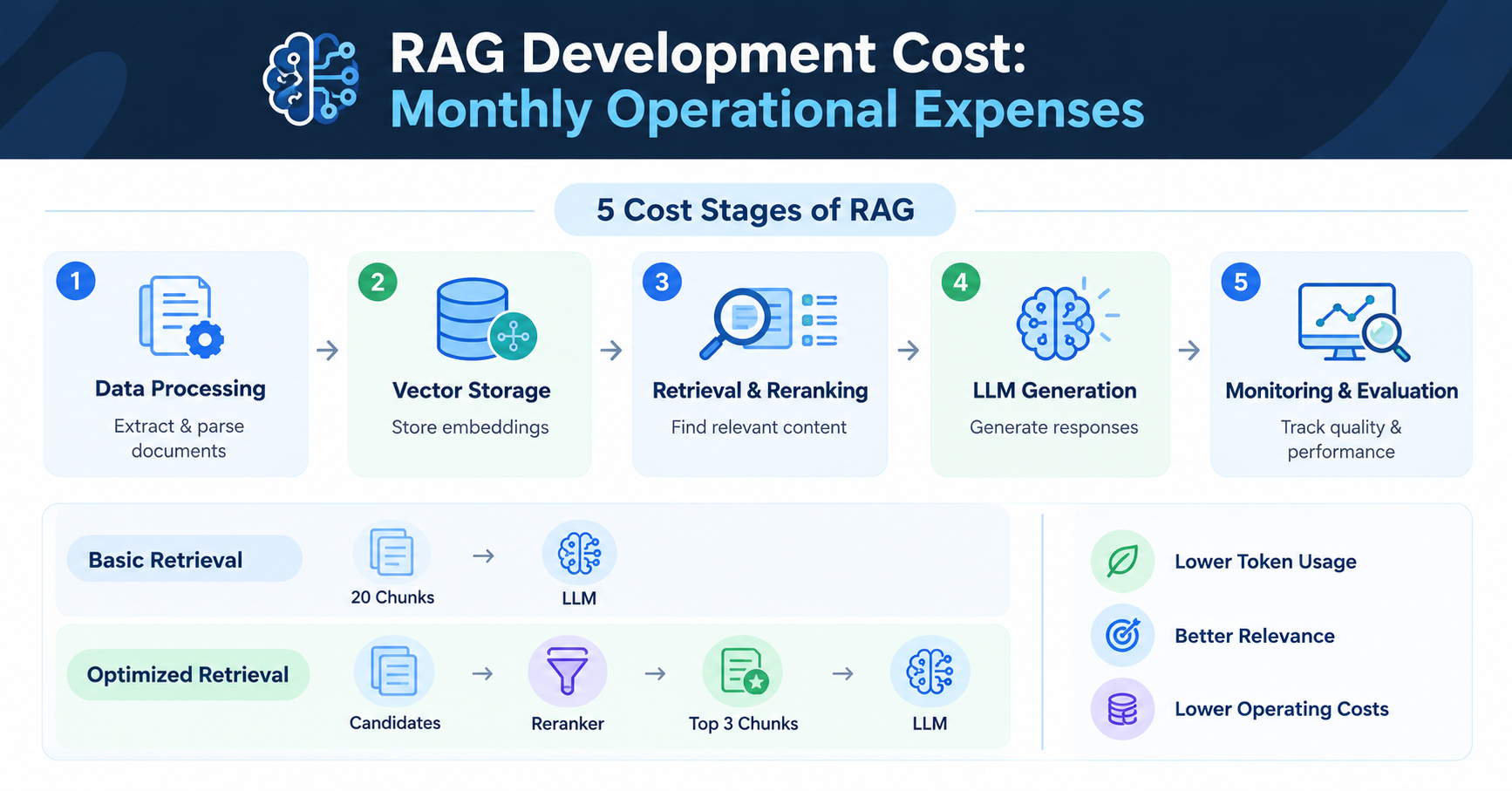
Key areas that influence monthly RAG costs include:
Data Processing: Extracting, parsing, and updating enterprise documents.
Vector Storage: Storing and managing document embeddings.
Retrieval & Reranking: Finding relevant content and ranking the best results.
LLM Generation: Processing prompts and generating responses.
Monitoring & Evaluation: Tracking response quality, performance, usage, and reliability.
3-Chunk Retrieval for Lower RAG Development Cost
One effective way to control RAG operating costs is to reduce unnecessary context sent to the LLM. Instead of passing 20 retrieved chunks directly to the model, a two-stage retrieval process can first identify a larger set of candidates and then use reranking to select the top 3 most relevant chunks.
This approach can:
Reduce unnecessary prompt tokens.
Improve retrieval relevance.
Lower recurring LLM costs.
Maintain better response quality as query volume grows.
For high-volume enterprise systems, these retrieval and FinOps optimizations can help control monthly operating expenses while improving overall RAG performance.
Ready to Build a Scalable RAG Solution?
RAG Development Cost: Vector Database Options at Scale
Choosing the right vector database is an important part of RAG development cost because infrastructure choices can affect performance, scalability, and ongoing operational expenses. The best option depends on your data volume, query requirements, and existing technology stack.
pgvector
Works as an extension within PostgreSQL.
A practical choice when relational data and vector data need to stay together.
Suitable for smaller and moderately sized RAG workloads.
Can require careful index tuning as the vector dataset grows.
Qdrant
A dedicated vector database designed for high-throughput workloads.
Supports advanced filtering and efficient vector search.
Can be self-hosted or deployed through cloud infrastructure.
Self-hosting provides more control but requires additional DevOps management.
Pinecone
A fully managed, cloud-based vector database.
Reduces the need to manage underlying infrastructure.
Useful for teams that want to scale vector search without maintaining their own database infrastructure.
Usage-based pricing should be considered when estimating long-term operating costs.
How Vector Database Choice Affects RAG Development Cost
When evaluating vector databases for a RAG project, consider:
Data volume: How many documents and embeddings will be stored?
Query performance: What latency does the application require?
Filtering: Do searches need metadata or permission-based filtering?
Infrastructure: Does your team prefer managed or self-hosted services?
Scalability: How quickly will the dataset and query volume grow?
Total cost: Consider both infrastructure requirements and ongoing operational costs.
The keyword “RAG Development Cost” matches this section naturally because the section compares different approaches and their long-term TCO.
RAG Development Cost: Build vs. Buy vs. Co-Develop
When evaluating a RAG investment, enterprises should compare not only the initial development cost but also long-term TCO, time to production, ownership, and integration flexibility.
Evaluation Metric | Option A: Off-the-Shelf SaaS | Option B: 100% In-House Build | Option C: Co-Develop with Zignuts |
|---|---|---|---|
Year 1 Financial Outlay | $36,000 - $90,000 (Per-seat fees) | $820,000+ (Full engineering payroll) | $60,000 - $140,000 (Capped CapEx) |
3-Year Cumulative TCO | $140,000 - $350,000+ (Escalating) | $2,400,000+ (Fixed salaries & ops) | $120,000 - $220,000 (Predictable) |
Time to Production | 1 - 3 Weeks (Fastest) | 6 - 9 Months (Hiring lag) | 4 - 8 Weeks (Immediate kickoff) |
Intellectual Property | 0% (Vendor owns all IP) | 100% (Fully owned) | 100% (Transferred on day one) |
Custom Integration Depth | Low (Rigid vendor APIs) | High (Fully customized) | High (Enterprise ERP/DB sync) |
Real-World RAG Implementations and Cost Considerations
A strong AI engineering partner should be able to demonstrate how RAG and AI technologies solve practical business challenges. Here are three examples from Zignuts’ engineering portfolio.
1. AI Legal Research RAG Implementation
Business Challenge:
Legal teams needed a faster and more reliable way to search large volumes of legal documents, case precedents, and agreements while reducing the risk of inaccurate information.
Engineered Solution:
A Hybrid RAG solution combining vector search, keyword search, citation-based retrieval, domain-specific embeddings, and verification guardrails.
Business Impact:
Reduced document audit turnaround time by 75%
Reduced token context retrieval costs by 45%
Improved reliability of regulatory research outputs
2. AI Agents Platform RAG Implementation
Business Challenge:
Enterprise teams faced challenges when building and managing multi-agent workflows across different internal services.
Engineered Solution:
A modular AI agent platform with workflow orchestration, LLM routing, persistent vector memory, and secure tool execution.
Business Impact:
Accelerated agent deployment velocity by 4x
Reduced initial development CapEx by over 50%
Reduced redundant prompt usage across multi-step workflows
3. AI Productivity RAG Implementation
Business Challenge:
Distributed teams struggled to find information across documents, communications, and internal knowledge sources.
Engineered Solution:
Context-aware workplace copilots with NLP summarization, semantic retrieval, and automated action-item extraction.
Business Impact:
Enabled knowledge discovery across 50,000+ internal documents
Reduced information search time by 65%
Improved access to distributed enterprise knowledge
Ready to Build a Scalable RAG Solution?
RAG Development Cost: 5-Step Budgeting Playbook
A well-planned RAG initiative is easier to budget, scale, and manage. Engineering leaders can reduce unexpected costs by focusing on these five practical steps:
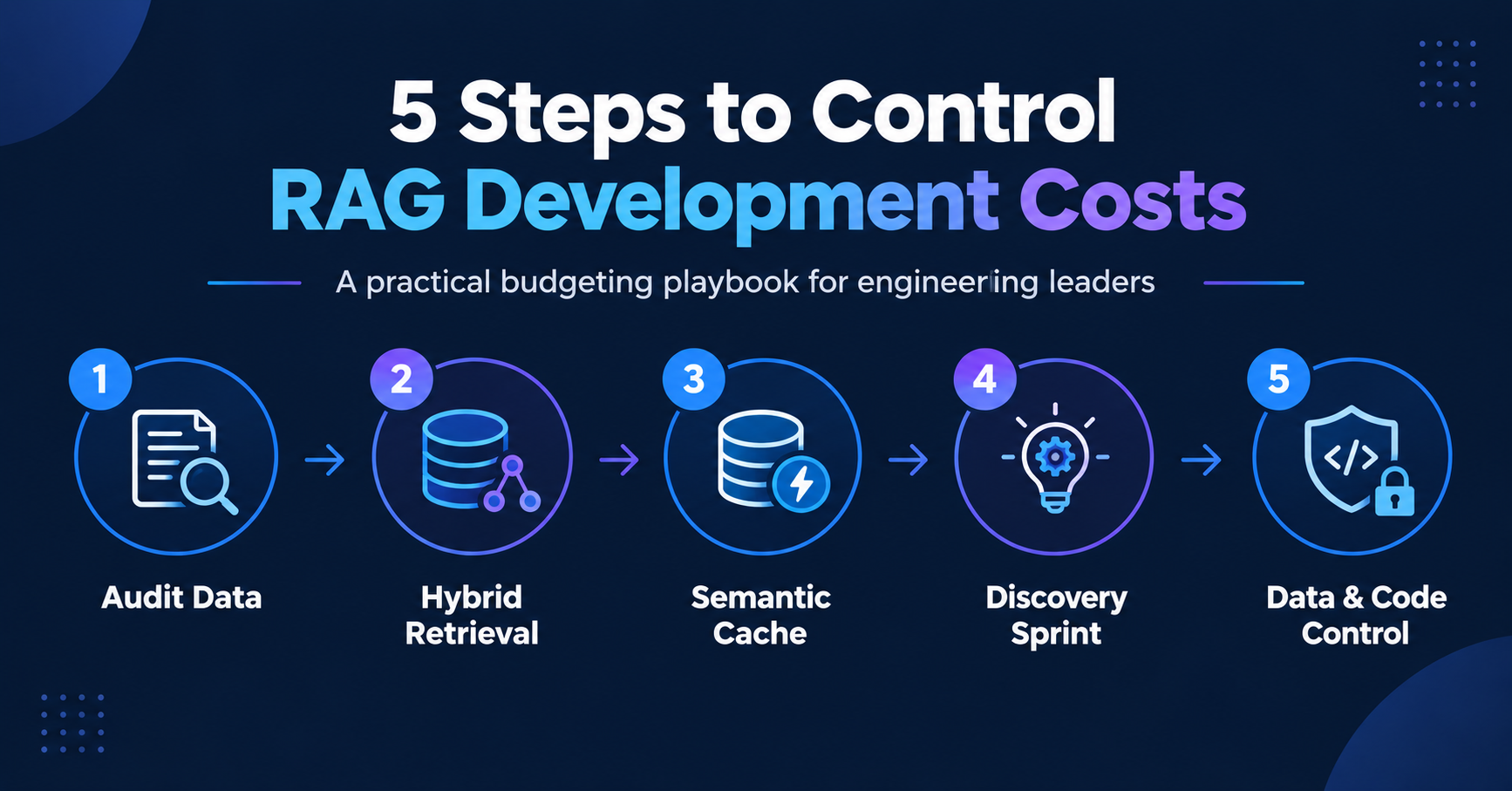
Start with a Data Readiness Audit
Understand the data before estimating development effort. Identify clean documents, complex tables, scanned files, and structured business data.Use Two-Stage Hybrid Retrieval from the Start
Combine dense vector search with BM25 keyword search and reranking to improve retrieval quality without relying on expensive model calls for every query.Add Semantic Caching Early
Use semantic caching to reuse results for similar queries and reduce unnecessary LLM calls, helping control ongoing token and infrastructure costs.Begin with a Focused Discovery Sprint
Start with a short architecture and feasibility phase. This helps define the technical approach, identify risks, and create a realistic cost model before committing to full development.Keep Data and Code Under Your Control
Keep retrieval pipelines, vector schemas, application code, and deployment infrastructure within your organization's controlled environment to support security, compliance, and long-term flexibility.
Conclusion
RAG development in 2026 is about more than selecting the right language model or vector database. Costs and complexity can vary based on your data, retrieval approach, integrations, security needs, infrastructure, and expected usage. Planning these factors early can help engineering teams build a more predictable and scalable RAG solution.
For businesses considering an enterprise RAG solution, the key is finding the right balance between performance, security, scalability, and ongoing costs. Contact us today to discuss your requirements and explore the right approach for taking your RAG project from an initial idea to production.

Mukund Patil
Business Enthusiast | Exploring ideas, trends, and opportunities, turning curiosity into meaningful insights and discovering smarter ways to make an impact.