


Executive Summary:
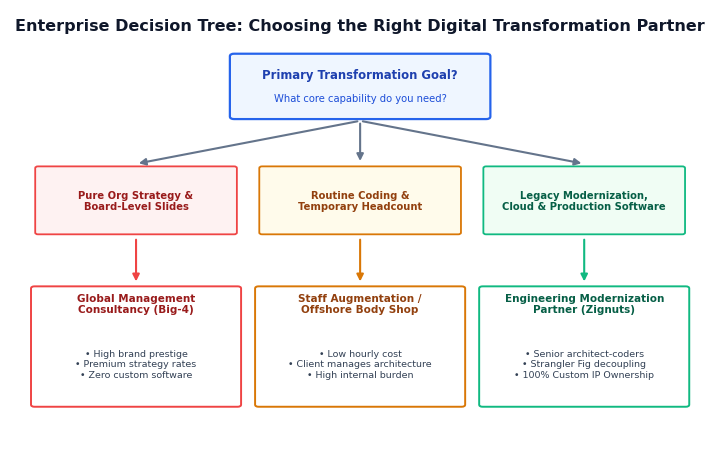
Enterprise leaders should choose a Digital Transformation Consulting partner with strong hands-on engineering capabilities, proven legacy modernization and integration expertise, and the ability to design scalable cloud architectures with effective FinOps governance. The right partner should also provide direct access to experienced architects and senior engineers throughout the engagement while ensuring clear ownership of custom code, infrastructure, APIs, schemas, and documentation.
Why Digital Transformation Consulting Companies Fail: The Strategy-Execution Gap
Industry analyses from leading research institutions consistently indicate that over 70% of enterprise digital transformations fail to meet their stated objectives or suffer severe cost overruns. In our architectural consulting engagements, we observe that these failures rarely stem from flawed high-level business visions. Instead, they originate from a structural misalignment between how traditional consulting firms operate and the technical realities of modern enterprise software systems.
1. Advisory-to-Execution Gap in Digital Transformation Consulting
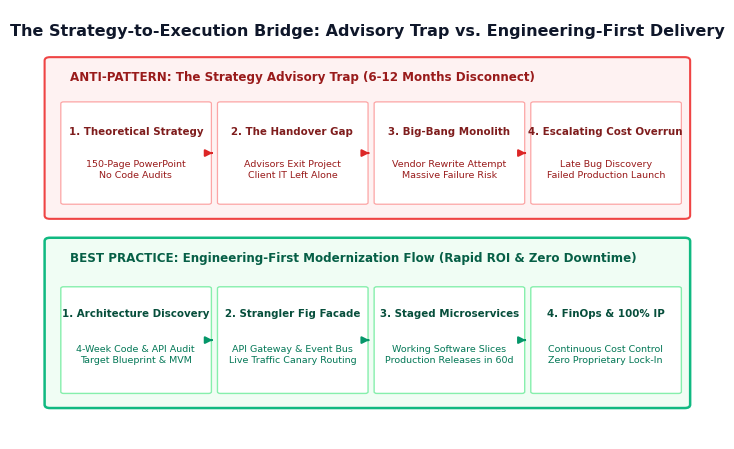
Traditional management consultancies excel at corporate strategy, market sizing, and organizational change charts. However, their engagements typically conclude with the delivery of a static strategy report. When internal IT teams or third-party contractors attempt to implement these recommendations, they discover that the proposed target architectures failed to account for undocumented stored procedures, legacy database locks, high-latency API dependencies, and real-world network security boundaries. This strategy-execution gap forces organizations to discard initial deliverables and start over.
2. Staffing Models and Senior Talent in Digital Transformation Consulting
Large global consulting firms operate on a high-leverage staffing model. Senior partners and domain directors lead initial sales discovery, conduct boardroom workshops, and draft proposals. Once the contract is signed, delivery is delegated to junior associates and generalist business analysts with minimal production software engineering experience. Enterprise clients pay premium bill rates ($250 to $450+ per hour) for resources who learn software architecture fundamentals on the client's live systems.
3. Big-Bang Modernization Risks
Inexperienced consulting firms often propose monolithic "rip-and-replace" strategies, promising that rebuilding an entire enterprise ecosystem from scratch will eliminate all technical debt in 18 to 24 months. In reality, big-bang rewrites carry catastrophic failure rates. Business requirements evolve during extended multi-year build cycles, undocumented edge cases emerge late during monolithic cutover, and budgets inflate by 50% to 150% before a single transaction is processed in production.
4. Platform Lock-In Risks in Digital Transformation Consulting
Certain consultancies operate as value-added resellers for proprietary enterprise software suites or low-code platforms. While drag-and-drop workflow builders enable rapid visual prototypes, they create severe long-term architectural rigidity. As data transaction volumes scale, organizations face escalating per-user, per-bot, or per-core licensing fees, while finding themselves trapped in closed ecosystems that cannot interface with modern cloud-native developer tooling.
Ready to Modernize Your Business?

4 Digital Transformation Consulting Company Delivery Models Compared
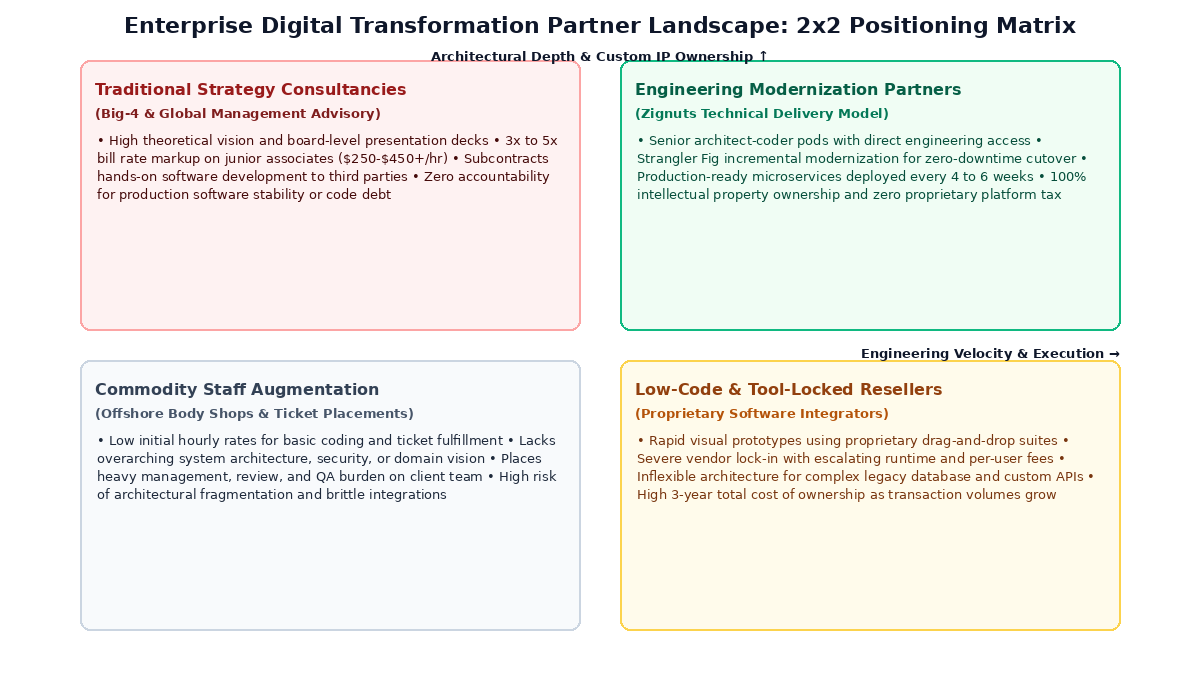
Enterprise technology leaders must navigate a crowded vendor landscape spanning four distinct delivery models. Understanding the architectural strengths, commercial structures, and inherent trade-offs of each model is critical to selecting the right partner for your organizational maturity level.
Digital Transformation Consulting Company Comparison Matrix
Partner Category | Engagement & Staffing Model | Architectural & Engineering Depth | Delivery Velocity & Time-to-Value | IP Ownership & Long-Term TCO |
|---|---|---|---|---|
1. Engineering-Led Modernization Partners | Senior architect-coder pods with direct engineering access and transparent two-week agile sprints. | Deep distributed systems expertise, Strangler Fig legacy decoupling, event streaming, Kubernetes, and custom AI. | High: Production-ready modernization slices delivered in 4 to 8 weeks. | Client-Owned: Transfer of custom code, IaC scripts, and schemas with no platform markup. |
2. Global Strategy & Management Consultancies (Big 4) | Leveraged pyramid model. Senior partners lead engagements while junior teams handle much of the execution. | Strong strategic frameworks and enterprise roadmaps, but hands-on implementation may involve third parties. | Slow: Extended discovery and planning phases before software development begins. | Mixed: Clients receive strategic documentation, while implementation can add high long-term costs. |
3. Low-Code & Tool-Locked Integrators | Platform-certified teams configured around proprietary SaaS and low-code platforms. | Effective for standard workflows but can be limited by vendor-specific APIs and complex legacy transformations. | Moderate: Fast prototyping, but complex integrations may require additional hardening. | Platform-Dependent: Recurring subscriptions and transaction-based costs can increase long-term TCO. |
4. Commodity Staff Augmentation & Body Shops | Individual developers or contractors placed into client teams. The client manages architecture, reviews, and roadmap. | Variable. Developers typically execute assigned work without owning the broader architecture or governance strategy. | Unpredictable: Depends heavily on the client's project management and technical oversight. | Client-Owned: Code ownership generally remains with the client, but fragmented architecture can increase technical debt. |
Ready to Modernize Your Business?
6 Criteria for Evaluating a Digital Transformation Consulting Company
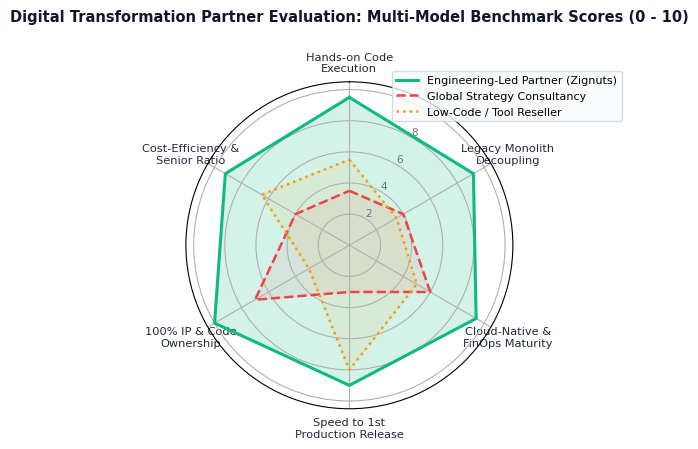
To systematically evaluate competing consulting proposals, technology leaders should benchmark candidate firms across six foundational engineering and operational pillars.
Pillar 1: Hands-On Engineering Expertise
Modern software transformation requires leaders who understand the nuances of distributed data consistency, asynchronous event queues, and container networking. When interviewing prospective consultants, demand to speak with the actual lead software architects who will write and review the codebase. Ask them to explain how they handle schema drift in legacy databases, how they implement distributed transaction compensation (such as the Saga pattern), and how they structure automated CI/CD canary releases. If a firm only provides client relationship executives or high-level strategists who cannot discuss code-level architecture, they will not be able to solve deep production bottlenecks.
Pillar 2: Legacy Modernization and Decoupling Expertise
Enterprise applications rarely live in isolation; they interface with decades-old core systems, on-premises SQL clusters, and third-party APIs. A top-tier digital transformation company does not advocate for dangerous full-system rewrites. Instead, they demonstrate mastery of incremental modernization patterns:
The Strangler Fig Pattern: Placing an API routing gateway in front of legacy monoliths to intercept inbound traffic, routing individual endpoints to newly deployed cloud-native microservices while legacy backends continue operating uninterrupted.
Event-Driven Data Replication: Utilizing change data capture (CDC) pipelines (such as Debezium and Apache Kafka) to stream database updates in real time from legacy relational stores to modern cloud databases without impacting transactional throughput.
Dual-Run and Canary Verification: Running legacy and modernized services in parallel with automated reconciliation scripts to validate data accuracy before deprecating legacy subsystems.
Pillar 3: Cloud Architecture, Resilience & FinOps Expertise
Migrating to cloud environments without rigorous financial and architectural guardrails leads to severe cloud budget inflation. A competent digital transformation partner designs infrastructure using Infrastructure as Code (Terraform or Pulumi), implements automated container bin-packing on Kubernetes (EKS/GKE), and configures proactive FinOps monitoring. They must demonstrate practical strategies for auto-scaling, cold-storage archiving, and multi-region high availability (99.99% uptime) while maintaining tight control over monthly cloud infrastructure bills.
Pillar 4: Enterprise Security, Compliance & Zero-Trust Architecture
Modern distributed architectures expand the enterprise network attack surface. Transformation partners must embed security into every stage of the software delivery lifecycle (DevSecOps). Evaluate whether candidate firms adhere to strict governance protocols, including:
Zero-Trust Network Perimeters: Enforcing end-to-end encryption (TLS 1.3 in transit, AES-256 at rest with automated key rotation via AWS KMS or HashiCorp Vault).
Fine-Grained Access Control: Implementing Role-Based Access Control (RBAC) and Attribute-Based Access Control (ABAC) anchored to centralized enterprise identity providers (OAuth2, SAML, OIDC).
Regulatory Compliance Frameworks: Documented engineering experience meeting industry-specific regulatory standards, such as SOC 2 Type II, ISO 27001, HIPAA/HITECH, GDPR, and PCI-DSS.
Pillar 5: Senior Engineering Talent and Communication
Project velocity is directly proportional to engineering maturity. Inquire about the exact senior-to-junior ratio of the assigned team pod. Top-tier engineering firms deploy small, highly concentrated squads of senior software engineers and principal architects (typically maintaining a 1:2 or 1:3 senior-to-mid ratio) who communicate directly with your engineering leads in daily standups and weekly sprint reviews. Eliminating unnecessary layers of non-technical account managers accelerates feedback loops and prevents scope misunderstandings.
Pillar 6: Intellectual Property Ownership and Code Control
Your enterprise must retain complete, unencumbered ownership of all intellectual property produced during the engagement. Ensure that consulting contracts explicitly state that all custom code, configuration files, Terraform scripts, database schemas, and documentation belong 100% to your company upon payment. Avoid any vendor that attempts to retain proprietary ownership of underlying connector frameworks or charges recurring runtime license fees for custom software modules.
Ready to Modernize Your Business?
10 Red Flags in Digital Transformation Consulting Proposals
When reviewing vendor responses to your Request for Proposal (RFP), watch for these common industry warning signs that indicate high operational risk, hidden costs, or impending project delays.
Consulting Proposal Red Flag | Underlying Technical or Business Risk | Recommended Engineering Counter-Measure |
|---|---|---|
1. Pure Big-Bang Rewrite Approach | High project failure risk; zero business value delivered until final cutover; high probability of budget overruns. | Mandate an incremental Strangler Fig pattern with functional microservices released into production every 4 to 6 weeks. |
2. Absence of Named Senior Engineers | Bait-and-switch staffing model where senior sales partners hand off execution to unvetted junior associates. | Require named resumes, GitHub code samples, and technical interviews for all principal architects and lead engineers. |
3. Proprietary Platform or Tool Dependency | Vendor lock-in, recurring runtime license fees, and constraints on custom integrations and open-source tooling. | Enforce open cloud-native standards such as Docker, Kubernetes, relational or NoSQL databases, open APIs, and full IP ownership. |
4. Vague or Extended Discovery | Theoretical slide deck production without working software; consumes significant budget before technical feasibility is tested. | Cap initial discovery at 3 to 4 weeks, ending with an executable architectural blueprint and working code prototype. |
5. No Discussion of FinOps or Cloud Costs | Uncontrolled infrastructure invoices, over-provisioned virtual machines, and unoptimized serverless architectures. | Require Terraform-based infrastructure definitions, automated scaling policies, and explicit cloud cost guardrails. |
6. Disregard for Legacy Data Cleansing | Schema drift and corrupted historical data can delay production launches during database migration. | Allocate dedicated data engineering milestones for ETL reconciliation and schema validation pipelines. |
7. Generic AI Buzzwords Without Guardrails | Routing structured data through costly LLMs can increase hallucination risks and token inference costs. | Demand hybrid architectures using deterministic validation rules for routine workflows and AI for appropriate unstructured edge cases. |
8. Unwillingness to Execute a Paid POC | May indicate limited ability to deliver production-grade code under real-world conditions and reliance on marketing demos. | Condition major commitments on successful completion of a 3- to 4-week paid architectural proof of concept. |
9. Fixed-Price for Vague Enterprise Scope | Can lead to aggressive change orders, reduced testing, and friction over technical edge cases. | Structure contracts around time-and-materials with staged milestone gates and sprint-level visibility. |
10. Neglect of Team Training & Enablement | Internal engineering teams may struggle to maintain the modernized architecture after vendor handoff. | Require comprehensive API documentation, paired programming, and continuous knowledge transfer. |
Ready to Modernize Your Business?
Digital Transformation Consulting Company POC Evaluation Framework
The most effective way to eliminate vendor risk is to test a candidate consulting firm on a live, scoped technical challenge before committing to a multi-year transformation engagement. Rather than relying on references or case study slides, top-performing enterprises commission a 3- to 4-week Paid Architectural Proof of Concept (POC) or Minimum Viable Modernization (MVM) slice.
How to Structure a 4-Week Digital Transformation Consulting POC
An effective architectural POC should focus on your most critical or high-friction technical integration. For an investment of $15,000 to $35,000, you can evaluate candidate consultants across four verifiable delivery dimensions:
POC Evaluation Phase | Target Engineering Milestone & Deliverable | What to Evaluate in the Digital Transformation Consulting Partner |
|---|---|---|
Week 1: Architectural Blueprint & Schema Design | Domain decomposition, OpenAPI/GraphQL contract definitions, data synchronization schemas, and threat model analysis. | Clarity of architectural thinking, identification of undocumented legacy constraints, and pragmatic technology stack selection. |
Week 2: Integration Facade & API Gateway | Deploying a containerized API gateway in front of a live legacy database or service with canary traffic routing. | Clean infrastructure as code (Terraform), minimal disruption to legacy services, and secure OAuth2/JWT token validation. |
Week 3: Microservice Slice & Event Streaming | Extracting one discrete business capability into an independent microservice with real-time Kafka or Redis event buffering. | Code modularity, automated unit and integration testing, fault tolerance, and appropriate response-time targets. |
Week 4: Production Staging & Knowledge Handover | Deploying the MVM slice to a cloud staging environment with OpenTelemetry dashboards, CI/CD pipelines, and team walkthrough. | Observability depth, code documentation quality, developer onboarding readiness, and collaborative cultural alignment. |
Ready to Modernize Your Business?
Real-World Digital Transformation Consulting Lessons
Real-world modernization projects demonstrate how architecture-first execution can help organizations reduce technical risk, improve operational efficiency, and build more resilient digital platforms. Across different enterprise environments, several modernization approaches have proven valuable:
Zero-Downtime Cross-Cloud Migration: Large-scale containerized platforms can be migrated across cloud environments while maintaining service continuity. Live database and microservices migration can reduce vendor dependency, support multi-region disaster recovery, and improve platform performance.
Cloud Cost Optimization and FinOps Governance: Cloud-native infrastructure can be optimized through Kubernetes resource management, automated scaling, and database rightsizing. These practices can help reduce infrastructure costs while improving resource utilization and platform throughput.
Intelligent Workflow Automation and Middleware Decoupling: Decoupling legacy operations from core systems through dedicated orchestration layers can enable automated multi-system workflows, durable state management, and more reliable process execution.
Enterprise Supply Chain and Data Pipeline Integration: Connecting legacy ERP systems, warehouse management platforms, and real-time tracking systems through event-driven integration can create unified data flows and reduce manual data-entry requirements.
Financial Modernization and Automated Reconciliation: Modern financial architectures can replace manual record-keeping with secure digital workflows and automated reconciliation pipelines, helping improve data accuracy, auditability, and regulatory compliance.
Digital Transformation Consulting Company: Key Takeaways
Prioritize Hands-On Engineering Expertise: Choose partners with strong software architecture and production engineering capabilities, rather than relying solely on theoretical recommendations or strategy reports.
Favor Incremental Modernization: Consider phased modernization approaches that gradually replace legacy components and allow working software to be introduced without the risks associated with a complete system rewrite.
Maintain Team Transparency: Request clear information about the proposed team, including roles, experience, technical responsibilities, and senior engineering involvement throughout the project.
Embed FinOps and Cloud Governance Early: Include infrastructure as code, automated scaling, resource monitoring, and cloud cost controls from the beginning to maintain greater visibility over infrastructure spending.
Validate Through a Paid Architectural POC: Test a prospective consulting partner on a well-defined technical challenge through a short proof of concept before committing to a larger, long-term transformation program.
How to Choose a Digital Transformation Consulting Company: Final Considerations
Choosing a digital transformation consulting company requires evaluating more than cost or proposals. Consider the partner’s engineering expertise, modernization approach, technical leadership, security, cloud governance, and long-term maintainability.
A technical assessment or proof of concept can help validate their capabilities before a larger engagement. If you are planning modernization, cloud optimization, system integration, or a digital transformation roadmap, contact us today to discuss your requirements.

Swati Bais
Business Enthusiast | Curious about how businesses evolve, connecting ideas with insights to discover opportunities and shape better ways of working.