


What Is the Digital Transformation Strategy Cost in 2026?
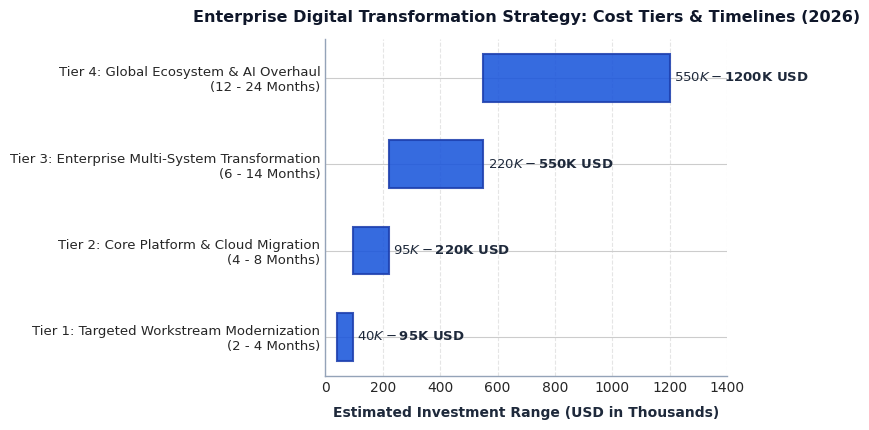
Enterprise digital transformation initiatives in 2026 typically range from $40,000 for targeted workstream modernizations to over $1,200,000 for comprehensive, multi-system enterprise overhauls. Digital Transformation Consulting can help organizations plan these investments effectively, while strategic discovery and architectural roadmapping alone typically require an initial investment of $25,000 to $65,000, establishing the technical blueprints required to prevent costly downstream refactoring. Most mid-market to large enterprise modernization programs fall within the $120,000 to $550,000 range across an 8- to 18-month execution lifecycle.
Ready to Modernize Your Business?

Digital Transformation Strategy Cost at a Glance
Transformation Scope | Estimated Cost (USD) | Timeline | Core Technology & Architectural Focus |
|---|---|---|---|
Tier 1: Targeted Workstream Modernization | $40,000 - $95,000 | 2 - 4 Months | REST/GraphQL API middleware, serverless functions, database query optimization, cloud database replication, automated CI/CD pipelines. |
Tier 2: Core Platform & Cloud Migration | $95,000 - $220,000 | 4 - 8 Months | Containerization (Docker/Kubernetes), microservices refactoring, cross-cloud migration (AWS/Azure/GCP), event queues (Kafka/RabbitMQ), SSO/IAM integration. |
Tier 3: Enterprise Multi-System Transformation | $220,000 - $550,000 | 6 - 14 Months | Distributed event-driven architecture, ERP/CRM core modernization, Strangler Fig pattern migration, zero-trust security, real-time data streaming, FinOps governance. |
Tier 4: Global Ecosystem & AI-Native Overhaul | $550,000 - $1,200,000+ | 12 - 24 Months | Polyglot microservices, custom AI/LLM orchestration, multi-region high-availability infrastructure, automated compliance governance (SOC 2/HIPAA/GDPR), enterprise data fabric. |
Ready to Modernize Your Business?
What Factors Affect Digital Transformation Strategy Cost?
The total capital required for digital transformation is dictated by underlying software architecture, system dependencies, and organizational complexity rather than generic advisory hours. When structuring transformation budgets, our engineering team evaluates five foundational technical drivers that directly impact engineering velocity, cloud infrastructure expenses, and operational risk:
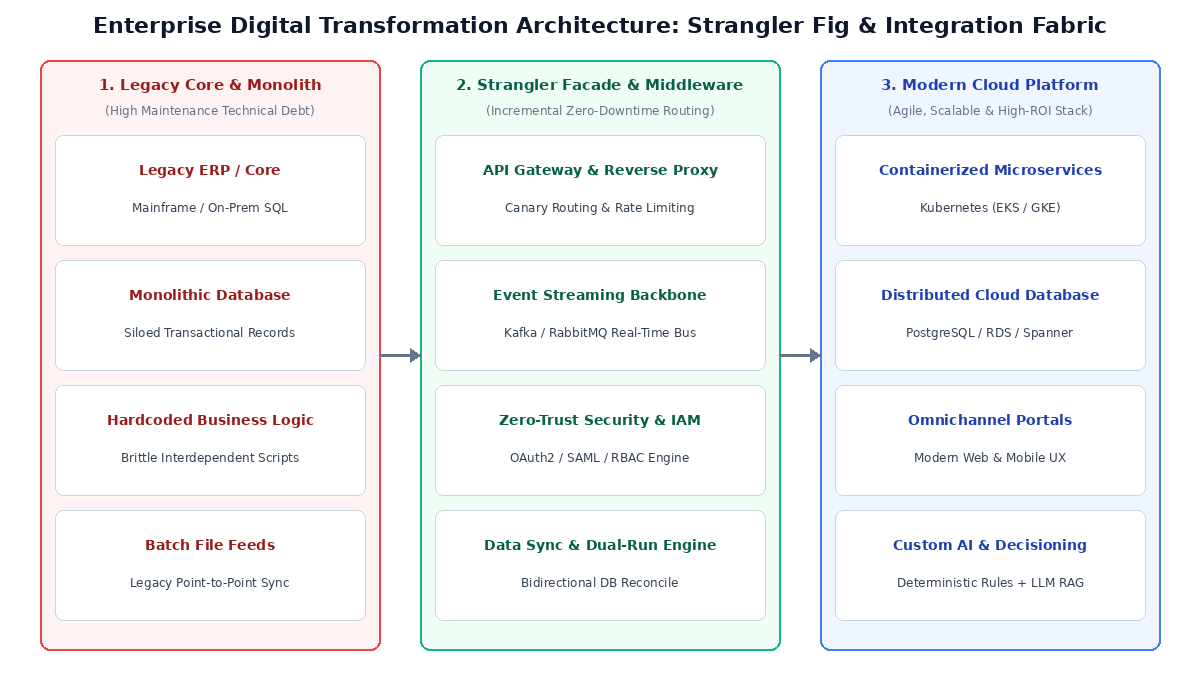
Legacy Monolith Decomposition and Technical Debt: Modernizing legacy monolithic applications built on outdated frameworks or proprietary architectures represents the largest single variable in project cost. If existing codebases lack modular boundaries, automated test suites, or clear API contracts, extracting core business logic requires meticulous reverse engineering. Utilizing the Strangler Fig pattern to incrementally replace monolithic sub-systems with independent microservices minimizes operational risk but requires intermediate API abstraction layers, synchronization routines, and dual-run validation mechanisms, adding 25% to 40% to upfront engineering effort compared to greenfield development.
Cloud Architecture, Infrastructure Topology, and FinOps Governance: Transitioning from on-premises data centers or monolithic virtual machines to containerized, cloud-native architectures requires careful infrastructure design. While cloud platforms (AWS, Google Cloud, Microsoft Azure) offer elasticity, poorly designed architectures lead to severe cost overruns. A cost-effective strategy must incorporate infrastructure as code (Terraform/Pulumi), automated resource auto-scaling, cold-storage tiering, and FinOps governance to prevent over-provisioning. Establishing multi-zone failover, Kubernetes orchestration (EKS/GKE), and secure service meshes accounts for 20% to 30% of infrastructure budgets.
Data Integration, Pipeline Modernization, and Semantic Layering: Enterprise systems depend on seamless data flow between Enterprise Resource Planning (ERP ) platforms, Customer Relationship Management (CRM) tools, billing engines, and transactional databases. Extracting data from siloed legacy SQL databases or proprietary file formats and converting it into real-time event streams (via Apache Kafka, AWS SQS, or Redis Streams) requires robust ETL/ELT pipelines. Schema normalization, data cleansing, conflict resolution, and master data management (MDM) constitute significant engineering milestones that directly govern project duration.
Enterprise Security, Zero-Trust Architecture, and Regulatory Compliance: Modernization initiatives in regulated sectors (such as healthcare, financial services, and legal tech) must adhere to strict governance standards, including SOC 2 Type II, ISO 27001, HIPAA, GDPR, or CCPA. Establishing a zero-trust security perimeter requires end-to-end encryption (TLS 1.3 in transit, AES-256 at rest with automated key rotation), fine-grained Role-Based Access Control (RBAC ) and Attribute-Based Access Control (ABAC), centralized OpenTelemetry logging, and automated vulnerability scanning in CI/CD pipelines. Compliance engineering typically represents 15% to 20% of the overall budget.
Organizational Enablement, Change Management, and DevSecOps Culture: A digital transformation strategy fails if internal teams cannot adopt the modernized architecture. Sustainable transformation requires continuous training, comprehensive API documentation, automated test frameworks, and cultural transition toward DevSecOps. Investing in automated deployment pipelines, canary releases, and internal developer platforms ensures that productivity gains are realized across the engineering organization.
Ready to Modernize Your Business?
Digital Transformation Strategy Cost by Project Scope
To assist executive decision-makers in formulating accurate capital expenditure plans, we have categorized digital transformation initiatives into four distinct implementation tiers based on technical scope, organizational scale, and architectural depth.
Targeted Digital Transformation Cost
Projects focus on modernizing a specific, high-friction business capability, such as customer onboarding, payment processing, or internal reporting workflows. These initiatives modernize discrete subsystems without rewriting entire enterprise applications.
Typical Scope: Decoupling a legacy reporting module, creating a unified GraphQL API gateway over legacy databases, automating database synchronization with webhooks, and establishing containerized CI/CD pipelines.
Architecture & Stack: Node.js/TypeScript, Python (FastAPI), PostgreSQL, Redis caching, AWS Lambda / Google Cloud Run, Docker, GitHub Actions.
Implementation Duration: 2 to 4 months.
Budget Distribution:
Discovery, Architectural Blueprint & API Schema Design: 20% ($8,000 - $19,000)
Custom Middleware & Core Backend Modernization: 45% ($18,000 - $42,750)
Security Hardening, Integration Testing & Data Validation: 20% ($8,000 - $19,000)
Cloud Deployment, Monitoring & Knowledge Transfer: 15% ($6,000 - $14,250)
Core Platform and Cloud Modernization Cost
Initiatives address foundational platform modernization for mid-market enterprises, migrating legacy on-premises or monolithic virtual machine infrastructure to modular, cloud-native microservices.
Typical Scope: Monolith decomposition into domain-driven microservices, cross-cloud database migration with minimal downtime, implementing centralized authentication (OAuth2/SAML/OIDC), and setting up distributed caching and message brokers.
Architecture & Stack: Go / Python / Node.js microservices, Kubernetes (EKS/GKE), Apache Kafka / RabbitMQ, Amazon RDS (PostgreSQL/Aurora), Redis Cluster, OpenTelemetry, Prometheus & Grafana.
Implementation Duration: 4 to 8 months.
Budget Distribution:
Enterprise Discovery, Legacy Audit & Target Architecture Strategy: 20% ($19,000 - $44,000)
Microservices Engineering & Service Mesh Implementation: 35% ($33,250 - $77,000)
Database Migration, Data Pipelines & Synchronization: 20% ($19,000 - $44,000)
Security, Single Sign-On (SSO) & Compliance Hardening: 15% ($14,250 - $33,000)
Automated DevOps, Load Testing & Staged Production Rollout: 10% ($9,500 - $22,000)
Enterprise Multi-System Transformation Cost
Encompasses large-scale digital modernization programs connecting multiple core enterprise platforms (ERPs, CRMs, custom line-of-business software, and third-party SaaS ecosystems) into an integrated, real-time operating environment.
Typical Scope: Full Strangler Fig modernization of legacy core systems, building an enterprise API integration fabric, establishing real-time data streaming architectures, implementing automated financial or operational reconciliation engines, and multi-tenant portal development.
Architecture & Stack: Distributed event-driven microservices, Event Sourcing / CQRS patterns, Kafka event backbone, polyglot persistence (PostgreSQL, MongoDB, Elasticsearch), Kubernetes with Istio service mesh, HashiCorp Vault.
Implementation Duration: 6 to 14 months.
Budget Distribution:
Strategic Discovery, Domain-Driven Design & Phased Roadmap: 15% ($33,000 - $82,500)
Core Microservices & Event-Driven Backbone Engineering: 35% ($77,000 - $192,500)
Enterprise Connector Fabric & Legacy Synchronization: 20% ($44,000 - $110,000)
Unified Web/Mobile Experience Portals & Admin Consoles: 15% ($33,000 - $82,500)
DevSecOps, Multi-Region Cloud Infra, Pentesting & Governance: 15% ($33,000 - $82,500)
Global Digital Transformation and AI Modernization Cost
Represents holistic digital transformations for multinational enterprises or high-growth platforms requiring global data consistency, intelligent AI agent orchestration, and automated regulatory governance across multiple jurisdictions.
Typical Scope: Multi-region cloud topology with active-active failover, custom AI/LLM cognitive workflows integrated into core business operations, automated compliance telemetry, and enterprise data mesh implementation.
Architecture & Stack: Polyglot microservices (Go, Rust, Python, Java), multi-region Kubernetes, distributed transactional databases (CockroachDB, Spanner, Aurora Global), Vector databases (Pinecone, Qdrant), LLM orchestration frameworks, FinOps automation engines.
Implementation Duration: 12 to 24 months.
Budget Distribution:
Global Enterprise Architecture, Security & Governance Blueprint: 15% ($82,500 - $180,000)
Scalable Distributed Engine & Real-Time Data Fabric: 30% ($165,000 - $360,000)
Custom AI Engine, Intelligent Agents & Decision Pipelines: 20% ($110,000 - $240,000)
Integration Fabric Across Global Legacy & Third-Party Systems: 15% ($82,500 - $180,000)
DevSecOps, Multi-Cloud Reliability Engineering & Global Compliance: 20% ($110,000 - $240,000)
Ready to Modernize Your Business?
Digital Transformation TCO: 3-Year Cost Comparison
When selecting a transformation strategy, engineering leaders frequently compare three fundamental approaches: Incremental Modernization (utilizing the Strangler Fig pattern), Big-Bang System Rewrites, and Maintaining Legacy Infrastructure. While maintaining legacy systems avoids immediate capital expenditure, escalating maintenance overhead, security patching costs, and operational downtime make it the most expensive long-term option.
3-Year Digital Transformation Cost Comparison
Cost & Risk Component | Incremental Modernization (Strangler Fig Pattern) | Big-Bang Full Rewrite (High-Risk Overhaul) | Maintaining Legacy Systems (Status Quo) |
|---|---|---|---|
Year 1: Upfront Build & Setup | $140,000 - $220,000 (Staged Microservices MVP) | $350,000 - $500,000+ (Monolithic Rebuild) | $0 Capex ($240,000 - $280,000 in legacy patching) |
Year 1: Operational Disruptions | Minimal (Zero-downtime canary rollouts) | High risk during monolithic cutover | Frequent unplanned outages and bugs |
Year 2: Scaling & Maintenance | $70,000 - $110,000 (Phased migration expansion) | $150,000 - $210,000 (Stabilization & post-launch fixes) | $280,000 - $340,000 (Escalating tech debt & licenses) |
Year 2: Business Agility & ROI | Rapid value delivery within first 90 days | Delayed until full project completion | Severely constrained innovation velocity |
Year 3: Steady-State OpEx | $50,000 - $70,000 (Optimized cloud & FinOps) | $75,000 - $105,000 (Cloud infra & ongoing updates) | $340,000 - $420,000+ (Legacy vendor lock-in fees) |
Estimated 3-Year Total TCO | $260,000 - $400,000 | $575,000 - $815,000+ | $860,000 - $1,040,000+ |
Project Failure Risk | Low (De-risked via continuous delivery) | High (Historically >60% fail or overrun) | Severe (Catastrophic outage or security breach) |
Intellectual Property & Control | 100% Owned, modular proprietary stack | 100% Owned proprietary stack | Trapped in outdated, vendor-locked stacks |
How Incremental Modernization Affects Digital Transformation TCO
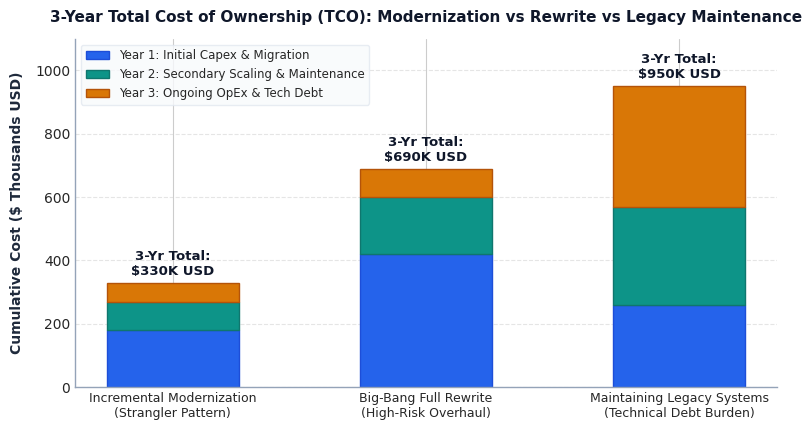
Continuous Value Realization: Rather than waiting 18 months for a monolithic rewrite to launch, incremental modernization delivers functional microservices into production every 4 to 6 weeks, generating early business ROI.
De-risked Architectural Validation: High-risk integrations and database schemas are validated in real-world environments with live traffic before subsequent modules are refactored.
Avoidance of Big-Bang Cutover Failures: Big-bang rewrites frequently exceed initial budgets by 50% to 100% due to unrecorded legacy business logic, changing market requirements during long development cycles, and massive cutover deployment risks.
Ready to Modernize Your Business?
Hidden Costs and Risks in Digital Transformation Strategy
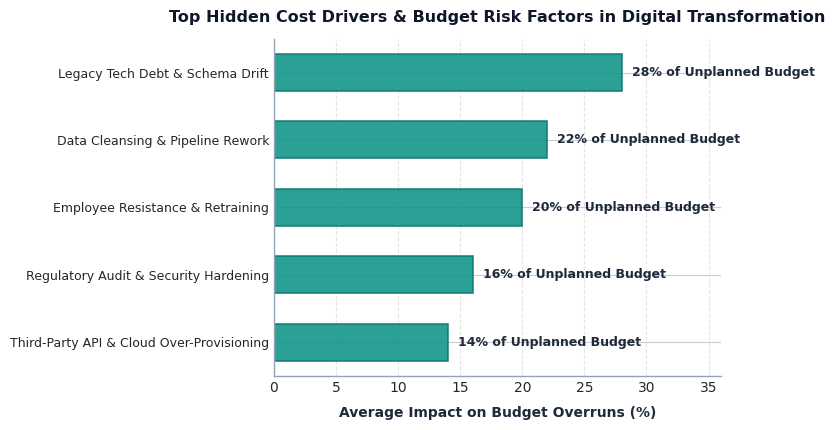
Industry research indicates that over 70% of enterprise digital transformations exceed their initial budget allocations. These overruns rarely stem from basic software engineering tasks; rather, they arise from hidden systemic complexities that were omitted during initial scoping.
Legacy Technical Debt and Schema Drift Costs
Legacy systems that have operated for a decade or more inevitably accumulate undocumented stored procedures, hardcoded business logic, and schema discrepancies. When decoupling these systems, unexpected edge cases emerge that require custom data normalization and exception handling routines. Conducting a thorough technical discovery and code audit during Phase 1 significantly reduces this risk.
Data Migration and Cleansing Costs
Transferring years of historical transactional data into modern, normalized relational or document databases frequently uncovers corrupt records, duplicate entries, and inconsistent relational keys. Allocating dedicated data engineering resources for automated data validation scripts and reconciliation pipelines prevents costly launch delays.
Change Management and Training Costs
New software platforms provide zero return on investment if operational teams refuse to use them or revert to manual workarounds. Comprehensive user documentation, interactive onboarding flows, and staged department rollouts must be funded as an integral component of the strategy.
Security and Compliance Implementation Costs
Modern distributed systems expose a broader network attack surface than isolated monolithic servers. Retrofitting security measures right before launch causes severe schedule delays. Implementing DevSecOps principles, automated secret management, and third-party penetration testing early in the development lifecycle prevents budget inflation.
Cloud Over-Provisioning and FinOps Costs
Migrating to cloud environments without strict auto-scaling policies, proper instance sizing, and resource lifecycle management leads to unexpected monthly cloud invoices. Implementing FinOps monitoring and automated cost guardrails from day one keeps ongoing cloud consumption within budgeted targets.
Ready to Modernize Your Business?
How to Measure Digital Transformation Strategy ROI
To secure executive and board approval for transformation capital expenditures, technology leaders must articulate quantifiable return on investment across operational efficiency, risk reduction, and top-line revenue growth.
How to Optimize Digital Transformation Strategy Cost
Drawing on our experience modernizing mission-critical architectures across healthcare, logistics, financial services, and enterprise software, our team applies four core engineering principles to minimize capital expenditure and eliminate implementation risk.
Phased Modernization to Control Transformation Costs
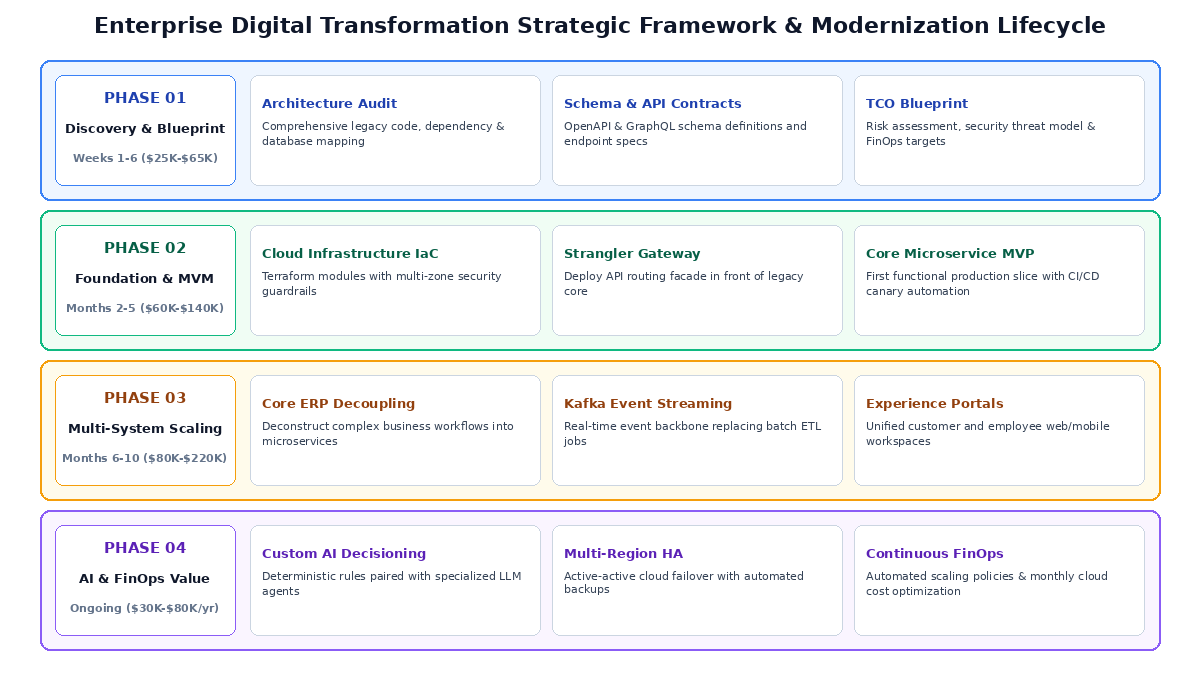
We avoid prolonged discovery phases that produce theoretical documentation without working software. Our approach establishes a concise 4- to 6-week architecture audit that defines API contracts, domain boundaries, and data schemas, immediately followed by the rapid development of a production-ready Minimum Viable Modernization (MVM) slice. This validates the core technical stack under live conditions and demonstrates immediate business value.
Incremental System Modernization to Reduce Transformation Cost
Rather than attempting a risky full-system replacement, we introduce an API gateway and event streaming layer (such as Apache Kafka or AWS EventBridge) in front of existing systems. This allows new microservices to be developed independently while legacy databases and backends continue running uninterrupted. As individual business domains are modernized, traffic is gradually redirected using canary routing with automated rollback capabilities.
Cloud Cost Optimization for Digital Transformation
We design cloud infrastructure with financial governance built directly into Terraform templates. By implementing intelligent container bin-packing on Kubernetes, utilizing Spot/Savings Plan instances for asynchronous workloads, and configuring automated database storage scaling, we prevent cloud budget inflation before workloads reach production.
Cost-Effective AI and Automation in Digital Transformation
We evaluate artificial intelligence through a lens of business pragmatism. Rather than applying costly foundation models indiscriminately, we implement lightweight deterministic validation rules for structured processes, reserving generative AI models and semantic vector pipelines for complex unstructured document extraction, search, and cognitive decision support.
Digital Transformation Case Studies and Implementation Lessons
Our approach to digital transformation strategy and cost is grounded in practical software delivery across healthcare, logistics, financial services, and enterprise software. These implementations demonstrate how the right modernization strategy can reduce infrastructure costs, improve operational efficiency, and minimize implementation risk.
Cross-Cloud Migration & Architecture Modernization: Migrating complex containerized workloads across cloud environments helped improve availability, reduce platform latency, and establish a stronger multi-region disaster recovery strategy.
Cloud Cost Optimization & FinOps Governance: Cloud-native modernization using automated scaling, database rightsizing, and architectural refactoring helped reduce infrastructure costs while improving platform performance and resource utilization.
Intelligent Workflow Automation & Middleware Modernization: Decoupling business workflows from monolithic systems enabled end-to-end automation of complex, multi-step processes while improving system responsiveness and operational efficiency.
Multi-System Supply Chain & Data Integration: Integrating disparate ERP systems, warehouse management databases, and real-time tracking feeds created unified visibility and reduced manual data-entry bottlenecks across supply chain operations.
Financial Modernization & Automated Reconciliation: Modernizing financial systems with secure digital architectures and automated validation pipelines helped reduce billing discrepancies while supporting auditability and regulatory requirements.
Ready to Modernize Your Business?
Digital Transformation Strategy Cost: Key Takeaways
Adopt Incremental Modernization: The Strangler Fig pattern provides the highest success rate and lowest 3-year total cost of ownership by modernizing enterprise systems in discrete, value-generating increments rather than high-risk big-bang rewrites.
Budget for Architecture and Discovery: Investing $25,000 to $65,000 in a rigorous technical discovery and architectural blueprint phase de-risks multi-million-dollar programs by identifying undocumented legacy dependencies early.
Embed FinOps Early: Integrate cloud cost governance, infrastructure-as-code guardrails, and auto-scaling into the initial system design to prevent uncontrolled cloud expenditure.
Plan for Change Management: Allocate 15% of the transformation budget to developer enablement, automated testing pipelines, and comprehensive documentation to ensure long-term adoption and operational velocity.
Partner with Experienced Software Engineers: Modernizing enterprise architectures requires proven expertise in distributed systems, legacy API integration, cloud governance, and security compliance. Collaborating with an experienced engineering team mitigates architectural risk and accelerates time-to-market.
Digital Transformation Strategy Cost: Final Considerations
Digital transformation in 2026 is not simply about replacing legacy technology. It requires strategic decisions that balance business priorities, technical complexity, security, scalability, and long-term costs. A well-planned strategy helps organizations modernize incrementally, reduce operational risk, improve engineering efficiency, and build a stronger foundation for future growth.
Whether you are planning a new transformation initiative, modernizing legacy systems, or optimizing an existing digital platform, the right engineering approach can turn transformation investments into measurable business value. Contact us today to discuss your digital transformation goals and explore a practical, scalable roadmap for your organization.

Swati Bais
Business Enthusiast | Curious about how businesses evolve, connecting ideas with insights to discover opportunities and shape better ways of working.